I always wondered how you can be a university president & on the board of pharmaceutical companies & run a gigantic research lab

I know that guy! That’s Marc Tessier-Lavigne! He’s about my age, and we shared similar interests — we were both interested in axon guidance, and I followed his work avidly some years ago. He was publishing about netrins, signaling molecules that affect the trajectory of growing neurons, while I was studying growing neurons in grasshopper embryos. I met him several times, I attended talks he gave at various meetings, it was hard to avoid Tessier-Lavigne.

Our careers followed very different paths, though. I ended up teaching at a small liberal arts college, while he got a position at UCSF, and then was CSO at Genentech, and then was president of Rockefeller University, was on the boards of various pharmaceutical companies, and finally was president of Stanford University. He was a major go-getter, running gigantic factory-style labs, getting regularly published in Science and Nature and Cell. It was a life that looked horrible to me, just as my life of obscurity and teaching would have looked horrible to him, if ever he had deigned to notice me.

Why would I have disliked the prestigious path he took in science? Because he turned himself into a manager, a guy who was disconnected from the science that was being done in his massively well-funded labs. Ick. I’d rather play at the bench and help students get enthusiastic about doing science.

I may have chosen wisely, because now Tessier-Lavigne has been compelled to resign as an investigation found evidence of fraud in his work. Yikes. This is bad.

The Board of Trustees’ inquiry stopped short of accusing Tessier-Lavigne — who has been Stanford’s president since 2016 — of fraud, saying there’s no evidence he “personally engaged in research misconduct.”

However, it was concluded that five papers on which Tessier-Lavigne was a principal author included work from “some members of labs overseen by Dr. Tessier-Lavigne” who had “either engaged in inappropriate manipulation of research data or engaged in deficient scientific practices, resulting in significant flaws in those papers.”

When the issues emerged, “Tessier-Lavigne took insufficient steps to correct mistakes in the scientific record,” the board’s report said.

This is what happens when you become an over-worked administrator with your fingers in too many pies. That does not excuse him — he has his name on so many papers, and getting an authorship entails significant responsibilities — and it just tells you the kind of peril ambition can put you in.

I’ve been teaching about netrins and robo and neuropilins and all these molecules in neurodevelopment for years. Am I going to have to put an asterisk by the source papers and review their validity now? I’m hoping the descent into sloppiness was a late-career problem that doesn’t call into question all the fundamental stuff he did.


I double-dog dare you to pronounce that name

New movie marketers decided to use the Greek alphabet in their poster, and caused my brain to stutter.

There is no “C” in the Greek alphabet; they should have substituted a Κ, kappa. No “L”, but there is a lambda, Λ. We get a sigma instead of an “e”, which is pronounced like an “s”. Then an omicron, so that part is OK. P is rho, it is pronounced like an “r”. Greek has a perfectly good, familiar letter A, alpha, but they put a delta, Δ, in there. That’s a “d”. Then a tau, Τ, which is a fine “T”, and an “R” character which doesn’t exist and should be a Ρ. Then it ends with another “d”.

I think that whole gemisch is pronounced “??sordt?d,” somehow, and I now have no confidence in the historicity of whatever this movie is.

I wonder if they plan to distribute this movie in Greece with that poster?

Progress in embryo analysis!

Our new development in spider development is pretty basic stuff. We’re dechorionating embryos! That is, stripping off a thin membrane surrounding the embryo, so we can do staining and fixation and various other things. It’s a standard invertebrate technique — it turns out you can remove it by just washing them in bleach. Look, it works! This is a Parasteatoda embryo.

We’re still tinkering with the timing of the treatment. Five minutes is way too long, which basically dissolved the whole embryo. All it takes is a brief wash to break the chorion down. We’re also working out methods for manipulating them — they’re tiny! Just pipetting them into a solution is a great way to lose them. We’re now using a cut off microfuge tube to make a cylinder that we cap with a sheet of fine nylon mesh, to lower them into the solution. Of course, then we have to separate the embryos from the mesh. Fortunately, we opened up one egg sac and 140 embryos rolled out, so we have lots of material to experiment on.

The next question is whether they survive our abuse. We’ve got some of them sitting under a microscope, time-lapsing their response. We’ll see if they grow…or die and fall apart.

Ending the legacies!

Conservatives cheered the Supreme Court decision to eliminate consideration of race in university admissions. I have to wonder if they’ll be so happy about this other change at the University of Minnesota.

Admissions officers working on the U’s Twin Cities campus, which typically enrolls about 55,000 students, say they have long used a “holistic review” process that places the greatest weight on an applicant’s academic track record. But it also allowed them to report 10 additional attributes that were sometimes used to distinguish between otherwise similar candidates.

The university announced late last week that it would stop considering an applicant’s race, ethnicity or ties to U alumni or faculty — though it would still ask “for this optional information for recruitment and communication purposes about programs and services offered.”

Undergraduate student government leaders said Tuesday that they welcomed the effort to eliminate legacy admissions, noting some other colleges had already done so. But they wanted to know more about the plan to stop considering race and ethnicity, saying they believe it’s crucial to have a diverse campus.

Oh god yes. End the legacy admissions. If you’re going to eliminate biases in admissions, the first place you should start is ending the privileges that give preferential status to children of alumni. The only reason to benefit them is the hope that alumni will give them more money.

I don’t think Republican businesspeople and professionals realized how much of an advantage they’ve had, and now it’s going to be gone (optimistically — I don’t believe someone who donates money for a building on campus is going to find their kids rejected, not matter how unqualified they are. After all, our appointed interim president brings nothing to the school except his affiliation with Hormel.)

It’ll be interesting to see how this works out.

Gosh, I sure hope Marjorie Taylor Greene keeps working for the Biden campaign

I worried that this ad by Joe Biden that quotes Marjorie Taylor Greene saying favorable things about him was a quote mine. I’m so used to creationists pulling out short quotes that mean something completely different from what the author intended that I was afraid the Democrats might be pulling the same dishonest stunt, because we know she hates him. But MTG words do make a pretty good campaign ad.

So I looked a little deeper. She actually said those things in a speech to TPUSA; she actually thought these things are bad for the country.

“Joe Biden had the largest public investment in social infrastructure and environmental programs,” Greene says in the ad, while images of the president smiling in various locations are shown as upbeat music plays. “That is actually finishing what FDR started, that LBJ expanded on and Joe Biden is attempting to complete.”

“Programs to address education, medical care, urban problems, rural poverty, transportation, Medicare, Medicaid. And he is still working on it,” she continues just before a Biden/Harris campaign logo appears on screen to end the video.

WTF? “education, medical care, urban problems, rural poverty, transportation, Medicare, Medicaid” are unpopular, awful programs for a president to promote, so she seeks to saddle him with that? FDR was one of our greatest presidents, and that’s a comparison she wants to make? That’s nuts, but it’s actually what she thinks.

Clinching it, MJT posted a response to Biden’s ad, and it’s a different excerpt from her TPUSA speech, filling in the gaps in Biden’s thoroughly edited version. What she was trying to communicate, poorly, was that Biden is a big fat socialist.

Lyndon B. Johnson is very similar to Joe Biden. How are they the same?

They’re both Democrat Socialists.

Lyndon B. Johnson was the majority leader in the Senate. Does that sound familiar?

He was Vice President to Kennedy. Joe was Vice President to Obama.

He was appointed as the president after JFK was assassinated, then he was elected.

His big socialist programs were the Great Society.

The Great Society were big government programs to address education, medical care, urban problems, rural poverty, transportation, Medicare, Medicaid, food stamps, and welfare, the Office of Economic Opportunity, and big labor and labor unions.

Now, LBJ had the Great Society, but Joe Biden had Build Back Better, and he still is working on it.

The largest public investment in social infrastructure and environmental programs that is actually finishing what FDR started that LBJ expanded on, and Joe Biden is attempting to complete, socialism.

Biden is not a socialist, not even a Democrat Socialist. He is not trying to complete socialism, whatever that means. If the Great Society programs were socialism, then hooray for socialism, give us more of that, please.

Clearly, MTG was trying to put down Biden by chanting socialism, socialism, socialism at him, but by spelling out what socialism means to her, she’s basically educating everyone on what a good thing socialism can be.

Pay attention, Biden. Greene is actually telling you what works.

Burying the dead

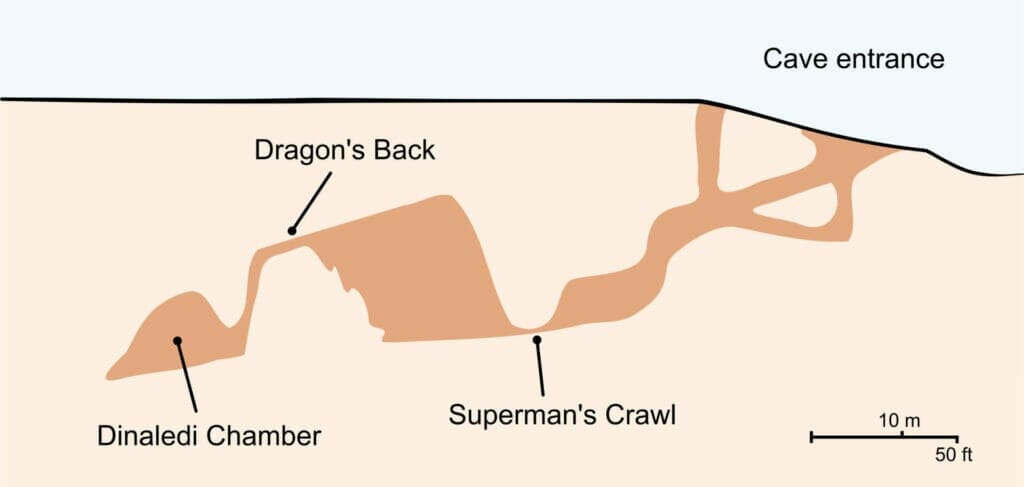
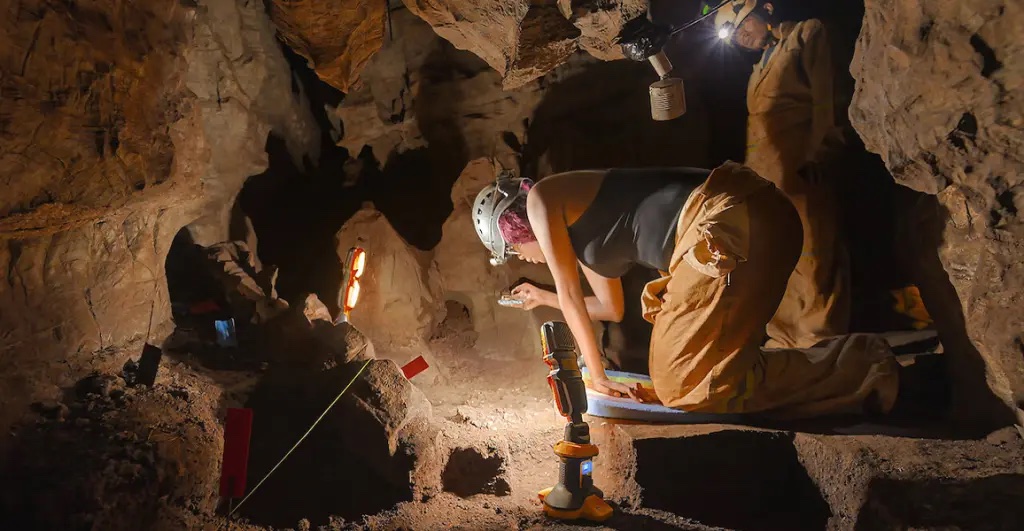
If you have a subscription to Netflix, you might want to watch Unknown: Cave of Bones, about the discovery of Homo naledi in the Rising Star cave system. It’s spectacular.

On the other hand, if you’re claustrophobic, you might want to skip it. I’m not particularly, but I watched the video of those women wriggling their way down a narrow crack to reach the Dinaledi Chamber gave me a rising sense of panic. There’s no way I could put myself in that position without having a screaming heebie-jeebie fit.

If you can get past that, though, it’s worth it to watch the adventure of science.

Yes, please: death to the lawn!

If only everyone would pay attention to this video.

Lawns are deserts for living things. Rip ’em up and replace them with diverse species, even the “weedy” ones. We’re trying to evolve our yard away from the boring monoculture, but doing so gradually; Mary has been actively planting a lot of things that are not turf grass, like milkweed.

Also, I work at a so-called ‘green’ university, which is green in some ways and terribly destructively traditional in other ways. We’ve got vast empty grassy lawns, which I suppose are great for scenic views of students playing frisbee, but not much else. I recently found out that those nice fields of grass are regularly sprayed with Q4, and a few years ago I discovered that we were hosing the shrubbery with an insecticide, specifically to kill the grass spiders that would accidentally end up in the buildings. Could we not? Could we maybe let wild nature take over? We’ve got some areas planted with native prairie grasses and forbs, and they are freakin’ gorgeous — the campus would be so much more attractive if the whole place were covered in exuberant foliage, rather than the stubby boring green stuff.

The spiders would be much happier, too.

Exploring underground

It wasn’t quite as thrilling/perilous as a D&D dungeon crawl, but we did walk through the steam tunnels beneath campus, and survived. I think we saw two living spiders, a moth, a few mud dauber nests, and some ghastly slime, but that’s about it.

It is impressive how extensive the tunnels are…and we never really notice them. Apparently we can get to every building on campus without stepping outside, except that most of the access doors are locked for safety reasons: there are asbestos covered pipes everywhere, cables snaking around the ceiling, and hot metal supports that it would be unwise to touch.

But now I know how to get into them whenever I want!

Perspectives on the apocalypse

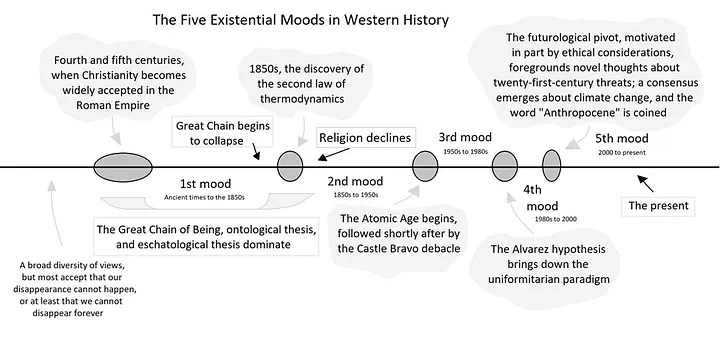
Émile P. Torres has a provocative perspective on the historical views on Human Extinction. He breaks it down into five periods of general ideas about the possibility of humanity going extinct, and here they are:


(1) The ubiquitous assumption that humanity is fundamentally indestructible. This mood dominated from ancient times until the mid-19th century. Throughout most of Western history, nearly everyone would have said that human extinction is impossible, in principle. It just isn’t something that could happen. The result was a reassuring sense of “Comfort” and “perfect security” about humanity’s future, to quote two notable figures writing toward the end of this period. Even if a global catastrophe were to befall our planet, humanity’s survival is ultimately guaranteed by the loving God who created us or the impersonal cosmic order that governs the universe.

(2) The startling realization that our extinction is not only possible in principle but inevitable in the long run — a double trauma that left many wallowing in a state of “unyielding despair,” as the philosopher Bertrand Russell wrote in 1903. The heart of this mood was a dual sense of existential vulnerability and cosmic doom: not only are we susceptible to going extinct just like every other species, but the fundamental laws of physics imply that we cannot escape this fate in the coming millions of years. This disheartening mood reverberated for roughly a century, from the 1850s up to the mid-20th century.

(3) The shocking recognition that humanity had created the means to destroy itself quite literally tomorrow. The essence of this mood, which percolated throughout Western societies in the postwar era, was a sense of impending self-annihilation. Throughout the previous mood, almost no one fretted about humanity going extinct anytime soon. Once this new mood descended, fears that we could disappear in the near future became widespread — in newspaper articles, films, scientific declarations, and bestselling books. Some people even chose not to have children because they believed that the end could be near. This mood emerged in 1945 but didn’t solidify until the mid-1950s, when one event in particular led a large number of leading intellectuals to believe that total self-annihilation had become a real possibility in the near term.

(4) The surprising realization that natural phenomena could obliterate humanity in the near term, without much or any prior warning. From at least the 1850s up to the beginning of this mood, scientists almost universally agreed that we live on a very safe planet in a very safe universe — not on an individual level, once again, but on the level of our species. Though humanity might destroy itself, the natural world poses no serious threats to our collective existence, at least not for many millions of years, due to the Second Law of thermodynamics. Nature is on our side. This belief was demolished when scientists realized that, in fact, the natural world is an obstacle course of death traps that will sooner or later try to hurtle us into the eternal grave. Hence, the essence of this mood was a disquieting sense that we are not, in fact, safe.

(5) The most recent existential mood — our current mood — is marked by a disturbing suspicion that however perilous the 20th century was, the 21st century will be even more so. Thanks to climate change, biodiversity loss, the sixth major mass extinction event, and emerging technologies, the worst is yet to come. Evidence of this mood is everywhere: in news headlines declaring that artificial general intelligence (AGI) could annihilate humanity, and the apocalyptic rhetoric of environmentalists. As we will discuss more below, surveys of the public show that a majority or near-majority of people in countries like the US believe that extinction this century is quite probable, while many leading intellectuals have expressed the same dire outlook. The threat environment is overflowing with risks, and it appears to be growing more perilous by the year. Can we survive the mess that we’ve created?

I don’t know — it seems to me the big shift was between (1) and (2), and (2) through (5) and more subtle distinctions about how and when the species is going to die. He also argues that these transitions are fairly sharp and clear, but really, Alvarez ended the uniformitarian hypothesis? I don’t think so. But then, I haven’t read his book yet.

Also, just to complicate things, there are a lot of people today who are stuck in the (1) mindset. He gives one horrifying example, of a man who got elected to the American presidency.

As I write in the book, end-times prophesies are both rigid and highly elastic, often able to accommodate unforeseen developments as if the Bible predicted them all along. Ronald Reagan provides an example. In 1971, while he was governor of California, he declared that,

for the first time ever, everything is in place for the battle of Armageddon and the Second Coming of Christ. … It can’t be long now. Ezekiel [38:22] says that fire and brimstone will be rained upon the enemies of God’s people. That must mean that they’ll be destroyed by nuclear weapons. They exist now, and they never did in the past.

For Reagan and other evangelicals, the possibility of a nuclear holocaust was filtered through the lens of a religious hermeneutics. Consequently, their mapping of the threat environment was completely different than the mapping of atheists like Carl Sagan and Bertrand Russell. The latter two did not see nuclear weapons as part of God’s grand plan to defeat evil. Rather, a thermonuclear Armageddon would simply be the last, pitiful paragraph of our species’ autobiography. Whereas for Christians, the other side of the apocalypse is paradise, for atheistic individuals it is nothing but oblivion. In this way, secularization played an integral part in enabling the discovery and creation of new kill mechanisms to alter the threat environment and, with these alterations, to induce shifts from one existential mood to another.

Man, Reagan was a batshit lunatic fuck, wasn’t he? And he thought a nuclear holocaust would be a good thing. When Torres says our current mood, that has to be interpreted as a rather narrow “our” because I think a scary huge percentage of the public don’t share that mood with us.