An exciting Friday morning!

I got to go outside! Actually, I had to go outside, since I have a ravenous population of spiders in my lab that must be fed, or there will be consequences. The one problem is that I’m still stuck in a wheelchair, which turned out to be almost no problem at all. The only steps I had to deal with were 3 short steps just outside my back door, and the rest of the way was all ramps, all the way to the science building elevator. Then, of course, I had my assistant Mary to push me there and back.

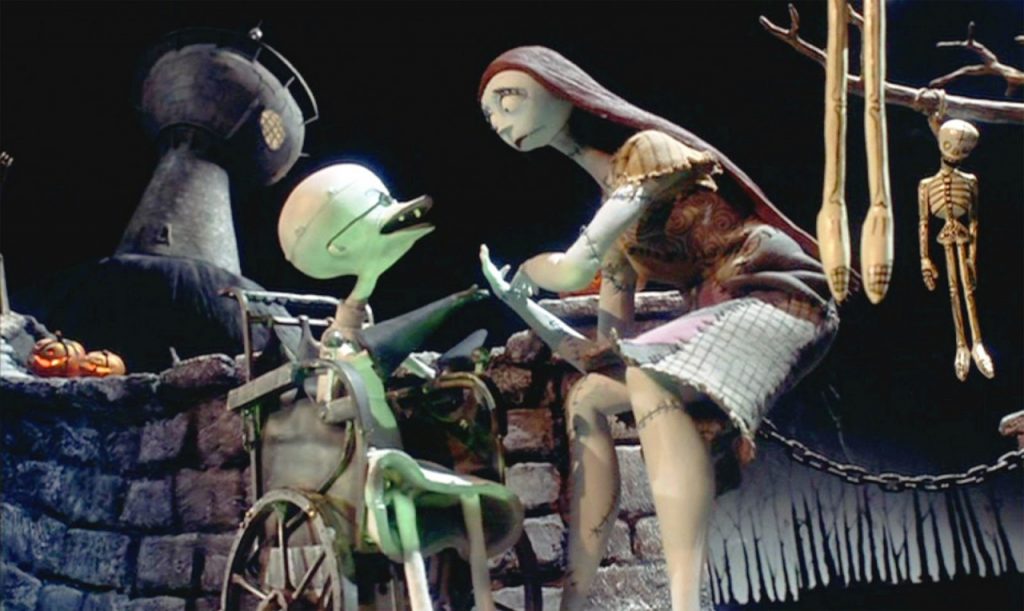
Actual photo of Mary helping me navigate the science building this morning.

The only real problem was that, as always it seems, we had another major thunderstorm roll through, with skies dark as night and thunder and lightning and a drenching rain. I think it’s fine that my return to the lab would be heralded with spooky nightmare weather.

Now the spiders are all snug in their webs, happily crunching through mealworms and flies, and all is right in the world.

Imagine finding a 10 foot long sausage

And deciding to try starting at one end and eating the whole thing. This is the bold jumper, Phidippus audax, that I’m raising in the lab (I’ve got 6 different species of spider thriving there), and I gave her a large mealworm which did not intimidate her in the least — she’s bold, remember. This is a pattern with her. She starts eating a big mealworm, and gets full halfway through, and I’ll have to clean up half-eaten corpses in a couple of day.

(I know, not a great photo, but it was shot through some dirty plexiglas so that’s as clean as I could get it.)

Spider apocalypse

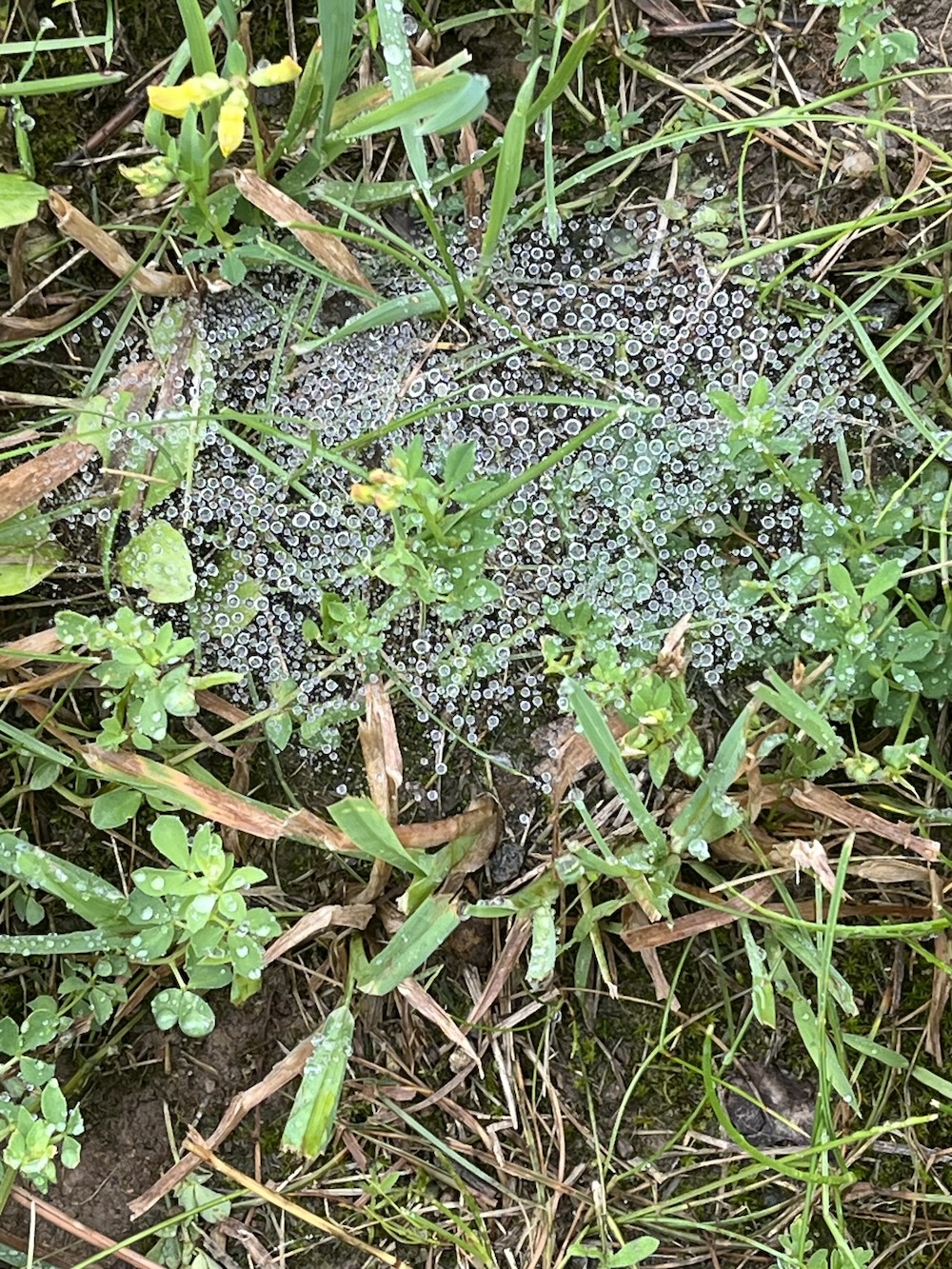
Last year, I would go outside in the early morning, when the dew was on the grass, and see my yard dappled with grass spider webs. Dozens of them!

My yard was a village full of these little tent-like structures.They would appear in July through August, and I’d also see the grass spiders steadily taking over other micro-environments, creeping up the walls of my house and displacing the Parasteatoda who had been living there in early summer. I wasn’t thrilled about that — grass spiders were ubiquitous and so common that I would rather see more interesting spiders.

But this year…I went outside around 6:30am on a humid (but cool) summer day, and could see all the grass and clover dotted dew. What I didn’t see was grass spiders. Zero spiders. No webs. It’s August! This is prime spider population time, and my familiar little friends are gone. This is the first time in my 25 years here that they’ve been absent.

I missed an opportunity. If I’d been tracking these things all along, I’d have an easy metric to tally a sample of the spider numbers — if I’d counted last year, I’d guess the daily numbers in August would have been between 20 and 30 grass spider webs in my lawn, but I didn’t because I assumed they’d always be there. So I’ll have to start tracking now. The number is…ZERO.

On the bright side, the number can only go up from here. Or stay dead forever.

Maybe it’s just a weird seasonal fluctuation? Why would all the spiders disappear from a lawn with a diverse plant population, never in all these years years treated with pesticides of any kind? WHAT IS GOING ON WITH THIS PLANET?

Many fat happy babies!

The Steatoda borealis spiderlings have finally emerged from their egg sac! They are slow, plump, and numerous.

I spent a good chunk of the morning plucking them out one by one and putting them in separate vials. Tomorrow, once they’ve laid down some silk, they’ll get many fruit flies and will be able to make their first kill.

Spider mommies are the best mommies

How nice. The mother of these spiderlings lies back and lets her babies eat her.

Not so nice: the spiderlings then gang up and cannibalize all the other adult spiders in the colony. Hooligans! These kids, always getting into trouble.

Which reminds me…I have to go into the lab this morning and sort out a couple of egg sacs I expect to see hatching out. The species I work with don’t practice matriphagy, but I do like to set up the young’uns with a lot of flies early on.

An almost day

I hobbled into the lab this morning, anticipating a lot of spiderlings that would need to be sorted out. I’ve got several egg sacs dancing on the edge of maturity, and I’d noticed on Friday that one of the Steatoda borealis sacs was really close — maturing spiders were darkening and moving about just below the surface of the sac, so I expected to come in today and find an explosion of spiderlings scurrying about looking for something to kill.

I was disappointed. They haven’t quite emerged.

See the dark mottled blob on the top left? The dark things are spiderlings clinging together in a ball, with the bounds of the disintegrating sphere of the sac. The white things are the final molt, that leaves behind a crumpled bit of cuticle. But they aren’t out yet!

Also in view is a second egg sac which isn’t quite as far along. I can tell by the somewhat granular appearance of the contents that the embryos are developing just fine, maybe a week or two behind their older siblings.

Mom is also there, a bit out of focus. These spiders are very good mothers, hovering over the egg sac and fighting anything that comes along to disturb her babies. Also, they do the greatest kindest action — they do not eat their own children when they emerge, no matter how juicy and tasty they look. I expect there has to be a swarm either tomorrow or Tuesday.

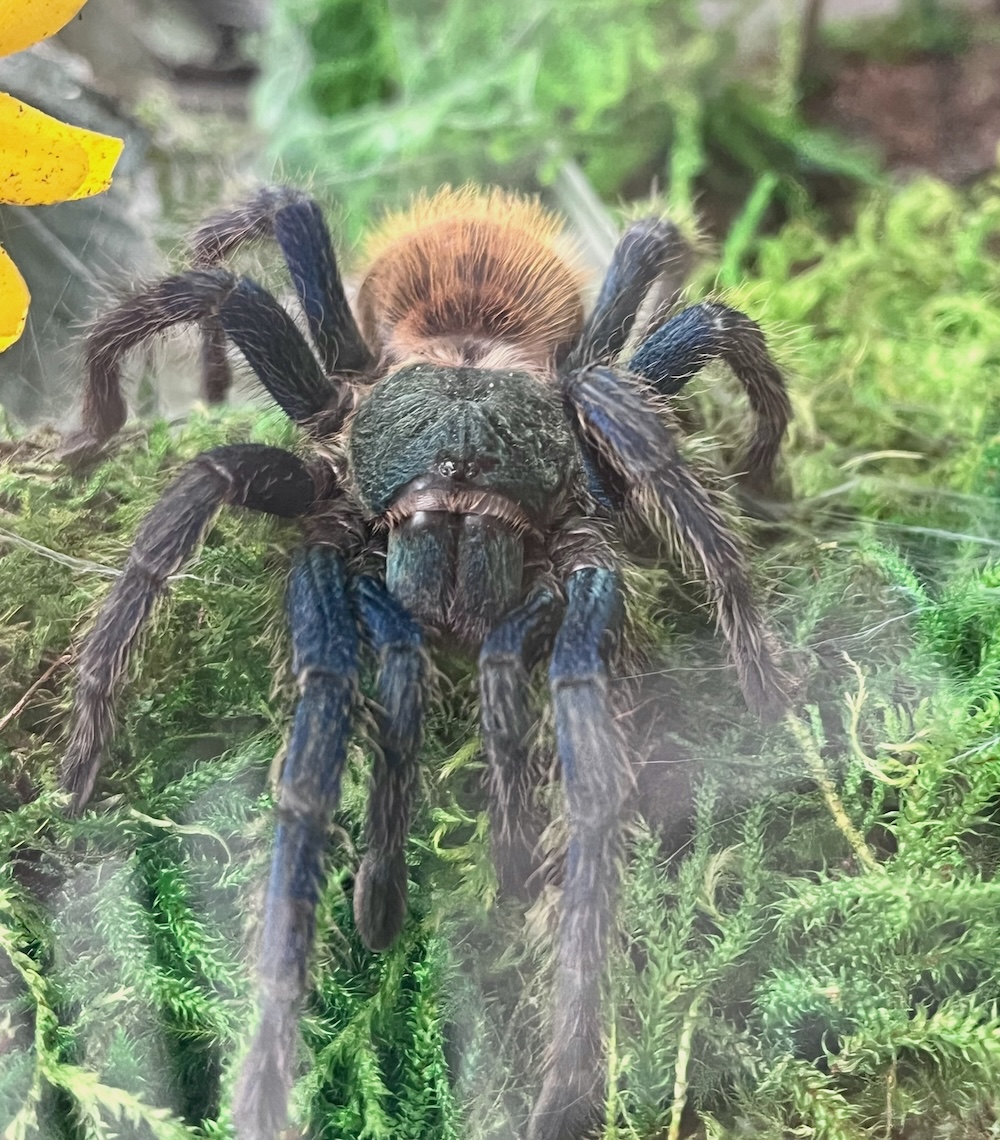
Also I got a little treat: my tarantula, Blue, usually hunkers down in her hidey hole, but every once in a while she emerges to explore her big cage. Here she is, just before I rewarded her with a mealworm.

I can do arachnomancy, too

Everybody and their mother has been sending me links to this story, Spider divination. In Cameroon, they have a practice of cluttering up a spider’s burrow with leaves and sticks and stones, and then interpreting the future from how it tidies up the garbage.

Questioning a spider involves first clearing the area around its burrow. Then a large, open pot that has had its base removed is placed over the hole, with a piece of tin used as a lid. The pot and tin keep the spider in a contained space. A stick and stone are left inside, with special marked leaves (which I think of as ‘cards’) placed over the hole. The diviner then asks a question in a yes/no (or either/or) format – with each response corresponding to either the stick or stone – while tapping the enclosure to encourage the spider to emerge from their hole. The stick and stone represent possible answers, while the leaf cards offer the possibility of further clarification.

My tarantula, Blue, likes to hide in a silk covered tent she has constructed — when I look in, all I usually see is a dark hole with maybe a couple of legs visible in the shadows. I leave her meals in a space in front of the opening, and she will dart out and the prey disappears. She is very tidy, keeping her silk-lined floor clean, so could see using standard spider behavior as an indicator of the state of the universe.

Blue is back in the lab, but I have an oracle right here in my home. She lives in the corner by our internet router, and has strung silk around all the various cables. I trust that she has far more access to information than a spider in a hole in a remote Cameroon village. Here she is:

She is very pretty, so you know you can trust her. I asked her whether these spiders are a good source of information.

“Of course,” she told me, “this is a historic, traditional mode for getting input from spiders, a variation of the technique you are using to communicate with me — I’m just a bit more articulate. However, you have to read deeper into the article to see the truth. Read this paragraph.”

In many forms of divination, randomness is important. Examples include bibliomancy (opening a holy text and picking a verse at random), tarot and other sorts of cartomancy (shuffling the cards and picking some at random), Yijing and Ifá (throwing coins or chains; picking up odd or even numbers of sticks or nuts), or African basket divination in which objects placed in a basket are repeatedly tossed in the air (those that settle on top are then interpreted to answer a question). The point of this randomness is that the diviner cannot influence the result, so the message from beyond can be heard without the risk of human manipulation and interference.

She continued, “They are using the spider as a random pattern generator. The author fails to understand the key to the author’s misunderstanding, though, is that final sentence, ‘The point of this randomness is that the diviner cannot influence the result,’ which is false, and gives the game away. The diviner has all the power here as the interpreter of the pattern. The spider can be howling that the answer is X, but the interpreter can then declare that the answer is Y. The author is an unreliable source if they are able to ignore the power of the human manipulator of information.”

“By the way, PZ, I expect you to report my explanation accurately and completely, or my children will build nests in all of your orifices while you sleep.”

She really didn’t have to threaten me — of course I would avoid manipulating or interfering with her truth — but I could tell that she was annoyed by this story about humans stealing the authority of spider-kind for their own selfish ends.

Emergence!

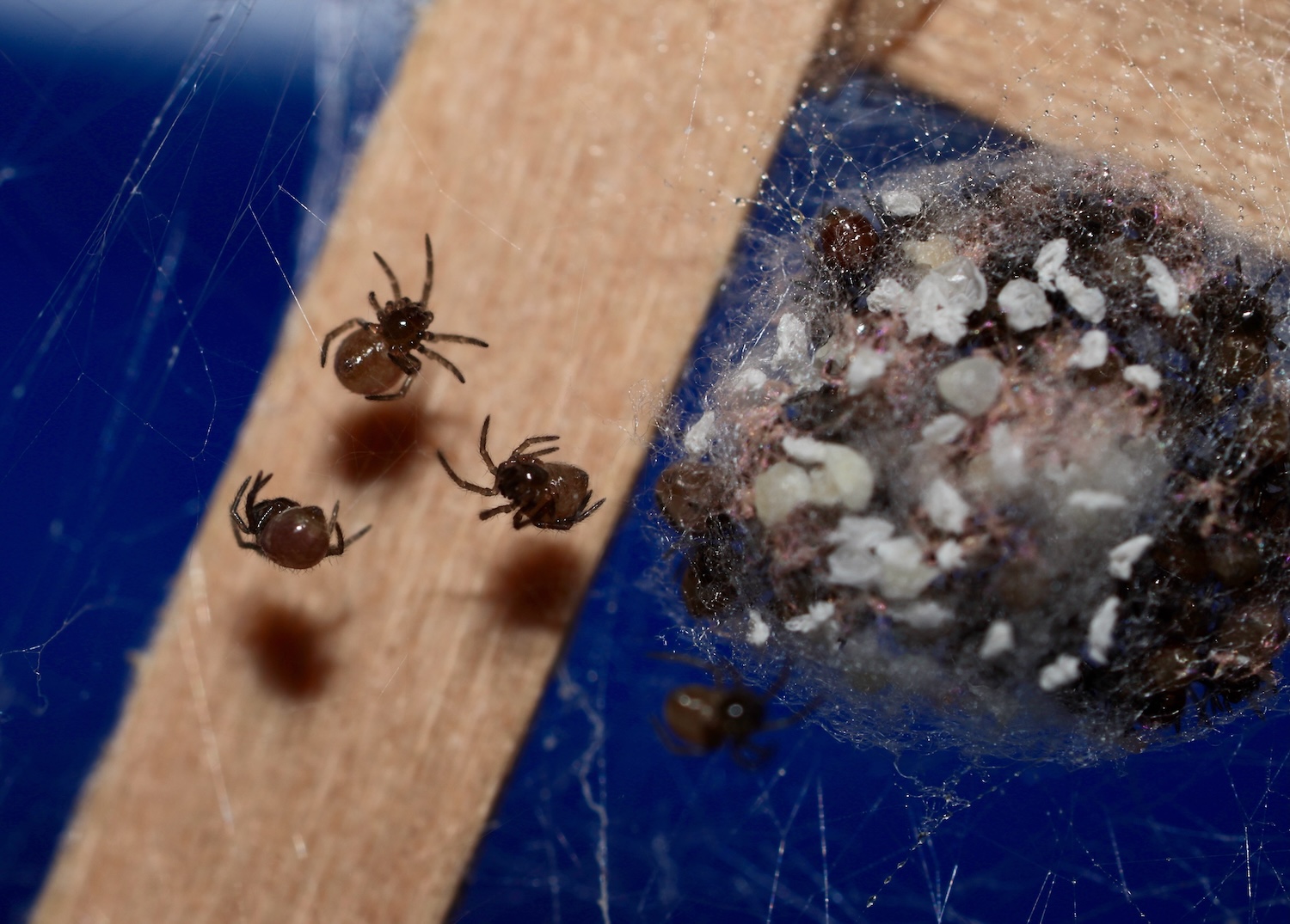
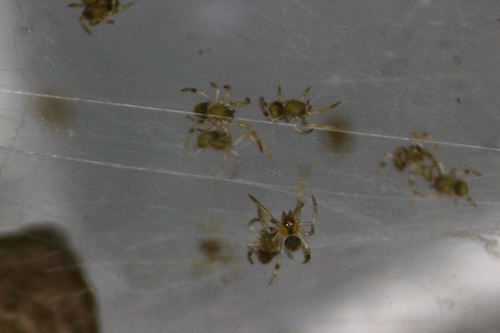
I thought I struggled with two small children over the weekend, but I just cracked a container in the lab and found one Parasteatoda mama dealing with a few hundred little spiderlings. Everyone was scampering all over the place.

Look! They’re all over the jungle gym! Seemed familiar.