An unpleasant memory

I just had a flashback to my worst academic experience ever. I think it was a combination of my recent posts about all those scientists losing their jobs and that cool video of Pakistani mechanics cutting and shaping steel.

In the 1990s, I was an assistant professor at Temple University, and I had a magnificent custom microscopy rig. A top of the line Leica was at the heart of it, but I had modified the heck out of it. I’d built an air table — a massive 2cm thick sheet of steel resting on a cushion of tennis balls — that had been a huge effort to get cut and hauled up to my lab. I had hydraulic actuators for single cell injections. The microscope itself was modified with a motorized stage and a UV filter wheel (thanks to my friends at Applied Scientific Instrumentation, who are still in business, I’m pleased to see) all programmable and controlled by custom software I’d written. It was beautiful, and unique.

Unfortunately, I did not get tenure at Temple. You may not be aware of this, but if you’re hired by a university for a tenure track faculty position, and you do not get tenure, you’re done. You have one year to clear out your stuff, and then the axe falls, and there ain’t nothin’ you can do about it. You’re a dead man walking, still ambling zombie-like about the university, still obligated to do your teaching and committee duties, but there’s a deadline ahead of you, at which time you have to vacate your office, your lab, everything, it all comes to an abrupt close.

Yeesh, but that was a miserable year, with all my former colleagues cutting ties. Fortunately, I landed another job in Minnesota, but that gorgeous microscope was not mine, it belonged to the university. I had to abandon it.

But that wasn’t the worst of it. At that time, there was a political crisis: HMOs were consolidating and going bankrupt, and many of them had associations with research universities that they were abruptly shutting down. Temple saw that they could buy up entire research groups for a song! It was time to shuffle out the peons working at their university already, and instead bring in all these big biomedical people who already had research grants. And so they did.

One day, in the waning days of my employment, a pair of these new hires walked into my lab, zeroed in on my microscope (that I was using at the time!), and started taking photos, writing down part numbers, and measuring stuff with a tape measure, while talking to each other about where they could put it in their lab space. They looked a bit puzzled by the filter wheel and the weird piezoelectric stage and the strange camera I was using, but they didn’t ask about any of it. They didn’t talk to me at all. They didn’t even acknowledge my existence. It was a strange experience that left me feeling like a ghost, and also sad, because these clueless twits were no doubt going to carve up my microscope for parts.

It was a dehumanizing experience that poisoned all my good memories of working at Temple. It did make me feel better about saying goodbye to that place.

Academia is a cruel and heartless beast, and overpaid biomedical researchers who lack the basics of human interaction are the worst.

Impressive mechanical work

The Algorithm threw this video at me and I had to watch it. Now you shall watch it too.

It’s not clear where the video was made…Pakistan? I liked the look of the truck to start, but then they haul the tire to a shop where they completely rebuild the wheel. I don’t think we could do any of that where I live. There’s a whole massive body of infrastructure in those communities to keep machinery running.

I don’t think “tariffs” will bring that back to the US.

Another reason to ignore social media

As a man who was born a Chad (I keep telling myself), I am immune to the “looksmaxxing” trend, but apparently a lot of men have fallen prey to it, and it’s hurting them.

But for some young men who participate in an online community called “looksmaxxing,” those self-critiques can become excessive. And the criticism they receive from other members — and their suggested remedies, which can include self-injury and surgery — are even more extreme.

Looksmaxxing is, on the surface, about trying to look your best in order to attract a partner. But a new study from Dalhousie University says while the community is framed as self-help, it can be harmful to participants.

This shouldn’t be a surprise. If you tell people that their only value is their appearance, they’ll obsess over their looks. We’ve known this for years from the way our society treats women, and now young men are being hit by the phenomenon.

Green says the hypersexualization that women have felt for decades has been hitting guys acutely in recent years, with social media messages that push the physical ideals of being tall and muscular.

“I happened to be at a hotel gym just last week and the manager of the gym said this place is packed with teenage guys from like 4 until 6 in the afternoon, but no one’s doing any cardio,” says Green. “They’re all doing weight training.”

They’re not doing this for their health, but to impress other even more obsessed people online. The source of the problem isn’t individuals — they’re getting screwed up and are victims — but a whole shallow, superficial culture that skews people’s perspectives, and it’s actually killing people.

Halpin says the looksmaxxing community can cause harm in several ways, firstly by creating body image issues in men and boys.

“They’re finding flaws that I think people outside of that community wouldn’t really find,” he says. “So, they’re teaching people how to look at their bodies in a really critical, negative way.”

The solutions members suggest to remedy perceived physical shortcomings can also be risky and cause harm, Halpin says.

But most disturbing, Halpin says, is the regular encouragement participants give each other to die by suicide.

“We saw numerous men being told that they’re beyond help, beyond saving,” Halpin says. “It’s like, your appearance is set, nothing you can do will help you and you should complete suicide because looks are all that matter and you’re going to have a terrible life because you’re an ugly man.”

We should take this problem seriously, but then I learned about the fad of “mewing,” the practice of pushing the tongue against the roof of the mouth to achieve a more masculine jaw. Fine. That sounds harmless, and mostly pointless. But then I learned about the origins of the practice. It’s promoted by this squirrely looking guy:

The term ‘mewing’ originated with Mike Mew (pictured above) and John Mew, British orthodontists who promoted a technique that purports to change the structure of the jaw.

There’s nothing wrong with his appearance, but he doesn’t represent some kind of classical ideal of masculinity — he’s just a guy. Maybe we can cure people of “looksmaxxing” by sharing that photo around.

Sure. And then people will start floating photos of George Clooney around. We all want to look like handsome George.

Did you know that early in his career George Clooney starred in a movie called Return of the Killer Tomatoes?

We’re all a little bit squirrely. It’s part of our charm.

They aren’t coming back, you know

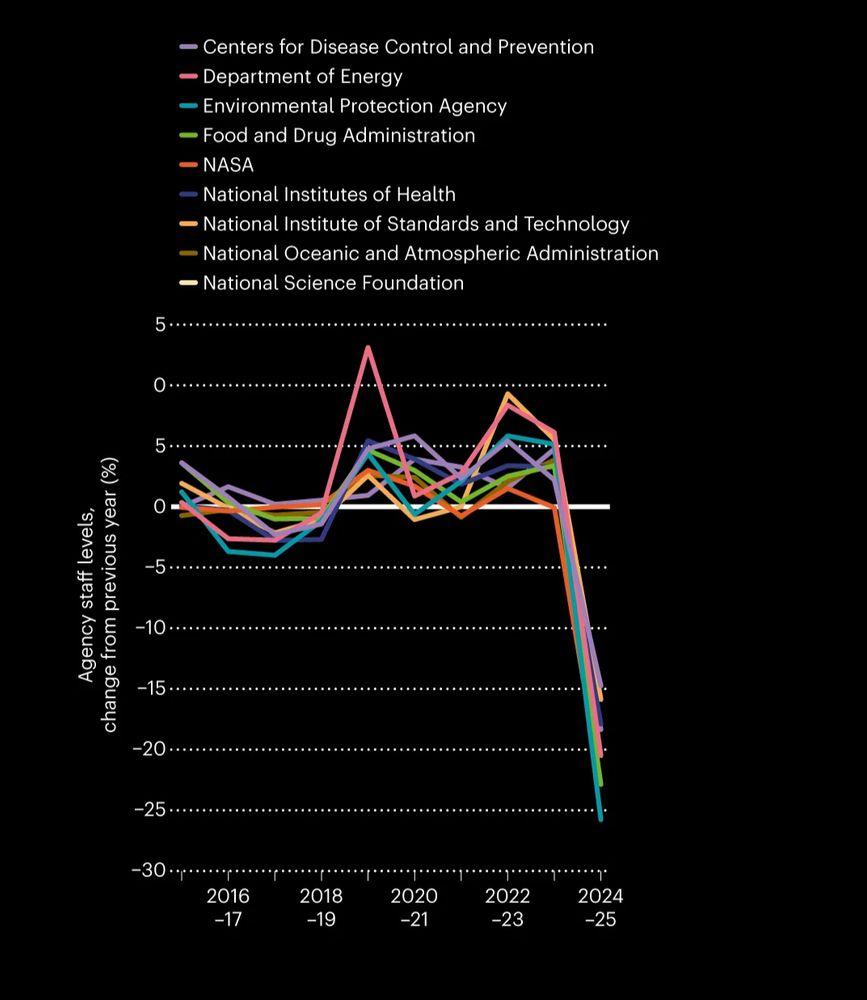
Conservatives hate science. This is why they slashed budgets to science agencies, and put lunatic ideologues in charge of the NIH, NSF, and the environment, with the clear intent to cut the knees out from under science education and policy. Jessica Knurick is precisely right on this matter.

You can also see it in the staffing of all of these critical science organizations.

It’s like science got pushed off a cliff when Trump took office.

Perhaps you would like me to reassure you that once we throw the rascals out and elect responsible politicians who respect the role science has played in American prosperity, we’ll just hire them back. No, sorry, this isn’t like rehiring workers at the Amazon warehouse. A science hire is accompanied by a large investment in equipment and personnel. I’m at a small liberal arts college; when I was hired here, I was also offered tens of thousands of dollars in startup money to set up my lab the way I needed to be able to do my work. I was dirt cheap. I’ve known colleagues who were offered hundreds of thousands of dollars, and even a few who got somewhere near a million dollars, to cover the ancillary costs of setting up a major lab.

It’s not as if a custom lab and technicians and instruments are sitting around waiting for someone with the expertise to do cutting edge research to show up. This stuff needs to be assembled at great cost to fill a need.

The people are also not generic tools you can swap in and out. We pay science staff peanuts for years, and we hang in there to do the work we love — we generally don’t have a massive financial cushion to weather heavy shifts in employment. Some of those laid off personnel are going to leave the country, looking for work in a nation that doesn’t disrespect science, while most are going to simply give up, get a job at that Amazon warehouse or switch to writing software. Their hearts are broken by the American science establishment. They’re not going to revisit this occupation shown to be willing to discard them if an orange moron gets elected or a con man with half his brain eaten by worms gets appointed.

That is a graph of disillusionment. It would take decades and a new generation to repair it, if we even had the will to bring science back. Given that the damage is being delivered right down to support for grade school education, don’t even count on a single generation being enough.

It’s not just a few people being let go. It’s the demolition of a cultural heritage of science.

What’s happening in Minnesota is Science

My state is impressing the world with its communal cooperation and altruism. It turns out we’re just responding in a normal human way.

In sociology, there’s a term to describe this phenomenon: “bounded solidarity.” Alejandro Portes, a prominent sociologist at Princeton University, first introduced the term in a paper published in The Annual Review of Sociology in 1998. It’s used to describe when a community is bound by a crisis, and during this time, it can lead to extreme acts of altruism and kindness that aren’t usually seen in non-crisis times.

OK, nice of sociologists to provide a name for the phenomenon.

We are seeing this in Minnesota right now. Multiple media reports have highlighted the ways in which the community has come together. Volunteers are delivering groceries so immigrants can hide at home. People are raising money to help Minnesotans cover rent because they haven’t felt safe to go to work. People are taking each other’s kids to school, organizing shifts for people to stand guard and protect immigrants in their neighborhoods. As NPR recently reported, when a preteen got her period for the first time — a preteen who hadn’t felt safe enough to leave the house to go to school — a community rallied together and launched an underground operation to get her pads. Minnesotans have been braving the below-freezing cold to show up for protests and denounce the violence in their communities for weeks.

These acts of kindness and solidarity matter because it’s exactly what people need to move through a crisis, build resilience, and transform a community for the better. Daniel Aldrich, a professor at Northeastern University teaching disaster resilience, and a survivor of Hurricane Katrina, once told me that when it comes to a disaster, his research found that community-based responses are more successful than individual-based ones.

You mean like mutual aid? The antithesis of the rugged individualism this country usually promotes? We’ve been talking about that for a century or so.

When conspiracy theorists try too hard to find a conspiracy

It’s cold across much of the country. There’s snow and ice on the ground.

IT’S A CONSPIRACY!

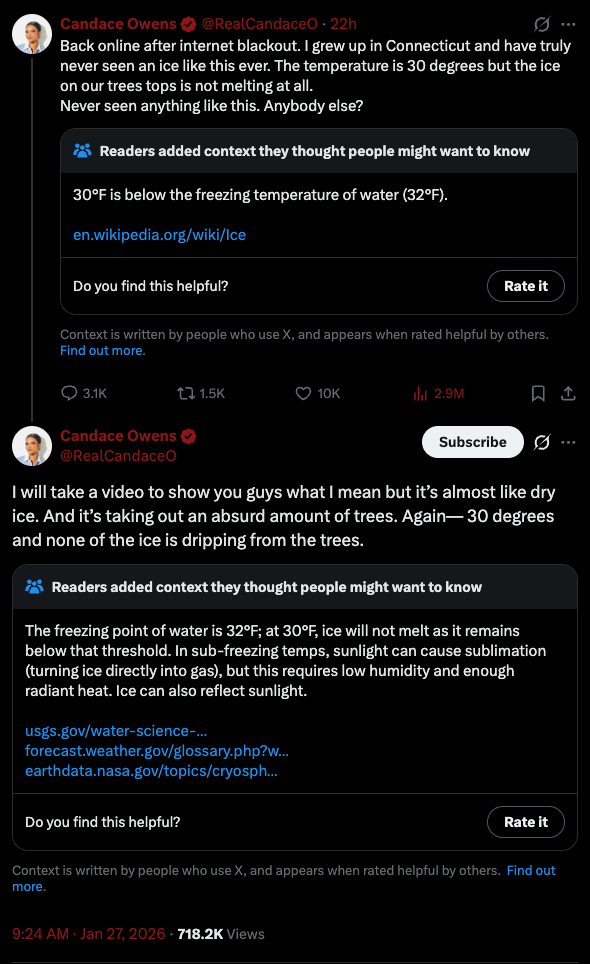
At least, some stupid people are trying to imagine alien weirdness going on, including this desperate ignorance from Candace Owens, who thinks it’s artificial because it doesn’t melt at 30°F.

I looked at some of the comments. Many are trying to explain to her that the freezing point of water is 32°F, and that 30 is less than 32, and some mention that the temperature in Connecticut when she was horrified by frozen water was actually 25°F. Others are agreeing that yes, it’s a government or alien conspiracy.

Remember this when Candace Owens trots out another bizarre conspiracy theory. I think the lawsuit by Brigitte Macron against her is going to go well.

A resilient Minnesotan

An ugly old white man (I can say it, I’m one of them) took a seat in the front row of an Ilhan Omar speech, and then jumped up, shouted something unintelligible, whipped out a syringe, and sprayed something unpleasant and bad smelling on her. Then he was promptly tackled.

That’s a metaphor for something — ineffectual, horrible person making a stink and trying to disrupt a democratic event. Even more appropriate is the response by Omar.

Omar continued to talk after the disturbance, commenting: “We will continue. These f****** a**holes are not going to get away with it.”

Exactly right. Say it!

“We’re going to keep talking … just give me 10 minutes. Just give me 10 minutes. I beg you,” Omar told a man, who appeared to be security. “Please don’t let them have the show.”

“Here is the reality that people like this ugly man don’t understand. We are Minnesota strong, and we will stay resilient in the face of whatever they might throw at us,” she continued.

“Everybody settle down. I’m going to finish my remarks. It is important for me to continue to lead my Democratic colleagues in demanding her (DHS Secretary Kristi Noem) resignation. And like I said, if she does not resign, we are going to introduce articles of impeachment.”

I like representatives who have a clear idea of what needs to be done, and Ilhan Omar has that power.

Waiting for another creepy old man to die

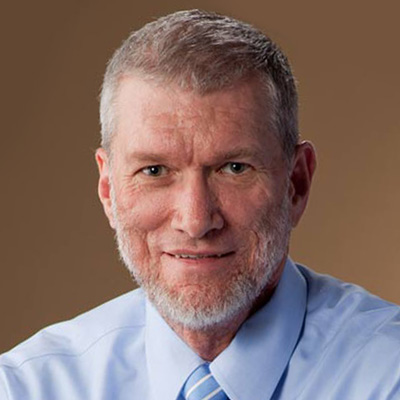
Daniel Phelps, who tracks attendance at Ken Ham’s cheesy roadside attractions in Kentucky, tells me that they’re in decline.

According to my monthly Kentucky Open Records Act (KORA) request, December Ark ticket sales were the lowest ever (with the exception of 2020 – during the Covid pandemic). In December 2025, the Ark sold 35,223 tickets, about 4,000 less than December of 2024. Of course, these ticket sales numbers don’t include lifetime pass members or children under 10. My summary of all available ticket sales numbers can be found below.

The December ticket sales number means that the Ark sold 652,342 tickets in 2025. These numbers indicate that the Ark will never come close to the 1.4 to 2.2 million attendees per year projected when the Ark was begging/shaking down Grant County, Williamstown, and Kentucky Tourism for perks including 100 acres of land for $2, $200K cash, reduced taxes, a $62 million bond, and $1.825 million dollars/year in sales tax rebates.

Because of massive donations, AiG and its shell companies are not in danger of collapse. They, however, aren’t doing as good as in previous years.

Yeah, no likelihood of imminent demise, unfortunately — I’m sure the leadership is living comfortably for the duration, and has no major concerns for the future, but they’re in a cult that demands the conversion of everyone in the country (the world!) to their weird apocalyptic doomsday religion. They must be hoping for some magical miracle, and it isn’t happening right now.

Perhaps of greater concern is that their cult of personality is led by a personality that isn’t propagating.

If you look at AiG’s website https://answersingenesis.org, more and more of the content is exclusively coming from Ken Ham himself. Most notably, no one appears to be a replacement for Mr. Ham if he ever retires. His onetime appointed successor, Martyn Iles somehow ended his employment with AiG and returned to Australia to form his own conservative ministry. There have been no official reasons given for this departure by either AiG or Martyn Iles himself (if you know, let us hear about it).

That’s a problem with authoritarian cults. They are ruled for life by unpleasant, weird people who alienate everyone around them, and maybe instill in them the ambition to be in charge on their own. I hope I outlive Ken Ham, because I’d really like to see the chaos that will follow on his death.

Kickin’ Thomas Chatterton Williams and The Atlantic? Yes, please

Thomas Chatterton Williams has written up another piece sucking up to the powers-that-be, blaming the “super-woke” for the fact that he’s only on the board of The Atlantic and gets published in The Atlantic and has many peers and colleagues reading The Atlantic and is good buddies with the wise conservatives who steer The Atlantic. It’s as obliviously hypocritical as my short summary sounds, but don’t read The Atlantic to verify — just listen to Thought Slime who quotes bits of the article and also checks the statistics that Thomas Chatterton Williams didn’t bother to read.

Charming. It reminded me of an era when pretentious conservative twits like Williams were everywhere and didn’t have any real power, yet, and we’d point out how insane and ridiculous their claims were, and we didn’t have to worry that they and their friends were going to march up and shoot us. The good old days.