
Data feels

cn: rape, sexual violence, & CSA juxtaposed with cold data. This is being crossposted to my other blog.

Some of my most important activist work is in volunteering technical skills for the Asexual Census, a survey of English online ace communities. This past week, I’ve been on a roll analyzing our 2015 survey. No numbers will be reported here, this is just a personal account.

Unsurprisingly, as soon as I was done with prep work, my attention was drawn to the statistics on sexual violence. As a programmer, I’ve been trained to always use descriptive variable names. Now I’m looking at variables named “rape” and “rapeCombined”.
[Read more…]
Better identity labels

Last month, I said I didn’t care for most atheist models of identity. For example, I hate the “weak”/”strong” atheist distinction. I am not too fond of the gnostic/agnostic atheist/theist scheme. Dawkins’ 1 to 7 scale is okay though.

My views on identity label schemes is largely informed by my participation in asexual discussions. Asexual communities are renowned for making up new words and models. For example, one person might identify as heteroromantic demisexual gray-ace, and another as gray panromantic agender asexual. While these lists are often subject to mockery by Redditors, I find that they are far more intelligible and informative than, say, all the names we have for colors. Also note, for every successful asexual word, there have been many unsuccessful ones.  Everything goes through trial by fire.

The atheist community tends to be a lot less introspective about labels, which results in the persistence of bad identity label schemes. Here I’ll discuss some general qualities that you want identity schemes to have.
[Read more…]

In praise of the most important relationship

This is a repost of an (only slightly facetious) article I wrote in 2015.

Where much of fiction is devoted to the most tumultous kinds of relationships–those of lovers, family, and enemies–let us never forget that there is another kind of relationship which is much more important, and in fact essential to everyone’s daily functioning.  I speak, of course of the stranger.

I am infinitely grateful for all the strangers in my life, all seven billion of them.  I am enriched by the fact that they don’t know who I am, and waste no time thinking of me.  The great number of conversations we don’t have is a source of great joy.  And it’s heartening to think about how much we care about each other, under a thick layer of distant abstraction.  It’s a special kind of love, the kind that is tolerable in large quantities.

And yes it is true that I don’t mind losing a few strangers, that losing a stranger can even be a happy occasion.  But that’s just the kind of relationship that strangership is.  Another way of looking at it is that strangership is such an abundant gift that it’s no problem to skim a little off the top to form more mundane relationships.

[Read more…]

Non-binary people who aren’t trans

As it says on the sidebar, one of my most important activist projects has been analysis of ace community demographics. More specifically, I volunteer expertise for the AVEN Community Census. As far as activism goes, it isn’t as glamorous as blogging, but IMHO the glamour of survey analysis is way underrated.

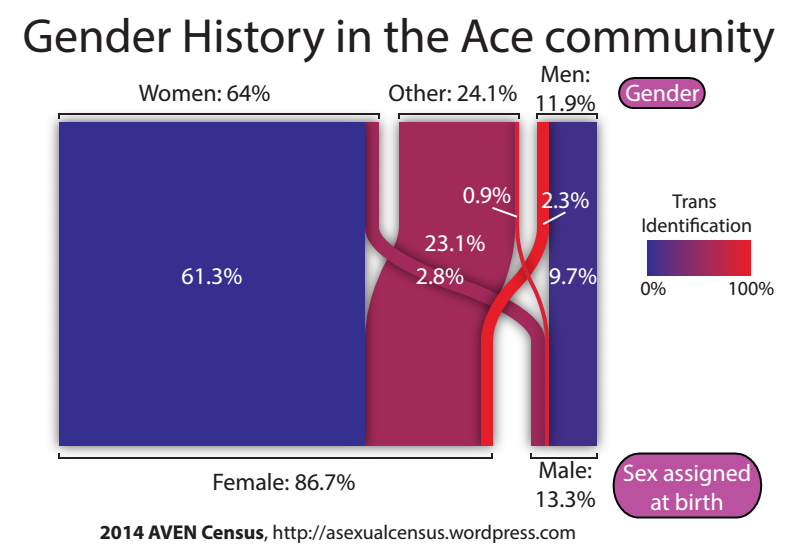
Anyway, let’s talk about the results on gender from 2014:

gender history

This figure was originally published here, but I made a slight revision. The width of each line is proportional to the percentage of the ace community. The color of each line indicates how many people in that subgroup identify as trans or unsure. “Other” refers to people who indicated that they were neither men nor women, but throughout this post I will refer to this group as non-binary.*

Within this figure is a cross-section trans politics. The biggest surprise to me was how few non-binary people identify as trans. But I should first offer brief comments about other features of the data.
[Read more…]

Love is chemicals, and I am grateful

The problem with a naturalistic world view is that everything is just a bunch of chemicals bouncing around, and nothing means anything. The only way to produce any meaning is if there are a few supernatural spirits bouncing around too.  You know, so they can moan about the meaning of life, the nature consciousness, and objective morality.  Or something like that.

But let’s be real. Chemicals are not “just” chemicals. Quarks and leptons can be quarks and leptons, while at the same time forming chemical structures. Likewise, a chemical can be a chemical, while at the same time forming a person. When we say that love is “just” chemicals, it is not a statement of fact, it is an aesthetic.

A common criticism of naturalism is that it forces us into the “just chemicals” aesthetic. But that’s just one of many aesthetics available to us. If you want to say “love is free yet binds us“, I don’t entirely know what that means, but it seems consistent with reality too. Aesthetics are a matter of preference.

“Love is just chemicals” is an aesthetic I prefer, and I think you should prefer it too. The chief point is that chemicals permit diversity. Love can be experienced in a variety of ways, or not at all, and that’s okay.
[Read more…]

Re: Necessity of sex-positivity

Fellow FTB blogger Great American Satan wrote a post called Sex Positivity: Still Necessary, which defends sex-positivity against asexual discourse.  This is a response from an asexual perspective.

First, some general comments:

  • I consider myself sex-positive.  However, because I participate in the ace community, non-sex-positive, or sex-negative views are within my Overton window.  I will offer some defenses of these views, but I ultimately agree with the thesis that sex positivity is still necessary.
  • If you read the comments on GAS’s post, there are a few from Elizabeth Leuw.  I will say basically the same things she does, but with fewer links.  This does not necessarily reflect a consensus view, it’s just that Elizabeth and I are on similar wavelengths.  She is one of my cobloggers on The Asexual Agenda.

Sex positivity in principle and practice

The central problem with sex-positivity is its supporters.  If you meet several sex-positive people, and all of them advocate for harmful messages (e.g. everyone should enjoy sex; no one should ever be grossed out by sex; more sexual content in the public sphere is necessarily better in the long run), you might reasonably disidentify with sex-positivity.  You might like sex-positivity in principle, but dislike in practice, and what it is in practice is important.  Or perhaps you think that the roots of its problems lie within its principles.

I will point out that this is not so different from the way many FTB readers disidentify with the skeptical or atheist movements.  You could decide that Richard Dawkins, Sam Harris, and DJ Grothe are so bad that you want no part.  Or you could decide that you want to stay involved. [Read more…]

Rational ideals

This post is for the Carnival of Aces, whose theme this month is “Questioning your faith“.

Leaving religion was a rather unemotional process for me. There was no catalyzing event. I was interested in skepticism. I learned about philosophical arguments for God, and found them unpersuasive.  Without any real urgency, I spent a whole year thinking to myself, “Gee, there’s really no justification for belief in God, and there may never be.” At the end of the year, I considered myself an atheist.

Unlike leaving religion, leaving straightness was a far more emotional experience. And yet, I tried to treat it the same way. “Am I straight or am I asexual?” was an intellectual puzzle, to be approached under the same rational ideals.  It is not clear to me, after the fact, that this approach was a good idea.  Here I give a taste of my thought process.
[Read more…]