
Trolleyology bad

In my last post, I offhandedly disparaged the Trolley Problem as a serious thought experiment. Let me elaborate.

Any philosophical thought experiment contains stipulations about what is going on. In the trolley problem, it is stipulated that by flipping the switch, it *will* prevent five deaths, and it *will* cause another person’s death.

Question: do we believe that stipulation? We don’t exactly believe in it, it’s a fictional scenario. But you at least have to accept the stipulation to think about the problem on the level that it was intended.

In the variant of the trolley problem, it is stipulated that by pushing a fat man in front of the trolley, this *will* prevent five deaths, and it *will* cause the death of the fat man.
[Read more…]

Newcomb’s Paradox occurs in real life

Newcomb’s paradox is a philosophical thought experiment. There is an entity called Omega, who can predict your choices. Omega presents you with two boxes; you may open one or both boxes, and take whatever you find. The first box contains $1k, guaranteed. The second box contains $1M if and only if Omega predicts that you will leave the first box alone. So the dilemma is between “one-boxing” (taking only the $1M), or “two-boxing” (taking both boxes, finding a total of $1k).

When I put it that way, it seems obvious that $1M is more than $1k, so therefore you should open only one box. The two-boxer argument is that Omega has already decided whether the box contains $1M or not. So whatever’s in the second box is a constant, and it’s only rational to take the free $1k. Omega may have chosen to arbitrarily punish players who behave rationally, but what’s done is done, might as well collect the $1k consolation prize.

Do we care about Newcomb’s paradox?

Newcomb’s paradox has received a great deal of discussion from Rationalists, i.e. the community popularized by Eliezer Yudkowsky. That’s how I know about the paradox. But I’m an outsider, and it appears to me like Rationalists stared at this paradox for so long that they went mad. Yudkowsky is a dedicated one-boxer, and has attempted to construct elaborate theories to justify it. Some of these ideas were crucial in the construction of Roko’s Basilisk.

I believe the reason Yudkowsky and others are so obsessed with Newcomb’s paradox, is because they’re transhumanists. They believe the future will contain a super powerful AI. To most people Omega sounds fantastical—how can any entity make perfect predictions about our actions? But to a transhumanist, a super powerful AI could easily step into the role of Omega.  Additionally, we can think about what happens when AI steps into the role of the player. If the AI is deterministic, then of course we can predict what the AI will choose. So Yudkowsky’s interest is ensuring that an AI will choose correctly in this situation.

But for the rest of us folks who aren’t transhumanists, does Newcomb’s paradox make sense? Is this a problem we even need to think about?

[Read more…]

War mismanagement, in Helldivers

Helldivers 2 is a game that takes a significant amount of inspiration from Starship Troopers, being basically a satire of fascist propaganda. Players take the role of Helldivers, who fight on the side of Super Earth in a galactic war. Super Earth’s goal is to spread liberty Managed Democracy. Managed Democracy is basically a totalitarian government where an algorithm votes on people’s behalf, allegedly based on a prediction of how they would vote.

But where Starship Troopers is a short self-contained movie, Helldivers 2 is a game that people pour hundreds of hours into. It can’t just be a satire of fascist propaganda. It can’t be any single thing. There are many narratives that emerge from it, some of which are at tension with each other. For example, in the interpretation of Starship Troopers it is possible to argue that the bug aliens did nothing wrong, and the humans are the aggressors. On the other hand, Helldivers doesn’t lend itself to such a straightforward interpretation, because there are many clear examples where the aliens are the aggressors.

So I’d like to explain a grander emergent narrative that took me months to understand. It’s a narrative about how players are kept in the dark, and how this leads to a mismanaged war that wastes billions of lives.

[Read more…]

Rock Paper Scissors and variants

Rock Paper Scissors is a game where two players simultaneously pick one of the three things in the title. Rock beats Scissors, Scissors beats Paper, Paper beats Rock, and if both players pick the same thing they tie.  Rock Paper Scissors is important in game theory, because it is a toy model that helps understand a much broader class of games.

To understand the correct strategy in Rock Paper Scissors, we must understand the difference between pure strategies and mixed strategies. A pure strategy is deterministic, where a mixed strategy is random. There are only three possible pure strategies: pick Rock, pick Paper, and pick Scissors. There are infinitely many mixed strategies available, for example assigning 50% probability to Rock, 25% to Paper, and 25% to Scissors.

[Read more…]

Origami: Drawer box

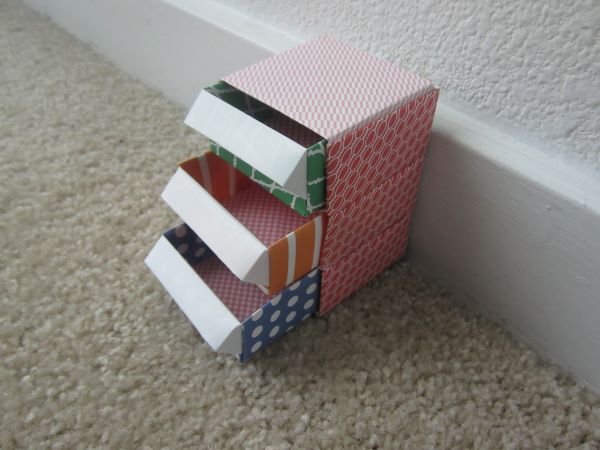
Drawer box

Drawer Box, designed by Akiko Yamanashi

I got this drawer box from something called the Practical Origami Convention.  I didn’t actually attend the convention, but happened to access the models later, and picked this one out to fold.  I have to imagine that there are a bunch of origamists making “practical” designs like tiny chairs to sit on, and tiny tables to hold tiny flowers.  (I’m joking, I know that practical origami has a lot of emphasis on boxes and envelopes.)

I can’t remember how many sheets this needed, but it was over 10.  Each drawer is a separate sheet, with another sheet to be used as lining.  The cabinet box (I had to look up what this part of the drawer is called) is made of 4 pieces, or maybe more?

Now obviously there’s a lot of origami that stretches what you would think is possible with a single sheet.  But other designs are more sheet-maximalist, with multiple distinct units working together.  There’s some complexity in that; you need to make the sizes match, accounting for the thickness of the paper, and some units need to be firmly attached to each other.