I know, they all are, but this one is mangling developmental biology and genetics, so I had to criticize Rob Carter.
Pharyngula
Evolution, development, and random biological ejaculations from a godless liberal

I know, they all are, but this one is mangling developmental biology and genetics, so I had to criticize Rob Carter.

I was trying to read while sitting in my sunny garden, but I kept getting distracted by all the spiders out there, in particular, all the jumping spiders. They kept hopping on my book, trying to get an education in biology, and they were hopping on me, trying to figure me out. It was distracting.
I finally tried taking a photo of one, but all I had was my iPhone, which isn’t great for these kinds of pictures. Next time, I’ll bring my Canon R8 with the 100mm macro lens…but then I won’t get any reading done!


I’m not gay, or trans, or bi, but even so, if I were living in Texas, I’d be desperate to escape. And the direction I’d take would be…Northwest, baby.

Amid a glut of anti-LGBTQ+ laws passed by the state legislature over the past half-decade, many queer Texans have decided to pack up and move to greener, more supportive pastures. So many have chosen Seattle that the Pacific Northwest city is now considering declaring an emergency.
As first reported by the Seattle Gay News, the City of Seattle is close to declaring a state of civil emergency in response to LGBTQ+ refugees from red states moving there. That comes after Seattle’s LGBTQ Commission, an advisory committee that counsels local leaders on matters related to Seattle’s queer community, reportedly sent a letter last month asking the city council to make an emergency declaration. The commission said that the city needed “an effective and empathetic response” to protect a “rapid influx of 2SLGBTQIA+ persons seeking refuge in Seattle.”
I don’t have to ask “Why Seattle?” I know Seattle. But for those of you unfamiliar with the place, here’s the perspective of a trans woman:
For some ex-Texans, Seattle has become a haven. Victoria Scott, a trans woman and freelance writer, lived in Houston working as a programmer at NASA after college in 2018. After coming out as transgender, she said that she found both Houston and Texas hostile. Scott moved around and lived briefly in Reno, Nevada, before settling in Seattle with her wife at the end of 2023. In Seattle, Scott found the foundation she had long needed.
“It’s done more for my day-to-day lived experience and mental health as a trans woman than basically any other thing I’ve ever done,” Scott told Chron.
For her, Seattle was everything Houston wasn’t. (For one, it isn’t nearly as hot.) Scott appreciates the city’s relatively decent cost of living and protective state and local laws for LGBTQ+ residents. But Scott also said that there were more queer and trans people out and about in Seattle, noting that she could form physical communities in a way she couldn’t in Texas. She attributed that to Seattle’s long, vibrant queer history.
“Trans people here are normalized to a degree they’re not elsewhere,” Scott said. “I get culture shock visiting other places now because I return pretty suddenly to people staring or murmuring about me … Here, I genuinely feel like just another woman.”
I’m a little bit envious: Why not Minnesota? It’s also socially inviting, but I admit that it does have a few shortcomings. No ocean. No mountains. It gets a little bit chilly in the winter.
I guess I’d also put the Pacific Northwest in first place. But Minnesota is in second place.
Poor Texas. They’re losing a lot of intelligent, creative people in order to pander to MAGA dorks.

Oooh, pretty.

That’s something called the Athena Bowl, a treasure recovered from a buried hoard in Germany.
In 1868, soldiers from an Imperial Prussian Army regiment discovered a hoard of dozens of ancient silver artifacts while constructing a new shooting range near the city of Hildesheim in central Germany. The Hildesheim treasure included elaborate and expensive tableware, including the Athena bowl, that may have belonged to Publius Quinctilius Varus or another Roman military commander who fought against Germanic tribes in the first century.
Fortunately, it ended up in a museum. If I found it, I’d be proudly serving soup in it. In my neighborhood, though, all we ever dig up is the occasional fossil and worthless old rocks.




A few weeks ago, I saw a movie called Normal. It was a violent shoot-em-up set in a small Minnesota town named Normal, starring Bob Odenkirk as the new sheriff. I guess his new standard role is as a more humorous, laid-back John Wick. Anyway, the premise of the movie, which was rather unbelievable, is that this town was a quiet, secret storage place for vast sums of yakuza money. Ha ha, very likely. The new sheriff discovers the hoard of cash and gold, and hijinks ensue, hijinks that involve the citizens of the town shooting and blowing things up to protect their lucrative local industry.
It was entertaining, but not great, and nothing like the small town Minnesota I see. Except…
Today I went downtown to pay my home insurance bill at a local bank. This bank has always felt weird to me — there are never any clients inside, it’s got these gigantic high ceilings and very classy decor, and I only ever see one or two tellers at “work,” that is, doing nothing but sitting at their desks looking bored. Suddenly, the idea that this bank could be a front for yakuza treasure seemed a little more probable.
Then I discovered that the bill I was paying was not for 6 months coverage, but for one month. Eeep. This was way too high for me, or for most people in this little town, so now I’m thinking that the idea that we’re under the yakuza seems much more plausible.
Bob Odenkirk, come save us!

You should find this image of the location of rich people’s planes soothing and reassuring.

It’s part of an Apocalypse Early Warning Tracker. The idea is that if trouble is coming, you should look at what the rich people — you know, the ones who practice insider trading and have tentacles in the government — are doing.
The site isn’t your run-of-the-mill private plane tracker. The system pulls from publicly available aviation data, specifically ADS-B signals, which broadcast an aircraft’s position, speed, and altitude in real time. By tracking around 11,000 private and business jets and comparing the number airborne at any given moment against historical norms, the site assigns an alert level from 1 to 5. A normal day hovers at 1. A sudden spike, five standard deviations above the baseline, suggests some s—t is going down.
The alert level is at 1 right now. Good news: Elon Musk isn’t scrambling to get to his secret, skull-shaped lair right now.

Once we’ve primed the AI pump with our brains, university doesn’t have to pay us anymore.
rizona State University soft launched a web app earlier this month that allows anyone, for $5 per month, to create an apparently unlimited number of customized “learning modules” using artificial intelligence. The AI chatbot, called Atom, uses online instructional materials from ASU professors to create a course that’s tailored to the goals, interests and skill level of the user. After asking a handful of questions and processing for about five minutes, Atom debuts a personalized course that includes readings, quizzes and videos from a half dozen experts at ASU.
You might be wondering, as I was, about the quality of the “learning modules” produced by running a course through a buzzsaw and splicing fragments together. Apparently and unsurprisingly, it’s not good.
ASU literature professor Chris Hanlon was one of the first to raise awareness of ASU Atomic. Hanlon told 404 Media that no professors he’d spoken with had given their permission for this generative content.
“None of the ASU faculty whose course materials were harvested for the module I generated were aware that their image, lectures, lessons, or other teaching materials are being used,” posted Hanlon on Bluesky.
Hanlon said the course materials were pulled from Canvas, a course management system. Hanlon criticized the AI-generated clips as error-laden, jumbled, lacking context, and confused.
“Concerning the course itself, there’s no throughline I can see; none of the videos really speak to one another — it’s a mishmash, though the individual lessons that comprise it probably make a lot more sense in their original context,” said Hanlon.

Oh, great. We use Canvas here. I respect my fellow biology professors, but I don’t see how it would improve our courses to have a machine fuse us into a nightmarish agglomeration. But that’s what happens when you see education as a fungible collection of “modules”.
The initiative by ASU is called “Project Atomizer”. An atomizer is “a device for converting a substance, especially a perfume or medicine, to a fine spray.” That sounds like an apt description of the project.
You may be wondering who is responsible for this abomination. I think it’s safe to blame the president of the university, Michael Crow.
Not much exists publicly on Project Atomizer. The initiative was mentioned briefly in a February presentation by ASU President Michael Crow, part of a larger proposal to make AI the focus of the future: “current realities require current solutions,” according to the presentation.
Crow said in an interview last week with the Greater Phoenix Chamber that ASU has 50 AI tools, three of which are augmentative AI tools for students. Crow said he uses AI for “everything” in his daily life.
“[W]hen I’m driving to work, I use the Gemini tool. Basically, I’ll pick a subject that I don’t know enough about and I’ll get myself educated in like 22 minutes or 25 minutes,” said Crow. “I use it for basically quick analysis of really complicated things that I don’t have enough facts [for].”
Crow also revealed that he has used AI to write 20 white papers since November. He’s also used AI to create multiple architectural proposals: one for a site in Hawaii near the village of Javi, another for an addition to the West Valley campus in Phoenix.
Oh god. An administrator who thinks a subject is a collection of facts, who uses it to churn out papers, who uses it to design buildings…fuck me sideways.

Found on Bluesky:
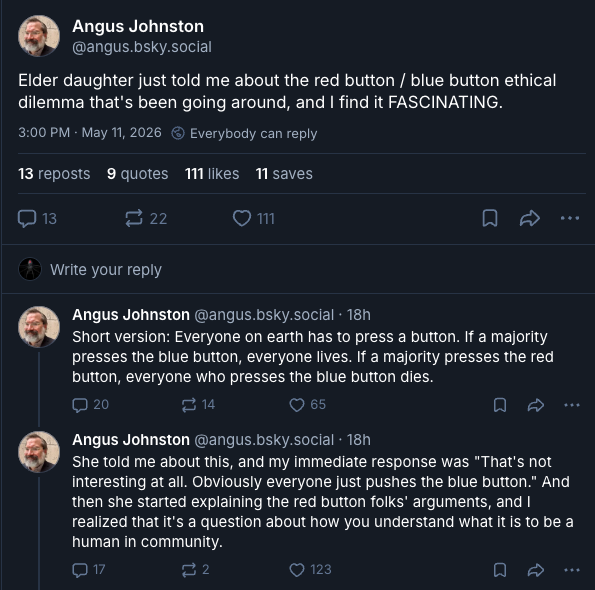
@angus.bsky.social
Elder daughter just told me about the red button / blue button ethical dilemma that’s been going around, and | find it FASCINATING.
Short version: Everyone on earth has to press a button. If a majority presses the blue button, everyone lives. If a majority presses the red button, everyone who presses the biue button dies.
She told me about this, and my immediate response was “That’s not interesting at all. Obviously everyone just pushes the biue button.” And then she started explaining the red button folks’ arguments, and |realized that it’s a question about how you understand what it is to be a human in community.
Likewise, my first thought was to press the blue button. But then I thought that that would just give all the red button people what they wanted, and I’d end up dead while they could take all my stuff. But then I thought again, would I want to live in a world full of murderous bastards? And I was back to pushing the blue button.
You could cycle around and around this dilemma all day long. Entertaining, but I have better things to do.
This does have evolutionary implications. We don’t have buttons with global effects, but throughout our history we’ve had people meeting and having to choose between cooperating and expediently executing those who oppose us. I think in the long run, cooperation wins, but the problem with this thought experiment is that it compresses a billion incremental decisions into one final, immediate commitment, and that isn’t at all realistic.

I got up this morning and was moved to churn out a YouTube video before 9am. It was really easy because Sam Harris said some incredibly bigoted things about that sinister theocrat
, Zohran Mamdami.
Making videos is easy when you get inspired by looney-tunes creeps.
