Yes. I need more limbs.

When we were talking to my daughter the other evening, she was struggling to manage a phone in one hand and a busy baby in the other, and I told her she just needed a third. Surprise! Science provides with a wearable robotic “third arm” that can punch through a wall. The “punch through a wall” feature seems particularly useful in the context of child care. Except, I’m sorry, the video makes it less than useful.

Nice gadget, but it requires one person to wear it, and a second person with two arms to control it remotely, effectively requiring four arms to enable three-armed activity, in which one of the three arms is rather clumsy. It’s going to require a better control mechanism, something with a neurological link to the wearer. As long as we’re doing that, why stop at three? Why not…eight? I am ready for my robotic exoskeleton that will let me climb walls and punch through walls and destroy walls any day now.

Oh, and do more efficient childcare, I guess.

Liberal Arts FTW!

Never tell me that an art history degree is useless.

Art history doesn’t usually have much to offer in the way of practical, directly actionable lessons. But Sarah Parcak, a renowned professor of Egyptology at the University of Alabama at Birmingham, recently plumbed humanity’s cultural past to offer some very concrete advice. On Sunday, she posted detailed, step-by-step instructions on Twitter (including a helpful diagram) for how to tear down an obelisk, culled from her research into ancient Egypt. (For every 10 feet of monument, you need 40 or more people; use rope attached to a chain; everyone should wear gloves; pull hard in unison from either side.)

After she shared the sketch, she added, “There might be one just like this in downtown Birmingham! What a coincidence. Can someone please show this thread to the folks there.”

You’d be surprised at what you can learn with a little education.

Also, while protesters failed to totally destroy the monument, the mayor of Birmingham promised to finish the job, which has prompted the state of Alabama to sue the city. Don’t worry! Liberal arts students are also fearless!

The police can no longer rely on extortion to get support

With every budget year, there are factions in Minneapolis that call for more police, in the mistaken belief that more police equals more safety. It’s never true, but they tend to get their way. As we can rather clearly see this year, the police are a destabilizing, violent institution that has grown over-confident in their untouchability.

Five decades ago, police departments operated under the authority of city governments, most notably serving as enforcers for corrupt political machines. That was then. With the decline of the machines in the ’70s, the police emerged as the most powerful section of municipal governments, more influenced by Homeland Security, regional fusion centers, and a police equipment industry aggressively pushing the latest in weapons and surveillance systems.

While politicians turn over every few years, the police have built an enduring base of support, unwavering in its belief that more cops mean more safety. As a result, their numbers, budgets, and clout have steadily increased over the years, as racial and economic inequality have grown.

Elected backers of police expansion like Minneapolis City Council members Linea Palmisano, Lisa Goodman, and Alondra Cano seem to believe they would be supporting a community-oriented police department spearheaded by Chief Medaria Arrodondo. That department is a mirage. They would be better off investing in a unicorn park. Reformist chiefs have at best a fleeting impact on their departments, their effort—what former Minneapolis Police chief Tony Bouza called his “futile attempt to reform the police”—erased within a year or two of their departure.

That’s changing. Right now, Minneapolis City Council members consider disbanding the police. I doubt it will be as radical as it should be — they’ll probably just end up stripping them of some functions and putting them in the hands of more responsible organizations — but it’s a first step.

Now the council members are listening to a city that is wounded, angry, fed up with decades of violence disproportionately visited upon black and brown residents. Various private and public bodies – from First Avenue to Minneapolis Public Schools – have essentially cut ties with the police department. Council members are trying to figure out what their next move is.

Their discussion is starting to sound a little more like what groups like Reclaim the Block and the Black Visions Collective have been saying for years. On Tuesday, Fletcher published a lengthy Twitter thread saying the police department was “irredeemably beyond reform,” and a “protection racket” that slows down responses as political payback.

“Several of us on the council are working on finding out what it would take to disband the Minneapolis Police Department and start fresh with a community-oriented, nonviolent public safety and outreach capacity,” he wrote.

You can peruse that thread in its entirety here.

Please, please make it happen. Remove this malignant force from our cities. All the money spent on cops and their toys and the prison system that feeds on police action would be far more effective if spent on correcting the root source of much of our crime: poverty.

How to recognize a fool

Well there’s our problem. When wingnuts see a man with swastikas tattooed on his body, they think that’s antifa. Sorry, guy, that’s just the fa.

Although it should be said that the guy with the tats has seen the error of his ways, and has repudiated Naziism. You can’t judge a man by the mistakes of his past, I guess.

This, by the way, is Chris Loesch. Scraggly bearded, skimpy mustached Chris Loesch, who is so vain that he thinks curling a sparse few hairs with wax makes him look good.

That’s just an ongoing mistake. I’ll forgive him after he apologizes for his deeper crimes against humanity.

I learned today that my county has spent a million dollars on a “mine resistant vehicle”

Little ol’ Stevens County, Minnesota, population 10,000 (dropping to between 8 and 9 thousand when the students go home) has been busy militarizing their police force.

Right. We needed one of these things:

I vaguely recall reading a while back that there was a small coalition of a couple of rural counties to put together a mighty task force of super-soldiers to handle Big Crime; they may have made the news for an assault on a motel in Sauk Center. So maybe it “serves” a slightly larger population, where “serves” is a rather dubious verb.

I’m having a tough time imagining the circumstances in which local law would need a monster troop transport. A meth house catches fire, and the gangly, toothless desperate addicts start puking on the lawn? Another cat lady refuses to allow animal services to break up her 50 cat swarm? The corn revolts? Maybe they’re getting ready for a hypothetical “Red Dawn” scenario.

There is a petition to defund the Minneapolis police. Maybe we should all be looking closer to home, too, and asking what kind of ridiculous expenditures our local police are making. This is basically Mayberry — we’ve got some modern challenges, but nothing that requires a tank.

The police are a mob of bullying cowards

The Asheville police bravely assaulted a first-aid station. It was clearly marked, it was staffed by doctors, nurses, EMTs and such people, and no one in the group was participating in the protests. They were just there to help people. Yet the police charged in, knifed all the water bottles, looted bandages and sutures, trashed everything in sight, and harassed the medical staff.

The excuses given: they were only supposed to confiscate medical supplies (why?). They had to search for explosives (in a med station?). They had to get rid of the water bottles, because protesters had thrown them at the police.

Take a closer look at those police.

Holy crap. They’re armored up like storm troopers from Star Wars. And they’re afraid of thrown water bottles? Did they watch Return of the Jedi, think it was a documentary, and worry that there were Ewoks among the protesters?

I also have to point out that they chose to fight medical assistants who have been struggling to get proper PPE for months, and who in this bold assault were wearing t-shirts and handkerchiefs tied over their faces, and were volunteers who weren’t getting paid. How much overtime did Asheville sink into depriving its citizens of medical assistance?

FTP.

Pinker parodies himself

We’re in a time of crisis, when a sense of injustice is acute, when communities are in flames and people march in protest, when white supremacists run the country and the police have willingly become a tool of fascism. What we really need right now is some clueless dweeb from Harvard to come along and reassure us that it’s all an illusion, the country is really becoming less racist, therefore all you white bigots out there can relax and not feel guilty because the statistics say you are all becoming better angels, even if you’ve institutionalized social norms that allow black concerns to be minimized even as you’re throwing huge numbers of them into an inhumane prison complex. That dweeb is the self-appointed guru of white denial, Steven Pinker. You can always count on him to show up at a cataclysmic failure of the system to let us know that this terrible event doesn’t really expose an ugly reality. Everything is getting better, don’t you know. So he takes to twitter to make his usual Pollyannaish pronouncement.

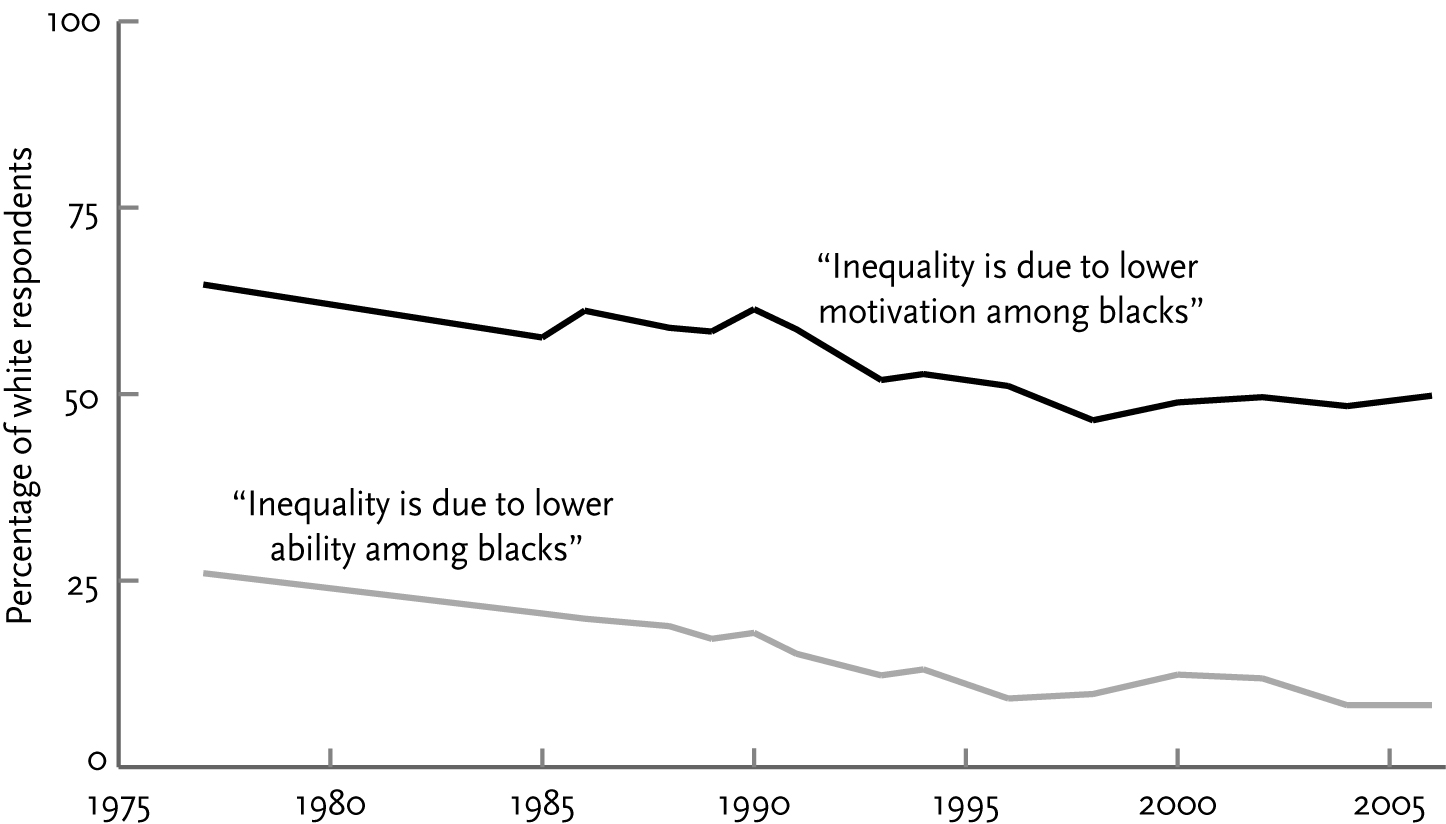
Good god. He’s a psychologist. He has to know that people are really good at rationalization, making self-reported attitudes difficult to trust. Look at this one graph he shows (as if a graph is more powerful than one photo of a cop with his knee on a black man’s neck):

What, exactly, is that supposed to demonstrate? That white people have become less racist since the 1970s, or that racists have been shifting their rationalizations since the 1970s? Are “Inequality is due to lower motivation among blacks” and “Inequality is due to lower ability among blacks” the only two excuses white people give for discrimination, so those two responses encompass the totality of the rationalizations? Has he even considered that both responses are pretty damned racist and are centered on explaining the othering of black people? Has he considered that a shift in what is socially acceptable to say in public doesn’t necessarily imply a shift in underlying attitudes?

Also, wow, over half the white respondents are making those two equally racist arguments. I don’t find this at all reassuring.

Pinker is referencing a black social psychologist (also a big shot at Harvard, which ought to be a caution to anyone reading their work — he’s black, but also in a highly privileged position) who is also cautiously optimistic about the future, but isn’t trying to bury the lede in happy-clappy noise.

We had all thought, of course, that we made phenomenal strides. We inhabit an era in which there are certainly more rank-and-file minority police officers than ever before, more African American and minority and female police chiefs and leaders. But inhabiting a world where the poor and our deeply poor communities are still heavily disproportionately people of color, where we had a war on drugs that was racially biased in both its origins and its profoundly troubling execution over many years, that has bred a level of distrust and antagonism between police and black communities that should worry us all. There’s clearly an enormous amount of work to be done to undo those circumstances and to heal those wounds.

Pinker really is the Norman Vincent Peale of our generation. We don’t need some racist-leaning, evo-psych-loving, IDW-associated professor telling us that everything will just get better gradually over time if we’re patient and wait for white people to become more tolerant. Action is the agent of change. Every incremental shift is the result of people standing up, speaking out, shoving reality in the face of the complacent and demanding change. There is no magic internal trend towards less racism, especially not among the people who hold all the power.

I have good news, and I have bad news

The Iowa primaries were held yesterday. Great news: rabid racist and white supremacist Steve King is out on his ass. Finally!

The bad news: he was defeated for the Republican nomination by Randy Feenstra, who promises to be more of the same, except he just won’t say the quiet parts out loud anymore.

But there have been notable changes of heart in Iowa, too. Among those who backed Feenstra was activist Bob Vander Plaats, a GOP political kingmaker in western Iowa who once was one of King’s staunchest allies. In an ad funded by the Priorities for Iowa super PAC, Vander Plaats said King was “no longer effective” in Washington — echoing Feenstra’s central campaign message.

“He can’t deliver for President Trump, and he can’t advance our conservative values,” he said. “Thankfully, Iowa has a better choice.”

Craig Robinson, who runs the website TheIowaRepublican.com, said Feenstra offered the district everything King did as a conservative, but with no baggage.

New boss same as the old boss, I guess, just with slightly more discretion.

Progress on Linux

Thank you to everyone for your suggestions! I’m still plugging away at Linux, and mostly adapting just fine. My major complaints right now are with my reflexes: cut/copy/paste are handled with the control key in Linux, while in Mac OS X you have to hold down the command key, which means that every time I intend to copy some text, I instead delete it and replace it with the letter “c”, followed by a panicky attempt to undo it by adding a “z”. Also, Pop!_OS uses the command key by itself to switch to a system menu and a display of running apps, so it’s like the screen explodes in confusion every time I make an elementary mistake. Lesson learned: stop making mistakes. Or get my pinky trained to press the correct modifier button.

I’m also experiencing the joy of non-Mac klunkiness. I tinkered with KDENLive as a replacement for iMovie. It’s got some things iMovie lacks, like as many track layers as you want. On the other hand, iMovie is easy — you click on an object in a layer, tell the program to apply the green screen effect, and everything green turns transparent. In KDENLive, you do the same thing, and in addition to requiring that you set a bunch of parameters to define what “green” is, it turns everything else transparent. I’m going to have to go through a bunch of tutorials to figure it all out, while with iMovie I just ran it and everything was intuitive and obvious.

I’m committed at this point, and will master it all eventually, since this is the only laptop I’m using now. Sink or swim! Bye, Apple!