This wouldn’t fly in Minnesota

This particular bozo is the mayor of Hudson, Ohio.

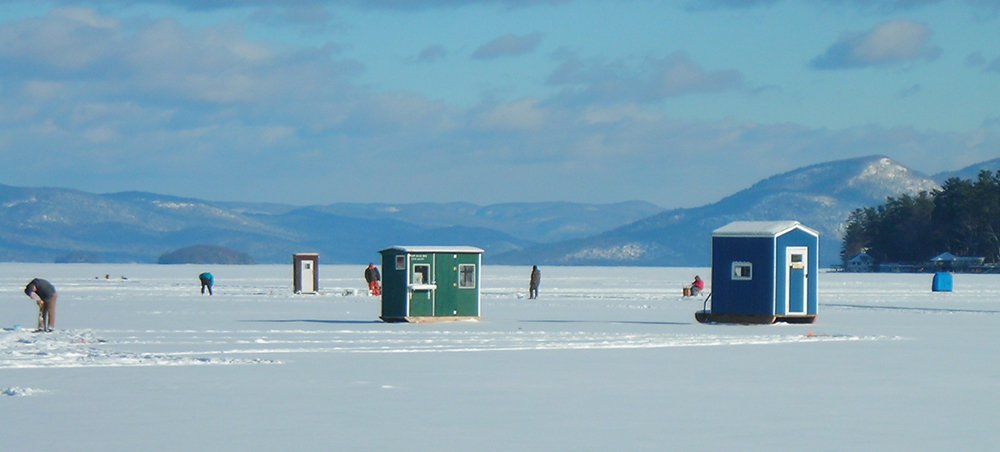
If you allow ice fishing, the next thing you’ll get is ice shanties. We all know where that leads: prostitution! On the ice!

Our lakes are covered with ice houses right now, I don’t know that there is much of a prostitution problem. And if there were, so what? If some enterprising young woman or man sees a market opportunity, let ’em. That’s just capitalism, you know.

Holy crap, Harvard took it to another level

This is stunning. In the investigation into the accusations against Comaroff, Harvard decided to turn the investigation around and dig into the accuser’s personal history. So they got private psychotherapy records of one of the women, without her consent (how did they do that? Patient confidentiality doesn’t matter anymore?), and then turned them over to Comaroff.

I am flabbergasted. This is such a blatant violation of ethics that the university and that private therapist need to be censured. Or worse, that’s just plain criminal.

I am becoming confirmed in my belief that university administrators everywhere are tainted with evil.

Every time. Jesus, this pandemic will never end.

Once again, we get to suffer with shortsighted thinking. I just got this memo from the president of my university.

Trends in COVID-19 transmission statewide continue to show significant decreases, both in terms of current data related to case numbers, positivity rates, and available hospital beds, but also in forecasts predicting continued declines. Given those trends, the University is lifting the temporary, systemwide policy that mandated all events with over 200 attendees require individuals to show proof of vaccination or a negative COVID test. From February 10 on, proof of negative test or vaccination status is no longer required.

Masks remain required for all indoor facilities across the system. They are an effective tool for preventing the transmission of COVID-19 as well as influenza. We continue to monitor state and federal guidance and will update you as additional decisions are made.

Attendance at football games must have been down.

Here we go again. The precautions are working! So let’s stop taking them!

42 years, and still healing

I still remember the eruption of Mt St Helens vividly. I was living in Eugene, Oregon at the time, where we mainly experienced it as annoying chronic ash falls, but I was recently married and my wife’s family all lived in Longview and Vader, towns not far from the volcano. We got in a little volcano tourism that summer.

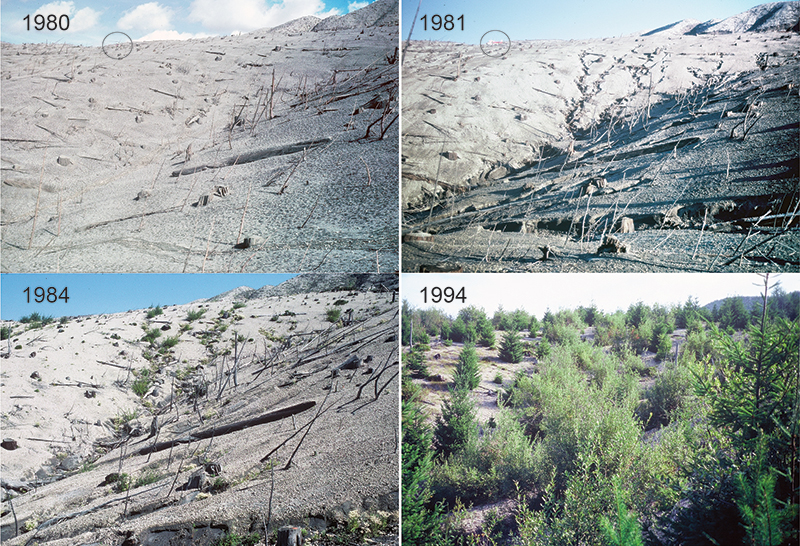
It was catastrophic, but also an opportunity. Researchers have been thoroughly studying that area ever since, documenting how nature recovers. You can still see the scars, but it’s impressive how much the landscape has bounced back.

Sequence of images showing geomorphic and vegetation change at a site in upper Smith Creek valley that received 50 centimeters of blast PDC and tephra fall deposits. Vegetation initially sprouted from surviving rootstocks in pre-eruption soils that, after the eruption, were re-exposed in the floors of gullies eroded through the new deposits. By 1994, trees were established on the hillside between the gullies and both surviving and colonizing species anchor the sediments. Helicopter circled for scale in the top two images. Credit: F. J. Swanson, U.S. Forest Service

We should pay a call on the area again sometime. Unfortunately, my in-laws have either died or moved away now, so sometimes nature can get better, but on a small scale, it can get worse.

Battling letters!

Margaret Czerwienski, Lilia Kilburn, and Amulya Mandava

Maybe I was too hard on Harvard professors yesterday. Maybe 38 prestigious Harvard professors signed a letter to protect one of their own from a finding that he’d been a sexual harasser, but today 73 of them signed a letter protesting the first letter.

We, the undersigned, write in strong opposition to the open letter signed by 38 Harvard faculty calling into question the sanctions against Professor John Comaroff. We are dismayed that these faculty members would openly align themselves against students who have lodged complaints about a tenured professor.

Without full knowledge of the facts of the Title IX and Professional Conduct investigations, the signatories have endorsed details provided by Professor Comaroff’s legal team, which has taken advantage of the confidentiality of these processes to publicize its view of the case.

Furthermore, some of the signatories to the original letter are having second thoughts.

Whoopsiedoodle! Maybe they should have thought about it before reflexively signing on to defend their colleague.

And then, oh boy, 3 former students have filed a federal lawsuit against Harvard University for its failure to protect them. Maybe Harvard administrators should have considered the implications for their students if they didn’t slap down the bad boys in their midst.

Three Harvard University graduate students said in a federal lawsuit filed Tuesday that the Ivy League school for years ignored complaints about sexual harassment by a renowned professor and allowed him to intimidate students by threatening to hinder their careers.

“The message sent by Harvard’s actions alleged in the complaint is clear: students should shut up. It is the price to pay for a degree,” Russell Kornblith of Sanford Heisler Sharp, the women’s law firm, said in a statement.

The suit filed in U.S. District Court in Boston alleges that one of the students, Lilia Kilburn, was subjected to repeated forcible kissing and groping as early as 2017 by anthropology and African and African American studies professor John Comaroff.

On another occasion in 2017, when she met with Comaroff to discuss her plans to study in an African country, he repeatedly said she could be subjected to violence in Africa because she was in a same-sex relationship, the lawsuit said.

Whew. I suspect there are a bunch of Harvard administrators who are now realizing they’ve waddled into a colossal clusterfuck of their own creation. Good. Maybe they’ll learn something and change. Maybe other universities around the country will see Harvard as a dreadful example, a warning that this could happen to them, too.

Rebecca Watson takes on both Joe Rogan and Jon Stewart and clobbers them

It’s not just the racism, it’s the ignorance. Rebecca Watson pulls up a horrendous clip of Joe Rogan yammering on about cryptozoology — he’s claiming that a mysterious new giant primate had been discovered in Africa, called the Bondo ape. He’s quite insistent about it, to the point where when an actual primatologist calls in to say it’s not true, he screams at her, belittles her Ph.D., and scornfully references her vagina. It’s an amazing performance. He’s Gish Galloped against Phil Plait, claiming that the moon landings were faked.

And now, apparently, were supposed to accept that he’s just a guy who has interesting conversations with interesting people? Bullshit.

All right, all right, I guess there are legit reasons some people fear spiders

They are venomous, after all, some more than others.

The bite of the king baboon spider (which looks like a tarantula and lives primarily in Tanzania and Kenya) is not lethal, but it does produce a lot of pain in hapless victims. In this new effort to discover why, the researchers conducted a proteotranscriptomic analysis of the venom to identify possible peptides that they thought might be involved in producing pain. They identified one known as Pm1a (prior work has shown that it is typically involved in modulating dorsal root ganglion receptors in nerve cells.) They then synthesized the peptide to allow for NMR spectroscopy to ascertain its structure.

Next, they studied the impact of the peptide on mice by injecting a small amount into a toe. That allowed them to see that the peptide modulated ion channels and incited excitatory sodium currents. At the same time, it also reduced potassium currents that are typically involved in inhibiting excitatory currents. The end result was hyperexcitability in nerve cells, which, to the mouse, meant pain. To conclude their work, the researchers created a mathematical model of the peptide and its impact on nerve cells to further prove that it was the main driver of pain in victims of the spider’s bite.

The researchers also note that the hyperexcitability they saw in the mouse nerve cells very much resembled the type of hyperexcitability seen in people who experience chronic pain. They suggest that a better understanding of how spider venom can produce similar results could perhaps lead to a way to reduce pain in these patients.

I used to work down the hallway from a lab studying conotoxins. They’d collect the venom from cone snails, chemically separate its components, and then inject each fraction into a mouse to see what would happen. Sometimes nothing. Sometimes excruciating pain. Sometimes bleeding from the eyes. Sometimes they’d fall asleep. Sometimes they’d die instantly. It was fascinating stuff that yielded all kinds of interesting molecules with useful neurological effects. But you had to sometimes wonder, who was the monster? The organism that produced the venoms, who lived in a place these mice would never encounter, or the investigator who imported the toxins and afflicted them on hordes of mice, for the betterment of humankind?

Besides, the King Baboon spider has such a cute and adorable face. (No, no, no, arachnophobes. Don’t click through.)

[Read more…]

Pay attention, debaters

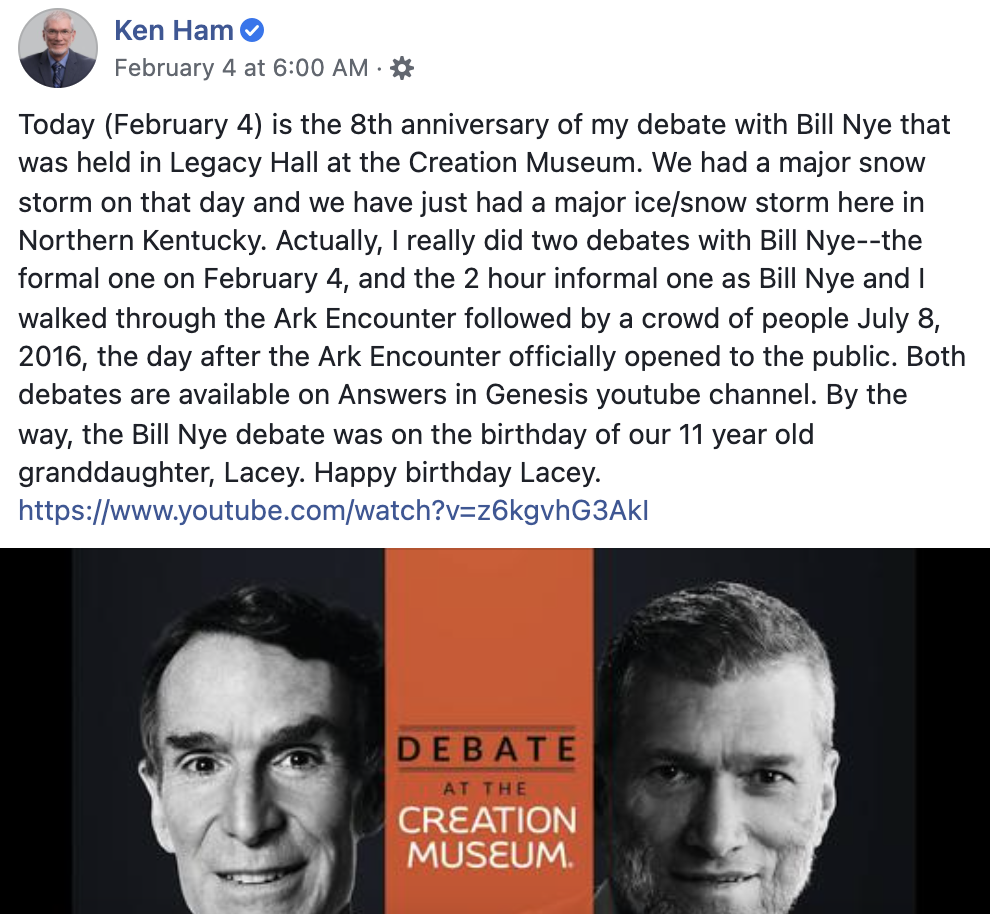
Eight years ago, Bill Nye and Ken Ham met to debate evolution vs. creationism. They engaged in the Creation Museum, which was a big mistake — never willingly give the home court advantage to your opponent. Nevertheless, if you ask any biologist how it went, they’ll mostly agree that Nye kicked Ham’s ass. The low point for the creationist was when he proudly declaimed that no amount of evidence could ever convince him he was wrong, because the Bible was absolute truth.

However, even now Ken Ham brags about the debate. He and his followers think he trounced Nye, and specifically think his testimony about the infallibility of the Bible was a clincher. Ham isn’t hiding in shame, he still trumpets the debate regularly.

He didn’t learn a thing, but neither did many people on the other side. I’m still seeing people lining up to debate Kent Hovind, or Standing For Truth (if you don’t know him, he’s a fraud on YouTube) or the “Great” Debate Community, or any of these yahoos whose ticket to traffic on social media is to host debates on “controversial” topics, which usually means putting up an idiot on equal standing with someone supporting conventional science. The more absurd their position, the more inane their response, the more conflict they generate and the more traffic they get.

The loser is always the person who gives respectability to the kook at the other lectern. Learn from this. It doesn’t matter how slick, professional, and clever you are in your side of the debate — at the end of the day, the winner is going to be the one who praises Jesus the most.

I miss the tetragnathids

I have been discovering that many people seem to have a weird perspective on spiders. They’re just animals, you know. They do the same stuff that squirrels or cats or lizards do: they eat, they drink, they court, and are entirely mundane in their behaviors. I’ve noticed, for instance, that one of the things that interested people was seeing that they drink! They have a heartbeat! I’m sure that even a moment’s thought would have made them figure out that of course they do…but we don’t usually think of spiders that way.

So here’s a story about a spider slurping up water and using it to rehydrate the dessicated bodies of their prey. Groovy. Spiders are clever enough to make instant bug soup.

One night in late December 2020, John Gould—a behavioral biologist at the University of Newcastle in Australia—was on Kooragang Island in southeastern Australia, surveying the area for a threatened frog species. Near an ephemeral pool, he spotted a long-jawed orb weaver spider (Tetragnatha) suspended in a web anchored in some vegetation. About two minutes later, Gould watched the arachnid suddenly “bungee” down to the pond’s surface, retrieve a large globule of water in its jaws, and race back up the silk line in a matter of seconds.

As soon as the spider ascended to its web with the liquid cargo, Gould knew he “had observed something really peculiar.”

He watched as the spider returned its jaws to a shriveled, partly drained insect it had been feeding on, droplet and all. The first-of-their-kind observations were published in the journal Ethology in January.

Just yesterday I was feeding my spiders and watched as one bungee-jumped down and scooped up a fly to haul back into its home cobweb. Clever girl. It was impressive how agile and adept it was, but that’s simply its nature.

Oh, also, tetragnathids are cool. They’re common, one of the more common spiders I see around here, but also diverse, with a lot of species I can’t distinguish. They make gorgeous orb webs, the classic kind with radials and spiral fibers, and they’re distinctive, with skinny, elongate bodies and huge jaws.

Now I’m pining for spring, when the tetragnathids will be back decorating the shrubbery in my yard. Until then, here’s a photo below the fold — arachnophobes, don’t click through!

[Read more…]