No lie too low

Coral Ridge Ministries, that awful fundagelical organization founded by D. James Kennedy, has “discovered” a couple of former workers willing to testify about the evil practices of Planned Parenthood.

“They have an abortion budget and they have a certain number of patients that you have to perform abortions on every month, and there’s a dollar amount attached to each woman.”

Everett’s business plan included outreach in schools with talks given to break down children’s natural modesty and promote Everett and her clinic associates as trusted authorities for all things sexual.

Everett wanted students to “come to us with their sexual questions so we could put them on a low dose birth control pill we knew they’d get pregnant on. Of course we passed out condoms but we never passed out high quality condoms; we always used seconds or defective condoms. Our goal was to get the kids pregnant.”

The target, Everett says, was “three to five abortions between the ages of 13 and 18 from every girl we could find.”

I know, when you’re dealing with this brand of Christian, no lie is too low. But you’d think they’d at least care about plausibility.

Oh, wait…they believe that Jesus nonsense. I take it back, neither sleazy lies nor unbelievable absurdities are barriers to these guys.

Ellen Lewin tells it like it is

Ellen Lewin is a professor in the anthropology department at the University of Iowa. Like all of us, she is constantly dunned with email announcing this, that, and the other thing at our universities, and sometimes we get email that makes our blood boil. In this case, she got mail from the College Republicans, announcing a “coming out” party (like Republicans in the midwest are a closeted and oppressed minority…) that featured some hagiographic movie about George W. Bush (that ignorant ass), an “animal rights barbecue” and other such joyful shenanigans to celebrate the party of morons and thugs and self-destructive ideologues.

Ellen Lewin had enough. Ellen Lewin got angry. Ellen Lewin fired off a one-sentence reply.

FUCK YOU, REPUBLICANS.

I think I’m in love with Ellen Lewin.

She later apologized for losing her temper — and I can sympathize with that, too — but I hope she never backs down in her righteous contemptuous opinion of the Republican party. I share it. I think her response was relatively mild.

Now, of course, the right-wingers are outraged. How dare she disagree loudly with an entire party of mouth-breathing, sanctimonious idiots? Read the Free Republic for examples of their response; the first comment sarcastically complains that “Liberals are SO CLASSY!!”, and then the rest, with no sense of irony, posts a picture of her and proceeds to call her a “pervert”, a “lesbian”, a “cow”, a “demonic lesbian demon”, a “bitter, old, ugly, lesbian with a hairy lip”, and suggests that she has sex with dogs.

And more! Those delicate little flowers, the College Republicans, are so hurt by her unkind words that they are filing an official complaint.

Ginty, 21, a junior, filed her complaint with the provost and the Office of Equal Opportunity and Diversity. In the complaint, she states that the April 18 email from professor Ellen Lewin and Lewin’s followup “halfhearted apology” violate general standards of decency, respect for civility in public discourse and the university’s antiharassment policy.

Ginty’s complaint says “there is little doubt that the university would not tolerate a similar string of emails by a member of the faculty targeted at a number of other student groups.”

She has a point. It wasn’t civil or respectful (although turning a brief outburst into a case of harassment and a “string of emails” is a bit much). But you know what? I approve of incivility and disrespect towards organizations that deserve it, and the Republican party is currently the party of know-nothings, hypocrites, liars, and greed — it’s the stagnant, festering slime towards which all the worst elements of society now gravitate. The problem isn’t college professors snarling at them, it’s that the party itself encourages short-sightedness, idiocy, and hatefulness. So, until the grown-ups wake up and clean out the bigotry and ignorance from their own house, I think it’s only fair for us to air our vigorous disgust with them.

I stand in solidarity with Ellen Lewin.

FUCK YOU, REPUBLICANS.

Squid in space

The last mission of the space shuttle will contain a student-initiated experiment: a collection of bobtail squid embryos will be launched into space. Which is cool, I suppose. I like squid, I like space, I like science, I like student research, let’s just throw them all into one big tossed salad of extravagantly expensive tinkering.

So why am I so disappointed?

Because the experiment is so trivial and uninteresting. The squid Euprymna has a commensal relationship with the luminescent bacterium, Vibrio. Early in their development, special organs in the squid are colonized by the bacteria; the squid provides a privileged environment for Vibrio growth, the bacteria give Euprymna a glowing organ that is thought to camouflage itself when viewed from below against a moonlit sky. This is a really cool phenomenon that has engaged the interest of many researchers, and there is serious work being done on the genetics and development of the symbiosis.

But, you know, I’ve never seen any speculation that gravity is a significant factor in the interaction. There’s cilia, and there are secreted amino acids, there is a mucus trap, and there’s a venting process, but gravity? Why would that matter?

I suspect the experiment was chosen because it’s easy for the shuttle engineers and technicians. Load up some chambers with embryos, launch it into space where it will require minimal attention from the crew, assay the results, that is, the development of the light organ, when it returns to earth. The results don’t matter. NASA will check off an item on a list, and say, yep, we did experimental embryology on the shuttle, and we gave a little bit of space to a student research project.

And what will the results be? Most likely, the light organ will be colonized and develop perfectly normally, because there’s no reason to think that microgravity will affect it. Or there will be abnormalities, which could either be because delicate embryos do not take well to the abuse of a shuttle launch, so we’re seeing the effect of stress, or there will be some surprising peculiarity in development that suggests maybe microgravity does make a difference, but repeating and expanding the experiment to puzzle out what’s going on will be out of the question.

I get the impression that NASA is simply filling a quota of interdisciplinary research for PR purposes, with only a nominal investment in the project. I wish I could be more of a cheerleader for the combination of space and developmental biology, but I haven’t yet seen an engaging project that would actually help me understand anything. There’s good science that we do because we really want to find an answer, and there’s lazy science that we do just because we can. This is an example of the latter, I’m sorry to say.

This is not a poll

Well, it is, but I don’t recommend voting on it. It’s on WingNutDaily, and the only way to vote is to register with them…which is not recommended. Them folks is craaaaazy! They were asked their opinion of Obama’s birth certificate.

Sound off on Obama’s release of his purported long-form birth certificate

The most compelling eligibility arguments deal with parental citizenship, and this document shows Obama’s father was not a U.S. citizen, making Obama ineligible 40% (93)

Now that Obama is so willing to be open, let’s hear him explain why he has a Connecticut-based Social Security Number when he and his parents never lived there 12% (28)

I’m with Trump in calling for the rest of Obama’s vital documents that he’s been concealing for years 9% (21)

I suspect the image released by Obama is a forgery 8% (19)

I know the image of the document is a fake, just like Obama 8% (18)

If the document is so innocuous, why did Obama take so long and spend a fortune on attorneys preventing its release? 8% (18)

The release is opening up a can of worms and is creating more questions than answers 3% (8)

Obama blinked. I can’t wait to see what happens next 3% (6)

The birthers will never be satisfied no matter what documents are released 3% (6)

All I can think about is Lt. Col. Terry Lakin rotting in prison because Obama refused to release this document before now 2% (5)

Let’s hope this signals an end to this nutty birther nonsense once and for all 1% (3)

Thanks to WND and Trump, Obama was forced kicking and screaming to release his document 1% (3)

Face it, Obama has outsmarted the birthers and completely destroyed their issue now 0% (1)

Good, let’s move on, there are far more important issues for the country to deal with 0% (1)

If it had been a poll I could have voted on, I would have picked the very last entry above. Trust WND readers to favor the nuttiest of the choices!

TSA Poll: I’ve come to really hate these guys’ bosses

No more, no more, please. We’re already taking off our shoes, getting our junk scanned, waiting in line, dangling our goo in plastic bags, and basically suffering through ludicrous post hoc measures that do nothing to improve our security. And now the TSA is dispatching ‘behavioral experts’ to watch you as you stand in line. Don’t look nervous, don’t act annoyed, don’t do anything that these arbitrary arbiters of the appropriate might notice!

Do you think behavioral specialists are a good idea?

Yes, it’s an extra layer of security. 49.5%
No, it’s completely ludicrous. 50.5%

The true story of the Archaean genetic expansion

i-e88a953e59c2ce6c5e2ac4568c7f0c36-rb.png

I’ve been giving talks at scientific meetings on educational outreach — I’ve been telling the attendees that they ought to start blogs or in other ways make more of an effort to educate the public. I mentioned one successful result the other day, but we need more.

I give multiple reasons for scientists to do this. One is just general goodness: we need to educate a scientifically illiterate public. Of course, like all altruism, this isn’t really recommended out of simple kindness, but because the public ultimately holds the pursestrings, and science needs their understanding and support. Another reason, though, is personal. Scientific results get mangled in press releases and news accounts, so having the ability to directly correct misconceptions about your work ought to be powerfully attractive. Even worse, though, I tell them that creationists are actively distorting their work. This goes beyond simple ignorance and incomprehension into the malign world of actively lying about the science, and it happens more often than most people realize.

I have another painful example of deviousness of creationists. There’s a paper I’ve been meaning to write up for a little while, a Nature paper by David and Alm that reveals an ancient period of rapid gene expansion in the Archaean, approximately 3 billion years ago. Last night I thought I’d just take a quick look to see if anybody had already written it up, so I googled “Archaean genetic expansion,” and there it was: a couple of references to the paper itself, a news summary, one nice science summary, and…two creationist distortions of the paper, right there on the first page of google results. I told you! This happens all the time: if there’s a paper in one of the big journals that discusses more evidence for evolution, there is a creationist hack somewhere who’ll quickly write it up and lie about it. It’s a heck of a lot easier to summarize a paper if you don’t understand it, you see, so they’ve got an edge on us.

One of the creationist summaries is by an intelligent design creationist. He looks at the paper and claims it supports this silly idea called front-loading: the Designer seeded the Earth with creatures that carried a teleological evolutionary program, loading them up with genes at the beginning that would only find utility later. The unsurprising fact that many gene families are of ancient origin seems to him to confirm his weird idea of a designed source, when of course it does nothing of the kind, and fits quite well in an evolutionary history with no supernatural interventions at all.

The other creationist summary is from an old earth biblical creationist who tries to claim that “explosive increase in biochemical capabilities happened in anticipation of changes that were to take place in the environment”, a conclusion completely unsupportable from the paper, and also tries to telescope a long series of changes documented in the data into a single ancient event so that they can claim that the rate of innovation was so rapid that it contradicts the “evolutionary paradigm”.

So lets take a look at the actual paper. Does it defy evolutionary theory in any way? Does it actually make predictions that fit creationist models? The answer to both is a loud “NO”: it is a paper using methods of genomic analysis that produce evolutionary histories, it describes long periods of gradual modification of genomes, and it correlates genomic innovations with changes in the ancient environment. It is freakin’ bizarre that anyone can look at this work and think it supports creationism, but there you are, standard operating procedure in the fantasy world of the creationist mind.

Here’s the abstract, so you can get an idea of the conclusions the authors draw from the work.

The natural history of Precambrian life is still unknown because of the rarity of microbial fossils and biomarkers. However, the composition of modern-day genomes may bear imprints of ancient biogeochemical events. Here we use an explicit model of macro- evolution including gene birth, transfer, duplication and loss events to map the evolutionary history of 3,983 gene families across the three domains of life onto a geological timeline. Surprisingly, we find that a brief period of genetic innovation during the Archaean eon, which coincides with a rapid diversification of bacterial lineages, gave rise to 27% of major modern gene families. A functional analysis of genes born during this Archaean expan- sion reveals that they are likely to be involved in electron-transport and respiratory pathways. Genes arising after this expansion show increasing use of molecular oxygen (P=3.4 x 10⁻⁸) and redox- sensitive transition metals and compounds, which is consistent with an increasingly oxygenating biosphere.

This work is an analysis of the distribution of gene families in modern species. Gene families, if you’re unfamiliar with the term, are collections of genes that have similar sequences and usually similar functions that clearly arose by gene duplications. A classic example of a gene family are the globin genes, an array of very similar genes that produce proteins that are all involved in the transport of oxygen; they vary by, for instance, their affinity for oxygen, so there is a fetal hemoglobin which binds oxygen more avidly than adult hemoglobin, necessary so the fetus can extract oxygen from the mother’s circulatory system.

So, in this paper, David and Alm are just looking at genes that have multiple members that arose by gene duplication and divergence. They explicitly state that they excluded singleton genes, things called ORFans, which are unique genes within a lineage. That does mean that their results underestimate the production of novel genes in history, but it’s a small loss and one the authors are aware of.

If we were looking for evidence for evolution, we might as well stop here. The existence of gene families, for cryin’ out loud, is evidence for evolution. This paper is far beyond arguing about the truth of evolution — that’s taken for granted as the simple life’s breath of biology — but instead asks a more specific question: when did all of these genes arise? And they have a general method for estimating that.

Here’s how it works. If, for example, we have a gene family that is only found in animals, but not in fungi or plants or protists or bacteria, we can estimate the date of its appearance to a time shortly after the divergence of the animal clade from all those groups. If a gene family is found in plants and fungi and animals, but not in bacteria, we know it arose farther back in the past than the animal-only gene families, but not so far back as a time significantly predating the evolution of multicellularity.

Similarly, we can also look at gene losses. If a gene family or member of a gene family is present in the bacteria, and also found in animals, we can assume it is ancient in origin and common; but if that same family is missing in plants, we can detect a gene loss. Also, if the size of the gene family changes in different lineages, we can estimate rates of gene loss and gene duplication events.

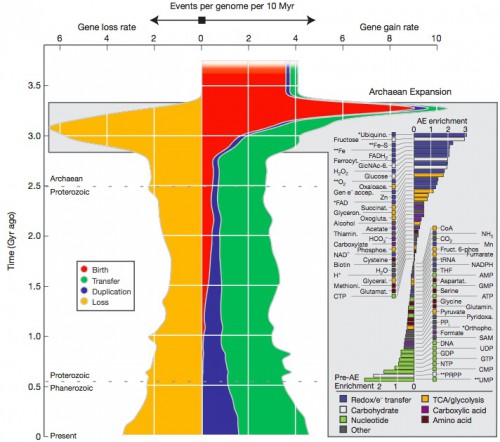
I’ve given greatly simplified examples, but really, this is a non-trivial exercise, requiring comparisons of large quantities of data and also analysis from the perspective of the topologies of trees derived from that data. The end result is that each gene family can be assigned an estimated date of origin, and that further, we can estimate how rapidly new genes were evolving over time, and put it into a rather spectacular graph.


(Click for larger image)
Rates of macroevolutionary events over time. Average rates of gene birth (red), duplication (blue), HGT (green), and loss (yellow) per lineage (events per 10 Myr per lineage) are shown. Events that increase gene count are plotted to the right, and gene loss events are shown to the left. Genes already present at the Last Universal Common Ancestor are not included in the analysis of birth rates because the time over which those genes formed is not known. The Archaean Expansion (AE) was also detected when 30 alternative chronograms were considered. The inset shows metabolites or classes of metabolites ordered according to the number of gene families that use them that were born during the Archaean Expansion compared with the number born before the expansion, plotted on a log2 scale. Metabolites whose enrichments are statistically significant at a false discovery rate of less than 10% or less than 5% (Fisher’s Exact Test) are identified with one or two asterisks, respectively. Bars are coloured by functional annotation or compound type (functional annotations were assigned manually). Metabolites were obtained from the KEGG database release 51.0 and associated with clusters of orthologous groups of proteins (COGs) using the MicrobesOnline September 2008 database28. Metabolites associated with fewer than 20 COGs or sharing more than two- thirds of gene families with other included metabolites are omitted.

Look first at just the red areas. That’s a measure of the rate of novel gene formation, and it shows a distinct peak early in the history of life, around 3 billion years ago. 27% of our genes are very, very old, arising in this first early flowering. Similarly, there’s a slightly later peak of gene loss, the orange area. This represents a period of early exploration and experimentation, when the first crude versions of the genes we use now were formed, tested, discarded if inefficient, and honed if advantageous.

But then the generation of completely novel genes drops off to a low to nonexistent rate (but remember, this is an underestimate because ORFans aren’t counted). If you draw any conclusions from the graph, it’s that life on earth was essentially done generating new genes about one billion years ago…but we know that all the multicellular diversity visible to our eyes arose after that period. What gives?

That’s what the blue and green areas tell us. We live in a world now rich in genetic diversity, most of it in the bacterial genomes, and our morphological diversity isn’t a product so much of creating completely new genes, but of taking existing, well-tested and functional genes and duplicating them (blue) or shuffling them around to new lineages via horizontal gene transfer (green). This makes evolutionary sense. What will produce a quicker response to changing conditions, taking an existing circuit module off the shelf and repurposing it, or shaping a whole new module from scratch through random change and selection?

This diagram gives no comfort to creationists. Look at the scale; each of the squares in the chart represents a half billion years of time. The period of rapid bacterial cladogenesis that produced the early spike is between 3.3 and 2.9 billion years ago — this isn’t some brief, abrupt creation event, but a period of genetic tinkering sprawling over a period of time nearly equal to the entirety of the vertebrate fossil record of which we are so proud. And it’s ongoing! The big red spike only shows the initial period of recruitment of certain genetic sequences to fill specific biochemical roles — everything that follows testifies to 3 billion years of refinement and variation.

The paper takes another step. Which genes are most ancient, which are most recent? Can we correlate the appearance of genetic functions to known changes in the ancient environment?

the metabolites specific to the Archaean Expansion (positive bars in Fig. 2 inset) include most of the compounds annotated as redox/e– transfer (blue bars), with Fe-S-binding, Fe-binding and O2-binding gene families showing the most significant enrichment (false discovery rate<5%, Fisher’s exact test). Gene families that use ubiquinone and FAD (key metabolites in respiration pathways) are also enriched, albeit at slightly lower significance levels (false discovery rate<10%). The ubiquitous NADH and NADPH are a notable exception to this trend and seem to have had a function early in life history. By contrast, enzymes linked to nucleotides (green bars) showed strong enrichment in genes of more ancient origin than the expansion.

The observed bias in metabolite use suggests that the Archaean Expansion was associated with an expansion in microbial respiratory and electron transport capabilities.

So there is a coherent pattern: genes involved in DNA/RNA are even older than the spike (vestiges of the RNA world, perhaps?), and most of the genes associated with the Archaean expansion are associated with cellular metabolism, that core of essential functions all extant living creatures share.

Were we done then, as the creationists would like to imply? No. The next major event in the planet’s history is called the Great Oxygenation Event, in which the fluorishing bacterial populations gradually changed the atmosphere, excreting more and more of that toxic gas, oxygen.

What happened next was a shift in the kinds of novel genes that appeared: these newer genes were involved in oxygen metabolism and taking advantage of the changing chemical constituents of the ocean.

Our metabolic analysis supports an increasingly oxygenated biosphere after the Archaean Expansion, because the fraction of proteins using oxygen gradually increased from the expansion to the present day. Further indirect evidence of increasing oxygen levels comes from compounds whose availability is sensitive to global redox potential. We observe significant increases over time in the use of the transition metals copper and molybdenum, which is in agreement with geochemical models of these metals’ solubility in increasingly oxidizing oceans and with molybdenum enrichments from black shales suggesting that molybdenum began accumulating in the oceans only after the Archaean eon16. Our prediction of a significant increase in nickel utilization accords with geochemical models that predict a tenfold increase in the concentration of dissolved nickel between the Proterozoic eon and the present day but conflicts with a recent analysis of banded iron formations that inferred monotonically decreasing maximum concentrations of dissolved nickel from the Archaean onwards. The abundance of enzymes using oxidized forms of nitrogen (N2O and NO3) also grows significantly over time, with one-third of nitrate-binding gene families appearing at the beginning of the expansion and three-quarters of nitrous-oxide-binding gene families appearing by the end of the expansion. The timing of these gene-family births provides phylogenomic evidence for an aerobic nitrogen cycle by the Late Archaean.

So I don’t get it. I don’t see how anyone can look at that diagram, with its record of truly ancient genomic changes and its evidence of the steady acquisition of new abilities correlated with changes in the environment of the planet, and declare that it supports a creation event or front-loading of biological potential in ancestral populations. That makes no sense. This is work that shouts “evolution” at every instant, yet some people want to pretend it’s an endorsement of theological hocus-pocus? Madness.

Scientists, you need to be aware of this. The David and Alm paper is an unambiguously evolutionary paper, using genomic data to describe evolutionary events via evolutionary mechanisms, and the creationists still appropriate and abuse it. If you publish anything about evolution, be sure to google your paper periodically — you may find that you’ve been unwittingly roped into endorsing creationism.


David LA, Alm EJ (2011) Rapid evolutionary innovation during an Archaean genetic expansion. Nature 469(7328):93-6.

This is a game Obama cannot win

The president has announced that he has an American birth certificate, like this was really an issue. If he thought this would end the yammering inanity, he was mistaken.

Donald Trump is preening.

He should have done it a long time ago. I am really honored to play such a big role in hopefully, hopefully getting rid of this issue.

Playing the role of a prancing moron who promoted the issue is nothing to be proud of, Donny.

Meanwhile, the Republicans are playing a game of pretending they didn’t never call Obama’s parentage into question, no how.

In a statement after Obama spoke, Republican National Committee Chairman Reince Priebus called the issue a distraction — and yet blamed Obama for playing campaign politics by addressing it.

“The president ought to spend his time getting serious about repairing our economy,” Priebus said. “Unfortunately his campaign politics and talk about birth certificates is distracting him from our number one priority — our economy.”

A Republican…chastising someone else for not being serious? Watcha gonna do, gomer, fix the economy by shutting down Planned Parenthood, praying, and giving rich people more tax breaks? Yeah, that’s serious.

I agree that Obama shouldn’t have wasted his time with this nonsense. Besides, you know that wingnuts are next going to argue that his birth certificate is a high-tech fake cobbled up by the geniuses at the NSA. Conspiracy theories simply do not die when presented with evidence — they absorb the evidence and claim that it’s further evidence of an even more elaborate conspiracy.

Creationism evolves!

The existence of Ken Ham proves that creationism changes, therefore proving that it is not absolute, inerrant truth as he claims, therefore Ken Ham disproves creationism. QED. We can all go home now.

i-6abf94ac6ac557bc68600ff8785c3ad9-evolvingcreationism.jpeg

By the way, that’s not a bad diagram for illustrating the relationships of the various versions of creationism, except that the pedigree breaks down for Intelligent Design creationism, which is kind of a weird syncretic hodge-podge that accommodates both of the major branches of the creationist tree. It really ought to be shown as the warped, evil offspring of an unnatural act, an orgy of all of the critters in the bestiary. And then it also lies about its parentage (as would we all, if we sprang from such mindless chaos).