Avoid the racket

Tauriq Moosa has a righteously indignant article on diamonds and engagement rings. Diamonds are rocks with industrial utility, but we’ve been fed this horrible line of propaganda that they’re essential geegaws for lining the bower to attract a mate; it’s an incredibly dumb myth, leading to much waste and obscene profits to a monopoly. Meanwhile, the whole engagement/wedding ring ritual is absurd: jewelers have unilaterally declared that the rule of thumb is that you should spend three month’s income on an engagement ring…and people actually fall for it. Why three months? I don’t know. Maybe because the jewelers thought it was the maximum they’d be able to bilk the rubes out of.

When my wife-to-be and I decided to get married, we went to the local jeweler and spent about $100 on plain gold bands, simple and adequately symbolic. We would not have spent more, because we were already committed to a freakin’ partnership, and sinking more into a pointless status symbol would have been a reckless waste of our mutual funds. I wasn’t buying her, I wasn’t trying to impress her into thinking I was rich (we knew exactly what we were each worth financially, and that didn’t matter), and tying up our limited capital in a useless rock was not part of the agenda.

Also, Moosa says he’s giving a man’s perspective — but it’s also a sensible woman’s perspective. My wife was even more insistent on keeping our little tokens appropriately priced than I was.

I just saw the worst-passing skeptic leader ever

It was on Facebook. I knew it would be insulting, but I had to take a picture.

DJ Grothe judges a transsexual.

No hyperbole: I just saw the worst-passing transsexual I’ve ever seen in the lounge here. It was so disruptive that I am forced to believe it was an intentional way to protest against rigid gender binaries. Or so I’d like to think.

Just beware, transsexuals: you must meet DJ Grothe’s high standards before appearing in public. You will be judged.

Isn’t it sweet that 12 people like his comment?

I support Movember

You go, guys, but…what can I do to support a charity fundraiser for men’s health issues when the gimmick is to grow a moustache? It’s not as if I can grow a second one. I guess all I can do is urge all of you poor barefaced men to join Movember, and let your face do its manly thing.

But then, there’s the dilemma — I have to tell you to not shave it off in December, so you won’t be able to do it again. What’s with all these guys with naked lips, anyway? Don’t you get cold? How do you filter plankton?

Don’t forget the other coping strategies

In a rather cheerful article about the increasing numbers of Americans who insist on secularism, especially among the youth, we get a number of explanations for why young people are leaving religion.

A third explanation [the others being demographic shifts and increasing levels of education –pzm] for the rise of Americans claiming no religion is the increasing politicization of religion. Michael Hout and Claude Fischer argue that the political right has become so identified with a conservative religious agenda that it has alienated moderates who consider organized “religion” a synonym for an antigay, antiabortion, procivic religion agenda. At the same time, while they may feel disenfranchised from organized religion, many of them remain privately religious or “spiritual.” This reaction against the politicization of religion is seen particularly among young adults.

I agree with this. I see it as a psychological coping strategy: as it becomes increasingly obvious that religious explanations fit real world situations poorly, as there is increasing dissonance between faith and reality, people deal with it in rational ways. One way is to distance oneself from specific claims, to generalize, and adopt an increasingly vague term to describe oneself. “Spiritual” is popular. It’s so open and meaningless that conflicts are minimized…and that’s what all of this is about, is reducing disparities between your mental model of how the universe works and your functional behavior.

The article is all about how people and families have adjusted to the declining importance of religion, but I have to say that they left out a few strategies that worry me.

One important long term strategy: we have to recognize that religions are flexible and plastic — even, or especially, the oldest ones are capable of remarkable shifts over time. As dissonance between science and faith increases, don’t expect religions to break. Expect them to adapt and coopt instead (how do you think they managed to last so long, anyway?) We’re already seeing remarkable plasticity in Christianity. Megachurches are crucibles of religious evolution, where the selective pressures are high and the pastors are sensitive to losses in membership and income. Atheists should worry: one beneficial mutation and a new religion could erupt (or possibly worse, atheism becomes that religion).

But the other coping mechanism that we see in play right now is self-reinforcing tribalism. It would be less deleterious to our society for a popular new religion to emerge that accommodates itself to reality better, than for what we see right now: a society fracturing itself as groups wall themselves off into little hothouses of sanctimonious delusion.

The history of creationism is instructive. As we came out of the 19th century, religious people were sincerely trying to reconcile the Bible with science. There were many models proposed for how the book of Genesis, for instance, could accommodate the new geology: there was the gap theory and the day-age theory, and lots of less well integrated attempts to solder faith and rocks together with revelation. But the model that won out, that is now the dominant (but not sole!) form of creationism, is rigid denial. They simply reject the testimony of the rocks, because there is no way their stories can be reconciled.

And how can they do that? Just by forming tight little groups where they repeat their messages to each other incessantly — they are self-affirming enclaves that find vindication by finding other people who want to believe the same things they do. Apes are good social animals who are quite adept at doing that: what rocks and trees and stars are saying is far less significant to an ape-mind than what that other ape who grooms your hair is saying. How do you think Answers in Genesis and the Tea Party can persist, when the real world is shrieking at them at full volume that their myths are false? They simply don’t care.

So I’m a bit more pessimistic than that article. The secular nones are rising, and we could get lucky and just see religious movements slowly fade away and become little more than traditional social groups. But don’t ever lose sight of the fact that, like any group of pathogenic parasites, religions are trying adapt and exploit us, and also that human beings have an amazing capacity for forming weird little subgroups that can have a deadly effect on the body politic.

I’m always getting asked if I think religion will go away and secularism will become dominant. I think the trends are going that way, fortunately, but there’s always this nagging thought in my head that innovation and changing circumstances can bring about novelties that completely upset any trends.


A related story about a religious innovation: That’s what objectivism is, and it certainly does appeal to a subset of the population.

I get email

Well, darn. I guess I can’t just shut down the whole blog now.

I’ve been following your blog for a long time now, starting as a 16-year-old Christian trying to cope with my father’s sudden cardiac-related death. With help from you and many other intelligent, unyielding atheist commentators, I’ve long since shed the religious mindset and all its associated toxicity.

Today, FreethoughtBlogs remains as important as ever in maintaining my sanity. Over the past few years I have managed to rid myself of an eating disorder that has haunted me from my youth, but I still find myself vulnerable to hurtful comments about appearance and its relation to a woman’s worth as a person — a susceptibility against which the recent profusion of MRA nastiness on the internet has preyed. However, every time I am drawn into the bowels of MRA pseudoscience that would have me believe that as a 23-year-old woman, the quality and value of my life will decrease with each passing day (and commensurate drop in my “SMV”), I meander over to your blog to receive the antidote — healthy servings of science and compassion — and leave with my self-esteem and knowledge increased.

I want to sincerely thank you and your regulars for your tireless dismantling of nonsense — religious, MRA, libertarian, or otherwise — and for sharing your love of science. I’m proud to announce that in May, I — despite my inauspicious beginnings as a Christian bulimic from a family netting $17,000 a year — will be graduating from a prestigious university with a degree in the sciences, a love for which field your posts helped to kindle.

You will never know how much your blog has helped to change my life for the better.

Methinks it is like a fox terrier

I’ve had, off and on, a minor obsession with a particular number. That number is 210. Look for it in any review of evolutionary complexity; some number in the 200+ range will get trotted out as the estimated number of cell types in a chordate/vertebrate/mammal/human, and it will typically be touted as the peak number of cell types in any organism. We have the most cellular diversity! Yay for us! We are sooo complicated!

It’s an aspect of the Deflated Ego problem, in which scientists exercise a little confirmation bias to find some metric that puts humans at the top of the complexity heap. Larry Moran is talking about the various techniques people use to inflate the complexity of the genome, making special case arguments for novel molecular gimmicks that we mammals use to get far more ooomph out of our genes than those other, lesser organisms do.

As I was reading it, I had this sense of deja vu, and using my psychic powers, I predicted that someone was going to make the argument that because we mammals have so many more cell types than other organisms, there must be some genetic trick we’re playing to increase the number of outcomes from our developmental processes, and that therefore there must be something to it. Because we are measurably more complex than other animals, there must be a mechanism to get more complexity out of our 20,000 genes than nematodes get out of theirs.

And did I call it? I did. Very first comment:

I dont think its a sign of an inflated ego to think mammals are more complex than flies. There are objective measures one could use such as cell type number, number of neurons or neural connectivity.

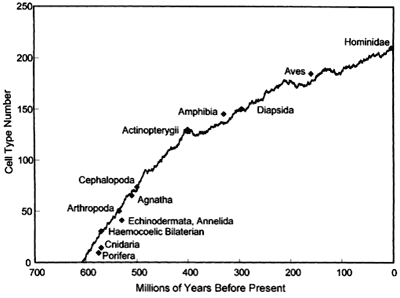
There’s a problem with this claim, though. Many people, including quite a few prestigious scientists, believe that cell type number in various organisms has actually been measured, and you’ll even find respected people like Valentine putting together charts like this:

cellnumberchart

That chart is total bullshit. You know how I expressed my visceral repugnance for an MRA who made up a “sexual market value” chart? I feel the same rage when I see this chart. There is no data supporting it. There we see humans listed as having 210 cell types, and everything else is lesser: birds have only 187 cell types. Do you believe that? I sure as hell don’t.

I periodically get a bit pissed off about this. I wrote about it in a thread on Talk.Origins in 2000, and I’ve put a copy of that below. I complained about it in a blog post from 2007. It hasn’t sunk in. I still run into this nonsense fairly regularly.

The short answer: this number and imaginary trend in cell type complexity are derived entirely from an otherwise obscure and rarely cited 60 year old review paper that contained no original data on the problem; the values are all guesswork, estimates from the number of cell types listed in histology textbooks. That’s it.

The long answer, my digging from 13 years ago:

This is a topic in which I’ve long had an interest, of a peculiar and morbid sort. It’s been a case of occasionally running into these arguments about cell types, and wondering whether I’m stupidly missing something obvious, or whether the authors of these claims are the cockeyed ones. I can’t see a middle ground, it’s one or the other. Maybe somebody here can point out how idiotic I must be.

The issue is whether we can identify a good measure of organismal complexity. One way, you might think, would be to look at the number of different cell types present. I first ran across this metric in the late ’70s, in JT Bonner’s book _On Development: the biology of form_. He has a number of provocative graphs in that book, that try to relate various parameters of form to life history and evolution. Some of the parameters are easy to assess: maximum length, or approximate number of cells (which is just roughly proportional to volume). Others were messy: number of different cell types. Bonner didn’t push that one too much, just pointing out that a plot of number of types vs. total number of cells was sorta linear on a logarithmic plot, and he kept the comparison crude, looking at a whale vs. a sequoia vs. a sponge, that sort of thing. He also said of counting cell types that it was “in itself an approximate and arbitrary task”, but doesn’t say or cite where the numbers he used came from, or how they were obtained.

It came up again in Stuart Kauffman’s work. He tried to justify his claim that the number of cell states (or types) in an organism was a function of the number of genes, and he put together a chart of genome size vs. number of cell types. It was glaringly bogus. He (or someone) clearly selected the data, leaving out organisms with what I guess he would consider anomalous genome sizes — and Raff and Kaufman thoroughly trashed that entire line of argument in their chapter on the C-value paradox in _Embryos, Genes, and Evolution_, showing that one axis of Kauffman’s graph has to be invalid. Nobody has touched on that other axis, the number of cell types, and I’m still wondering how anybody determined that humans have precisely 210 different kinds of cells, while flies have 50 (those numbers seem to have become canonized, by the way — I’ve found several sources that cite them, +/- a bit, but very few say where they came from).

And then Morton mentions this interesting little paper that I hadn’t seen before:

Valentine, JW, AG Collins, CP Meyer (1994) Morphological complexity increase in metazoans. Paleobiology 20(2):131-142.

[note to Glenn: the citation on your page is incorrect. It’s in Paleobiology, not Paleontology]

Abstract.-The number of cell types required fo rthe constructon of a metazoan body plan can serve as an index of morphological (or anatomical) complexity; living metazoans range from four (placozoans) to over 200 (hominids) somatic cell types. A plot of the times of origin of body plans against their cell type numbers suggests that the upper bound of complexity has increased more or less steadily from the earliest metazoans until today, at an average rate of about one cell typer per 3 my (when nerve cells are lumped). Computer models in which increase or decrease in cell type number was random were used to investigate the behavior of the upper bound of cell type number in evolving clades. The models are Markovian; variance in cell type number increases linearly through time. Scaled to the fossil record of the upper bound of cell type numbers, the models suggest that early rates of increase in maximum complexity were relatively high. the models and the data are mutually consistent and suggest that the Metazoa originated near 600 Ma, the the metazoan “explosion” near the Precambrian/Cambrian transition was not associated with any important increase in complexity of body plans, and that important decreases in the upper bound of complexity are unlikely to have occurred.

At least, the paper *sounds* interesting. After reading it, though, I’m left feeling that it is an awful, lousy bit of work.

The first major flaw: there is no data in the paper. The first figure is a plot of cell type number against age, in millions of years before the present — the numbers and groups described are listed on Glenn Morton’s page. These are the observations against which several computer models will be compared. These data were not measured by the authors, but were gleaned from the literature. The sources for these critical numbers are listed in an appendix, about which more in a little bit.

The bulk of the paper is about the computer models they developed. The final figure is the same as the first, showing the data points from the literature with the plot generated by their best-fit simulation superimposed. It’s a very good fit. From this, they make several conclusions: 1) that their model is in good agreement with the historical data, 2) that the rate of increase in complexity was greatest near the origin of metazoans, 3) that that origin was relatively late, and 4) there was no particular change in rate during the Cambrian explosion. It is a fine example of GIGO.

The work is completely reliant on the validity of the data about cell type number, which is not generated by the authors, and worse, which is not even critically evaluated by the authors. It is just accepted. That data left me cold, though, with lots of questions.

What is a cell type? There was no attempt to define it. Histologically, it’s a fuzzy mess — you can go through any histology text and find long lists of cells types that have been recognized by morphology, location, staining properties, and so forth. I just skimmed through the index of an old text I have on hand (Leeson and Leeson), and without trying too hard, counted a bit more than a hundred distinct, named, vertebrate cell types in the first 5 pages…and there were 25 more pages to go. What criteria are the authors using? How well do these superficial criteria for identification mesh with the molecular reality of the processes that shape these cells?

Why did they throw out huge categories of cells? The nervous system is simply not considered — it’s ‘lumped’. This seems to me to be grossly inappropriate. Here is this HUGE heap of cellular diversity, in which half the genome is involved, and it is discarded in what are supposedly quantitative models. I can guess that it was thrown out because it is impossible to quantify…but that doesn’t sound like a good excuse if you are trying to model numbers. Furthermore, they only count cells in adults, so cell types found only in larvae or juveniles are rejected. Whoops. Isn’t that an admission that complexity in arthropods is going to be seriously underestimated? I don’t know, since they don’t say how they define a cell type.

How did they get these tidy single numbers for a whole group? ‘Arthropods’ have only 50 cell types. They admit that “within some groups there is a significant range of cell type numbers”. The range of variation, however, is not reflected in any of their graphs, nor which groups exhibit this range. Instead, they say, they picked a representative “primitive number” of cell types from “the more primitive living forms within each group”. I guess the more primitive living forms haven’t done any evolving.

A really bothersome and related point: the high end of their plot is anchored by the hominids, with 210 cell types and a time of origin within the last few million years. Remember, they are going to fit all these computer-generated curves to these data, and they explicitly scale everything to this endpoint and an earlier one. This point is invalid, though. We humans don’t have any novel cell types that were generated a few million years ago — that number of 210 cells ought to be applied to all of Mammalia, and the time of origin shoved back a hundred million years. Or more. Is there any reason to think 200 million year old therapsids were lacking any significant number of histological cell types found in mammals today?

For that matter, why should we think that these cell type numbers are anything but arbitrary indicators of the relative amount of time histologists have spent picking over the tissues of these various organisms? Do fish really have fewer cell types than mammals, or just different ones? Fish may lack all the cell types associated with hairs, but we don’t have all the ones that form scales. The authors show amphibians as being more complex than fish, on the basis of cell type counts in living forms…and that is completely the reverse of what I would expect, if I thought there was any difference at all.

What was really the killer for me, and what I was really looking for, was the primary sources for these numbers. These are listed at the very end, in a separate appendix. A few are easy: it’s not hard to imagine being able to count all the different cell types in a sponge or a jellyfish. One is admitted speculation by Valentine — he estimates the number of cells a primitive hemocoelic bilaterian must have had. Another, the number of cells in arthropods, is cited as an unpublished ms by Valentine. However, almost all of the counts boil down to one source, a critical source I haven’t yet been able to find. This very important paper, that purports to give cell type numbers for echinoderms, cephalopods, fish, amphibians, lizards, and birds, is:

Sneath, PHA (1964) Comparative biochemical genetics in bacterial taxonomy. pp 565-583 in CA Leone, ed. _Taxonomic biochemistry and serology_. Ronald, New York.

It’s a paper about bacterial taxonomy? And biochemistry? The only discussion in the text of the Valentine paper about this source mentions that it compares DNA content to cell type number, a measure that Raff and Kaufman have shown most emphatically to be invalid. And it’s from 1964, although the author seems to still be around and active in bacterial taxonomy and molecular biology right up until at least a few years ago. He doesn’t look like a histologist or comparative zoologist though, that’s for sure.

It’s from 1964. Oh, boy. I did manage to track down a copy of this volume in a library a few miles away, but I haven’t yet been able to get out and read it. I’m not too inclined to even try right now, because this appendix also has a little subscript in fine print at the bottom…virtually every source in this list, including Sneath, is marked with an asterisk, and the fine print tells us that that means “estimates NOT [my emphasis] documented by lists of cell types or by references to published histological descriptions”. In other words, there ain’t no data there, either.

I’m afraid to look up Sneath, for fear that it will turn out to be an estimate of cell number derived from measures of DNA content, with a bit of subjective eyeballing tossed in. At least that would explain why Kauffmann could find a correlation between DNA content and complexity, though.

From my perspective right now, this whole issue of cell type number is looking like a snipe hunt, a biological myth that is receding away as I pursue it. Does anybody know any different?

I didn’t have quick access to the all-important Sneath paper, but Mel Turner did, and he summarized it for everyone.

…there’s no original data. Here’s the relevant text:

“Although there are many possible correlations, for example, that between cell size and DNA content (135), it seems plausible to suggest that the amount of DNA is largely determined by the amount of genetic information that is required and that this will be greater in the more complex organisms. Fig. 38-2 shows the distribution of DNA contents of haploid nuclei taken from the literature, mostly from several compendia (4,10,87,128,134,135). The haploid nucleus was chosen for uniformity, and because the genetic information in diploids is presumably mostly reduplicated. The values are plotted against the number of histologically distinguishable cell types in the life cycle of the organism (suggested by a figure of Zimmerman (141)). This number is some measure of complexity, and was estimated from standard textbooks (5,13,85,126). In Fig. 38-2 organisms incapable of independent multiplication (e.g., viruses) have been assigned to the 0.1 cell level. The values for some well-known organisms are shown in Fig. 38-3.”

Fig. 38-2 is a graph of number of cell types (Y-axis) vs. log content of DNA/gamete, with a extra superimposed x-axis of “number of bits” (“one nucleotide pair = two bits”).No species names are indicated, but there are clusters of multiple separate points plotted for “mammals”, “birds”, “fish”, “angiosperms”, “bacteria” “algae & fungi”, “viruses”, etc. [oddly, he scores “RNA viruses” as having DNA content].

Fig. 38-3 purports to show “the histological complexity of some well-known organisms” with a log graph placing examples like “Man, Mammals” at the top with ca. 200 cell types, and “birds”, “reptiles”, “amphibia”, “fish” [again, no species names] just below that, then various cited generic names of plants animals, protists and bacteria [e.g., Pteromyzon (sic), Sepia, Helix, Ranunculus, Polypodium, Escherichia, etc.; about 50 taxa altogether]. Strictly unicellular organisms with different cell types during the life cycle [cysts, spores, gametes, etc. are properly scored as having histological complexity; e.g., Plasmodium scored with ca. 6 cell types]

There’s also discussion of the significance of the reported rough correlation of complexity and DNA content, a suggestion that histologically complex organisms should require disprortionately many times the DNA amounts of simple ones [cell specialization and regulation], a mention of some plants and amphibia with ‘unexplained’ very large DNA contents, and a page of stuff on base-pair changes, informational “bits”, & Kimura.

Table 38-3 “estimated amount of genetic and phenetic change in vertebrate evolution” looks pretty odd indeed [especially in a paper on bacterial biochemistry!]; it apparently tries to say something about times of origin and amounts of DNA change [% and in “bits”] for classes, orders, families, genera, species…. a bit dubious, to put it mildly.

Looking at the References list for the anatomical data sources cited for Figs 38-2 and 38-3, the “standard textbooks” were indeed just that:

5. Andrew, W. 1959. Textbook of Comparative histology. Oxford Univ. Press, London

13. Borradaile, L.A., L.E.S. Eastham, F.A. Potts, & J. T. Saunders. 1941. The Invertebrata: A manual for the use of students. 2nd ed. Cambridge Univ. Press, Cambridge.

85. Maximow, A.A. & W. Bloom. 1940. A textbook of histology. W. B. Saunders Co., Philadelphia.

126. Strasburger, E., L. Jost, H. Schenck, & G. Karsten. 1912. A textbook of botany. 4th English ed. Maximillian & Co. Ltd. London.

The Zimmerman citation from above is: Zimmerman, W. 1953. Evolution: Die Geschichte ihrer Probleme und Erkenntnisse. Alber, Freiburg & Munchen 623 pp.

Stephen Jay Gould wrote about a similar issue in Bully for Brontosaurus, in his essay on “The Case of the Creeping Fox Terrier Clone”, which describes how certain conventions, like describing the size of a horse ancestor as being as large as a fox terrier, get canonized in the literature and then get reiterated over and over again in multiple editions of textbooks.

This one isn’t as much a textbook problem as it is a deeply imbedded myth in the scientific literature. We haven’t even defined what a cell type is, yet somehow, again and again, we find papers and books claiming that it has been accurately quantified, and further, that it supports a claim of increasing complexity that puts humans at the pinnacle.

STOP IT.

I seem to have written about this problem every 6 or 7 years, to no avail. I’ll probably complain again in 2020, so look for a version of this post again, then.