This is Thunderdome, the unmoderated open thread on Pharyngula. Say what you want, how you want.
Status: UNMODERATED; Previous thread

This is Thunderdome, the unmoderated open thread on Pharyngula. Say what you want, how you want.
Status: UNMODERATED; Previous thread

Science is always working a tough room. It’s inherently progressive — we’re constantly achieving incremental improvements in our understanding, with occasional lurches forward…and sometimes sudden lurches backward, when we realize that we got something wrong. We’re performing for a crowd, the general citizenry and most importantly, the funding agencies, that expect us to fix problems and make the world better, and they’re a fickle bunch who will turn on us with disdain if we don’t keep delivering new medical therapies and tinier electronics and more spectacular robots landing on alien worlds.
Unfortunately, there are a couple of sources of tension in our act.
One problem is that we aren’t doing what everyone thinks we’re doing. The world outside the sciences thinks we’re all about making material improvements in your standard of living, or increasing our competitiveness with other countries. Wrong. We do what we do to increase our understanding. There is an applied side to science that is asking about, for instance, better treatments for cancer, but it’s built on a foundation of scientists just asking, “how do cells work?”
An analogy: imagine building race cars. Everyone watching is thinking that it’s all about winning races (that’s also the case for the backers who are paying for all the machines). But the scientists are the ones who are just thinking about what’s going on inside the engine, tracing the flow of fuel and energy, optimizing and adjusting to make it work. Put a scientist in the driver’s seat, and she wouldn’t be thinking about winning the race; if she heard a mysterious “ping!” at some point, her instinct would be to just pull over then and there and take things apart until she’d figured out what caused it. And figuring out the ping would be more satisfying than finishing the race.
So everyone criticizes the scientist for not winning any races, but the scientist is feeling triumphant because her performance wasn’t what you thought it was — she learned a little bit more about what makes the engine tick, and you should be happy about that!
So that’s one source of tension. Here’s another: funding and public support thrives on positive results, that constant reassurance that yes, we’re proceeding apace towards the finish line, but science itself thrives on criticism. Probing and patching and making fruitful errors and getting criticism that forces us to reconsider our premises and rebuild our hypotheses…that’s the progressive force behind science. And we should be appreciative when someone tells us that a major chunk of research is invalid (and as scientists, we are), but at the same time, we’re thinking that if we have to retool our labs, retrain our students, rethink everything from the ground up, as exciting as it is in a scientific sense, it’s going to be a really hard sell to NSF or NIH. The granting agencies, and the media, love the safe, reliable churn of data that looks like progress from the outside.
Which brings me to an interesting argument. On one side, John Horgan gets all cynical and critical of science, pointing out deep and fundamental flaws in peer review, the overloading of science journals with poor quality work, the lack of progress in many of our goals for science, and bemoaning the reassuring positivity of the media towards science.
…I’m struck once again by all the “breakthroughs” and “revolutions” that have failed to live up to their hype: string theory and other supposed “theories of everything,” self-organized criticality and other theories of complexity, anti-angiogenesis drugs and other potential “cures” for cancer, drugs that can make depressed patients “better than well,” “genes for” alcoholism, homosexuality, high IQ and schizophrenia.
And he’s right! We don’t have any cures for cancer or schizophrenia, and as he also points out, the scientific literature is littered with trash papers that can’t be replicated.
But on the other side, Gary Marcus says wait a minute, we really have learned a lot.
Yet some depressed patients really do respond to S.S.R.I.s. And some forms of cancer, especially when discovered early, can be cured, or even prevented altogether with vaccination. Over the course of Horgan’s career, H.I.V. has gone from being universally fatal to routinely treatable (in nations that can afford adequate drugs), while molecular biologists working in the nineteen eighties, when Horgan began writing, would be astounded both by the tools that have recently been developed, like whole-genome-sequencing, and the detail with which many molecular mechanisms are now understood: reading a biology textbook from 1983 is like reading a modern history text written before the Second World War. Then there is the tentative confirmation of the Higgs boson; the sequencing of Neanderthal DNA; the discovery of FOXP2, which is the first gene decisively tied to human language; the invention of optogenetics; and definitive proof that exoplanets exist. All of these are certifiable breakthroughs.
And he’s right!
See what I mean? It’s conflict and tension all the way through. The thing is that the two are looking at it from different perspectives. Horgan is asking, “how many races have we won?” and finds the results dispiriting. Marcus is asking “have we figured out how the engine works?” and is pleased to see that there is an amazing amount of solid information available.
Here, for example, are some data on cancer mortality over time. In this instance, we are actually looking at the science as a race: the faster that we can get all those lines down to zero, the happier we’ll all be.
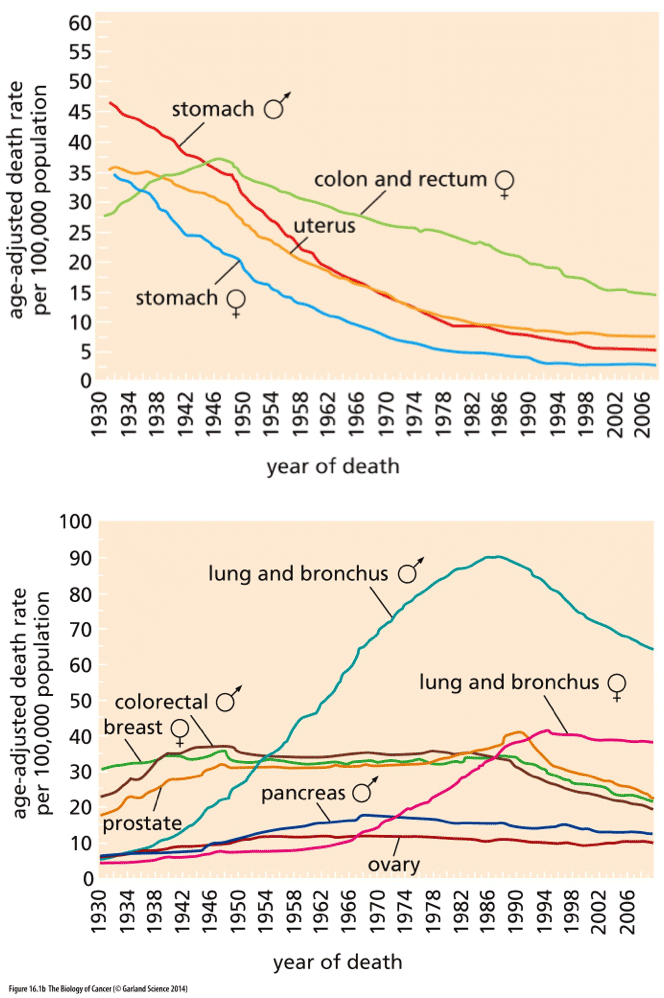
Weinberg, The Biology of Cancer
Look at the top graph first. That’s where we’re doing well: the data from stomach and colon and uterine cancer show that those diseases are killing a smaller percentage of people every year (although you can probably see that the curves are beginning to flatten out now). Science did that! Of course, it’s not just the kind of science that finds a drug that kills cancer; much of the decline in mortality precedes the era of chemotherapy and molecular biology, and can be credited to better sanitation and food handling (hooray for the FDA!), better diagnostic tools, and changes in diet and behavior. We’re winning the war on cancer!
Wait, hold on a sec, look at the bottom graph. It’s more complicated than that. Look at lung cancer; science was helpless against the malignant PR campaigns of the tobacco companies. Some cancers seem relentless and unchangeable, like pancreatic and ovarian cancer, and show only the faintest hint of improvement. Others, like breast cancer, held steady in their rate for a long time and are just now, in the last few decades, showing signs of improvement. It’s complicated, isn’t it? Horgan is right to point to the War on Cancer and say that the complex reality is masked by a lot of rah-rah hype.
But at the same time…Horgan got his journalism degree in 1983, and I got my Ph.D. in 1985. He’s on the outside looking in and seeing one thing; over that same time period, I’ve been on the inside (still mostly looking in), and I’ve seen something completely different.
If I could show my 1985 self what 2013 science publishes as routine, 1985 self would be gibbering in disbelief. Transgenic mice? Shuffling genes from one species to another? Whole genome sequencing? Online databases where, with a few strokes of the keyboard, I can do comparisons of genes in a hundred species? QTLs that allow us to map the distribution of specific alleles in whole populations? My career spans an era when it took a major effort by a whole lab group to sequence a single gene, to a period when a grad student could get a Ph.D. for completing the sequencing of a single gene, to now, when we put the DNA in a machine and push a button.
You can look at those charts above and wonder where the cure for cancer is, or you can look at all the detailed maps of signaling pathways that allows scientists to say we understand pretty well how cancer works. Do you realize that hedgehog was only discovered in 1980, and the activated human ras oncogene was only identified in 1982? It’s rather mindblowing to recognize that genes that we now know are central to the mechanisms of cancer have only emerged in the same short period that Horgan finds disappointing in the progression of science.
Everyone on the outside is missing the real performance!
Unfortunately, a growing problem is that some of the people on the inside are also increasingly focused on the end result, rather than the process, and are skewing science in unfortunate directions. There’s grant money and tenured positions on the line for getting that clear positive result published in Cell! As Horgan points out, “media hype can usually be traced back to the researchers themselves”. We’ve seen that with dismaying frequency; recently I wrote about how the ENCODE project seems to have fostered a generation of technicians posing as scientists who don’t understand the background of biology (and Larry Moran finds another case published in Science this week!). We’re at a period in the culture of science when we desperately need more criticism and less optimism, because that’s how good science thrives.
That’s going to be tricky to deliver, though, because the kind of criticism we need isn’t about whether we’re winning the race or not, or translating knowledge into material benefits or not, but whether the process of science is being led astray, and how that’s happening: by the distorting influence of big biomedical money, by deficiencies in training scientists in big picture science, or by burdensome biases of science publication, or by all of the above and many more.
But ultimately we need the right metrics and to have well-defined outcomes that we’re measuring. It doesn’t help if the NIH measure success by whether we’ve cured cancer or not, while scientists are happily laboring to understand how cell states are maintained and regulated in multicellular eukaryotic organisms. Those are different questions.

Sick, exasperated, tired, overloaded. May I recommend any of the other fine establishments on Freethought Blogs who will appreciate your custom?

Now, in addition to controlling who you are allowed to have sex with and how long you are supposed to be pregnant, the Republicans want to make sure science goals are short term and in the “national interest”.
Key members of the US House of Representatives are calling for the National Science Foundation (NSF) to justify every grant it awards as being in the “national interest”. The proposal, which is included in a draft bill from the Republican-led House Committee on Science, Space, and Technology that was obtained by Nature, would force the NSF to document how its basic-science grants benefit the country.
Yeah, OK, so how does working out the interactions in the hedgehog signaling pathway “benefit the country”? How does measuring the lipid composition of neurons in the substantia nigra “benefit the country”? How does documenting the identity of waxes on the abdomens of fruit flies “benefit the country”? Shall we just stop all research that doesn’t make a profit, doesn’t improve the range of cruise missiles, and doesn’t directly improve heart disease treatments for sclerotic old conservatives?
This is a first step in imposing a patriotism requirement on science…and a first step in killing the enterprise altogether.
It’s also terrifying that judging the worth of science is being put in the hands of Republicans — the know-nothing party of ignorant Jebus-lovin’ buffoons. (It would also be terrifying to see it under the thumbs of the credulous new-agey clowns in the other party — how about keeping science apolitical?)

Did you know that Skepticon is next week? Next week! My talk isn’t done! I have vowed to finish it this weekend, though: they’ve got me scheduled to talk on the first night, probably because they know that I have a tendency to fuss over these things and would be tweaking it every day before I go on.
Do you know what else is almost, but not quite done? Fundraising! They’re within a few thousand dollars of reaching their goal, so it’s the final push. It’s like my talk, we’re always skirting the edge of getting it done in time. But I’ve already promised to get that talk done this weekend, so it would be nice if they could get their fundraising done then, too.
If you need additional incentive, consider this: this is the conference the haters hate the most. I’ve already got some wackaloons I’ve never met and who have never attended a conference I’ve gone to and in particular have never had any plans to attend this one ranting and raving about a boycott of the con, and a walkout of my session (but then, these are the same kooks who propose to do that every time I give a talk somewhere, and the only people who’ve walked out so far seem to be invisible). This is the convention that has Rebecca Watson, Amanda Marcotte, Greta Christina, Debbie Goddard and all kinds of uppity women stirring up trouble.
Subvert the dominant paradigm! Support the skeptical conference that isn’t run by asshats!

Last month, I wrote about the terrible botch journalists had made of an interesting paper in which tweaking regulatory sequences called enhancers transgenically caused subtle shifts in the facial morphology of mice. The problem in the reporting was that the journalists insisted on calling this a discovery of a function for junk DNA — the paper itself said no such thing, but somehow that became the dominant message of the popular press coverage. Strange. How did that happen?
So Dan Graur wrote to the corresponding author to find out how the junk crept in. He found out. It’s because the author doesn’t understand the science. Axel Visel wrote back:
When I talk to general audiences (or journalists) about my research, I generally explain that the function of most of the non-coding portion of the genome was initially unclear and many people thought of it as “junk DNA”, but that it has become clear by now that many parts of the non-coding genome are functional – as we know from the combined findings of comparative genomics, epigenomic studies, and functional studies (such as the mouse knockouts in our paper).
Aargh. Non-coding is not and never has been a synonym for junk. We’ve known that significant bits of non-coding DNA are functional for a period longer than I’ve been alive…and I’m not a young guy anymore. The mouse knockouts in his paper were tiny changes in a few very short sequences — even if we had somehow been so confused that we though enhancer elements were junk, whittling away at such minuscule fragments of the genome weren’t going to appreciably increase the fraction that is labeled functional. That focus on finding more functionality in the genome flags Visel as yet another ENCODE acolyte.
Man, I’m feeling like ENCODE has led to a net increase in ignorance about biology.
Graur does not mince words in his assessment:
My problem is that junk DNA does not equal noncoding or nontranscribed DNA, and I am sort of sick to see junk DNA being buried, dismissed, rendered obsolete, eulogized, and killed twice a week. After all, your findings have no bearing on the vast majority of the genome, which as far as I am concerned is junk. Turning the genome into a well oiled efficient machine in which every last nucleotide has a function is the dream of every creationist and IDiot (intelligent designer), so the frequent killing of junk DNA serves no good purpose. Especially, since the evidence for function at present is at most 9% of the human genome. Why not call noncoding DNA noncoding DNA? After all, if a DNA segment has a function it is no junk.
Larry Moran is also a bit peeved, and explains that we actually know what a lot of that noncoding DNA does. It’s not a magic reservoir of hidden functionality.
I’ve said it many times but it bears repeating. A small percentage (about 1.4%) of our genome encodes proteins. There are many other interesting regions in our genome including …
- ribosomal RNA genes
- tRNA genes
- genes for small RNAs (e.g spliceosome RNAs, P1 RNA, 7SL RNA, linc RNA etc.)
- 5′ and 3′ UTRs in exons
- centromeres
- introns
- telomeres
- SARs (scaffold attachment regions)
- origins of DNA replication
- regulatory regions of DNA
- transposons (SINES, noncoding regions of LINES, LTRs)
- pseudogenes
- defective transposons
These parts of noncoding DNA accounts for about 80% of the human genome. A lot of this noncoding DNA is functional (about 7% of the total genome [What’s in Your Genome?]). None of it is mysterious in any way. We’ve known about it for decades. As Dan Graur says, it’s a known known.
At least I’m in a position to do a little something about this ignorance. I’m teaching cell biology to our sophomores this semester, and next week I start the section on DNA replication, with transcription the week after. My students will know the meanings of all those terms and have a clear picture of genome organization.
And what that should tell all you employers out there is that you should hire UMM biology graduates, because they’ll actually have some knowledge of the science. Unlike certain people who seem to have no problem publishing in Science and Nature.

Chris Clarke has hit a rough patch, struggling to make ends meet and suffering with a sense of failure. I wouldn’t call him a failure at all; he’s a fabulous and provocative writer with an acute sense of the importance of the cause. I read his work every time I find it, and I look for it every day.
I think his problem is simple: he won’t sell out. But think of it! All he has to do is go to one of those corporations he keeps nagging and name his price, his price to shut up, his price to flog corporate PR. And then he could write pieces that, instead of talking about what people are destroying as they shred his beloved desert (downer, man!), he could write about their bright shining future of shiny technology and never-ending comfort (happy happy bliss!), and everybody will love being reassured.
There’s money in abandoning all your principles, you know.
Or readers could notice that big “DONATE” button at the bottom of his post, and click on it. Of course, that will only encourage him in his wayward course, and keep him poking at the powerful and comfortable.

Another day, another woman reports abuse from a skeptic leader. Pamela Gay describes the aftermath of being groped in a bar.
And I hate myself for wishing this would all just go away, instead of wishing that there could be justice. But I guess I fear that justice has a price I don’t have the life blood to pay for.
Over and over, I have made the choice, “what happened isn’t worth raising a stink about. Don’t ruin everyone’s [fun/con/career]“. Over and over, I’ve made the choice, “Yeah, that guy (but he was drunk!) slapped my butt in passing, but he is a leader at what he does, so I need to just get over myself and work with him.”
I hate myself for this.
I hate myself because I made the choice that not raising a fuss was more important than my self worth.
Read that again. It’s fucked up. But it’s who I am, … and when I read the hashtag #RipplesOfDoubt a few weeks ago, I realized how often we women make that decision. I’m fucked up, but I’m not alone. Too many of us fill our heads with euphemisms and excuses. It’s so much easier to think, “It’s a drunk guy being a drunk ass.” It hurts so much more to say, “I had someone try and sexually assault me.”
It’s a double strike. First there’s the assault proper, and then there’s the unwarranted guilt and self-recrimination afterwards.
It’s awkward for a man on the outside, too: I want to say, “Fight back.” I want to say, “You don’t have to suffer; you aren’t required to speak out.” But I don’t have the right to tell the victim how to process her situation, so I just have to stand back and support whatever decision she makes.

Ken Ham has tried to make excuses for all the delays and uncertainties in building their Ark Park boondoggle. It’s because it is a faith-based project, and he compares his struggles to those of Noah.
To us, the Ark Encounter, to be built on some beautiful property in northern Kentucky (south of Cincinnati), has been a giant step of faith. And yet, as I think about Noah, our endeavors really pale by comparison.
What a privilege it is that we can remind the world of a great man, Noah, and the faith-step he took, so that we can also share with the world about sin, God’s judgment on it, and of God’s love and provision for our salvation.
We’re not told how long Noah took to build the Ark—and we really don’t know when our Ark (called “Ark Encounter”) will be completed. It’s a complex project, involving complicated permits, the design of high-tech exhibits, and many legal matters.
For instance, we’ve had to spend the last few months re-doing the legal structure for the Ark project, largely because of the “ObamaCare” health care legislation. Our restructuring was done in an effort to try and avoid the same problem which the retail chain Hobby Lobby and religious-based organizations are now battling in the courts (i.e., the mandate to include abortion-causing contraceptives and drugs as part of their health insurance plan.)
He also includes this cartoon.

I’d say that looks like an admission that they’re building on clouds in the sky. Need I point out that Noah is a legend, there was no world-wide flood, and no ark of the type described in his book of fantasy was ever built?
I also like how one of his excuses is that they’re carrying out legal maneuvers to permit them to discriminate and cheat their workers out of ethical support. WWJD? Screw over his employees.

It’s no wonder they grew up to be godless heathens: this looks like a roundup of all the toys I let them play with, and cartoons I let them watch.
Watching those two grown men go on and on, I could scarcely believe the nonsense they were promoting. Only in the 70s and 80s would you find chairs with that upholstery…