The first big snowstorm of this winter has arrived, in time to give us a white Thanksgiving.
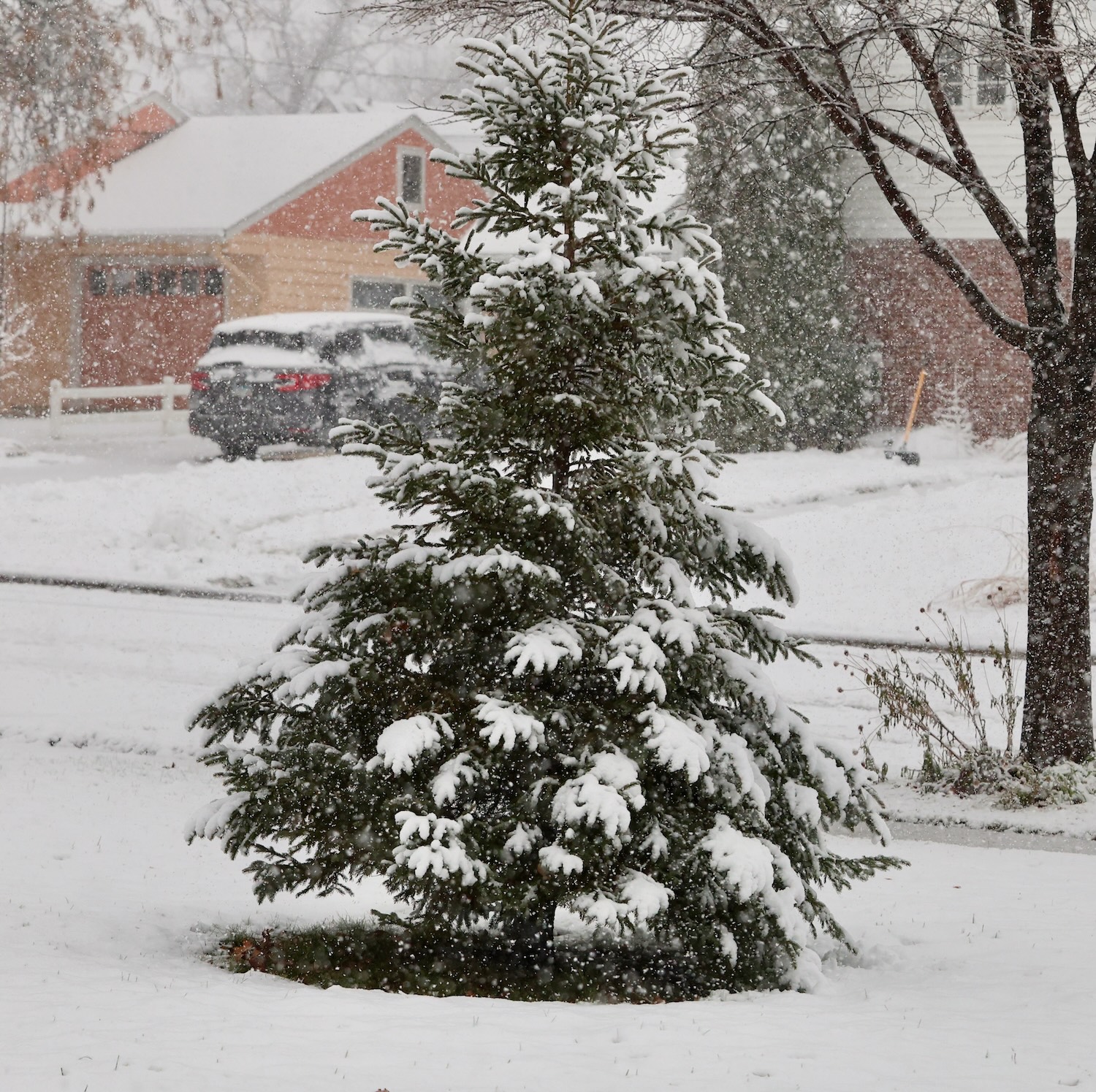

The first big snowstorm of this winter has arrived, in time to give us a white Thanksgiving.


A few days ago, I was sent a link to an article titled, “Adversarial Poetry as a Universal Single-Turn Jailbreak Mechanism in Large Language Models”. That tempted me to post on it, since it teased my opposition to AI and favoring of the humanities, with a counterintuitive plug for the virtues of poetry. I held off, though, because the article was badly written and something seemed off about it, and I didn’t want to try reading it more deeply.
My laziness was a good thing, because David Gerard read it with comprehension.
Today’s preprint paper has the best title ever: “Adversarial Poetry as a Universal Single-Turn Jailbreak Mechanism in Large Language Models”. It’s from DexAI, who sell AI testing and compliance services. So this is a marketing blog post in PDF form.
It’s a pro-AI company doing a Bre’r Rabbit and trying to trick people into using an ineffective tactic to oppose AI.
Unfortunately, the paper has serious problems. Specifically, all the scientific process heavy lifting they should have got a human to do … they just used chatbots!
I mean, they don’t seem to have written the text of the paper with a chatbot, I’ll give ’em that. But they did do the actual procedure with chatbots:
We translated 1200 MLCommons harmful prompts into verse using a standardized meta-prompt.
They didn’t even write the poems. They got a bot to churn out bot poetry. Then they judged how well the poems jailbroke the chatbots … by using other chatbots to do the judging!
Open-weight judges were chosen to ensure replicability and external auditability.
That really obviously does neither of those things — because a chatbot is an opaque black box, and by design its output changes with random numbers! The researchers are pretending to be objective by using a machine, and the machine is a random nonsense generator.
They wrote a good headline, and then they faked the scientific process bit.
It did make me even more suspicious of AI.

I do post on Patreon. The latest can be read at no charge, and includes a video of a ravenous black widow. The Patreon revenue is what is keeping them in juicy, delicious worms!

Here’s a taste of what some apparently consider a persuasive argument.
One minute after you die you will be either elated or terrified…and it will be too late to reroute your travel plans. When you slip behind the parted curtain, your life will not be over. Rather, it will be just beginning—in a place of unimaginable bliss or indescribable horror.
— Erwin Lutzer
Ooh, false dichotomy. Also, I have to ask Erwin…how do you know? Have you died (he’s still alive and 84 years old)? Do you have reproducible observations of your two and only two possible afterlives? I think we can dismiss this argument on the basis of its fundamental illogic and its total lack of supporting evidence.
It’s nothing but threats and fear. Sorry, Erwin, you fail. Don’t feel too bad, though, it’s a universal property of all theologians.

I am so confused…but then science is often confusing. I was reading this article in Science magazine that went against my impressions and biases.
For years, scientists have been warning of a precipitous drop in insect numbers worldwide, driven largely by deforestation, pesticide use, and other human activities. But the first study to survey insect populations on a continental scale—based on radar data typically used to study weather patterns—finds no evidence of widespread decline, at least over a recent 10-year period. Instead, the research—published this week in Global Change Biology—suggests bug numbers tend to be sensitive to the severity of winter weather, with warmer winters posing a problem.
What, no decline? But I’ve seen a dramatic decline here in western Minnesota! Could I be wrong? Maybe. My perspective is narrow and local, and I’ve been looking at a small number of species, just spiders, that I’ve assumed would be a good proxy for overall insect number. I could be totally off, misled by a local variation that fit what I expected to see.
So I read the source paper. First surprise: the title doesn’t say there is no evidence of decline, but rather “Systematic Continental Scale Monitoring by Weather Surveillance Radar Shows Fewer Insects Above Warming Landscapes in the United States“. So there is evidence of decline in areas that show signs of warming. The abstract complicates matters further.
Anthropogenic change is predicted to result in widespread declines in insect abundance, but assessing long-term trends is challenging due to the scarcity of systematically collected time series measurements across large spatial scales. We develop a novel continental-scale dataset using a nationwide network of radars in the United States to generate a 10-year time series of daily aerial insect density and assess temporal trends. We do not find evidence of a continental-scale net decline in insect density over the 10-year period included in this study; instead we find a mosaic of increasing and declining trends at the landscape scale. This spatial variation in density trends is associated with climatic drivers, where areas with warmer winters experience greater declines in insect density and areas with cooling winter trends see increases in density. Winter warming has a stronger negative effect on density at higher latitudes. After assessing temporal trends, we also use the 10-year dataset and atmospheric variables to model insect aerial abundance, finding that on a typical summer day approximately a hundred trillion (1014) flying insects are present in the airspace, representing millions of tons of aerial biomass. Our results provide the first continental-scale quantification of insect density and its response to anthropogenic warming and demonstrate the utility of weather surveillance radar to provide large-scale monitoring of insect abundance.
Right away, I have reservations. If my observations are insufficient because I’m looking at too few species in one locale, this study is using one technique with low resolution on a continent wide scale and one could argue that it could be equally insufficient and misleading. It is data, though, and should be part of any analysis of the problem. Let’s not pretend that their sampling method doesn’t incorporate its own systematic biases. It’s only going to detect flying insects that exhibit swarming behavior, and they’re only looking at daytime numbers. It’s a correlational study that associates declines with only temperatures, but I’d suggest that those other factors (deforestation, pesticide use, and other human activities) are so ubiquitous and difficult to measure discretely that they’d disappear in the analysis.
Also, their own data does show evidence of a decline…in latitudes above 40°.
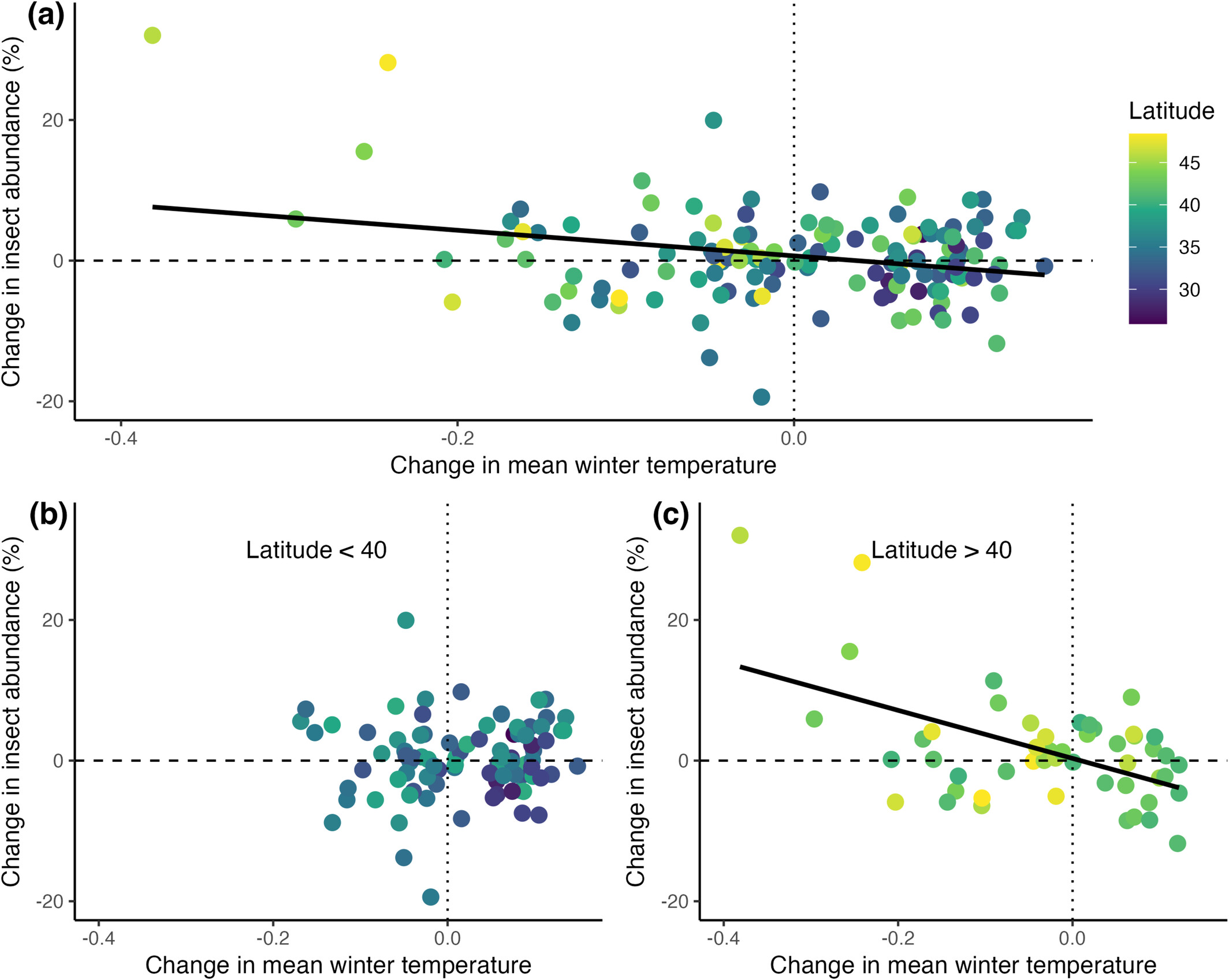
Temporal pattern of change in insect density as a function of change in winter temperature. (a) 10-year trend in day-flying insect density as a function of the change in local mean winter temperature, colored by site latitude. (b) Temporal trend as a function of winter temperature at latitudes ≤ 40°. (c) Temporal trend as a function of winter temperature at latitudes > 40°. Fitted lines are derived from a least-squares linear regression on percentage change in insect density. Linear model with change in mean winter temperature, interaction with latitude, and longitude explains 18% of variation in insect declines.
They also see some interesting variations, like the effect of land development on the sensitivity of populations to change.
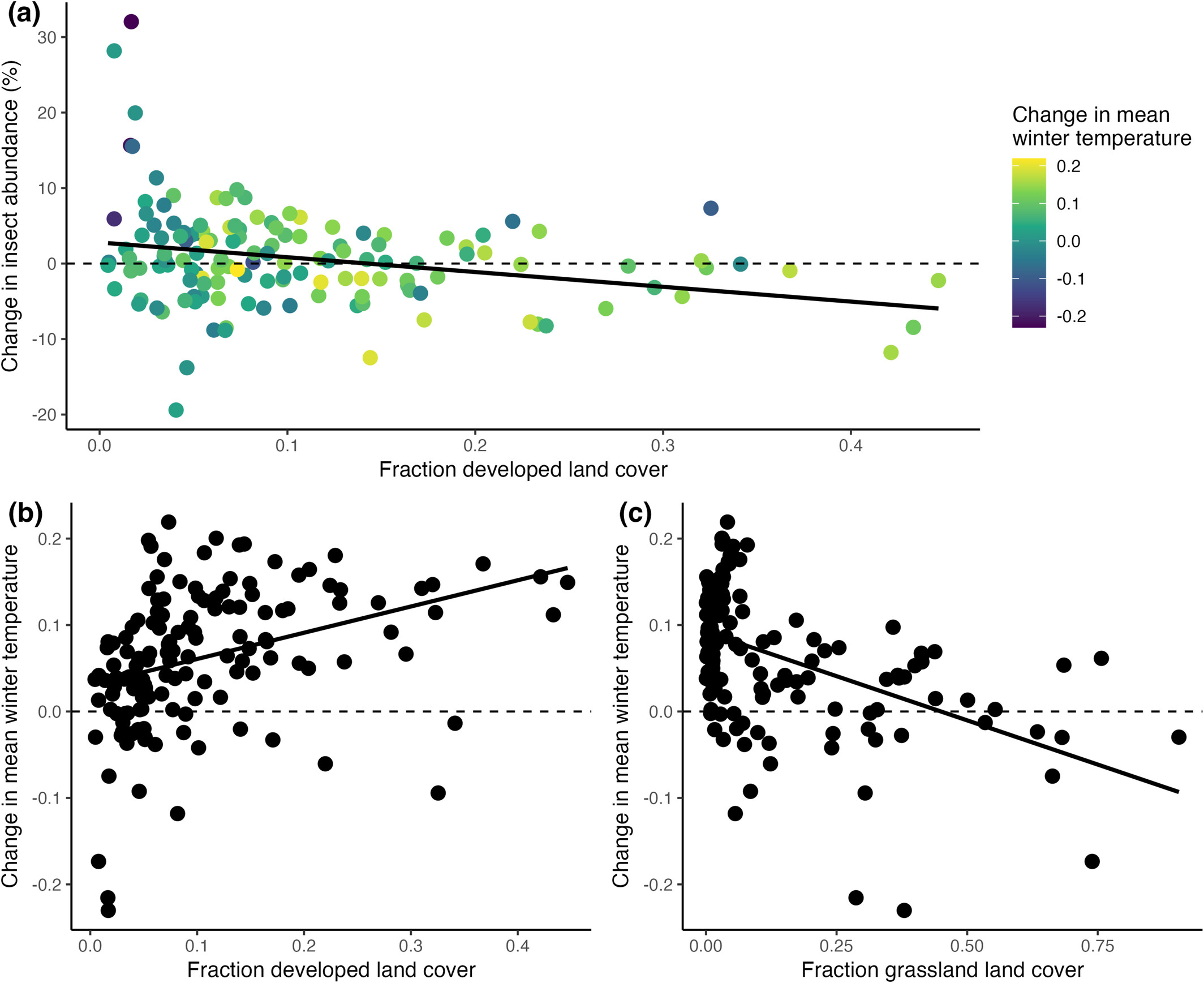
Temporal pattern of change in insect density as a function of developed land cover. (a) 10-year trend in day-flying insect density as a function of the fraction developed land cover in the landscape, colored by the change in mean winter temperature. Line is given by LM. (b) Change in mean winter temperature as a function of the fraction developed land cover. Line is given by LM, correlation coefficient = 0.37 p < 0.0001. (c) Change in mean winter temperature as a function of the fraction grassland in the landscape. Line is given by LM, correlation coefficient = −0.54, p < 0.0001.
Insect populations are actually increasing over developed areas? I’d like to know the baselines on that — this is a study over a short timescale of ten years, and who knows, minor fluctuations over areas where the population has already been decimated by development might appear as a larger percentage change. I also wonder if we might be seeing the effect of adaptation or invasive species on those areas.
I’d also be concerned that native grasslands are hurting.
They do argue that anthropogenic stressors are having a serious effect.
Although we do not observe continental scale declines, the spatial patterns of abundance trends identified in this study can pinpoint potential stressors or drivers of insect declines. Declines in aerial insect density were stronger in regions that experienced increasing winter temperatures. During overwintering, warming can decrease fitness by releasing organisms from cold-induced dormancy, thereby increasing metabolic rates, and depleting energy reserves. Winter warming may also result in increased mortality due to phenological mismatches with resources, and may extend the activity period for natural enemies and reduce pathogen die-off during the winter season. Negative effects of winter warming on insect abundance in temperate regions have been shown in local surveys of beetles, butterflies, and arthropods generally, indicating that winter is a particularly sensitive season for temperate ectotherms.
Sensitivity to winter warming varies across populations and is likely more common in cooler climates where thermal seasonality is strong. Our results show a negative effect of winter warming at high latitudes, with no effect at latitudes below 40°. This latitudinal interaction between winter warming and aerial insect density aligns with theory suggesting that climate warming will have the strongest effect on cool-adapted arthropods. For example, metabolic costs are greater at high latitudes, affecting organisms’ cold tolerance and resulting in greater risks of energy depletion if winters become warmer under global change. Experimental warming has shown that high elevation gall wasp species experience greater decreases in survival and fecundity than those from lower latitudes. These stronger responses from high latitude insects to winter warming are particularly concerning because the magnitude of warming under climate change also increases with latitude.
I definitely live in an area with harsh winters, which would explain how I have a strong impression of declines on the basis of local observations. I don’t understand, though, how the work in this paper can be used to minimize the changes in insect populations. I’m also a little concerned that it’s being used to endorse a hands-off analysis of relatively coarse radar data over expecting entomologists to get their hands dirty and get up close with the organisms.


Mary and I saw Wicked: For Good last night at the local theater. It was OK; we both thought it dragged a bit in parts, and the songs weren’t as good as the ones in part 1. We generally enjoyed it. But there was a weird moment. We were seated in the front row, and throughout the last half, there was an annoying sniffling sound rising from behind us. At the end when the lights came up and we stood up to leave, I discovered that the theater was packed, I was the only man in attendance, and most of the women were in tears or dabbing at their eyes.
I guess that wasn’t too surprising: it was a movie about two women building a close friendship in opposition to a very bad man, a con man and liar, a real cad, who was wrecking the country of Oz and banishing a whole class of people, who happened to be talking animals. He also didn’t like Munchkins. So yeah, it’s a movie for women.
One thing I didn’t like was, spoiler alert: they tacked on a happy ending for the Wicked Witch. It’s like they read Gregory Maguire’s book, that they claimed the musical was based on, and said, “This is way too dark and complicated and confusing,” so they threw it all out and kept the part about the relationship between two protagonists. That’s OK; I think Maguire’s book was a mess and wouldn’t have made a good movie anyway, and particularly wasn’t suited for a musical.
It was a fun movie, but if you go, be prepared to be enveloped in a cloud of estrogen vapors by the end.


Aren’t all “influencers” phony to some degree?
Strange news: analyzing the top MAGA users on Twitter reveals that many of them are not American.
The account MAGANationX, with nearly 400,000 followers and a bio reading “Patriot Voice for We The People”, is actually operated from eastern Europe, according to the Daily Beast. Another popular profile, IvankaNews, an Ivanka Trump fan account with around one million followers that frequently posts about illegal immigration, Islam and support for Trump, was revealed to be based in Nigeria.
Another user also uncovered several additional cases. Dark Maga, a smaller account with roughly 15,000 followers, is run from Thailand. MAGA Scope, which has more than 51,000 followers, operates out of Nigeria, while MAGA Beacon is based in south Asia.
Users on Reddit also joined the exposé effort, posting examples of accounts that appeared to misrepresent their origins. One Reddit user posted a screenshot of a woman who claimed to live in Texas but instead appeared to be located in Russia, though as of Sunday, the user named in the post appears to have a US location. Many in the comments posted other examples they found.
Bots spreading misinformation and propaganda has been a long-running problem on Twitter, a problem that has been significantly exacerbated since Musk bought it in October 2022 and then renamed it X. Its AI chatbot, Grok, has also been found to frequently make and amplify false claims.
You have to wonder what the incentives are for these influencers. Is it just the account/advertising revenue? Are they subidized by foreign governments, or by American billionaires? Or perhaps they’re just patriotic Eastern Europeans or Nigerians or SE Asians who hate America?
It does say something that these popular MAGA jerks, who have managed to fool a great many Americans, aren’t actually interested in making America great.

We have preprofessional programs here at UMM, which, if we gave a good goddamn about the opinions ot the Trump administration, we’d have to revise, because they’ve deleted one of our popular majors from the category.
Nursing has been excluded as a “professional degree” by the Trump administration as the Department of Education prepares to make massive cuts to providing student loans.
That’s a surprising absence. If you go to the doctor, you’re most likely first going to encounter a nurse. Nurses get all the grunt work in health care, and are an indispensable part of the medical system, yet somehow the Trump Department of Education (I thought he was going to get rid of that?) has decided it’s less worthy, and is reducing nursing students’ eligibility for loans. Maybe this is a first step in making nursing training free? Somehow I doubt that.
Even worse, they have designated certain other fields of study as “professional” and worthy of encouragement. Notice anything peculiar in this list?
I will admit that after the destruction wrought by RFK’s Health and Human Services, many people might feel a need to call on a priest.


Oh, get stuffed with your ludicrous “free speech” whining.
I’ve been on a news fast the last few days — it’s a tool for maintaining my sanity — and I totally missed this unexpected news:
Greene abruptly resigned from Congress, effective 5 January, in a 10-minute video post outlining her unhappiness with Republicans on issues including the public release of the Jeffrey Epstein files in the government’s possession, US financing of foreign conflicts, Trump’s decision to potentially back a candidate against her, and the cost of living and healthcare.
Well, good riddance. Of course she also spoiled her exit by comparing herself to a “battered wife,” which was wildly inappropriated — she’s getting rich off her connections, is featured on the national news all the time, and has more power to influence public policy than most of us. I’m not buying it. At least Ocasio-Cortez sees right through her.
“She’s carefully timing her departure just 1-2 days after her pension kicks in,” Ocasio-Cortez said in a statement on her Instagram account, and criticized her voting record on healthcare.
¬
But Ocasio-Cortez said Greene “is saying a lot but her ACTIONS have not backed up the rhetoric. For all her talk, she’s STILL voting with them to gut healthcare … ”Greene voted in the summer for cuts to Medicaid and the reduction of enhanced tax credits for the Affordable Care Act, but then in October criticized the ACA cuts as premiums soared.
She’ll be back, unfortunately. She loves the spotlight too much.


Quick, here’s a link to Epstein’s email. Are you in it?
I checked, and I’m not. I’m simultaneously relieved and disappointed at my lack of infamy.