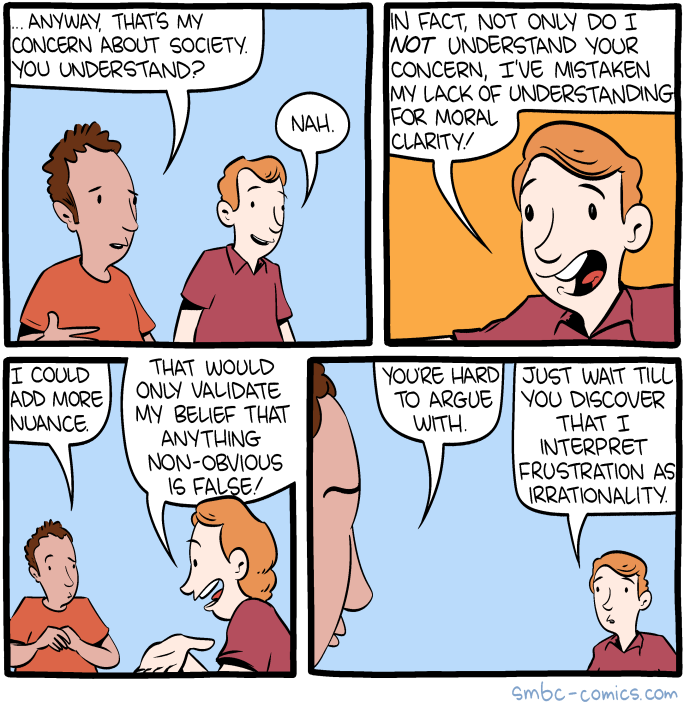
I was just reading this thought-provoking essay by Alan Levinovitz, The Awful Pleasures of Spiritual Pornography. Oooh, “spiritual pornography”, I wonder what that is, I thought. Levinovitz provides two examples: this is a review of Out of the Ashes: Rebuilding American Culture by Anthony Esolen and The Benedict Option: A Strategy for Christians in a Post-Christian Nation by the unpleasant Rod Dreher. And I have to say, this kind of pornography isn’t fun at all.
…the soul of these books is not love of God; it is bitter loathing of those who do not share it. They are a kind of spiritual pornography that works against spiritual regret, designed to arouse climactic cries of Yes! Yes! in its readers, pleasing the soul’s darker parts by swapping a hollow fantasy of physical union for an equally hollow fantasy of moral warfare: a Manichean vision of a virtuous few battling mightily against everyone else.
The basic engine of what I read — and its intended effect on readers — is little different from that of 19th-century anti-Catholic literature, the Left Behind series, Frank Peretti’s This Present Darkness, and Jack Chick’s wild-eyed cartoon tracts. Spiritual pornography, in all of its incarnations, stars easy heroes and villains. The heroes are idealizations of the target audience, which encourages narcissism, and the villains are caricatures of The Other, which encourages bigotry. And although a little spiritual pornography probably does no lasting harm, frequent, concentrated doses can seriously damage individual souls, and, worse, society at large.
I have to wonder if Dreher would find the comparison to Jack Chick to be terribly déclassé, but still rather flattering, in a vulgar way. He might think you’ve gone a bit too far if you point out another example of spiritual pornography, The Protocols of the Elders of Zion, which similarly treats the outgroup as literal child-murdering servants of Satan. But then this review makes a fairly safe accusation: that it’s not Jews or Catholics that are the new targets, but those damned liberal secularists. Dreher and Esolen would be fine with that, because their entire oeuvre is about how they deserve condemnation.
“Anti-Catholicism has always been the pornography of the Puritan,” observed Richard Hofstadter in his classic essay, “The Paranoid Style in American Politics,” using as his exemplar a hugely popular 19th-century fabrication by one Maria Monk, who accused priests of systematically raping nuns, then baptizing and murdering whatever children resulted.
The 21st-century equivalent is not anti-Catholic but anti-secular, a category capacious enough for atheists, reform Jews, New Age mystics, nihilist Nietzscheans, even liberal Christians — the last of these described by Dreher, derisively, as “moralistic therapeutic deists,” and Esolen, appallingly, as Persecutors and Quislings — anti-anyone, really, whose religiosity is deemed less austere than that of the pornographer.
Calling spiritual pornography a fantasy helps to evoke its psychological appeal, but the world it conjures up is closer to that of the fairy tale. Both genres are built on two foundational features: dramatic arcs that proceed from Order to Disorder to Order, and clearly defined roles and rules that map neatly onto good and evil. It’s a world that trades humans for archetypes, nuance for simplicity, and the tangled skein of history for the orderly vectors of myth — but if you’re on the side of the angels, living in it feels really, really good.
I have to confess that I think this is where the atheist movement has gone astray, and has too often veered into secular pornography — we possess a kernel of truth, that there is absolutely no evidence for gods, or even a coherent definition of what a god is, and it’s all too easy to segue from that grain of true knowledge to an absolute certainty that those who don’t agree with us are total idiots in all things. We demonize them right back.
It gets worse when the only time atheists find common cause with religious absolutists is when they find another scapegoat to abuse. Right now we have a sect of atheists who have decided that one religious group, the Muslims, are wronger than another religious group, the Christians, so they argue about which one is more evil and form alliances to wage war on whole cultures and suggest that maybe we should convert them from one wrong philosophy to another wrong philosophy as a tool of pacification.
What we should be arguing, as atheists, is that all of them are wrong about the indefensible god-nonsense, but that all of them, like us, are humans who have one life to live, and who come from long lines of humans with rich histories and diverse cultures that we ought to acknowledge and respect. Our obligation as atheists is to protect the rights and dignity of all of our fellow human beings, not to use differences in belief as a pretext to deny those rights and dignities to other human beings. We should, as people of science, be in universal agreement that all people are people, with equal rights, including a right to live and think freely.
Yes, it feels really, really good to live in the reality of True Science and Reason. It feels a lot less good when you’re trapped in that reality with people who seriously argue that all those outside of our shared intellectual domain ought to be arrested, deported, bombed, and tortured, who doubt the intellectual capacity of people with darker skins, or people who were brought up in a different faith tradition. You’ve joined the so-called Rationality Club only to discover it’s also open to secular pornographers.
It’s kind of disillusioning.