Appropriate academic relationships are possible — ignore the lech in the corner

Since I’m on sabbatical this year, I guess I’m going to miss out on my chance to hit on hot young coeds…wait a minute. I never do that. I’ve been missing out all these years?

This is a good article on professors who abuse the system, but I find myself having reservations, because most professors would be horrified at the behavior described there.

Splinter spoke to 11 current and former students about his behavior. A number of them identified a pattern: He’d tell a female grad student that he liked her writing, encourage her to meet with him to discuss it, and then begin making sexual advances.

These students often described his behavior as “creepy,” even as it was discussed among faculty and students alike that he was being groomed to eventually become chair of the department. He served as graduate adviser beginning in the 2016 school year, which meant that every graduate student—whether or not they had been on the receiving end of these flirty emails, been desired by Hutchison enough to be pursued by him, or had reciprocated his interest—was obligated to talk to him each semester about their courses, their timeline to completion, their funding, and which classes they would teach.

I’m not some weird outlier, either: I can’t imagine any of my colleagues doing that kind of stunt, and there is a culture in academia of respecting the students, and we’re supposed to be savvy enough to recognize the exploitation evident in that behavior. But at the same time, I recognize that there is another problem that many of us do exhibit, a defensiveness of the system that allows predators to persist.

The town hall meeting quickly turned contentious. Almost 50 people were in attendance when department chair Elizabeth Cullingford and professor Gretchen Murphy started by telling the assembly not to “panic” over the allegations. They declined to name names, and insisted that the accusations against the unnamed professor in Shapland’s essay occurred under a previous policy—but Cullingford also described the new policy, which went into effect in 2017, as “draconian” due to its prohibition on certain kinds of faculty-student relationships. Cullingford urged students to keep the specifics of the meeting to themselves. When students asked questions, Murphy told them to address those questions specifically to the people involved—including Hutchison, who wasn’t in attendance.

The professoriate is really good at the wagon-circling maneuver, and academic freedom is used as a catch-all excuse for anything. But these excuses are inexcusable.

This is academia, “A place where deep and lasting collegial bonds are formed, where mentors and protégés can become close friends and where young lives are transformed by a galvanic encounter with knowledge and their own latent capabilities,” as Laura Miller wrote in a 2015 essay for the New Republic, which questioned if “erotic longing between professors and students” was “unavoidable.”

No, it’s avoidable. It’s pretty easily avoidable. Or do you think heterosexual male professors are all experiencing fierce erotic tensions with their male students? The idea that intellectual relationships between two people will inevitably lead to some steamy smoldering is entirely a product of masculine privilege, used as a rationalization when someone in a position of power uses that to take advantage in a way that is irrelevant to scholarship.

In 2001, Harper’s published an essay by Cristina Nehring called “The Higher Yearning: Bringing Eros Back to Academe,” in which she argued that “teacher-student chemistry is what sparks much of the best work that goes on at universities, today as always,” and “the university campus on which the erotic impulse between teachers and students is criminalized is the campus on which the pedagogical enterprise is deflated.” Six years later, UCLA professor Paul R. Abramson published a book called Romance in the Ivory Tower: The Rights and Liberty of Conscience, arguing within its pages that a university policy that prohibits professors from dating their students “tramples the very nature of freedom itself.”

Oh, really?

In 1910, a 19 year old undergraduate began working with Thomas Hunt Morgan. This student, inspired and guided by Morgan’s mentorship, would do a series of experiments in recombination that would work out the principles of genetic mapping. These two would both have long careers of productive, influential research and would be recognized as pioneers in their discipline. It was a great example of a mutually rewarding teacher-student relationship.

I had no idea until now that the erotic impulse between TH Morgan and Alfred Sturtevant is what sparked their best work. Or that the freedom to indulge their passionate desires was necessary to achieve their accomplishments. Maybe if Tom hadn’t been so smitten with Alfred’s hot young body, he wouldn’t have been such a dick to Nettie Stevens, and she would have flourished under his tender, loving tutelage.

That is all nonsense, of course. It’s entirely possible and common to have a professional, productive relationship with other human beings without a sexual element. Most of our interactions are literally asexual…unless you’re going to tell me you can’t visit your pharmacist or buy groceries or go for a walk in the park or pick up a book at the library without banging everyone you meet. All of us, even the most horndoggy among us, know more people that we would not have sex with than those we would. The fact that there are 7.6 billion people I will not and would not have sex with on the planet right now does not imply that I cannot interact with them in other ways.

It is not draconian or repressive for an institution to inform its employees that they are not allowed to fuck the people over whom they have power and a responsibility to help; nor does it limit their ability to perform their duties well.

There will always be a few people who whine that they need sexual access to students to empower their best work. Just tell ’em to sit down and shut up, or fire them.

Consequences

Some people experience them, some don’t. Among the deservedly punished is Kevin Spacey, a great actor, not a particularly good person. His latest movie just opened.

On a grand total of 10 screens nationwide.

It brought in precisely…$126.

Despite its all star cast — including Ansel Elgort, Taron Egerton, Emma Roberts, Jeremy Irvine, Cary Elwes, Judd Nelson, and Billie Lourd — it brought in an abysmal $126 in total.

All those other people were also punished, unfortunately, as well as the backers and swarms of people who made the movie. I guess the message will sink in that Spacey is box-office poison.

Can a feminist or a woman be guilty of sexual harassment?

How about a feminist woman? They certainly can. All it seems to take is a power differential and sexual desire, and in the absence of restraint, along comes another case of sexual harassment. Read about the case of Avital Ronell, a famous feminist scholar, who took advantage of her position to be rather, umm, forward with her student, Nimrod Reitman. It’s all documented in embarrassing emails.

It’s all about hierarchies and power, so of course a woman can be guilty of harassment.

Reitman says he put up with this behavior because Ronell had power over him as his adviser, Greenberg reports. He also says that when he did complain to Ronell about her harassment, she retaliated by sabotaging his job prospects. Graduate students can be especially vulnerable to harassment by their advisers, who often wield enormous control over the direction of their careers.

What’s also shocking is how many other well-known feminists leapt to Ronell’s defense. It’s a serious problem when justice is strongly skewed by differences in power.

We clearly need to foster more irreverence in our culture.

Victim-blaming, an online sport

Oh god, I could tell exactly how this was going to turn out. A woman did an experiment: when she received abuse on Twitter, she tried being nice and asking them politely if they wanted to talk about it. I’m sure you can guess how it went. She boiled the results down to 6 observations/conclusions.

1. None of these people considered themselves misogynists. Yeah, I’ve noticed. They can spew out the most horrific sex-based insults, but they’ll insist to the end that they really love women.

2. They later doubled-down on the sexist insults. It only escalates. I’ve never seen a troll realize that what they’re doing is disgusting.

3. According to them, all of this was my fault. They think they can avoid all blame/guilt by shifting responsibility for their actions to the target.

4. This wasn’t harassment; I’m just too sensitive. This is part of #3. The real problem, they think, is that everyone else is too thin-skinned.

5. They accused me of harassing them. You want to see an affronted yawp? Block ’em. They react as if their rights have been abridged by your callous action.

6. This was about power. Exactly! It’s always about silencing someone with harassment.

And then the wrap-up:

There’s a lot of discussion about how we need to reach out and talk to people who disagree with us – how we need to extend an olive branch and find common ground – and that’s a lovely sentiment, but in order for that to work, the other party needs to be … well, not a raging asshole. Insisting that people continue to reach out to their abusers in hopes that they will change suggests that the abuse is somehow in the victim’s hands to control. This puts a ridiculously unfair onus on marginalized groups – in particular, women of color, who are the group most likely to be harassed online. (For more on this topic, read about how Ijeoma Oluo spent a day replying to the racists in her feed with MLK quotes – and after enduring hideous insults and threats, she finally got exactly one apology from a 14-year-old kid. People later pointed to the exercise as proof that victims of racism just need to try harder to get white people to like them. Which is some serious bullshit.)

I spent days trying to talk to the people in my mentions who insulted and attacked me. I’d have been better off just remembering that when someone shows you who they are, believe them the first tweet.

Yeah, I’ve seen that: my first reaction has been to block, because I’ve learned that there is no point in trying to engage with someone who shows you that they are an asshole with their first words.

What if she says “No”?

It used to be I’d get up in the morning and get battered with blog comments and email, and now I’ve added YouTube comments to my morning exercise. I think of it as part of my mental health regime.

I should probably stop, but I feel it’s necessary to clear out the worst slime from the comments there — and there’s a lot. Here’s one example of the kind of stuff that doesn’t get instantly trashed, but is indicative of the kind of mindset common there.

Why is the SSA suddenly the police regarding sexual rules between consenting adults? So now there are age restrictions against white men having sex; [Incorrect. There are rules about speakers of any age or color or gender hitting on student attendees] and if they’re too old, they don’t get to ask? Wow, actually the SSA seems way, way more gross and creepy and soul-dead and just plain inhuman than Carrier. I don’t get any of this so far. So “creepy” people no longer have the rights guaranteed to them in the Bill of Rights? [I think it’s more like that women have rights, too. I know, what a surprise!] I don’t get why you call yourself a progressive or a liberal. You sound like a Puritan, uptight square. Your into vlog sound just like a, “I’m normal and conformist,” video, so I don’t see anything deep or self-reflective other than that since our own people don’t really permit debate anymore, just a kind of weak self-preservationism in order to belong to the larger group by 100% conformity to the dogma of that group. (Note: I voted for Bernie Sanders in the primaries and Hillary in the general election; and I just got done voting for Feinstein in the midterms and virtually all Democratic candidates in our area [Would you like a cookie?] ; but I don’t get why being a liberal entails being a member of the #MeToo crowd.) I think you got by on your really calm, soothing voice style [Thanks, I think], that people mistook that for reasoning. I don’t see any reasoning here, just kind of stuff that my mean feminist friends say. (Because I’m progressive economically, I’ll continue to vote Democrat, but once we leave economic issues, most of the people around here in Northern California are just plain awful and cold and unfeeling; and I used to love them. Something really hideous is happening in our movement.)

There is a lot of this sort of thing, and there is so much to decode within it. I am trying to police men propositioning women! I don’t want people to have sex, because I’m a prude! I am the death of fun!

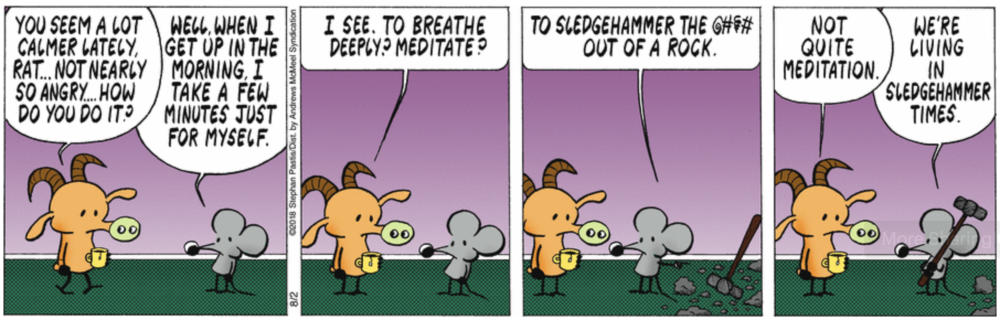
I do have a sledgehammer, though. It’s the word “No”.

You want to proposition women, OK. What do you do when they say “No”?

Sex is lovely. What if she says “No”?

What is your definition of a mean feminist? It seems to reduce to “A woman who says ‘No’.”

Can I hit you with this sledgehammer? No? Well, gosh, you’re no fun. Why are you trying to ruin this movement with your rules?

All right then, how about if I just run a calm, soothing hand across your thigh, sir? You can’t possibly complain about that. It would be something really hideous if you said “No.”


Although, to be honest, usually I just sigh and ignore these rants. It gets really tiring swinging a sledgehammer all morning. The women I know must have phenomenal upper body strength.

Another uninteresting nerd gets punctured

For a while, YouTube kept throwing these videos from someone called “Diversity & Comics” at me, until I managed to train it to realize that I despise this guy. He’s one of those white nerds — a regular snowflake — who gets irate at characters in comics who are not white men, or white women with large breasts. And now, of course, he’s outraged at the silly She-Ra controversy, where a reboot of a comic character is now drawn with less flamboyant boobs.

He got interviewed by Jim Jefferies at Comic Con. His views were treated with more respect than they deserved, but it’s still an effective skewering.

Do we really need 4500 words about an unrepentant pedophile?

This profile of W. French Anderson really needs some editing. Lots of editing. It’s about 4500 words long, and most of it is self-serviing puffery — we learn how highly he thinks of himself, how tough he is, that he recently aced his driving test, how he won a high school debate in 1951, and how he did some ambitious science in the 80s and 90s, but he’s unimpressed by this CRISPR stuff. The arrogance just oozes through the page, which I guess is one virtue of the article, but still it is tediously long. If I were editing it, I’d cut it down to less than 250 words. Here are the salient words; the rest is just noise.

But in July 2006, Anderson was convicted of three counts of lewd acts on a child and one count of continuous sexual abuse, including fondling her genitals. The sexual assaults started in 1997 when the girl was 10 and Anderson was 60, prosecutors said, and lasted until 2001 — abuse that his victim testified in court caused her “pain that led me to cut my own body and contemplate suicide.” Her mother ran Anderson’s lab, and he had mentored the child academically and in karate.

Before sentencing Anderson to 14 years in prison, Judge Michael Pastor said he had caused the girl “incalculable” emotional damage: “Because of intellectual arrogance, he persisted and he got away with as much as he could.”

It was not only the audiotape but also emails that helped convict Anderson. In response to the girl’s emailed request for an apology, for instance, he wrote that he “can understand what would drive a person to suicide. For me, a powerful 9-mm bullet through the head would be the way to go” and “just in case, I have bought the ammunition.” In another email, he wrote that he “came to the sad conclusion that there must be a very bad part of me that, now that I have recognized it, has to be permanently suppressed.”

OK, actually we could have ended it with the first paragraph. It’s enough. I’m indulging the writer.

Instead of hearing all that glurge about W. French Anderson’s grand scientific dreams stunted by his ten years in prison, the real story ought to have been about the cost and loss of opportunity to his victim, and to his victim’s mother, who was sufficiently qualified scientifically to run his lab. There’s the real loss to science, not the absence of an egotistical pedophile.

But we don’t hear their story, because they refused to be interviewed for this article. That ought to have told the author and her editors that maybe this is a story they should have shredded. W. French Anderson has had his decades in the spotlight. It’s past time to let him go.

With the right lens, I can reinterpret the world

I just stumbled across Making fists with your toes: Towards a feminist analysis of Die Hard. I am amused.

It gives me life when a certain sector of thin-skinned Nazis get sad about films I like. From Fury Road to Star Wars, their tears bring me joy. Since, like many other people, my favourite Christmas film is Die Hard, it is my intention to highlight how this film is in fact a celebration of femininity, and perhaps one could even call it feminist, for a rather Eighties value of feminism. Am I trolling? I don’t even know any more.

I don’t care if she is trolling. It’s an entertaining exercise to take a classic 1980s macho action movie, flip it over on its belly to get a completely different perspective, and then make penetrating reinterpretations of of its tropes, over and over again, until John McClane squeals and confesses to his inner femininity. I think it strains too hard and is a bit forced in places, but realistically, you’re not going to get Bruce Willis to surrender by being gentle with him.

Now I need a similar analysis of Michael Bay’s Transformers movies. That stuff is fraught, and Bay has … issues.