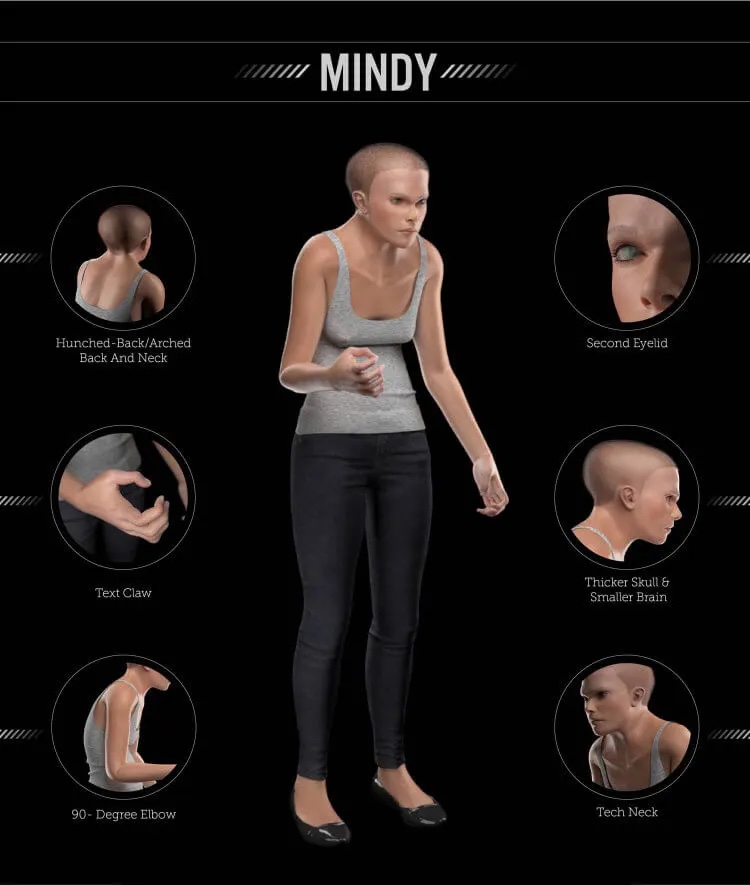
Who needs religion when you’ve got these clowns promoting bad ideas?

That’s an unholy trinity if ever I saw one: Bostrom, Musk, Galton. They’re all united by terrible, simplistic understanding of genetics and a self-serving philosophy that reinforces their confidence in bad ideas. They are longtermists. Émile Torres explains what that is and why it is bad…although you already knew it had to be bad because of its proponents.

As I have previously written, longtermism is arguably the most influential ideology that few members of the general public have ever heard about. Longtermists have directly influenced reports from the secretary-general of the United Nations; a longtermist is currently running the RAND Corporation; they have the ears of billionaires like Musk; and the so-called Effective Altruism community, which gave rise to the longtermist ideology, has a mind-boggling $46.1 billion in committed funding. Longtermism is everywhere behind the scenes — it has a huge following in the tech sector — and champions of this view are increasingly pulling the strings of both major world governments and the business elite.

But what is longtermism? I have tried to answer that in other articles, and will continue to do so in future ones. A brief description here will have to suffice: Longtermism is a quasi-religious worldview, influenced by transhumanism and utilitarian ethics, which asserts that there could be so many digital people living in vast computer simulations millions or billions of years in the future that one of our most important moral obligations today is to take actions that ensure as many of these digital people come into existence as possible.

In practical terms, that means we must do whatever it takes to survive long enough to colonize space, convert planets into giant computer simulations and create unfathomable numbers of simulated beings. How many simulated beings could there be? According to Nick Bostrom —the Father of longtermism and director of the Future of Humanity Institute — there could be at least 1058 digital people in the future, or a 1 followed by 58 zeros. Others have put forward similar estimates, although as Bostrom wrote in 2003, “what matters … is not the exact numbers but the fact that they are huge.”

They are masters of the silly hypothetical — these are the kind of people who spawned the concept of Roko’s Basilisk, “that an all-powerful artificial intelligence from the future might retroactively punish those who did not help bring about its existence”. It’s “the needs of the many outweigh the needs of the few”, where the “many” are padded with 1058 hypothetical, imaginary people, and you are expected to serve them (or rather, the technocrat billionaire priests who represent them) because they outvote you now.

The longtermists are terrified of something called existential risk, which is anything that they fear would interfere with that progression towards 1058 hardworking capitalist lackeys working for their vision of a Randian paradise. It’s their boogeyman, and it doesn’t have to actually exist. It’s sufficient that they can imagine it and are therefore justified in taking actions here and now, in the real world, to stop their hypothetical obstacle. Anything fits in this paradigm, it doesn’t matter how absurd.

For longtermists, there is nothing worse than succumbing to an existential risk: That would be the ultimate tragedy, since it would keep us from plundering our “cosmic endowment” — resources like stars, planets, asteroids and energy — which many longtermists see as integral to fulfilling our “longterm potential” in the universe.

What sorts of catastrophes would instantiate an existential risk? The obvious ones are nuclear war, global pandemics and runaway climate change. But Bostrom also takes seriously the idea that we already live in a giant computer simulation that could get shut down at any moment (yet another idea that Musk seems to have gotten from Bostrom). Bostrom further lists “dysgenic pressures” as an existential risk, whereby less “intellectually talented” people (those with “lower IQs”) outbreed people with superior intellects.

Dysgenic pressures, the low IQ rabble outbreeding the superior stock…where have I heard this before? Oh, yeah:

This is, of course, straight out of the handbook of eugenics, which should be unsurprising: the term “transhumanism” was popularized in the 20th century by Julian Huxley, who from 1959 to 1962 was the president of the British Eugenics Society. In other words, transhumanism is the child of eugenics, an updated version of the belief that we should use science and technology to improve the “human stock.”

I like the idea of transhumanism, and I think it’s almost inevitable. Of course humanity will change! We are changing! What I don’t like is the idea that we can force that change into a direction of our choosing, or that certain individuals know what direction is best for all of us.

Among the other proponents of this nightmare vision of the future is Robin Hanson, who takes his colonizer status seriously: “Hanson’s plan is to take some contemporary hunter-gatherers — whose populations have been decimated by industrial civilization — and stuff them into bunkers with instructions to rebuild industrial civilization in the event that ours collapses”. Nick Beckstead is another, who argues that saving lives in poor countries may have significantly smaller ripple effects than saving and improving lives in rich countries, … it now seems more plausible to me that saving a life in a rich country is substantially more important than saving a life in a poor country, other things being equal. Or William MacAskill, who thinks that If scientists with Einstein-level research abilities were cloned and trained from an early age, or if human beings were genetically engineered to have greater research abilities, this could compensate for having fewer people overall and thereby sustain technological progress.

Just clone Einstein! Why didn’t anyone else think of that?

Maybe because it is naive, stupid, and ignorant.

MacAskill has been the recipient of a totally uncritical review of his latest book in the Guardian. He’s a philosopher, but you’ll be relieved to know he has come up with a way to end the pandemic.

The good news is that with the threat of an engineered pandemic, which he says is rapidly increasing, he believes there are specific steps that can be taken to avoid a breakout.

“One partial solution I’m excited about is called far ultraviolet C radiation,” he says. “We know that ultraviolet light sterilises the surfaces it hits, but most ultraviolet light harms humans as well. However, there’s a narrow-spectrum far UVC specific type that seems to be safe for humans while still having sterilising properties.”

The cost for a far UVC lightbulb at the moment is about $1,000 (£820) per bulb. But he suggests that with research and development and philanthropic funding, it could come down to $10 or even $1 and could then be made part of building codes. He runs through the scenario with a breezy kind of optimism, but one founded on science-based pragmatism.

You know, UVC, at 200-280nm, is the most energetic form of UV radiation — we don’t get much of it here on planet Earth because it is quickly absorbed by any molecule it touches. It’s busy converting oxygen to ozone as it enters the atmosphere. So sure, yeah, it’s germicidal, and maybe it’s relatively safe for humans because it cooks the outer, dead layers of your epidermis and is absorbed before it can zap living tissue layers, but I don’t think it’s practical (so much for “science-based pragmatism”) in a classroom, for instance. We’re just going to let our kiddos bask in UV radiation for 6 hours a day? How do you know that’s going to be safe in the long term, longtermist?

Quacks have a “breezy kind of optimism”, too, but it’s not a selling point for their nostrums.

If you aren’t convinced yet that longtermism/effective altruism isn’t a poisoned chalice of horrific consequences, look who else likes this idea:

One can begin to see why Elon Musk is a fan of longtermism, or why leading “new atheist” Sam Harris contributed an enthusiastic blurb for MacAskill’s book. As noted elsewhere, Harris is a staunch defender of “Western civilization,” believes that “We are at war with Islam,” has promoted the race science of Charles Murray — including the argument that Black people are less intelligent than white people because of genetic evolution — and has buddied up with far-right figures like Douglas Murray, whose books include “The Strange Death of Europe: Immigration, Identity, Islam.”

Yeah, NO.

Your scientists were so preoccupied with whether or not they could, they didn’t stop to think if they should

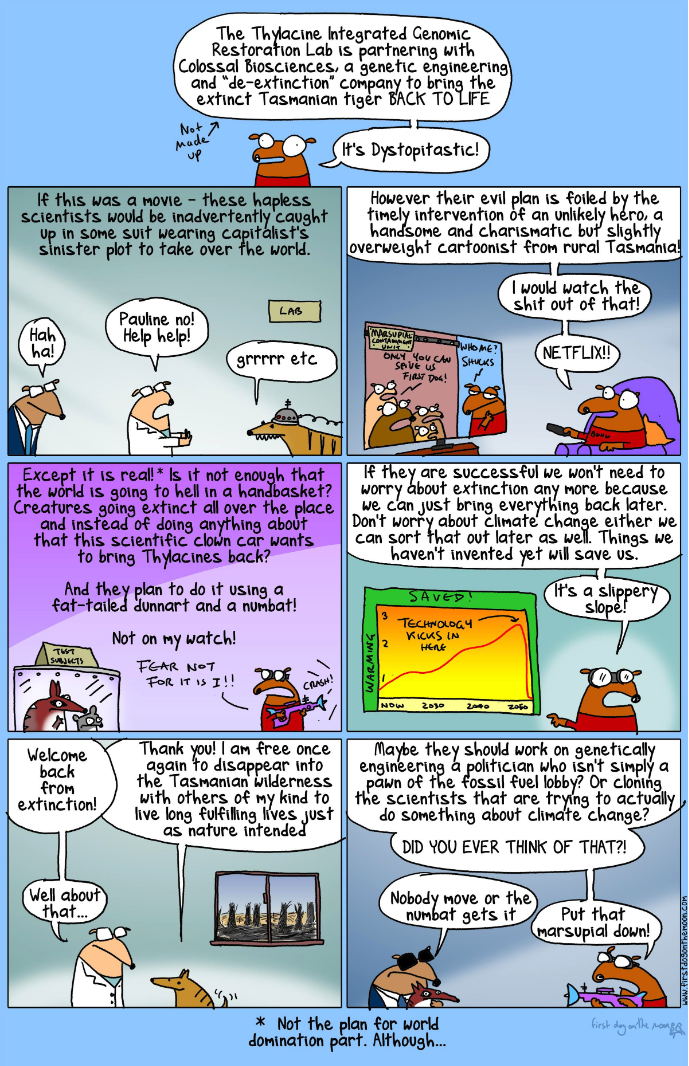
As usual, First Dog on the Moon scores.

Oh yeah. This again. Some molecular biologists with no training in population genetics or ethics think they can go into a lab and resurrect an extinct species.

Almost 100 years after its extinction, the Tasmanian tiger may live once again. Scientists want to resurrect the striped carnivorous marsupial, officially known as a thylacine, which used to roam the Australian bush.

The ambitious project will harness advances in genetics, ancient DNA retrieval and artificial reproduction to bring back the animal.

They won’t succeed. At best, they’ll assemble a maladapted hybrid something or other to be exhibited in some freak show of a zoo. It won’t be a thylacine, it’ll be a Frankenstein’s monster of an extant marsupial with no home environment and no prospects for the future and no population of conspecifics with which to live and no history. So much bugs me about this story.

They talk about “the thylacine genome”. There’s no such thing. A living population has many genomes. How many individuals are they sampling? How many individuals will they generate? Where will they live? These are carnivores — what will they feed on? Or are they just planning on conjuring up a technology demonstration that they’ll put in a cage and then move on to some other “project”?

They make a token nod towards the problem of extinctions, but aren’t very convincing.

“We would strongly advocate that first and foremost we need to protect our biodiversity from further extinctions, but unfortunately we are not seeing a slowing down in species loss,” said Andrew Pask, a professor at the University of Melbourne and head of its Thylacine Integrated Genetic Restoration Research Lab, who is leading the initiative.
“This technology offers a chance to correct this and could be applied in exceptional circumstances where cornerstone species have been lost,” he added.

No, it won’t accomplish any of that. The species is extinct because their habitat is destroyed and people killed them. That’s where you start, by rebuilding their environment, not with PCR machines and microinjection apparatus and flasks in incubators. It’s no surprise who is behind this: a guy with impressive credentials in molecular biology who thinks every problem is a lab exercise.

The project is a collaboration with Colossal Biosciences, founded by tech entrepreneur Ben Lamm and Harvard Medical School geneticist George Church, who are working on an equally ambitious, if not bolder, $15 million project to bring back the woolly mammoth in an altered form.

Yeah, right. He was claiming that he’d be bringing back the mammoth within two years…five years ago. He was also working on a dating app to eliminate genetic diseases (I guess he never heard of eugenics?).

Church has also speculated about resurrecting Neandertals. Nope. Not going to happen. If his thoughts on these matters were more than a millimeter deep, he wouldn’t be jumping onto high profile media to promote these sci-fi fantasies. It’s bad science.

The Pruitt stink lingers on

Speaking of crimes, Jonathan Pruitt is in the news again. Pruitt, you may recall, was a scientist at McMaster University who studied social behavior in spiders — very cool stuff, I’ve read many of his papers, he formed collaborations all over the place. Except…it seems he had faked a lot of his data, saddled his collaborators with untrustworthy work, and meanwhile, Pruitt nonchalantly continued on in his position and sailed off to do fieldwork. McMaster University seemed to have no problem with this stuff, even after Pruitt’s Ph.D. was retracted for his fraudulent behavior.

I would have thought faking data and having your degree invalidated would have been sufficient grounds for an instant dismissal, but someone at McMaster was really dragging their heels about getting the rubbish thrown out. I wonder if Pruitt was talking about lawsuits behind the scenes?

Now we’ve got some progress to report. McMaster never got around to firing him, but Pruitt has resigned instead!

With a pivotal research misconduct hearing nearing, a behavioral ecologist under fire for more than 2 years for data irregularities or possible fabrication in dozens of publications has resigned from their prestigious position at McMaster University, Science has learned. The Canadian school confirmed yesterday in a statement it has reached a “confidential” settlement with Jonathan Pruitt, whose work on social behavior in spiders had earned international acclaim and whose willingness to share data drew many eager collaborators.

What required a “confidential” settlement? What needed to be settled at all? I don’t understand why a clear violation of academic and scientific standards should have required prolonged meetings and a hush-hush resolution. Did McMaster pay him to get out?

Now Pruitt is talking like he’s won a great victory.

Pruitt has not yet responded to McMaster’s statement about the resignation but yesterday, before the university confirmed the news, told Science in an email, “I am approaching a moment when I will be able to speak about #PruittGate in an open forum.” (Twitter users labeled discussions about the ecologists’ research #PruittGate in 2020, when the controversy erupted.)

Do we care anymore what Pruitt has to say? The evidence that he faked data is strong and pretty much irrefutable. Nobody has been waiting to hear what excuses he can come up with. There’s a palpable arrogance to that statement. Especially given the few hints we’ve got about this settlement.

In the past few days, Laskowski says, McMaster contacted some of those researchers to say there would no longer be a hearing because of the settlement. The university noted in an email that as part of the deal, “Dr. Pruitt agrees that they will not initiate any legal action against you for making complaints to McMaster University about Dr. Pruitt, or for your participation in any McMaster University process or investigation.”

What the fuck? Laskowski was the victim here. McMaster has basically cancelled any investigation into wrongdoings and left all the collaborators whose work was corrupted by Pruitt hanging, and apparently Pruitt had threatened to sue the people who exposed his shoddy work. What an awful person.

Although Pruitt is no longer employed by McMaster as of 10 July, according to the statement, the university has still not revealed any conclusions from a recently completed probe into the scientist’s research. That leaves some journal editors and researchers in the field confused about what work from Pruitt remains trustworthy and whether any research misconduct occurred. “It’s appropriate that Jonathan is no longer employed—hopefully at any academic institution,” says Kate Laskowski, a behavioral ecologist at the University of California (UC), Davis. “But I won’t feel [McMaster administrators] have done enough until they make public their findings about the investigation. … I’m extremely frustrated.” Laskowski first brought concerns about Pruitt’s data to public light, via a blog post, in early 2020 after anomalies in a publication on which they were co-authors were brought to her attention.

Hey, confused journal editors and researchers, it’s easy to tell what work of Pruitt’s remains trustworthy: NONE OF IT. I read a fair amount of the scientific literature on spider behavior (it’s interesting!), and one thing I do to assess whether it’s worth reading the whole paper is to first look at the authors. If “Pruitt, J” is among them, I don’t need to waste my time reading it.

That’s the real injustice here. His coauthors don’t deserve that kind of dismissal, but I’m really not going to bother trying to sort out fact from fiction in those papers.

The racist BS of Intelligence and Breast vs. Ass Preference

Here’s one for the Evolutionary Psychology Hall of Shame:

The author of this “study” has a theory, which is his, that breasts are an expensive ornament that could only be selected for in a stable environment where individuals can afford them. They’re kind of like elaborate antlers in species that have them, I guess. Maybe. I could consider an argument along those lines, except this one runs off the rails pretty quickly.

My theory of the evolution of breasts is that they are an adaptation for a slow life history rather than a fast life history. Breasts are K-selected. r-selected animals with a fast life history have short lifespans and mature quickly. K-selected species have longer lifespans, invest more in their children and take longer to mature. Fast life history is an adaptation to unstable ecologies where mortality is more random and uncontrollable so the best option is to have as many offspring as possible. By contrast in predictable environments, there’s an advantage to investing more in offspring to increase their chances.

Breasts by selecting for stable, long-term relationships between males and females facilitate long-term investment in offspring. It makes sense that only humans would have permanent breasts. Compared to other primates we have a slow life history strategy. We live for a particularly long time, take a long time to mature and need substantial resources and protection to develop our large brains.

For those of you fortunate enough to have never encountered racist literature, this r and K stuff, while legitimate parameters in ecology and evolutionary biology, is going to be sadly abused by racists. They want to argue that different populations of humans are living in very different r and K selection regimes, and that they have been living in those situations for long periods of time that are evolutionarily significant. They only trot out these terms to justify with pseudoscience their biases. So be warned: this is garbage science of the rankest kind.

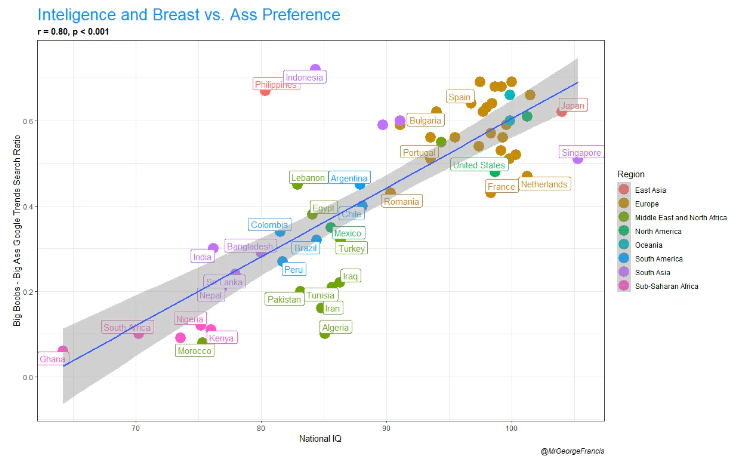
You can’t see the axes of the big graph in the tweet above, so let me extract it for you.

The title, Intelligence and Breast vs. Ass Preference, should alert you to the absurdity that is about to follow. Note the horizontal axis: National IQ. This is a totally bogus parameter. As near as I can tell, it comes from the work of Richard Lynn, an English psychologist associated with a network of scientific racists who fabricated a list of IQ values associated with different nationalities which supported his bias that Africans were less intelligent than Europeans who were less intelligent than Asians. He’s on the board of the Pioneer Fund, an organization that hands out cash to other racist groups and individuals, and he’s also on the board of the notoriously racist journal Mankind Quarterly, which is a recipient of those funds. It’s an incestuous gang of bad pseudoscientists who reference and support each other’s bad pseudoscientific claims.

Now turn your eyes to the vertical axis, Big Boobs-Big Ass Google Trends Search Ratio.

Yes, it’s exactly what it sounds like. He used Google Trends to look at the frequency of people in various countries searching for the terms “Big Boobs” vs “Big Ass”. In English. He even admits that his results may reflect a linguistic bias, unaware that there are a lot of other reasons why this could be a very poor metric for measuring anatomical preferences. He’s an idiot trying to shoehorn technical terms from evolutionary biology into an inappropriate context with an incredibly sloppy methodology, all to support his racist biases.

Also note that Emil O W Kirkegaard, another racist, is touting this “work”, suggesting that it should appear in the next issue of Mankind Quarterly, which does tell you something about MQ’s standards.

He did later sort of retract that, dismissing criticisms of the inanity of that graph by saying this was a blogpost, not a formal study and making it clear that it wasn’t his work, but George Francis’s.

I want you to know that it was painful for me to dig into Kirkegaard’s repulsively racist Twitter history, in part because he has me blocked (Yay! And also easily circumvented), but also because it was imbedded in all kinds of wretched crap. Did you know Gypsies got bigger balls than Hungarians? And that Unnatural hair color really is a danger zone marker? (You will not be surprised to learn that a picture of Rebecca Watson is used as evidence, although I’m sure she’s tired of it.)

I need a shower after that.

Kirkegaard, by the way, is an editor for Mankind Quarterly. You should be troubled by the fact that Psychology Today, a reasonably mainstream publication that I already didn’t trust at all, has cited him in a terrible article that claims “Higher rates of mental illness have been found on the far left.” The foundation of the entire claim is built on a single paper by Kirkegaard published in Mankind Quarterly, which, I remind you, he edits.

The real danger zone marker here is Mankind Quarterly. Any time you see that journal cited, know that you are going to be exposed to toxic racist bullshit of the worst kind, with the kind of rigor that can be demonstrated with a graph of Intelligence and Breast vs. Ass Preference.

How to spot a bad journal

I get solicitations to publish papers all the time, and I just roundfile ’em. There are journals that are desperate for suckers to pay them to publish their work, and they’ll accept anything. We call them predatory journals, but I have a reservation about that: the whole establishment scientific publishing system is predatory, taking the federally funded output of scientists and billing them so that they can publish. But some are more lacking in discrimination and prestige than others, and have lower standards to the point of absurdity.

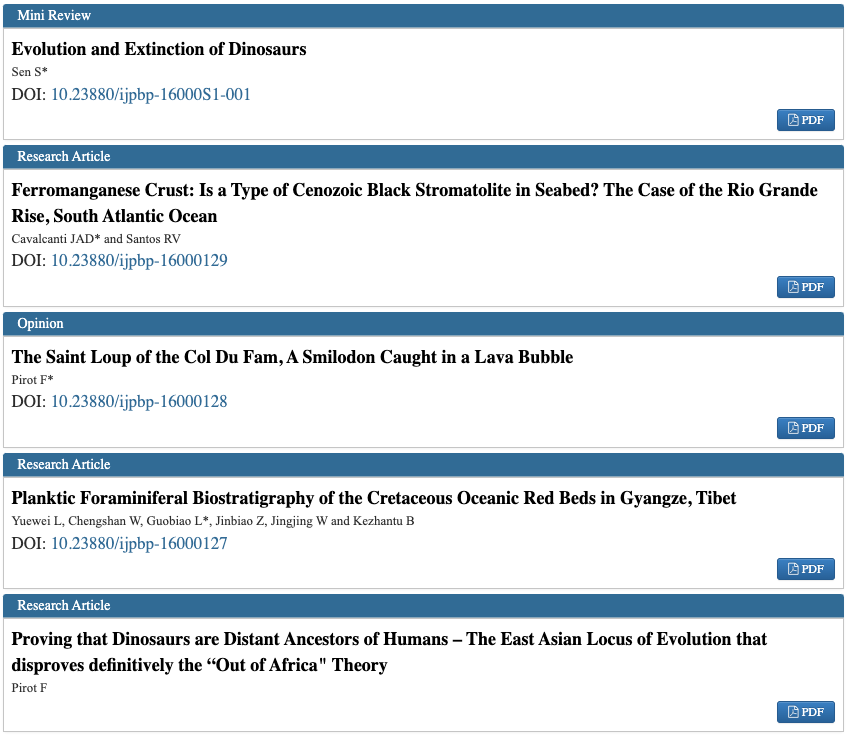
Dan Phelps got invited to publish in the International Journal of Paleobiology & Paleontology, which sure sounds like Serious Science, but he took one look at their table of contents and could tell this was a garbage dump. Do you notice anything funny about it?

When accused of being a predatory journal, they have a curious response.

Thank you for your reply, We would like to inform you that ours is not a predatory journal. We have received the ISSN which is provided in our previous email. For your convenience, we are providing the link of our journal where you can find complete information of our journal and Editorial Board members. Link: https://medwinpublishers.com/IJPBP/index.php Kindly revert back if you have any queries. Look forward hear from you soon. Kind Regards, Jackie Crystal Assistant Managing Editor

They can’t be a predatory journal, they have an ISSN! The International Standard Serial Number just means they registered with an organization that issues unique ID numbers to periodicals, magazines, newspapers, even blogs (kinda expensive with no big advantages, so we don’t have one here), and the organization itself says, “it does not guarantee the quality or validity of the contents”.

Some of those titles are dead giveaways, though, and I felt like digging into them a bit. Here’s a fun one, Proving that Dinosaurs are Distant Ancestors of Humans – The East Asian Locus of Evolution that disproves definitively the “Out of Africa” Theory. The title alone tells you that this is nonsense, and that there was no peer review, and that the journal will publish anything.

It was written by Florent Pirot, who is an independent researcher — that means he isn’t a professional employed by any relevant institution. That’s fine, amateur scientists are welcome, but all you have to do is read the abstract to see there’s no substance here.

The study of evolution is clad with vivid debates and each new fossil brought back from ground studies can start a debate, with the ever-existing risk of creative artists looking for celebrity and building dangerously resembling creatures out of thin air. There nevertheless is a very significant, and simple, way, to demonstrate that the parentry of humans is not to be found in the mice of the Jurassic that are presented to be the founding mammals in the mainstream theory but that big dinosaurs that escaped the -65 MY disasters slowly evolved into standing mammals and that our genes are more related to these mammals. Existing literature from PNAS and Science is brought together with the analysis of the author to prove the point.

That doesn’t say anything. He is saying in clumsy English that humans descended from dinosaurs that escaped the KT extinction, but he doesn’t say what he’s going to do in this paper. It’s just as well; this is going to be an exercise in pareidolia and random leaps of logic. For instance:

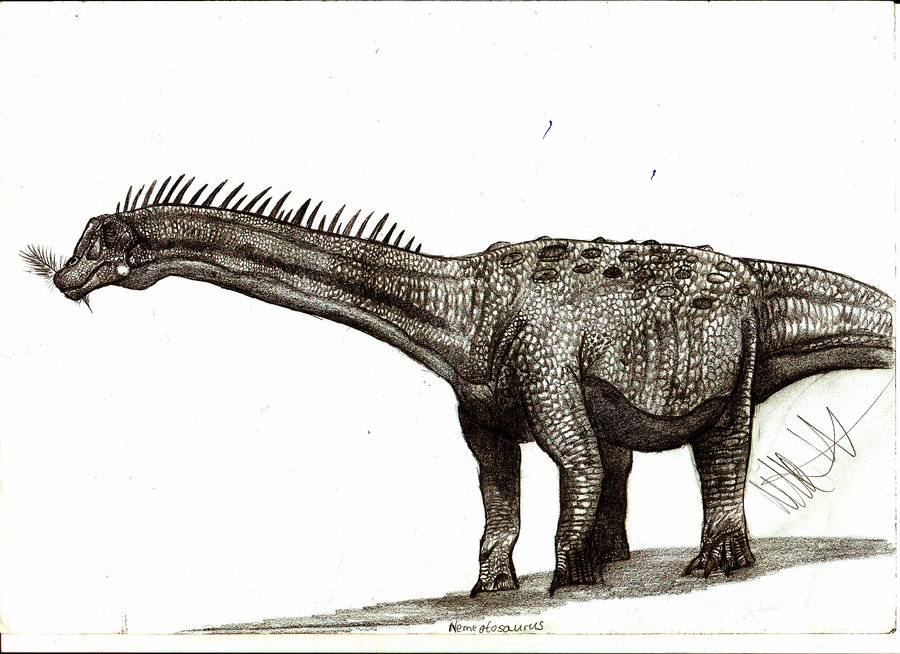
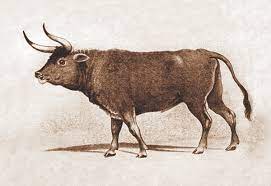
In Central Asia and Mongolia, the findings of the Nemegtosaurus in the Nemegt Basin show parentry with aurochs, based on the skull, and suggest a farther relation with oreodonts. The skull’s eyes (in the model presented in the Polish Academy of Sciences Evolution Museum) are below two circular areas that obviously were fitted with horns that were perhaps renewed each year, as in deers today. The prominence of the jaws suggests a link with Theropithecus gelada.

Here’s Nemegtosaurus:

Here’s an aurochs:

Anyone care to tell me where they show “parentry”? Because Mr Pirot doesn’t.

This, by the way, is Theropithecus gelada, the gelada baboon. I don’t see anything about the jaws of baboon, aurochs, and dinosaur that suggest a link, other than the general one, that they all have jaws.

Then he gets to his “data”. This, for instance, is a Parasaurolophus beak remain incrusted in the crystallized magmatic rock. Picture taken in Valbonne, from local supply of rocks.

No it’s not.

Another “fossil,” Theropitecus Gelada skull also molded in magma, from the same rock supply as above, estimated to be 10 to 12 MY old:

No, that’s not a baboon skull.

Read further and you find that Florent Pirot is a silly man who putters about in his yard in Valbonne, France looking at random rocks and imagining similarities with various species that he has read about, linking them in imaginary patterns of descent that he can’t justify.

He’s a French Ed Conrad or Roger Spurr! He’s one up on them because he managed to publish a couple of papers on his bizarre ideas in a garbage journal.

Yes, more than one. Here’s another you’ll find entertaining: The Saint Loup of the Col Du Fam, A Smilodon Caught in a Lava Bubble. He’s got lots of pictures of rocks that he fancies to be dramatic fossils, like this one of a teeth.

Ha ha, you may laugh, but keep in mind that this is delusional kook who is being preyed upon by a journal that charges substantial page fees (I don’t know what this one charges, but typically it’s on the order of hundreds of dollars) to put his mad ideas in print. If you can be outraged that televangelists bilk donations out of the poor to build their media empires, you should recognize that this is exactly the same thing, simply substituting Science for Jesus.

The other thing that should annoy you is some creationist wanker like Matt Powell will seize on this and wander about telling people that those stupid evilutionists believe dinosaurs evolved into a baboon evolved into humans when no, we don’t. Some bête imbécile in the South of France thinks that, and a criminally fraudulent journal is parasitizing him.

I f’in hate evolutionary psychology

Sorry, I saw this evo psych study and had to vent.

Here’s the protocol: subjects were primed with powerpoint slides of modern economic devastation with an explicit slide with text saying the 21st century is a “harsh and unpredictable world”. The controls, near as I can tell, saw the same slides without the text. Then they flashed a slide of topless women’s torsos with breasts of varying shapes and sizes, and asked the subjects to rate the women.

Let me just say that if you’re doing any kind of psych study that ends with a request to rate women’s breasts, you’re doing something wrong. I can’t even begin to unpack all the assumptions you’ve pre-loaded into the work.

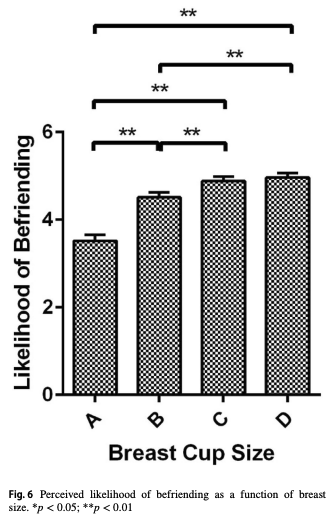
And then the results are underwhelming: a bunch of bar graphs that show very little variation in the responses, with a few showing statistically significant but totally unimpressive differences. Overall, men rated women with larger breasts as more attractive, fertile, healthier, reproductively successful, and likely to befriend. The n was 144, all drawn from college students at a midwestern American university, so of course we can infer universal principles of human evolution from it.

Here’s the kind of graph you can make as an evo psych goofball.

Dazzling information. If you hate yourself as much as I do, you can read the paper, too. It’s awful. So many statistics to strain to extract something significant from noisy data already compromised by cultural indoctrination.

A truly sinister trend

Look at the data, scientifically!

In 1900, only about 3% of the population would admit to being left-handed. In the mid-1970s, it was up to about 11%. I don’t want to know what it’s like now, but being left-handed is clearly trendy, and if we just extrapolate from those numbers of an 8% increase in 76 years, I’d estimate that the population must be about 16% left handed today, and that the lefties will have completely taken over by 2800. We righteous righties are on the path to extinction! This is the real Great Replacement! Someone needs to alert Tucker Carlson and get the word out!

Physics is an atavistic form of biology, then

I have addressed the nonsense about cancer as an atavism multiple times here, and I even made a video about it. Paul Davies is a medical crackpot, and his pal Charley Lineweaver is just as goofy, but it seems they noticed me, and I got a nice polite email from Lineweaver about it.

Hi PZ,

I just came across your video

I plead innocent of subscribing to the Haeckelian view that

“Development stages recapitulate adult evolutionary stages”

at 14:38 of your video.

If you remove the word “adult” then I would agree more with the statement.

You might be interested in our two recent papers (attached).

Also, as a biologist, you might be interested in an online video course
I just put up at arewealone.us

It’s got a lot of biology in it.

If you find any egregious mistakes, please let me know.

Yours for better science,

Charley Lineweaver

First, I would note that removing one word doesn’t help: “Development stages recapitulate evolutionary stages” is just as bad as “Development stages recapitulate adult evolutionary stages”. Development does not recapitulate the evolutionary history of the organism. Are we going to claim that mammals evolved from an ancient ancestor with a trophoblast that attached to a larger organism to leech off its fluids? Of course not. Mammalian extra-embryonic membranes are great examples of an evolutionary novelty appearing at a time in development that does not reflect a phylogenetic sequence.

As for his claim that cancers are atavistic reversions to a primitive state, see the links I posted above. Enough said. It’s garbage science. I’m just mildly horrified that yes, he sent me two more papers on the subject, published in 2021, and the idea is still getting published in respectable journals. Maybe I’ll dig into those papers some other time, but I think it’s sufficient to dismiss them out of hand since they provide no new information, and are just more exercises in frantic handwaving. Flap, flap, flap, oh look, we made another paper. Flap, flap.

I was mildly intrigued by the web site he mentioned, calling it an “online video course”, which it isn’t. It also doesn’t have much biology in it. But you be the judge: visit arewealone.us for yourself.

It was very nice of him to include a video summary of the “course”, titled “The Course in 7 Minutes”. Great, I can spare 7 minutes!

I didn’t even give it 7 minutes, I’m afraid. I skipped a lot, missing nothing of substance, because all it is is an excerpt from Beethoven’s Fifth played while random images flash by. There is no content there. There are no words, no explanations, not even an attempt to stitch any kind of story or explanation to it. It’s an incoherent mess. It is an accurate summary of the “course”, I’ll give him that.

I dug deeper, and he does have kind of a syllabus.

Week 1 – What does “Are We Alone?” Mean?
Week 2 – Our Evolution Over 20 Million Years
Week 3 – Our Evolution Over the Past 500 Million Years
Week 4 – Our Evolution Over the Past 3 Billion Years
Week 5 – Our Evolution Over the Past 4 Billion Years
Week 6 – Origins of Life: What is Life?
Week 7 – Intelligent Extraterrestrials?
Week 8 – More Conversations with Experts

Each of those entries is a link to more videos, and once again, we descend into chaos. Lineweaver’s approach seems to be to ask various of his science friends to let him interview them, and he drops by and sets up a camera in their office and asks a bunch of questions, like these:

This video-based course probes the question “Are we alone?” Unlike SETI scientists, Mars rovers and planet-hunting astronomers, we take a biological approach and ask: “How did WE get here?” Like salmon swimming upriver to the pond where they were born, we are led upstream from whence we came. We take a pilgrimage into the past to the origin of life 4 billion years ago. During this evolutionary odyssey with astrobiologist Charley Lineweaver, we ask: Who is “we”? Why did our brains get so big? How did life get started? Are viruses alive? What is life? Answers to these questions may help us get from How DID life start? to How DOES life start?

This leads to a confusing collection of short (typically 5-6 minutes) video interviews. There is no synthesis. There are no answers, not even an attempt to assemble some kind of consensus. I watched a few and then gave up.

If I were asked, “are we alone?”, my answer would be something like, “I don’t know, but probably not. I think the prebiotic chemistry that led to life is probably universal, so it could be common, but we’ve got an n of 1 so far. If we found signs of ancient life on Mars, though, that would increase the probability of life of some sort being common.” That’s all we’ve got so far. I also think that anyone who says yes, absolutely, or no, absolutely, isn’t worth talking to further.

I would turn the questions about, though, and ask how Charley Lineweaver, an honorary associate professor at the Research School of Astronomy and Astrophysics and Research School of Earth Science at the Australian National University, a man with an advanced education that is entirely in physics, who has a PhD in physics from Berkeley, gets to call himself an astrobiologist, and does that mean I get to call myself an astrophysicist, despite an education that was almost exclusively in biology, and despite having a position as a biology professor?

Oh, wait. He also says he is “the son of a high school biology teacher”, so I guess he inherited his parent’s qualifications. With that logic, that means that my father’s line of work means I get to call myself a diesel mechanic now. Or maybe an astro diesel mechanic?

Who writes these things?

Here’s an article to make you wonder: Future evolution: from looks to brains and personality, how will humans change in the next 10,000 years?. In my case, what I wondered is who would write a long essay on the topic, because if I were to do it, it would be one line, either “I don’t know” or “Incrementally, probably imperceptibly.” But no, in this case it’s written by a “Senior Lecturer in Paleontology and Evolutionary Biology” — whoa, he’s qualified — but the answer is drivel.

Ten thousand years is nothing. Ten thousand years ago we looked roughly like we do now, and we have to go back a hundred thousand or more years before we might see some differences visible to the naked eye, and even those we wouldn’t be able to distinguish from environmental differences. Why would you expect major changes in the next ten thousand? Are you going to predict colossal environmental changes, which would make this a rather dire story? Again, no. It doesn’t talk about serious changes in climate, or catastrophic collapses of social structures…it’s all about mysterious trends that evolution predicts (it doesn’t).

So we get platitudes.

It’s hard to predict the future. The world will probably change in ways we can’t imagine. But we can make educated guesses. Paradoxically, the best way to predict the future is probably looking back at the past, and assuming past trends will continue going forward. This suggests some surprising things about our future.

If we’re basing everything on “trends”, how could that suggest anything surprising? Isn’t it going to be just more of everything going in the same direction?

We will likely live longer and become taller, as well as more lightly built. We’ll probably be less aggressive and more agreeable, but have smaller brains. A bit like a golden retriever, we’ll be friendly and jolly, but maybe not that interesting. At least, that’s one possible future. But to understand why I think that’s likely, we need to look at biology.

I’m at a loss. We’re going to be like golden retrievers? Why would you think we’re becoming less aggressive and more agreeable? I think he’s been reading Pinker.

I agree, though, let’s look at biology. Unfortunately, he doesn’t.

Some scientists have argued that civilisation’s rise ended natural selection. It’s true that selective pressures that dominated in the past – predators, famine, plague, warfare – have mostly disappeared.

Starvation and famine were largely ended by high-yield crops, fertilisers and family planning. Violence and war are less common than ever, despite modern militaries with nuclear weapons, or maybe because of them. The lions, wolves and sabertoothed cats that hunted us in the dark are endangered or extinct. Plagues that killed millions – smallpox, Black Death, cholera – were tamed by vaccines, antibiotics, clean water.

Would you believe that he wrote this in March of 2022? Pollyanna lives!

He goes on and on. We’re going to live longer. We’ll get taller. We’ll become more beautiful, thanks to sexual selection. The “trend” says that our brains will get smaller. We’ll become more conformist. But maybe we’ll speciate!

In the past, religion and lifestyle have sometimes produced genetically distinct groups, as seen in for example Jewish and Gypsy populations. Today, politics also divides us – could it divide us genetically? Liberals now move to be near other liberals, and conservatives to be near conservatives; many on the left won’t date Trump supporters and vice versa.

Could this create two species, with instinctively different views? Probably not. Still, to the extent culture divides us, it could drive evolution in different ways, in different people. If cultures become more diverse, this could maintain and increase human genetic diversity.

Aaargh. Is the current American political divide going to be lasting and worldwide? Does he think Trump is a trigger for a speciation event? I give up. This article is just too stupid.

If someone were to ask me to write such an article, my first response would be “go away.” If pressed, I would say that what matters are entirely contingent evolutionary responses to material conditions which we cannot predict and therefore can’t use to estimate changes to our genes. And if an editor suggested just extrapolating from past changes in the last ten thousand years, I would point out that they are assuming that the patterns are a product of inherent biological processes and assuming that environmental forces don’t exist, and neither assumption is likely to be true.

Like I say, my version of this article would be very, very short. I don’t understand the reasoning behind any scientist’s decision to accept such a commission.