Yep, I finally did it: I have revealed to the creationists the secret we have held so long: how to destroy evolution.
Forgive me.

Yep, I finally did it: I have revealed to the creationists the secret we have held so long: how to destroy evolution.
Forgive me.

In case you didn’t realize this already, he’s got all the kook symptoms. Kent Hovind is a young earth creationist, and now, quite clearly, a vaccine denier. This is a short excerpt from a much longer conversation with another creationist, in which he apparently felt comfortable letting his hair down. Watch it while you can, it wouldn’t surprise me if it gets taken down.
To summarize, he thinks the Tribulation (which isn’t in the Bible) is about to start this year, or has already started. He thinks the Rapture (also not in the Bible) will occur in 2028. He believes that there are microchips (mark of the beast!) in the vaccines, and that the government will be tracking you by shining UV or blue lights on you.
I guess I’ll have to cite Deuteronomy 13:1-5.
1 If there arise among you a prophet, or a dreamer of dreams, and giveth thee a sign or a wonder,
2 And the sign or the wonder come to pass, whereof he spake unto thee, saying, Let us go after other gods, which thou hast not known, and let us serve them;
3 Thou shalt not hearken unto the words of that prophet, or that dreamer of dreams: for the Lord your God proveth you, to know whether ye love the Lord your God with all your heart and with all your soul.
5 And that prophet, or that dreamer of dreams, shall be put to death; because he hath spoken to turn you away from the Lord your God…
Also Matthew 24:36.
But of that day and hour no one knows, not even the angels of heaven, but My Father only.
Those actually are in the Bible.



These hardened criminals and repeat offenders…Kent Hovind has been found guilty, guilty, guilty of domestic violence in the third degree for throwing his girlfriend/”wife” to the ground. He’s been sentenced to a year in jail, but will only have to serve 30 days, and pay a fine.

This is going to punch a hole in his daily YouTube posting schedule. I checked the one from yesterday — it contains a long rant about the US prison system in which he claims the system of Biblical punishments was better, that getting a fine and 40 lashes was more humane than locking someone up. I kind of agree with him — US prisons are all kinds of fucked up, but not with whipping people — but I didn’t hear him say anything about the injustice of beating a spouse up.
It’ll be interesting to see what he complains about when he gets out.

I’m going to call the relentless, performative celebration of something called “rationality” Pinkerism now. I’ve noticed it before: every YouTube channel that considers it a sufficient declaration of their worthiness to simply label themselves “The <insert adjective for “smart” here> Atheist”, all the lists of logical fallacies, the books about how everyone else is so stupid, the insistence that we get better by just being more logical (even when they’re contradicting themselves), the Mr Spock envy. It got old. It just seemed so joyless.
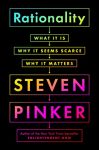 Well, you can trust good ol’ Steven Pinker to come along and dial it all up to 11. His new book is titled Rationality, and every smug wanker in the fading atheist movement will snatch it off the shelves. I won’t be one of them, so I’m going to have to rely on getting my impressions second hand, unfortunately. But oh boy, this review is stinging.
For someone who so frequently and serenely proclaims that he’s right, Steven Pinker can get curiously defensive. In “Rationality: What It Is, Why It Seems Scarce, Why It Matters,” Pinker writes as if he’s part of an embattled minority, valiantly making the case that “the ability to use knowledge to attain goals” is so underappreciated these days that the reading public needs a new book (by Pinker) “to lay out rational arguments for rationality itself.”
He’s very disappointed that we aren’t all down on our knees praising Saint Steven.
Still, Pinker is troubled by what he sees as rationality’s image problem. “Rationality is uncool,” he laments. It isn’t seen as “dope, phat, chill, fly, sick or da bomb.” As evidence for its diminished status, he quotes celebrations of nonsense by the Talking Heads and Zorba the Greek. (Pinker is also vexed by the line “Let’s go crazy,” which he says was “adjured” by “the Artist Formerly Known as Prince.”) It’s precisely this cultural derision of reason, he says, that prevents us from appreciating rationality’s spectacular accomplishments. “Human progress is an empirical fact,” he writes. “‘Progress’ is shorthand for a set of pushbacks and victories wrung out of an unforgiving universe, and is a phenomenon that needs to be explained. The explanation is rationality.“
You know the Talking Heads is a rather cerebral band, right? That dadaism was an intellectual movement? And that Prince was a joyful celebrant of art? I guess we’re not supposed to be happy. We’re supposed to be like Martians, with “intellects vast and cool and unsympathetic”.
No one would have believed in the last years of the nineteenth century that this world was being watched keenly and closely by intelligences greater than man’s and yet as mortal as his own; that as men busied themselves about their various concerns they were scrutinised and studied, perhaps almost as narrowly as a man with a microscope might scrutinise the transient creatures that swarm and multiply in a drop of water. With infinite complacency men went to and fro over this globe about their little affairs, serene in their assurance of their empire over matter. It is possible that the infusoria under the microscope do the same. No one gave a thought to the older worlds of space as sources of human danger, or thought of them only to dismiss the idea of life upon them as impossible or improbable. It is curious to recall some of the mental habits of those departed days. At most terrestrial men fancied there might be other men upon Mars, perhaps inferior to themselves and ready to welcome a missionary enterprise. Yet across the gulf of space, minds that are to our minds as ours are to those of the beasts that perish, intellects vast and cool and unsympathetic, regarded this earth with envious eyes, and slowly and surely drew their plans against us. And early in the twentieth century came the great disillusionment.
We all know how the Martians ended up.
Some of Pinker’s observations on racial issues are similarly blinkered. Are mortgage lenders who turn down minority applicants really being racist, he muses, or are those lenders simply calculating default rates “from different neighborhoods that just happen to correlate with race?” (A long history of racist redlining may “happen” to have something to do with this too, but Pinker doesn’t get into it.) He goes on to ask why “race, sex, ethnicity, religion and sexual orientation have become war zones in intellectual life, even as overt bigotry of all kinds has dwindled.”
Anyone paying attention to what’s been happening in the last few years might wonder where he got his information. In support of his vague claim, Pinker directs the reader to a footnote citing two sources: a study, whose data ended in 2016, that measured a person’s “explicit attitudes” based on self-reporting (i.e. the respondents had to admit their bigotry); and a few (unhelpful) pages from “Enlightenment Now.”
It looks like he’s well on the path to self-referential insertion of his head up his own rectum. Perhaps the walls of his colon prevent him from noticing the increases in hate crimes in the US.
Poverty is also negligible in Pinker’s brain, and he’s always ready to indulge in the small pleasure of wagging a finger at fat people enjoying lasagna. He’s very petty that way.
The trouble arrives when he tries to gussy up his psychologist’s hat with his more elaborate public intellectual’s attire. The person who “succumbs” to the “small pleasure” of a lasagna dinner instead of holding out for the “large pleasure of a slim body” is apparently engaged in a similar kind of myopic thinking as the “half of Americans nearing retirement age who have saved nothing for retirement.” His breezy example elides the fact that — according to the same data — the median income for those non-saving households is $26,000, which isn’t enough money to pay for living expenses, let alone save for retirement.
So what’s the source of these “problems”? If you’ve read any right-wing media in the last few decades, you know the answer: education. I’m a little surprised that a Harvard professor would so readily find common cause with Prager U.
He repeatedly says that by promoting rationality he’s promoting “epistemic humility,” but you’d be hard-pressed to find much humility here, as he pronounces that among the biggest barriers to rationality’s triumph is “the universities’ left-wing suffocating monoculture.”
Oh, I know. I’ve noticed that biology departments across the country suffer from a suffocating monoculture of evolutionists, and math departments still persist in suffocating students with calculus, and chemists, those old fuddy-duddies, still strangle students with stoichiometry and bonds and thermodynamics. I dare not look across campus to the humanities and social sciences, where everyone is in zombie-like lockstep, there is never any dissent, and no one has any ideas, other than ones that might make comfortable Harvard professors uncomfortable, and which may therefore be ignored and belittled.
Has he ever considered that maybe left-wing philosophies thrive on college campuses because a) we like diverse ideas, and b) we like to challenge those ideas, two principles that are anathema to conservatives? And, apparently, anathema to Pinker, who has The Answer to everything. Rationality. Don’t you dare go crazy or question the status quo. Same as it ever was. Same as it ever was. Same as it ever was. That’s “epistemic humility”.
But don’t worry. Pinker is a smart man who will make a good sum of money out of his schtick. And that’s what matters, although I have to recommend that he put on Remain in Light or Purple Rain and listen for a while. He’d be a better person for it.

I got out of Facebook, but the stench still follows me. Yesterday, a reader told me about a new Facebook group that was recruiting. It’s called “Skeptic Revival”, and its aim is to resurrect the old skeptical movement, you know, the kind of antique skepticism that existed before the Deep Rifts shredded everything, the kind of skeptical organization that Don Draper would have loved to join. The first problem is that Barbara Drescher is leading this effort, and I couldn’t imagine a worse person to rally a modern skeptical movement…until I saw the rogue’s gallery she’s assembled in her big tent.

There’s DJ Grothe, former president of the JREF who ignored sexual harassment complaints and lied about them.
There’s Ben Radford, creepy litigious sex pest who believes that girls have an evolved preference for pink.
Russel Blackford, generic philosopher and waffler in the middle ground who dislikes all those SJWs.
Abbie Smith, deranged hate-blogger (I thought Drescher despised those?) who started the Slymepit.
Just seeing these few names has me throwing up in my mouth a little bit — I wouldn’t want to be seen in public with any of these people, let alone join the same club. These are the people the rifts formed to separate us from their regressive brand of conservative skepticism, but there they are, standing on the far side of the chasm.
If you want to join them, feel free: here’s a link to Skeptic Revival. I will think less of you for joining, but I won’t know, I won’t be following their shenanigans, I’m not on Facebook, so you can secretly join the narrow-minded skeptic harasser’s club. No one who matters will know. Except yourself, of course.


A decade ago I briefly tangled with Bob Enyart and his pal Fred Williams. They had a show called Real Science Radio where they preached nonsense about creationism — there’s no real science anywhere in it — where they constantly claimed to have disproven evolution and threw debate challenges at every nobody (like me) that they stumbled across. Even then, I was disgusted with creationist debates and wasn’t going to get into it with a kook like Enyart. He sent me a challenge anyway, to explain how a little connective tissue loop in the eye socket called the trochlea evolved. I answered honestly.
I don’t know.
I don’t see any obvious obstacle to an arrangement of muscles evolving, but I don’t know the details of this particular set.
I explained why. We don’t have any intermediate forms for this tendon, so any thing I might suggest would be pure speculation, although I really don’t see anything unevolvable about the feature. I should have added that an interesting approach to answer it would involve tracking its development in some model vertebrate, such as a zebrafish, but I knew that would be a difficult job, given that it had to develop at something like 10-16 hours post-fertilization, not a task I would want to jump into. This is a solvable problem, even if it hasn’t been solved yet, and we won’t get an answer by prayin’ on it.
As you might have predicted, slimy ol’ Enyart declared victory, because of course he did. To a creationist, saying “I don’t know” is the same as saying “God done did it”.
Well, now Fred Williams has announced that Enyart is dead.
It comes with an extremely heavy heart that my close friend and co-host of Real Science Radio has lost his battle with Covid. Bob Enyart was one of the smartest, and without question the wisest person I’ve known. All the while being exceedingly kind and humble, and always, always willing to listen and discuss anything you wanted. It was an honor beyond measure to have been alongside him for 15 years and over 750 science shows. I always marveled how Bob put up with me all those years together. 🙂 When we pre-recorded a show and he asked me to do a retake, I’m convinced that many times he would on purpose follow it with one of his own retakes just to make me feel better. The number of lives he touched is immeasurable and I’m sure Jesus has an extra special place for him in heaven. ‘Well done, good and faithful servant’.
I was with Bob at his last public appearance in mid August in San Antonio Texas for an ex-JW conference. What an incredible honor and great time we had! I fondly reflect on my journey with Bob, from watching his eye-opening TV show in the 90s, to meeting Bob at St John’s church for an Age of the Earth debate (RSR sells that debate and the old earth group doesn’t, in case you are wondering who won), to Bob asking me to join him in doing Real Science Radio, then 15 years of weekly radio shows, culminating in the conference in San Antonio. In between we had many lunches and dinners together, some Nuggets games tossed in, and so many other good times and fond memories. I also really loved Bob’s sense of humor! As an example, the theme of our presentation at the ex-JW conference was “dinosaur blood”, perhaps the greatest discovery of the century that destroys millions of years. During Q&A, Bob responded to a question and asked “what two words do you say when someone says the Earth is billions of years old?”. No one answered, including myself, so Bob turned to me and said “Fred, you’re fired!” (you can see this at 1:12:50 here: https://www.facebook.com/watch/live/?v=4518764224820454&ref=watch_permalink).
Heaven’s gain has left an enormous hole here on earth. Bob’s enduring legacy will live on with the treasure trove he leaves behind, including an amazing website which many have recognized as the best online resource of science confirming the Genesis record, his captivating Bible study MP3s, science DVDs, YouTube videos, etc.
I miss my best friend and mentor. Please especially pray for Bob’s family.
It’s good that he admits that it was COVID-19 that killed him, but he doesn’t mention that part of their real science
show, and a view held by the wisest person
Williams knew, was actively, fanatically anti-vaccination and COVID-denialism from a guy who also taunted AIDS victims.
So about this: pic.twitter.com/HfqUNHtEBI
— Dan Savage (@fakedansavage) September 13, 2021
So Bob Enyart is dead. Fuck that guy.


I guess the Aubrey de Grey affair, in which he was accused of sexual harrasment and lost his job, has been concluded with the release of the independent investigation’s report. De Grey has his own peculiar twist on it.
Now that the relevant portion of the independent investigator’s work is finished, and especially because her report quoted the full text of the email in question, I am at last in a position to apologise – which I gladly do publicly – to Laura Deming for my email to her in 2012, about which I had forgotten until the investigator reminded me of it. As STAT reported three weeks ago, I consider that that email would have been a mistake even if she had been five years older, because we were in a mentor-mentee relationship. I catgorically deny Laura’s current (though, as she made clear on August 10th, not contemporaneous) view, shared by the investigator, that I sent that email with improper intent – but my email does not become OK just because improper intent is now being misread into it. It’s also no excuse that I had interpreted the email from Laura to which I was replying as light-hearted, rather than as expressing “concerns about mentors doing stuff like that” (as she wrote on August 10th), and allowed myself to be emboldened by it. Laura: I unreservedly apologise.
So only now can he apologize, after the investigators published his offensive email in full. If they hadn’t published it, he wouldn’t need to apologize? It’s nice that he apologizes now, but notice that he says nothing about the final results of the independent investigation, which found him guilty, guilty, guilty. It’s pretty scathing, actually, but I guess he’s in denial.
After a thorough review of the evidence, we make the following findings by a preponderance of the evidence.
First, we find Dr. de Grey purposefully and knowingly disregarded multiple directives (from the acting Executive Director, this investigator, and his own counsel) to retain the confidentiality of the investigation. In his interview, Dr. de Grey not only admitted to this conduct, he made unreasonable efforts to justify it (e.g., downplaying it as a “transgression” that “worked.”)
Second we find Dr. de Grey misrepresented facts to the Recipient. He suggested the investigation concluded Complainant #2’s claims were “100 percent fictitious.” Yet when pressed as to the source of that information, Dr. de Grey acknowledged he extrapolated this interpretation from Fabiny’s comment that he was going to be reinstated. We note in a Facebook post published after his termination on August 21, 2021, Dr. de Grey seemingly acknowledged taking liberty with Fabiny’s comment, characterizing his interpretation of her comment as “exaggerated.” We also note that after Dr. de Grey learned the following day that the investigation had in fact sustained Complainant #2’s claims against him, he made no efforts to correct his earlier misstatement, either to the Recipient or to his Facebook audience (having reposted on August 21, 2021 his original message referring to the claims as “100 percent fictitious.”)
Third, because of the public nature in which this investigation is being played out – including Dr. de Grey’s continued social media comments and his supporters’ prolific responses – we find it reasonable that key witnesses with material information (perhaps even more complainants), would be deterred and intimidated from meeting with the Firm. This deterrence and intimidation could seriously compromise the Firm’s ability to conduct a thorough investigation into ongoing sexual harassment claims, as the Board directed we undertake.
Fourth and similarly, Dr. de Grey’s message to the Recipient – incorrectly declaring the investigation was concluded in his favor – suggests he was privy to details of the investigation before others. Both aspects – that he had advance notice and that it was contrary to the actual findings – inaccurately portray the Firm as lacking impartiality and independence to potential witnesses and parties.
Fifth, we find Complainant #2 reasonably interpreted Dr. de Grey’s message to the Recipient to be a threat to her career. She heard from the Recipient that Dr. de Grey referenced her “career will be over soon.” This is consistent with his actual email. It is undisputed Dr. de Grey made the following statement, suggesting he alone could save her career, but only if she did his bidding: “I find [Complainant #2’s] career is absolutely over as things stand, and the only reason it actually isn’t is because I am a man of honour who refuses to let somebody (especially a meteoric rising star) be burned at the stake while an actual villian gets away scot free and is thereby emboldened.” While Dr. de Grey characterized his proposed course of action in the email to the Recipient as “rescuing” Complainant #2, we do not find this plausible, given the language he used. Dr. de Grey’s message to the Recipient did exactly what the confidentiality admonitions were designed to prevent – attempt to interfere with an investigation by influencing a party’s allegations. Dr. de Grey’s ill-advised message to the Recipient was in fact conveyed to Complainant #2. Indeed, Dr. de Grey intended this course of action by stating, “And you need to tell her so, as probably only you can. Go to it.”
Next, we find Dr. de Grey’s message an attempt to distract from his own conduct – part of which he admitted (sending a sexual message to underage mentee Complainant #1) – and to point to another individual as the “actual villain.” Regardless of anyone else’s motives or conduct in pursuing an investigation, the fact remains that Dr. de Grey is responsible for his own conduct, regardless of how it came to light.
Finally, we find the fact that Dr. de Grey sent the emails to the Recipient from his SRF email account was yet another attempt to unduly influence, at best, and threaten, at worst, the Recipient into taking the actions Dr. de Grey wanted, namely putting pressure on both the Recipient and Complainant #2. In this regard, we note Dr. de Grey’s subject line to the Recipient – “You will thank me.” – suggests Dr. de Grey was doing him a favor by asking him to put pressure on Complainant #2. This can only be interpreted as a demand the Recipient interfere with a confidential investigation and unduly influence a witness.
In closure, Dr. de Grey’s unapologetic interference with the investigation by reaching out to a witness through a third party, and repeatedly posting about the investigation, has generated angry attacks on the accusers and perpetuated misinformation (i.e., that he has been exonerated). This compromises the Firm’s ability to retain credibility and trust with witnesses. We find his attempt to influence a party may chill, and likely has chilled, others from coming forward; was an effort to alter and sidetrack the investigation; and, was reasonably threatening to a party.
De Grey’s response to all that was to announce, with a sigh of relief, that he can finally apologize to one of his accusers for one thing, while denying everything else, in spite of the fact that the investigation found him clearly in the wrong on everything. Furthermore, the investigators noticed all the squirrely stuff he was doing on social media to mislead and lie…it was danged obvious to everyone, except of course, to his cult-like fans who truly believe that Aubrey de Grey is going to cure death.

The Cultural Marxist War against Darwinism
Creationists: evolution is a social construct, not biologically real.
Liberal Creationists: race is a social construct, not biologically real.
Charles Darwin: I’m not a creationist: I’ll use the word ‘race’ in title of my Origin of Species
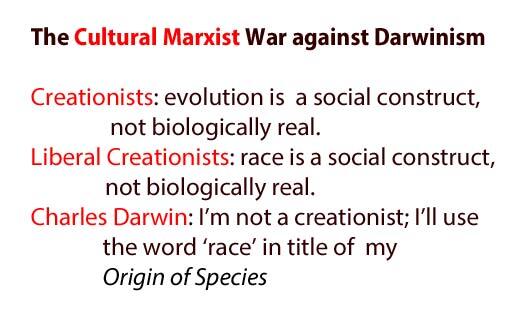
Been there, been accused of that. It’s such a familiar story I’m surprised it was worth a story in Religion & Politics. “Creationist!” is an extremely common accusation against anyone who disagrees with racists — they sincerely believe that their bigotry is as well supported by the science as evolution, which tells you right there how well informed they are about evolution and racism. So, yeah, I get a lot of this crap in my inbox.
Mark Looy, one of the cofounders of Answers in Genesis (perhaps the largest creationist organization in the world today), acknowledges that viewpoint diversity, stating “creationism is a very broad term with multiple definitions.”
But it would have to get a lot broader to include someone like Holly Dunsworth, a biological anthropologist at the University of Rhode Island who studies human evolution—and a self-described atheist. Nonetheless, earlier this year, Dunsworth and other scientists were somewhat surprisingly described as “cognitive creationists” in the first article published by the Journal of Controversial Ideas, a new publication that accepts anonymous peer-reviewed research on contentious ideas. The piece on creationism, credited to the pseudonym “Shuichi Tezuka,” targets these scientists’ criticisms of recent publications claiming that IQ is genetically determined and that different nationalities or ethnicities score differently on IQ measurements of mental abilities. What Dunsworth and other critics call a dangerous reprise of racist (and often sexist) tropes corrupting scientific research, Tezuka likens to the creationist practice of rejecting scientific truths because the results are morally or ideologically distasteful.
Happens all the time. I understand what they’re trying to do, ‘“creationism” is being used to describe and delegitimate arguments against a reductive genetic definition of race and identity’, but it’s not very effective.
In both these cases—of intelligence testing and Indigenous identity—“creationism” is being used to describe and delegitimate arguments against a reductive genetic definition of race and identity. While few scientists would claim that genetics play no role whatsoever in one’s identity, the idea that cultural or ethnic identity can be assessed solely or primarily by DNA is frequently criticized. Dunsworth pointed me to a recent article she co-authored arguing against the idea that race is a primarily biologically constructed. “‘Race’ is far more than ancestral/inherited DNA and is far more than geographically patterned morphological variation like skin color,” she said via email. It’s only by treating race as a genetic/biological category—and ignoring the role that history, culture, law, and environment play in how ideas of race are used—that make possible claims that intelligence can be genetically correlated with certain ethnic types or that authentic Indigenous identity can be found though a blood test.
The catch is they’re trying to dishonestly accuse a critic of a belief they definitely do not hold, so it undermines any trust we might have in their honesty, and turns the debate into a joke full of their lies.

I know, I should be grateful. Unfortunately, Sturgeon’s Law applies, maybe especially to free books.
So I got one yesterday, and the back cover was simultaneously tantalizing and repellent, which much I agree with, and other bits that sound like nonsense, and I think the author’s confidence is unwarranted.
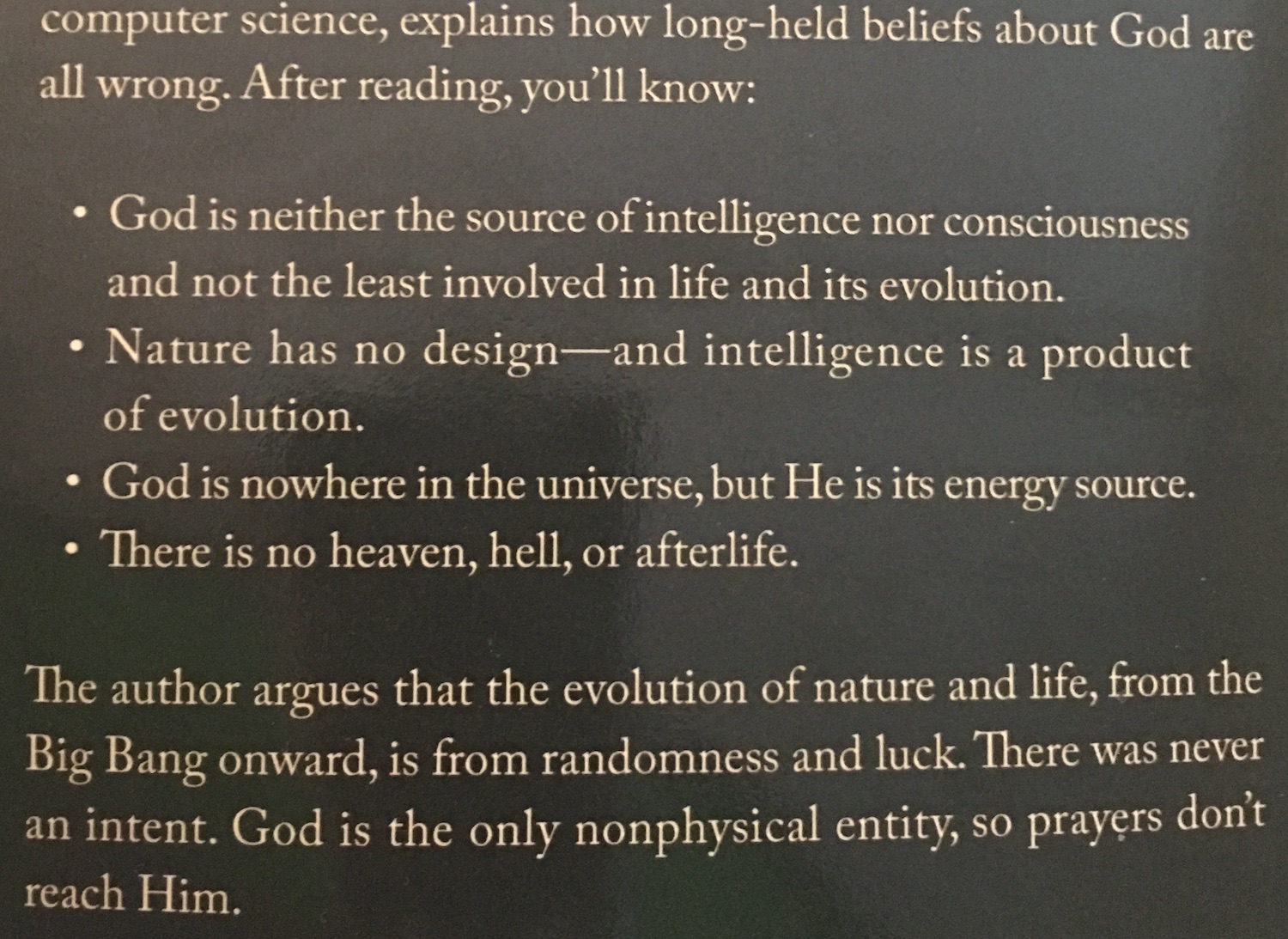
I don’t know what the hell the book is about, or who it’s for — it seems to be trying to get an atheist audience, with a little sop thrown in for theists. I gave it the benefit of a quick glance, and opened it to see…
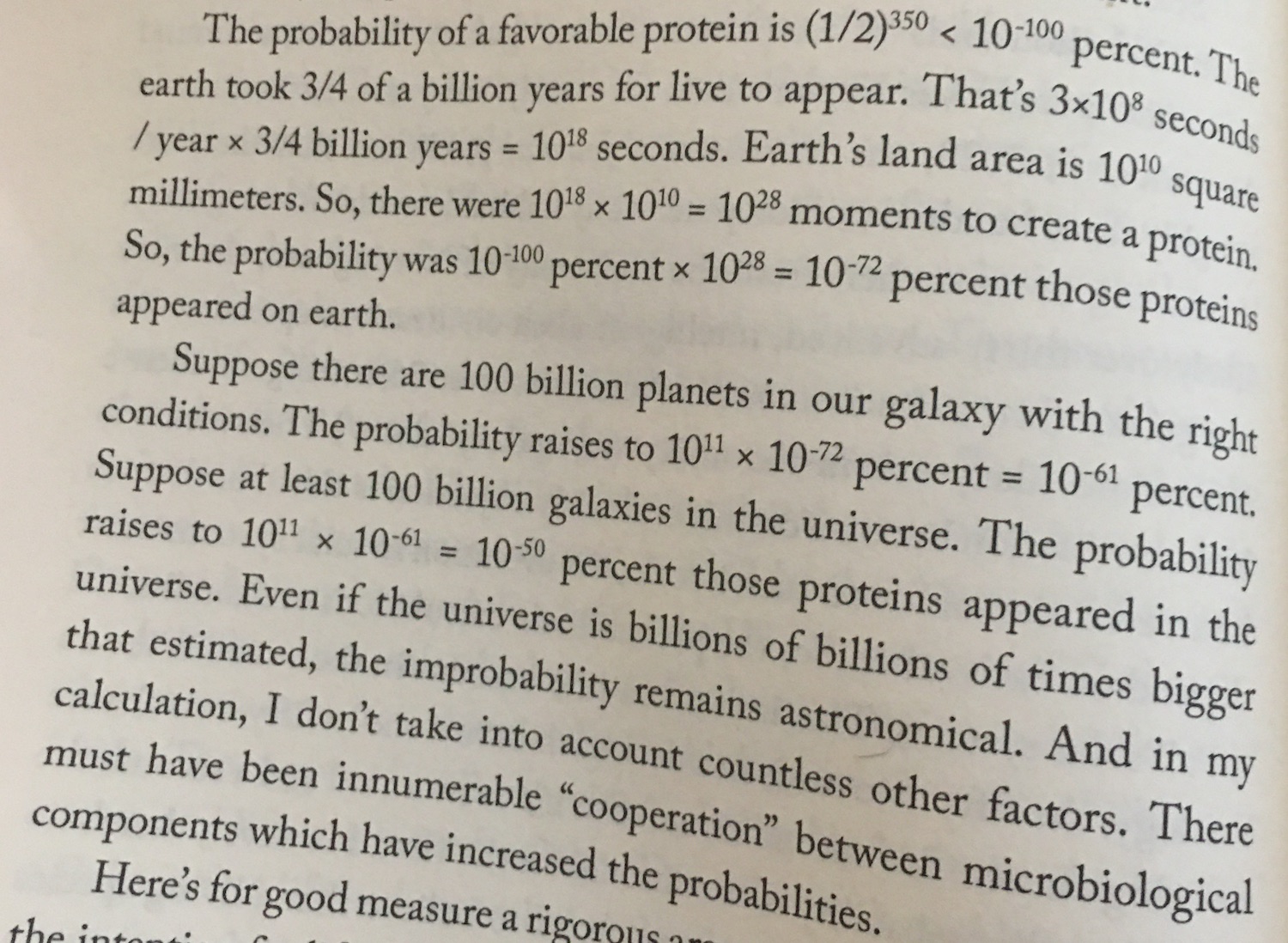
Oh, no. Not this creationist nonsense. I tried to figure out the context — is he arguing that this is wrong or right? (It’s not right.) Is he just trying to present different perspectives? I couldn’t tell. If you can’t be clear about your intent and meaning, I’m not going to work extra hard to extract it for you. All I know is he has a great fondness for logic games, frequently breaking into numbered syllogisms that left me bored.
I tried to find the bit where he explains how he knows a god is the energy source for the universe, but I gave up.
You get a reputation as an atheist, and suddenly everyone is sending you bad proofs. It gets wearing.
