Cephaloporn, a critique

People are always sending me porn, sometimes to harass and annoy (it doesn’t work), and sometimes because they think I’ll appreciate it. I suppose I’m unusual because much of the porn I get in my mailbox features cephalopods, and over the years I’ve become something of a connoisseur of cephalopod porn…and I’m sorry to say that 99% of it is crap, expressing a total lack of comprehension of why cephalopods have sensual appeal. I’ve put a couple of examples below the fold, and I’ll try to explain why they are so bad.

[Read more…]

Santorum will tell you how and when you can have sex

He’s a very creepy man. His wife had an abortion to save her life, but he wants to criminalize your abortion. And that’s not all: sex is supposed to be procreative, so he wants to criminalize contraception. In this long painful video, he preaches against gay sex, against contraception, and says we ought to be urging families to have many more children, and thinks a tax deduction of $20,000 per child is reasonable.

So “contraception is a license to do things in the sexual realm that is counter to the way things are supposed to be”. Woo hoo! I love that license! I don’t think I want to vote for a guy who’d take it away.

Bonus! Santorum also thinks most scientists are amoral.

I have to say, he’s doing a terrible job of campaigning for my vote.

Why I am an atheist – K. Davidson

Firstly, I take issue with having to explain why I don’t believe in the existence of one possible, or few possible, entities in a universe of infinite possibilities.

Why don’t I believe that doing three cartwheels down a particular road in Katmandu while whistling Ode to Joy backwards will rain pogo sticks upon the world? (What, it didn’t work? You must have missed one of the notes.) Why don’t I believe that the world sits on the shell of a giant turtle? Why don’t I believe that having sex with my boyfriend will result in an eternity of hell fire? Just because something can be conceived doesn’t mean it has to be disproved.

But I do object to religion, and that deserves an explanation. First let me state that I take a quintessentially American view toward personal belief: That’s cool. What’s none of my business is none of my business and I am not so omnipotent that I can expect everyone to think the way I think. Nor would I want them to. I am not everyone, only myself and I want to learn from other people, I want to be persuaded, I want other people to have thoughts different from own.

I also don’t want to take things away from other people. Religious belief can be very significant, even life saving. I live a privileged life. I’m one of the few people (let alone women) throughout history who experienced genuine autonomy. I have control over what happens to me on a day to day basis. I have no major crises to attend, no survival to fight for. My life is not a series of things just happening to me. I have control, mostly because I have an education, pale skin and knowledge of how to navigate this liberal, wealthy society. Not everyone does. Many, if not most, people live lives like pinballs, tossed around from bumper to bumper, scared, depressed, anxious. They lack control. So if those people get through their days with a belief that live under the umbrella of God’s love, if they are able to get up and function because they think when this is all over they will receive their just reward (and those rewards would be just), then God bless them. I will never begrudge anyone any tool of survival.

The problem comes when those with power believe in a false cause and effect. That is dangerous, that is anti-social and needs to be stamped out for the betterment of people.

There are two obvious problems with false cause and effect. The first is quite obvious. If a child is sick with infection and her adult care-taker believes that doing three cartwheels down a particular road in Katmandu will cure her, but antibiotics won’t, that empowered caretaker will cause unnecessary suffering, and possibly death. We can extrapolate that across society. If people with power believe that giving HPV vaccinations will lead to retaliations from a vengeful god, those empowered people will cause unnecessary suffering, and possibly death. There are so many examples of this affecting OUR shared society. Psychological torture of gays, miseducation of our children, stunting the potential of young girls by refusing them access to information about birth control, shooting wars with other cultures… ad infinitum.

That is completely unacceptable. We cannot allow the hard won bounty of human endeavor, i.e., knowledge and information, to be squandered at the expense of real, live humans who have the right to the best possible lives we as a society can offer each other. We have come together throughout history to benefit from our collective knowledge and works. Those who would stand in opposition to this knowledge reap its benefits every day. They flush toilets and watch television and eat cheap food. In my view, there is no difference in avoiding cholera by means of sewage systems and avoiding the pain of ostracism by means of admitting that it’s the only downside to homosexuality.

In short, I believe that failing to proceed with the best possible information about cause and effect is a crime.

The second problem with religious adherence is more subtle, but possibly more dangerous. On an individual level, believing that there is a set of specific desires held by some higher power leads to a population of people “just following orders.” It removes all ethical and moral agency from the individual, which is, in my view, distinctly unethical and immoral. One hears the tired argument, “How can anyone who doesn’t believe in God’s retribution know right from wrong?” The absurdity of this is obvious to anyone with a deeply personal and evolved set of principles. I know it is wrong to hurt people for my own gratification and I suffer emotionally in the here and now for it. I am not so disconnected from the rest of humanity that I forget the value of other humans. I am not so mercenary that without threat to my own personage I would harm others. I am a fully formed, typical human in that way.

But I would take my response to that a step further and say that I am more moral because of it. This is because I have to choose, from my own free will, what is wrong and what is right. When I was a child, my sense of right and wrong was influenced by adults, but I am no longer a child and have to take full and complete responsibility. If I simply believe that there is a list handed down from some higher being, I can no longer say that I know right from wrong. Anything can be plugged into that list — a list interpreted by humans, no less — and I will happily go along. Don’t eat meat on Fridays? Okay. Give ten percent to charity? Okay. Kill all first born children? Okay. (Interestingly, there are some beautiful Christian works which hit exactly on this issue, such as Milton’s Paradise Lost, which fundamentally posits that God chose his most beloved and beautiful angel to become the devil because He knew that there was no meaning in faith unless people chose it of their own free will. Even St. Augustine said that God values most the souls of those who sinned and came to Him by choice.)

Here’s what it really comes down to: the public sphere. There are places where I and other people have to intersect, people who believe in different sets of cause and effect. But here’s the thing: I can’t have a religious conversation with people in that public sphere, in doings of the State. I have nothing to say about anyone’s religion on a theological level and, not to put to fine a point on it, I don’t care how many angels one group thinks can dance on the head of a needle versus another group. When discussing social and public policy, I cannot have this conversation. I don’t know how strongly I can express this. I can only discuss the pragmatic outcomes of cause of and effect based on evidence and the shared knowledge created by my fellow humans.

But of course a religious person would be a hypocrite if they left their truest and deepest beliefs at the door. It’s the absolute and inevitable outcome of earnest belief. Now, I know a lot of people who identify as religious who do no such thing, who keep these spheres very separate and I have absolutely no objection. These are also the people who would walk away from any religious leader who asked them to violate their sense of right and wrong. But this is not everyone. We see people running for the presidency of the United States who quite literally cannot see any “right” besides pushing forward their own personal theology onto the nation as a whole. If you truly believe that doing three cartwheels down a particular road in Katmandu would prevent a massive tsunami, wouldn’t you hope you were the kind of person who would do everything in her power to get to Katmandu and do those cartwheels?

This is why religion is destructive. It is to this that I object. It for this reason that I would like to see it fade away into wisps of nothingness. So perhaps this doesn’t answer why I don’t believe in a god, but I hope it answer why I think it’s best not to believe in a god.

K. Davidson

Iowa caucus results

The Republican scores in Iowa are 25, 25, 21, 13, 10, 5, and 1. For an in-depth discussion of these remarkable numbers, we turn to our political analyst, Bob.

Thanks, Bob. These are very good numbers. 25 is clearly the winner, but the other 25 is very, very close. 21 is less than 25, but it’s still a good number, and I’m sure 21 is very pleased…although, of course, a bigger number would be even better. 13 and 10 are even smaller numbers.

5 and 1 are the littlest numbers. They are going to have to try much harder to get bigger if they want to stay in this race!

Excellent analysis, Bob. What does it mean that we have two 25s though?

It means that the election is very exciting so far, Bob, and that now more people will turn on our show to find out which one gets a bigger number. Compare it to the Democratic caucuses, where one person got 100. Boring, Bob, very boring.

So this means we get to keep our jobs, Bob?

Yes, Bob, and that is very good news indeed.

Now turning to our field reporter, Bob, we have an interview with one of the candidates.

“Sir, how do you feel about your number?”

“Well, Bob, it’s not a bad number, it could have been bigger, but it’s about where our polls predicted it would be. So we feel very good about our number.”

“Back to you, Bob.”

Thanks, Bob. And coming up after this commercial break, our chief political analyst Bob will explain these results to you with dazzling computer graphics.

<BUY OUR INSURANCE BEFORE YOU DIE. OUR DRUG WILL MAKE YOU HAPPY (side effects include dizziness, vomiting, wasting, exploding bowels, death, ennui, lack of ambition, impotence, and suicidal feelings.) HAPPY! ASK YOUR DOCTOR. THIS CAR IS VERY LARGE AND MANLY. STOCKPILE GOLD NOW. BUY OUR ALARM SYSTEM OR THIS VERY SCARY MAN WILL BREAK INTO YOUR HOUSE.>

Here is Bob, who will make these results meaningful by making them very bright and shiny and dynamic.

Thanks, Bob. We have created an animated chart of these results. Big numbers are shown as this very large, erect penis, much like yours if you got an offer to do a nude interview with Katy Perry, and small numbers are shown as this tiny little nubbin, like you’d see in a cold locker room after losing the big game. What this shows…

Bob, wait a minute. Isn’t one of the candidates a woman?

Ha ha, yes, Bob, but no clitoris is ever going to get as big as this magnificent purple monster, so it hardly matters, right?

Ha ha, of course. Go on.

As I was saying, Bob, we’ve illustrated all the candidates here, as you can see, and, well, they’re all pretty flaccid so far. None of them are even at half-mast yet, but the top candidates have clearly gotten a little tickle from Iowa and are beginning to stir.

Our job here on the Political Show in the next few months is to flatter and cajole these dicks until one is so aroused that he intimidates all the others into slinking away. We’ll be here every day, reporting on their relative turgidity until one is the biggest.

The power of the press, Bob. By the way, do you have a chart of the Democratic results?

We do, Bob, but the office here is pretty white and we found it too frightening to contemplate. Don’t worry, though, we’re ready, once the Republicans have sorted out who has the biggest number, to do what the media does best, and in the run up to the election we’ll be right here, fairly and objectively reporting the two penis sizes right down to the millimeter, right up to election day.

Good work, Bob. And may the biggest number win.

And that’s all from the election desk. Stay tuned as we bring in a series of pundits to talk about these numbers all day long.

So this is what skepticism has come to?

Jebus. After reading Ben Radford’s reply to the criticisms of his awful article denying sexism in the toy store, I feel even more repelled. It was ludicrous. It was ridiculous. It was pretentious.

Here’s Radford claiming the high ground.

So when I insisted that Riley was wrong in her claim that girls are forced or “tricked” into buying or liking pink items or princesses, my purpose was not to be pedantic, but instead to keep the discussion grounded and rooted in objective evidence.

[Read more…]

We still haven’t explained pink

There was something else that bugged me in that odd claim from Ben Radford that girls would just naturally like pink better than boys: it was the terrible evpsych rationale for it that just made no sense.

First was the argument that blue has always been associated with boys, and pink with girls, and therefore it was only natural to sustain the distinction.

The choice of blue for infants has its roots in superstition. In ancient times the color blue (long associated with the heavens) was thought to ward off evil spirits. Even today the tradition continues; in many parts of the world people paint their doorways and window frames blue. Originally [“Originally”? Like in Homo erectus, or are we going back to australopithecines?] only boys were swaddled in blue [apparently, no one cared if girls were possessed by evil spirits. By the way, what color were they swaddled in, “originally”?], and girls were later assigned the color pink for reasons that aren’t entirely clear. But the color distinction between the two genders dates back millennia [Oops. See below].

But what about pink toys for girls? It’s an interesting question, and there are several answers. One obvious reason is that dolls are by far the most popular toys for girls [And boys like fire trucks and little red sports cars and setting things on fire, so they ought to like red]. What color are most dolls? Pink, or roughly Caucasian skin-toned [Girls should favor beige, then]. There are, of course, dolls of varying skin tones and ethnicities (the popular Bratz dolls, for example, have a range of skin tones). But since most girls play with dolls, and most dolls are pink (a green- or blue-skinned doll would look creepy [And brown would be just horrible]), it makes perfect sense that most girls’ toys are pink [So their ovens and cooking utensils and cleaning tools and cosmetics all match their dolls’ complexions? That doesn’t make sense, that’s just weird].

Eh, what? The color distinction goes back millennia? Since when was 70 years equal to millennia?

The march toward gender-specific clothes was neither linear nor rapid. Pink and blue arrived, along with other pastels, as colors for babies in the mid-19th century, yet the two colors were not promoted as gender signifiers until just before World War I—and even then, it took time for popular culture to sort things out.

For example, a June 1918 article from the trade publication Earnshaw’s Infants’ Department said, “The generally accepted rule is pink for the boys, and blue for the girls. The reason is that pink, being a more decided and stronger color, is more suitable for the boy, while blue, which is more delicate and dainty, is prettier for the girl.” Other sources said blue was flattering for blonds, pink for brunettes; or blue was for blue-eyed babies, pink for brown-eyed babies, according to Paoletti.

In 1927, Time magazine printed a chart showing sex-appropriate colors for girls and boys according to leading U.S. stores. In Boston, Filene’s told parents to dress boys in pink. So did Best & Co. in New York City, Halle’s in Cleveland and Marshall Field in Chicago.

Today’s color dictate wasn’t established until the 1940s, as a result of Americans’ preferences as interpreted by manufacturers and retailers. “It could have gone the other way,” Paoletti says.

Pink for girls is a convention of the baby boomer generation. We’ve only had a couple of generations since, and I don’t think there has been much selection pressure to generate a sex difference.

But let’s be charitable here. Maybe there actually is a sex difference in how men and women perceive the colors blue and pink; that we dress baby girls in pink isn’t causal, but a consequence of a bias in how men and women see the world. Maybe, just maybe, these color preferences are a byproduct of a more significant evolutionary bias. At least, if you’re an evpsych proponent you’d like to imagine so. Which leads us to Radford’s citation of an amazing evolutionary hypothesis from Time magazine.

According to a new study in the Aug. 21 [2007] issue of Current Biology, women may be biologically programmed to prefer the color pink—or, at least, redder shades of blue—more than men…. [Researchers] speculate that the color preference and women’s ability to better discriminate red from green could have evolved due to sex-specific divisions of labor: while men hunted, women gathered, and they had to be able to spot ripe berries and fruits. Another theory suggests that women, as caregivers who need to be particularly sensitive to, say, a child flushed with fever, have developed a sensitivity to reddish changes in skin color, a skill that enhances their abilities as the “emphathizer.”

Really? I read that and thought it had to be some invention of the journalist at Time, so I had to go find the original article, and no, that was taken straight from the paper itself. What disappointing tripe.

It is therefore plausible that, in specializing for gathering, the female brain honed the trichromatic adaptations,
and these underpin the female preference for objects ‘redder’ than the background. As a gatherer, the female would also need to be more aware of color information than the hunter. This requirement would emerge as greater certainty and more stability in female color preference, which we find. An alternative explanation for the evolution of trichromacy is the need to discriminate subtle changes in skin color due to emotional states and social-sexual signals; again, females may have honed these adaptations for their roles as care-givers and ‘empathizers’.

I weep for all the African children who died or failed to reproduce because the enhanced red sensitivity of their mothers’ brains was insufficient to compensate for the reduced contrast caused by the color of their skin; I pity the poor African adults who bumble about romantically, unable to read potential partners’ social-sexual signals as well as their European peers. It’s also sad that even European males are less able, and have less need, to read their fellow human beings’ emotional states.

The utility of being able to evaluate when fruit is ripe isn’t in question, and I can see where that is a likely factor in the evolution of our color vision. But both males and females have that ability; there’s no reason to think that females have been selected for a slightly stronger preference for red, and that there’s some deep biological cause for this preference that is found in women, but not their sons.

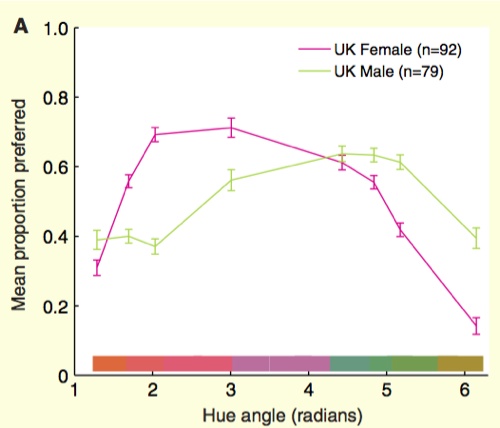
But hey, I’ve got the paper from Hurlbert and Ling, so let’s look at the data.

They do find a robust difference between the sexes in their study. It’s a simple experiment in which subjects are shown pairs of colored rectangles on a computer screen, and they are asked to select which of the two colors they like best. Do this many times, and you get a profile of favored colors. And what do you find? Most people like blue shades, but women tend to like a little more red in their colored rectangles.

Now hang on, you might say — those data are all from British subjects, and there’s no way to sort out the accumulated cultural biases from the biology. Maybe those British women had been brought up by baby boomers who told them from babyhood on that pink was the color for girls, and so all we’re seeing here is a reflection of that bias. To correct for that, the researchers sought out native Han Chinese who were recent immigrants to the UK, and tested them separately. And look! They also show a consistent difference, with Chinese women showing more preference for reds than Chinese men!

From this, they somehow conclude that the differences are biological. If that’s true, though, they missed another major conclusion: compare the color preferences of Chinese men, in the bottom graph, to UK women, in the top graph.

One obviously must conclude that Chinese men have experienced a long history of selection for the ability to make finely tuned distinctions in the ripeness of fruit, to detect delicate blushes in the cheeks of their lovers, and to diagnose childhood diseases at the first flush. I’m impressed.

Oh, wait — there’s another possibility. Could it be that color preferences are actually affected by one’s culture? The researchers even admit this!

Yet while these differences may be innate, they may also be modulated by cultural context or individual experience. In China, red is the color of ‘good luck’, and our Chinese subpopulation gives stronger weighting for reddish colors than the British.

I see absolutely no evidence in the paper that the differences are innate, but lots of evidence that color preferences are plastic and responsive to environmental influences. Even the title of the paper looks wrong: it claims to find “biological components”, but nothing in the methodology or the results exhibits any way to separate biological components from environmental responsiveness.

It’s a fine collection of data, filtered by an unjustifiable evolutionary interpretation, processed yet again by a credulous journalist in a mass market magazine, and then regurgitated without question by Ben Radford. Sorry, guy, it’s bad science, and all you saw was the implausible unacceptable bit.


Hurlbert AC, Ling Y (2007) Biological components of sex differences in color preference. Curr Biol. 17(16):R623-5.

(Also on FtB)


Wouldn’t you know Ben Goldacre already addressed this paper back in 2007?


Radford doubles down. Ugh.