
Mommy, why is that man covered with penises?

Have fun and go visit the Missing Universe Museum online. You will feel as if you are finally getting close to the bottom of human stupidity.

Every page promotes this argument:

If you don’t believe God created all living things, male and female, in 6 days….
How many millions of years was it between the first male and the first female?

It’s idiotic when Ray Comfort says it, and it’s just as inane when whoever put this website together says it.

I had to stop and close the web page at the sight of this, their argument against vestigial organs. You see, if evolution were actually true, and vestigial organs actually existed, then we’d all look like this:
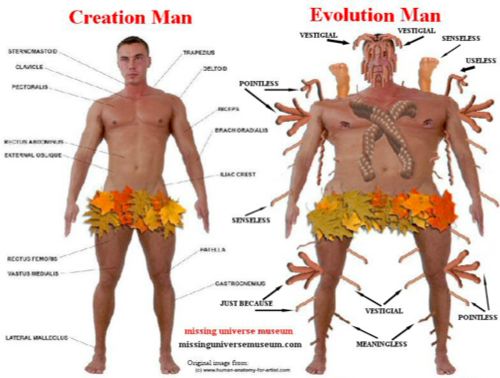
I’m baffled. Why would anyone imagine that a prediction of evolution is that humans should be covered with penises?


I had to add one more thing: their evolution test.

Students, give this test to your teachers. When they fail it, ask them why they are teaching this nonsense!

Teachers, give this test to your students if you really want them to know the truth about evolution!

1. Which evolved first, male or female?
2. How many millions of years elapsed between the first male and first female?
3. List at least 9 of the false assumptions made with radioactive dating methods.
4. Why hasn’t any extinct creature re-evolved after millions of years?
5. Which came first:
…the eye,
…the eyelid,
…the eyebrow,
…the eye sockets,
…the eye muscles,
…the eye lashes,
…the tear ducts,
…the brain’s interpretation of light?
6. How many millions of years between each in question 5?
7. If we all evolved from a common ancestor, why can’t all the different species mate with one another and produce fertile offspring?
8. List any of the millions of creatures in just five stages of its evolution showing the progression of a new organ of any kind. When you have done this, you can collect the millions of dollars in rewards offered for proof of evolution!
9. Why is it that the very things that would prove Evolution (transitional forms) are still missing?
10. Explain why something as complex as human life could happen by chance, but something as simple as a coin must have a creator. (Show your math solution.)
11. Why aren’t any fossils or coal or oil being formed today?
12. List 50 vestigial or useless organs or appendages in the human body.
13. Why hasn’t anyone collected the millions of dollars in rewards for proof of evolution?
14. If life began hundreds of millions of years ago, why is the earth still under populated?
15. Why hasn’t evolution duplicated all species on all continents?

Finals week is next week. Should I give that to my intro students?

(Also on Sb)

Why I am an atheist – Jabu M

Growing up in Zimbabwe presented many challenges. Calling anyone “middle class” was a joke – you were either filthy rich, struggled to make ends meet or were so poor words could not begin to describe it. My family was part of that second group – we lived comfortably, but only just. I’m an ex-fourth generation Seventh-day Adventist, which, considering that Adventism has been in Zimbabwe for about four generations is really something. One thing I can truly thank my parents for is that they never compromised on my education. My brothers and I always went to private school, even if it meant we had to cut back on a few luxuries to do so. I was also always very inquisitive, very much a nerd and had a deep love for science that my mother encouraged. I read a lot of books, particularly about physics, astronomy and dinosaurs so questions were inevitable. I was an introspective child, though, so I tended to keep those questions to myself and try to figure things out on my own.

At twelve I was baptised into the church. I think this was the turning point at which I began to come to terms with reality, because it forced me to examine what I believed and why I believed it, where previously I could just drift along and pretend there was no conflict between my faith and my aspirations to be a scientist. It wasn’t an easy journey, but less than eight months later, I came to the conclusion that God as envisioned by any Earthly religion does not exist. I still thought a higher being of some kind was possible, and so became somewhat of an agnostic.

The biggest problem I had at this stage of my life was that I had nothing concrete to fill the gap my faith left behind. One practical upshot of my country and my family’s financial state was that I had no access to the solid facts I needed – I had no access to the internet and what little I did know came from the now too vague books I could access from the kids’ section of the library. I was growing ever more hungry for knowledge, and would gobble up any little morsel I could get, regardless of quality. In time, this led me to a brush with pseudoscience no better than the faith I had recently forsaken.

Rifling through some old books at my grandmother’s house, I found a bunch by a certain fellow called Erich von Daniken. They had the words “stars” and “space” in them , so reading was a no-brainer. What I read had me instantly hooked. Soon, I was proclaiming to all my friends how aliens had visited us in ages past and imparted us with intelligence. I was rattling off every single piece of “evidence” E vD presented – the Piri Reis map, the Ica stones, the Nasca lines, Puma Punku – with the utmost confidence that I’d finally found the truth. E vD did an excellent job of pretending to have that which I had been looking for all along – good, solid facts. His book “Miracles of the Gods” also fit in with the pseudo-mystical approach I had taken, and this led into a brief but retrospectively embarrassing flirtation with the Law of Attraction.

It was this phase, in which I wholeheartedly accepted such nonsense as is contained in “The Secret” and “What the Bleep Do We Know” that led to me taking another deep look at my beliefs. I noticed that all my “positive thinking” and meditating on the things I desired was getting me nowhere, and I started really thinking about how this actually worked. I realised that all this talk of “qantum-this” and “quantum-that” was simply a different term for the magic I used to believe in when I was still Christian. It did not take long for the rest of my belief in the supernatural to disappear, and eventually any concession of the possibility of the existence of a deity went down the drain as well.

I remember the first time I ever referred to myself as an atheist. I had just moved to a new school in Botswana. We were in a class Guidance and Counselling session and the counsellor asked me what religion I belonged to. Right there and then, I realised – much as I had once reviled those who were so “close-minded” as to outright deny the existence of a god, I had become one of them. With newfound conviction in my voice, I proudly answered, “I’m atheist.” This was early in 2009, and I was 16, going on 17.

Perhaps not very oddly enough, I still lent some credence to Erich von Daniken’s hypotheses. I would think to myself, “Okay, maybe he got the metaphysics wrong, but some of his facts must be right.” I was also very critical of vocal atheists, even once writing a letter bashing Richard Dawkins over his hope that creating a cross between a human and chimp would end religion to the South African edition of Popular Mechanics. The Internet changed both these things, however. The Skeptic’s Dictionary in particular demolished von Daniken’s hypotheses, while reading of all the abuses to freedom that religion continues to perpetrate underscored the importance of activism to me.

I take a pragmatic view of the circuitous route I took to becoming rational: if it weren’t for it I wouldn’t be who I am today. I wouldn’t have experienced first hand how harmful and limiting believing in lies can be, and wouldn’t be so passionate about eliminating them. It’s not my lack of belief in gods that I count as my most important trait, though. I value being a rationalist because I choose to think, a skeptic because I choose to question, a humanist because I have compassion for my fellow man and have an unbridled love for the cosmos that drives me to achieve my dream of becoming an astrophysicist. It is from this dream that I draw the deepest meaning for my life: that of discovery, and questing to understand the universe we live in.

Jabu M
Botswana

I was compelled to post this

I said I didn’t want to say anything about free will, and I still don’t, but Massimo Pigliucci weighed in, and Jerry Coyne responded, and so did Sean Carroll, and of course I created a free will thread for everyone else to talk about it, so I guess there’s a fair bit of momentum behind it all.

I don’t understand why free will was getting all tangled up in indeterminacy vs. determinism, since that seems to be a completely independent issue. I’ll sum up my opinion by agreeing with Jerry Coyne:

Of course, whether the laws of physics are deterministic or probabilistic is, to me, irrelevant to whether there’s free will, which in my take means that we can override the laws of physics with some intangible “will” that allows us to make different decisions given identical configurations of the molecules of the universe. That kind of dualism is palpable nonsense, of course, which is why I think the commonsense notion of free will is wrong.

My mind is a product of the physical properties of my brain; it is not above them or beyond them or somehow independent of them. It doesn’t even make sense to talk about “me”, which is ultimately simply yet another emergent property of the substrate of the brain, modifying the how the brain acts. It is how the brain acts.

I think consciousness is a product of self-referential modeling of how decisions are made in the brain in the absence of any specific information about the mechanisms of decision-making — it’s an illusion generated by a high-level ‘theory of mind’ module that generates highly simplified, highly derived models of how brains work that also happens to be applied to our own brain.

(Also on FtB)

Ohio polls for a license plate design

Unfortunately, one of them is the awful “With God All Things Are Possible”, which has nothing to do with Ohio, or reality, for that matter. Go vote for anything else. For some reason, the motto “40,948 Square Miles” really appealed to my inner Aspie, but you could choose something more conventionally innocuous, like “Beautiful Ohio” (which will make it stand out from all those ugly states), or “The Buckeye State” (it’s the only state that would use that!). Just do your best to spurn the godly choices.

I was compelled to post this

I said I didn’t want to say anything about free will, and I still don’t, but Massimo Pigliucci weighed in, and Jerry Coyne responded, and so did Sean Carroll, and of course I created a free will thread for everyone else to talk about it, so I guess there’s a fair bit of momentum behind it all.

I don’t understand why free will was getting all tangled up in indeterminacy vs. determinism, since that seems to be a completely independent issue. I’ll sum up my opinion by agreeing with Jerry Coyne:

Of course, whether the laws of physics are deterministic or probabilistic is, to me, irrelevant to whether there’s free will, which in my take means that we can override the laws of physics with some intangible “will” that allows us to make different decisions given identical configurations of the molecules of the universe. That kind of dualism is palpable nonsense, of course, which is why I think the commonsense notion of free will is wrong.

My mind is a product of the physical properties of my brain; it is not above them or beyond them or somehow independent of them. It doesn’t even make sense to talk about “me”, which is ultimately simply yet another emergent property of the substrate of the brain, modifying the how the brain acts. It is how the brain acts.

I think consciousness is a product of self-referential modeling of how decisions are made in the brain in the absence of any specific information about the mechanisms of decision-making — it’s an illusion generated by a high-level ‘theory of mind’ module that generates highly simplified, highly derived models of how brains work that also happens to be applied to our own brain.

(Also on Sb)