
CFI’s Director of Public Policy

Amy talked to Michael De Dora about what he does as CFI’s Director of Public Policy and UN rep. It’s good that she did that, because what he does is important, and he does it. (No need for self-mockery about 1st world probs here.)

Many people in the secular community seem unaware of the extremely important work that Michael De Dora and CFI are doing. They are literally on the front lines battling to protect women’s reproductive rights. They are working to ensure the separation of church and state here at home. They tirelessly rage against the oppressors of the world so that all people may eventually have freedom of religion, non religion and freedom of expression. They fight to keep religion out of the classroom and they fight to keep government funding from being funneled from public schools into religious schools. Care about freedom of speech? Then you should care about CFI’s newly launched Campaign for Free Expression.

Huh? What’s that got to do with skepticism?! 

Hey, you know what? Skepticism isn’t all CFI does. How about that.

You probably knew that. I think some people don’t know that though. I mentioned the question I got after my talk, asking why I drag feminism into skepticism, when I hadn’t been talking about skepticism at all. Skepticism is one thing but it’s not the only thing, and CFI isn’t CSI.

Amy’s on it.

What?

Not enough?

Too much social justice and not enough traditional skepticism for ya?

Well, guess what?

They even educate local government on the dangers of alternative medicine and fight to stop tax funding and insurance coverage of risky or unfounded treatments. Oh, and yeah, climate science is on their list too.

See? It’s not the only thing, but it is one thing. Deep breaths, people.

Michael’s on it, CFI is on it, they’re all on it. It’s what they do.

Could you please explain the mission of CFI’s Office of Public Policy and your active role in that policy?

The broad mission of CFI’s Office of Public Policy is to push governing bodies to enact public policies based on secular values, humanist ethical principles, and, where possible, scientific evidence. Essentially, we combine the secular and humanist worldviews, and the scientific worldview, and apply the combined perspective to policy debates. I think that this multi-faceted approach results in some very compelling arguments.

Got that? It’s a multi-faceted approach. Secular values are part of it. Secular values are what my talk was about. I’m allowed to do that.

Free expression is one of those secular values.* CFI’s OPP works to support it.

Most recently our focus has been on protecting and defending the rights to freedom of religion, belief, and expression. Historically, these rights have been fragile, and they have come under widespread attack the last couple months – especially after the release of the Internet video Innocence of Muslims, which caused protests in the Middle East and Northern Africa.

One of our main focuses on this issue has been to shed light on the growing number of cases of people being punished simply for practicing a different, or no religion, or speaking their mind. Perhaps the most prominent case, at least for the secular community, is that of Alexander Aan, the Indonesian fellow who is in jail for posting on Facebook that he is an atheist.

In order bring attention to Aan and others like his, we just launched the Campaign for Free Expression, which seeks to rally broad support for the right to freedom of speech.

In concert with that, we have been working at the United Nations to fight attempts by the leaders of several countries to implement resolutions and agreements that would in effect restrict freedom of expression. And we have been working with the State Department to put diplomatic pressure on countries that do not respect freedom of expression. The idea is that the more social support you build for a position, the more feasible political action becomes.

How do they decide what issues to take on?

We decide which issues are important largely based on our mission. We will jump on an issue if it threatens the separation between church and state, is unethical from a secular humanist perspective, or is either unaligned or even opposed to current science.

Sounds sensible to me.

*No, that doesn’t mean people should call women they dislike fucking cunts, or non-white people they dislike fucking niggers, or Jews they dislike fucking kikes, or gay women they dislike fucking dykes, or gay men they dislike fucking faggots. It means doing so should not be a crime, or punished by the state.**

**Unless it adds up to harassment or incitement. Yes it makes a difference. A playful slap is one thing, a beating is another.
Torch all the schools

It’s not just the Taliban that destroys schools, Mohammed Hanif points out.

Last week, a girls’ high school was set ablaze in Pakistan’s second largest city, Lahore. And no, the Taliban were not the culprits. A mob, enraged after allegations of blasphemy against a teacher, carried out the attack. Instead of taking action against them, the police arrested the school’s 77-year-old owner.

The accused teacher, who allegedly committed blasphemy by photocopying the wrong page of a book for homework, is in hiding.

We make fun of ourselves by saying “first world problem” – sometimes when we’re misdirecting our attention or worry, sometimes when we’re addressing an admittedly smaller-than-genocide item. [Read more…]

Certain people, eh?

There was one guy who kind of ambushed me after the talk yesterday – by which I mean he came up to me afterward all friendly-like and had his picture taken with me, when actually he’s one of the “faction” there (and it apparently is quite organized) that hates me and all other…you know, Those Women and their Mangina Allies.

He probably got the picture for photoshopping purposes.

I took a quick look at his Facebook page just now (having been enlightened as to who he is and what he was up to) and saw a TAM 2012 album with this in it-

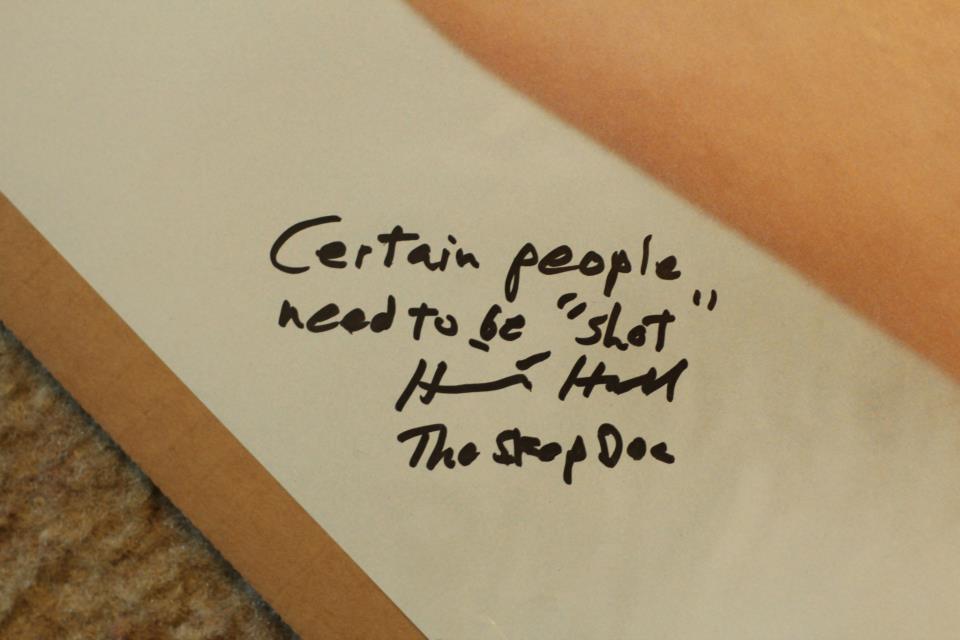
Uhhhh. Thanks a lot, Harriet Hall. I’m glad you think it’s so funny.

The reference is to vaccinations. My bad.

Travel report

You’re longing to hear all about My Trip To LA, right? No? Well you’re going to.

I think the talk went pretty well (she said modestly). I had fun doing it, anyway – I talked about some issues that are interesting to me. You guys contributed because of the discussion last week.

It turned out there were some people there who already had an opinion of me, and not a good one. (Perhaps they think I eat cat food.) There was one rather truculent question, but no rotting fruit, or even decanned cat food.

And we went to lunch after, and I talked to amazing Louise, until she had to go play the Auntie Mame part at a family gathering. Alice and Stacy and I went to Wacko, then the Museum of Jurassic Technology, then t0 meet up again with Amy and Johnny at a thrilling restaurant in the Hollywood hills, where they (Amy and Johnny) treated us all to dinner. Fabulous people.

The truculent question was why do I drag feminism into skepticism, when feminism is an ideology while skepticism is about questioning all the things (including, I think we are to infer, gender equality, but not gender inequality). I said basically that I don’t; my talk was about secularism and equality. As far as I know CFI doesn’t focus solely on skepticism. Then I said that on the other hand, I think it would be (or is) stupid for skepticism to drive women away from skepticism by treating them like crap. Apparently that’s a controversial view. Hmreally? Why?

Just now I went out, early while it was still coolish, and went north on Vermont past a bookshop and other nice stuff, then west a bit and back south, past CFI to Barnall Barnsdall Park which is across the street from them (and the Pentecostal church which snuggles up to their east wall). I went up to the top of the hill and was rewarded with a stunning view of the Griffith Park Observatory and the Hollywood sign and all the things to the north and west and a good deal to the south until the smog got too thick.

I like LA.

Food for thought

Something to think about…violence against women in Pakistan: 2,713 cases reported in 2012 so far, not in Pakistan, but just in southern Punjab. And those are only the reported ones. Something tells me that not all women subject to violence in Pakistan are able or willing to report it.

These include cases of aas-aaf custom (10) – in which women accused of ‘bringing shame to the family’ take an oath of innocence on the Holy Quran and then walk on burning coals spread over six metres–, abduction and torture after abduction (577), acid attacks (20), burning by throwing kerosene oil and petrol (17), kaala kaali (25), assault after divorce (45), assault by in-laws (100), ‘honour’ killings (112), murder and assault for contracting a marriage with their free will (114), murder (162), victims of panchayat decisions where women were either sold or killed (37), rape (304), assault by police (20), suicide in reaction to family pressure, rape or other forms of violence (444), torture leading to physical or mental disability (489), wani (37), watta satta (25) and cases of gender discrimination and disinheritance (175).

I hadn’t heard of that aas-aaf custom. That’s nice. Very 16th century Europe, where women accused of being witches might be thrown into a pond. If they drowned they were innocent. Yay.

Sometimes the violence is just grumpy neighbors.

Farkhanda, a second year student and a hafiz-i-Quran, had an argument with three women neighbours when she went to their house to collect her dupatta that had fallen into their house.

They said the women accused her of throwing the dupatta into their house on purpose.

They accused her of entering their house with an intention to steal from there. Some neighbours heard them arguing and intervened, police said.

The matter was resolved and Farkhanda returned home, they said.

However, later that night, police said, three youths, Ibrahim, Iqbal and Bilal, relatives of the women Farkhanda earlier had an argument with, went to her house while her family was away and beat her up. Police said they decapitated her with a butcher’s cleaver…

And then after a pause to catch their breath, they chopped off her arms and legs.


Just one?

I’m still wondering about this question of what is “religious morality”? Most people seem to think it’s just plain morality that’s (partly or wholly) motivated or endorsed or decorated by religion.

I think that’s completely wrong. That’s not because I think nobody is really motivated by religion. It’s because that’s not enough to make morality religious.

I think morality is secular. I haven’t been able to think of any morality that isn’t secular – any moral content that is religious as opposed to secular.

Can you? [Read more…]

Media scrutiny of these schools is feeble

Don’t miss Andy Lewis’s long and thorough article What Every Parent Should Know About Steiner-Waldorf Schools.

Just one sample, to whet your appetite –

Far from Steiner’s views being seen as a historical anachronism, the text books are full of unreformed anthroposophical views on the world. The text books I have got hold of teach that the heart is not a pump but is forced to beat by the pulsing blood that is forced around the body by the spirit. We learn that humans are bipedal because it frees the arms to pray. Anatomy is treated as a spiritual subject and not a science. The British Humanist Association notes that the source of the curriculum at Hereford state funded Steiner schools is acknowledged to be based on a book by Martyn Rawson and Tobias Richter which teaches that Darwinism “is rooted in reductionist thinking and Victorian ethics and young people need to emerge from school with a clear sense of its limits”. Homeopathy, a most egregious form of quackery, is  ‘a good example of an effect that cannot be explained by the dominant [atomic] model’.  It is worth noting that Steiner stated that the British Isles floated on the sea held in place by cosmic forces. And he believed in the historical truth of the vanished continent of Atlantis…

That article needs to be published somewhere.