Responses to my column on atheism

Yes, I know I should be frantically working on my thesis, but I’m taking a break to post some news I promised I’d share. On Wednesday I wrote an article on my experiences as an atheist at Purdue and the Society of Non-Theists. The overwhelming response was people emailing me, thanking me for writing it, which is absolutely awesome. I also found wonderful write up by a fellow Purdue student about how my experiences mirror his of coming to the Midwest as a Mormon:

When I lived in Utah most of the kids in school where Mormon. In Tennessee I could count the number of LDS students on one hand, two of them being myself and my sister, out of a student population of about 2000. And with Utah’s reputation of being “Mormon country” whenever someone learned where I was from the conversation would usually go something like this:

Person: “Where are you from?”
Me: “Utah”
Person: “Are you Mormon?”
Me: “Yes”
Person: (In disbelief and with a serious tone) “Are you going to have 10 wives when you get older?”

And the multiple wives question was usually just the tip of the ice berg. I could not believe how many strange outlandish questions I got asked about being LDS. It got to the point where I almost dreaded telling someone else I was LDS because of the various stereotypes and nonsense people would then assume about me. This was also when I began to meet LDS members who have had their families and friends shut them out of their lives because they became Mormon. I also met a girl here at Purdue who told us of her conversion and how her parents had cut off all contact with her because of her decision to become LDS.

So after reading Jennifer’s article I began to relate to what she was talking about. I could even relate to the preachers who stand out on the mall preaching hellfire and damnation on all those they disagree with because, surprise, they think Mormons are going to hell as well. Whenever you see one of the street preachers holding a sign with a list of “damned” groups of people, look at the names and you will see Mormons listed along with atheists, pedophiles, democrats, and homosexuals.

While we’ll probably never agree on theology, it’s wonderful that others understand what being an atheist is like, and realize we can be more similar than they might have thought. Responses like this make me think my article was a great success!

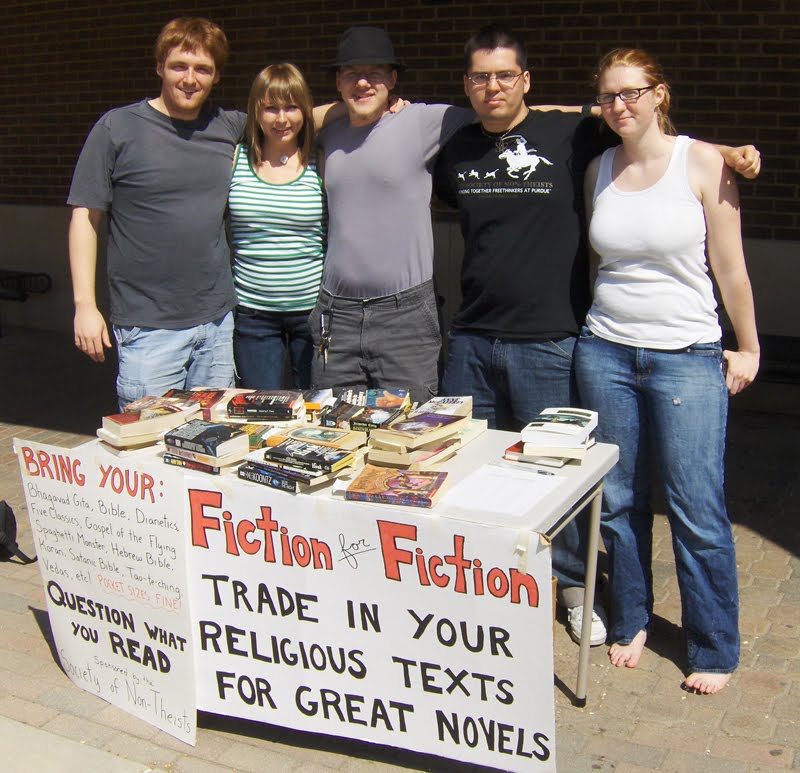
Fiction for Fiction: Trade religious texts for novels

Today the Society of Non-Theists held our annual spring event, Fiction for Fiction. The basic premise is that people can trade in various religious texts for fiction novels. We stick little bookmarks in the book explaining why we’re doing the event, which say the following:

“Religious texts may give some moral guidance, but that does not necessarily mean what they say is true. Fictional novels can contain important morals and insight into human life. You must think critically and ask questions to learn from what you’re reading. We encourage you to come to your own conclusions about what is fact and what is fiction. If you would like to investigate inconsistencies and contradictions specifically in the Bible, Koran, and Book of Mormon, skepticsannotatedbible.com is a great place to start.”

Or, to summarize:

Random student: Are you saying the Bible is fiction?!?!
Us: …Uh, yes?

This year it went just as well as in the past. We collected two Bhagavad Gitas, the Popol Vuh (from the Mayan religion), and a bunch of Bibles. The most common response was positive: People smiled, smirked, waved, laughed, came up and thanked us, took photos next to our sign, and generally were very appreciative. One parent who was on a tour with their high school student was grinning ear to ear. We also had theists come up wondering what we were doing and what our group was all about, and talking to them was great. There were no hard feelings and they agreed with what we were doing.
See? Happy non-scary atheists!

We did have the occasional scowl and a couple people who wanted to debate, which also always happens. One person came up (while I was off eating lunch, unfortunately) apparently trying to say the shroud of Turin was absolute proof of God’s existence. …Yeah, I know. Could you pick anything that has been debunked more than the shroud of Turin?

And in an ultimate event of irony, a guy that has been handing out chick tracts around campus came to pass them out to us. I squealed that I collected them (now up to 107!), so I gave him the totally wrong impression with my eagerness. Even more ironically, the tract was anti-evolution. Eventually he realized we were all atheists, and that I am majoring in evolution, so he tried to debate me. And by try, I mean he said Neanderthals were just arthritic humans and that Satan put fake fossils in the ground because he wants us all to act like monkeys (I wish I was making this up).

Him: The problem is people don’t hear enough facts about evolution. Have you talked to creationists?
Me: Tons, yes.
Him: And did they give you any facts? Not Biblical scripture, but science
Me: Well, they thought they were giving me facts, but no, they didn’t.

When I asked for an example of facts, he told me there were too many to remember (even a single one, apparently) and that I should go watch some Kent Hovind. He seemed impressed when I actually knew who he was. I was more impressed that I didn’t revert to my rage face during the conversation.

A liberal Christian who sometimes hangs out with our group then came up, and got all excited that it would possibly be a Christian debating a Christian, so she jumped in. The discussion turned to Biblical literalism and I had to run to class, so I missed most of their discussion. There was one part I did hear, however:

Christian Gal: Well, God used leprosy as a sign that you’ve done something wrong. I mean, I believe in modern medicine and everything, but I don’t think it can explain everything

Then I facepalmed and ran off to my psychology class. Really, she’s usually pretty good, so I was just like…wut?

Anyway, overall I would say Fiction for Fiction was a success. A club member said he overheard people talking about it favorably in one of his classes. Always good to generate discussion and not piss people off! At least, not everyone.

National Day of Prayer ruled unconstitutional

In a case of “Wow, it took you that long to figure it out?”, the National Day of Prayer was finally ruled unconstitutional in a federal court:

Congress established the day in 1952 and in 1988 set the first Thursday in May as the day for presidents to issue proclamations asking Americans to pray. The Freedom From Religion Foundation, a Madison-based group of atheists and agnostics, filed a lawsuit against the federal government in 2008 arguing the day violated the separation of church and state.

President Barack Obama’s administration has countered that the statute simply acknowledges the role of religion in the United States. Obama issued a proclamation last year but did not hold public events with religious leaders as former President George W. Bush had done.

Government involvement in prayer is constitutional only as long as it does not call for religious action, which the prayer day does, U.S. District Judge Barbara Crabb wrote in her ruling.

“It goes beyond mere ‘acknowledgment’ of religion because its sole purpose is to encourage all citizens to engage in prayer, an inherently religious exercise that serves no secular function in this context,” Crabb wrote. “In this instance, the government has taken sides on a matter that must be left to individual conscience.”

Good work, Freedom from Religion Foundation!

Now, I wonder how this will pan out when it almost assuredly goes to the Supreme Court… Any political science people want to weigh in?

My guest column in the Exponent: Non-theists, you are not alone on this campus

I’ve always been a bit notorious for writing letters to the editor for our campus newspaper, but this is even more exciting: The Exponent let me write a guest column on atheism at Purdue and the Society of Non-Theists for their opinions page! It’s an area usually reserved for opinion pieces for Exponent staff, and I had over twice as much space as a letter. Writing it was a lot more challenging than blogging, since it had a word limit (I can’t ramble?! Nooooo!), has to be a lot more formal (aka, intelligent), and is to a totally different audience (mainly Christians instead of a mob of atheists). It’s not revolutionary and probably won’t incite the masses to send hate mail, but it’s a message that needs to be seen on campus. Consider it my last hurrah after three years of being President.

And since I wrote it, I’ll reprint it below in its entirety.

Non-theists, you are not alone on this campus

By Jennifer McCreight
Guest Columnist
Publication Date: 04/14/2010

I grew up in Indiana, but coming to Purdue was a culture shock for me. Some people in my town were religious, but no one really cared about what others did or didn’t believe.

Less than a month after I arrived on campus, I sat in the McCutcheon laundry room reading Richard Dawkins’ “The God Delusion.” Another freshman approached me, wide-eyed, and asked if I was an atheist. When I said I was, she asked with sincere worry, “But how will you ever find a husband?”

Let’s ignore the assumption that getting a husband should be the most important goal in life. Actually, she was voicing a concern that many atheists and agnostics share. Sometimes it can feel like you’re the only person who doesn’t believe in God. I certainly felt that way when I came to Purdue.

There were over 50 Christian student organizations, a club for every other religion, religious advertisements in my mailbox, and preachers on the mall telling me I was going to hell. Political or ethical discussions and even small talk started with the assumption that I was a Christian.

That’s why I started the Society of Non-Theists in 2007: Not to convert or offend the religious, but to let other atheists and agnostics know that they weren’t alone. For our first callout, I expected maybe 15 people to come. So many students showed up that they were spilling into the hallway. People looked across the room as if to say “Where were you guys all this time?!”

While we’re a minority, we certainly do exist. About 16 percent of Americans are non-theists, and that number grows every year (1). Unfortunately, many are afraid to come out, and those fears are legitimate. Club members constantly share stories of discrimination, stereotyping and rejection from their families because of people judging their non-belief. Groups like ours provide a safe environment where non-theists can speak freely, something that is necessary to stay sane and happy.

Of course, we do more than serve as a community. Something as simple as being open about our non-theism can dispel negative stereotypes many have about us. We try to ensure the separation of church and state is upheld at Purdue and in Indiana. We hold events to promote skeptical thinking, and we help others by volunteering and raising money for charity. We encourage open dialogue about religion through group discussions and sometimes-controversial public demonstrations.

Even with all these activities, community has always been our focus. I’ve made dozens of close friends that I’ll have for a lifetime, and other members say the same. Who knows if we’d have met if we were too afraid to express our skepticism of the supernatural? Even people who don’t come to meetings frequently e-mail me, thanking me for letting them know that they have a voice on campus. Making Purdue more welcoming for non-religious students is more important than any grade I’ve received, and the club will be what I miss most when I graduate.

Future club members still have a lot of work to do keeping Purdue secular and increasing the acceptance of non-theists. We’ve had minor success cooperating with religious groups, but most still seem hesitant or unwilling. I will definitely feel disappointed if my graduation ceremony in May is full of thinly veiled prayers, religious commentary and the choir singing “Amen” like in the past.

Club flyers are torn down or defaced within hours of putting them up, and it’s rare to have an outdoor event without someone shouting something hateful. Our mere existence will always offend some, but we’ve come a long way. I’m no longer afraid or ashamed to call myself an atheist, and neither should anyone else on campus.

Just remember: Non-theists are good people, with similar morals and goals as theists. We don’t eat babies, we don’t hate religious people, we don’t wallow in depression and we don’t have drunken orgies (well, not all the time). We aren’t rebelling against our parents or God. We simply agree with Carl Sagan that “extraordinary claims require extraordinary evidence.”

1. Pew Forum’s U.S. Religious Landscape Survey, May 8 to Aug. 13, 2007

Jennifer McCreight is a senior in the College of Science and the president of the Society of Non-Theists (www.purduenontheists.com). She writes at the popular atheist blog www.blaghag.com and may be reached at [blaghagblog@gmail.com]*.

Major thanks to Tom, Mark, Bryan, and Jon for helping me revise it! And of course, thanks to the Non-Theists for a great three years. It’s hard to believe that I won’t be your President any more in a week.

*My Purdue email was printed in the paper, though I prefer that you guys email me here.

Dawkins & Hitchens plan a legal ambush to have Pope arrested

Yep, you heard right. Dawkins and Hitchens are planning on getting the Pope arrested when he visits England in September:

“Dawkins and Christopher Hitchens, the atheist author, have asked human rights lawyers to produce a case for charging Pope Benedict XVI over his alleged cover-up of sexual abuse in the Catholic church.

The pair believe they can exploit the same legal principle used to arrest Augusto Pinochet, the late Chilean dictator, when he visited Britain in 1998.

The Pope was embroiled in new controversy this weekend over a letter he signed arguing that the “good of the universal church” should be considered against the defrocking of an American priest who committed sex offences against two boys. It was dated 1985, when he was in charge of the Congregation for the Doctrine of the Faith, which deals with sex abuse cases.

function slideshowPopUp(url) { pictureGalleryPopupPic(url); return false; }

Benedict will be in Britain between September 16 and 19, visiting London, Glasgow and Coventry, where he will beatify Cardinal John Henry Newman, the 19th-century theologian.

Dawkins and Hitchens believe the Pope would be unable to claim diplomatic immunity from arrest because, although his tour is categorised as a state visit, he is not the head of a state recognised by the United Nations.”

(Side note: Could the Times have possibly found a more evil looking photo of Dawkins? Sheesh)

I find this quite interesting. I’m not well versed in international or British law, so the fact that this is plausible is intriguing. And I have to say, I agree with Dawkins’ and Hitchens’ sentiment. The Pope and the Catholic Church have systematically covered up hundreds of cases of child rape. They shouldn’t receive immunity because they’re a religious organization – thinking you have an imaginary friend isn’t exactly a good reason to commit such horrible crimes.

At the same time, I’m a little worried. There are still many people out there that are sympathetic to the Pope, and to have two figureheads for atheism going after him isn’t going to be too great for our image. I really hope that other religious figures will join in and support Dawkins and Hitchens. We need to show that this isn’t some atheist agenda to bring down the Catholic church – it’s a human agenda to protect our children and deliver justice.

(Hat tip to Miranda)

EDIT: It seems the Times has overblown the story a bit. For more of an explanation, check out this post.

Fiction for Fiction next week

For those of my readers who are at Purdue, don’t miss out the Society of Non-Theists‘ Fiction for Fiction event next week. As I’ve blogged before, it’s an event where people can trade in religious texts for great fiction novels.

When: Thursday, April 15th, 9 am to 4:30 pm
Where: Outside of CL50 at Purdue University
How: Bring a religious text! (pocket versions accepted)
Why: To encourage people to question what they read (and to stir up a little controversy, like always)

I’ll do a full write-up of the event next week. Oh, and if you want the good fiction books, come early – pretty sure Hitchhiker’s Guide will be snatched up quickly!

Atheist Barbie

I’ve never been a fan of Barbie (shocker, I know). My family always tried to buy them for me, but I wanted nothing more than to play with Legoes all day. But it looks like Barbie has a interesting new profession:
She’s been a princess, a firefighter, a Marine and a ballerina. After years of soul-searching, Barbie has finally found her true vocation. Meet Rev. Barbie, a plastic Episcopal Priest.

Rev. Barbie, the creation of Rev. Julie Blake Fisher, an Episcopal priest in Kent, Ohio, has her own Facebook page and comes dressed in the latest trends in clergy-wear.

Fisher created Rev. Barbie for use in her own youth ministry: “I thought the children would like to practice playing with the vestments and learning what they are,” she told Religion News Service. Over the years, Barbie’s many vocations have served as inspiration for young girls. And although Mattel has not endorsed Fisher’s improvised Reverend Barbie, the plastic priestess has emerged at a critical moment in Christian history, especially for women.

Man, why should religious people get to have all the fun? I want an atheist Barbie! (click for slightly larger image)Finally, a Barbie doll that represents my every day life…

A Christian, a Muslim, and an atheist walk into an classroom…

Today I took part in a religious diversity panel for an agriculture class at Purdue, Communicating Across Cultures. I was on the same panel representing atheists last year, which was a giant debacle that left a bad taste in my mouth. I decided to try again this year and hope for the best.

I have to say, it went much better. This time I was actually told that I was supposed to have a presentation prepared, and I was told the accurate topic (yes, last year was bad). I had limited time for my presentation, but here’s a brief outline of what I talked about.

– Definition for atheism and agnosticism
– Demographics of atheists in US
– Extraordinary claims require extraordinary evidence, I can be convinced
– Secular humanism and general ideals some atheist have (search for truth, reason, evidence, concern for this life, ethics)
– Why atheism is not a religion
– Not all atheists hate religion (though some do), and we don’t hate religious people. In fact, most atheists were at one point religious.
– Atheists are not depressed, angry, hopeless people

The Muslim speaker (a recently graduated student) did an excellent job at explaining exactly what Muslims believe and some of their traditions. The Christian speaker (a pastor for Alpha Chi, the group with the zombie event), while very nice, was one giant facepalm. I really shouldn’t be allowed to be on panels or do debates, because I make a very obvious “What you’re saying is stupid and annoys me but I have to look polite” grimace, like so:It wasn’t her description of her belief that annoyed me. I disagreed with her just as much about there being proof of Jesus rising from the dead (uh, care to share that with us atheists?) and Intelligent design being proof for God’s existence (No) as I did with the Muslim talking about Mohammed being a prophet. I’ve heard the arguments before and I don’t agree with them, but the whole point of the panel was diversity, so they were totally appropriate.

What annoyed me is that she felt the need to comment on people other than Christians. Namely, atheists. To summarize her argument:

You know how when you were a little kid, and your parents forced you to go to bed at a certain time and eat your vegetables? And at the time you hated them and whined and resisted, but now looking back you thank them for being good parents? That’s God. Atheists don’t like that God’s a meanie and makes them do things they don’t like, so they rebel and go to the extreme and say he doesn’t exist. Atheists need to realize that God is all loving, and he makes rules in our best interest.

First off, when I was a little kid I went to bed at my curfew and ate whatever my parents told me to ate and never threw tantrums.

*ahem*

Really? Did she even listen to the talk I gave? I had just got done saying how atheists usually come to that conclusion after many many years of thought and introspection. That we weighed the evidence, and it wasn’t even enough to jiggle the scale. That we live by many of the same moral rules as religious people. That if given sufficient evidence, we would totally not hesitate in believing in God.

But no, atheists are just rebellious, selfish people who don’t want to conform to God’s rules. It’s just so fucking condescending, which is highly ironic considering it’s always the atheists who get labeled as the pompous jerks. I don’t think she was saying this to be mean, or even consciously aware of how bad it sounded – she really seemed like a legitimately nice woman. I didn’t go up and say how only atheists use reason and logic, and that theists are dumbasses. Blaaarrgghh.

One of the questions during the Q&A for me was what sort of evidence it would take to convince me that God exists. I gave my standard quip, that “If God is all knowing, he’ll know what will convince me,” which the pastor actually liked and agreed with. Then I added “Or he could make a trout materialize in front of me right now.” I paused, but no trout. Sadness. That was your chance, God!

Most of the other questions for me were pretty standard – Do you believe in a soul? (No) Where do you think you’ll go when you die? (In the ground) What do you think the purpose of life is? (There isn’t a preordained purpose, but we chose to give our lives purpose). How do you get along with religious people? (Just like someone with different political beliefs, you try to put it aside and find other things you have in common). I wish we had more time in the Q&A, because there were good questions we ran out of time for (exactly where do you get your morals, and how can morality evolve?). But since the class seemed so interested, the professor is going to email me the questions and let me answer them, and then she’s going to give my answers to the students.

I also really would have liked to address all the arguments the pastor was making. When she feels down, she asks God for strength and it makes her feel better (feeling better doesn’t mean he exists). When she looks at nature, she knows it couldn’t have come about by chance (it’s evolution, not chance). She hears the voice of God speaking to her, therefore she exists (you might want to get that hearing voices thing checked out).

But more importantly, atheists aren’t just some rebellious cranky kids who want to be able to run around having promiscuous sex and drunken parties! The ironic part is that she agreed that we have similar morals and care about the well being of others and want to live happy lives…so what exactly are we rejecting? An all loving God? Heaven? Yeah, I would just hate to have those things.

All in all, I still think the panel was a success. At the beginning of the talk, one girl said she didn’t know what the word “atheism” meant – hopefully now she does. And while I probably didn’t make any converts, I think it helped for them to see that an atheist is just a normal, happy person. They might think I’m wrong, but hopefully they won’t hate me.

Atheism in 7 minutes

I’ve been invited to be on a religious diversity panel for a large class (200+ people) at Purdue. I’m representing non-theists, and I’ll have a maximum of 7 minutes to explain atheism & agnosticism to a room full of agriculture students. This will probably be the first time many of them have heard about atheism (at least, other than stereotypes), so I don’t want to screw up this opportunity.

If you had 7 minutes to explain atheism to someone, what would you include?

EDIT: These were the general guide lines I was given about the presentation:

– Who or what is God for you? (or what are your main objections about God)
– A summary of what you believe: Your faith
– What is your faith based on?

Yep, I get 7 minutes to explain a philosophy that took my whole life to understand. Awesome!