
What kind of marketing strategy is this?

I noticed that used copies of my latest book The Great Paradox of Science are available on eBay at about $10 higher than the list price set by the publisher and about $15 higher that the discounted price set by major retailers.

Since my book is readily available, why would anyone try to sell a used copy at a higher price than a new one?

I have never used eBay. Is there some weird marketing strategy that people use on that platform that I am unaware of?
The Costa Rican health care system

In the August 30, 2021 issue of the New Yorker, Atul Gawande takes a close look at the health care system in Costa Rica that, within a few decades, improved so rapidly that now its people have a higher life expectancy than the US and at a much lower cost. The numbers alone tell the story.

In 1950, around ten per cent of children died before their first birthday, most often from diarrheal illnesses, respiratory infections, and birth complications. Many youths and young adults died as well. The country’s average life expectancy was fifty-five years, thirteen years shorter than that in the United States at the time.

Life expectancy tends to track national income closely. Costa Rica has emerged as an exception… Across all age cohorts, the country’s increase in health has far outpaced its increase in wealth. Although Costa Rica’s per-capita income is a sixth that of the United States—and its per-capita health-care costs are a fraction of ours—life expectancy there is approaching eighty-one years. In the United States, life expectancy peaked at just under seventy-nine years, in 2014, and has declined since.

[Read more…]

Civil resistance versus revolution

Sometimes people who get frustrated by deep injustices in democratic societies seem to give up on their governments doing the right thing and start to consider the possibility of violent revolution as the only way to get any meaningful change. Andrew Marantz writes about an empirical study by Erica Chenoweth, the Berthold Beitz Professor in Human Rights and International Affairs at the Harvard Kennedy School, to try and address empirically the question of which kind of effort, mass civil rights struggle or revolution, is more likely to produce the results sought.
[Read more…]

Deprivation can lead to common knowledge

In an earlier post, I mentioned how nowadays people have so many sources of news and entertainment that it is hard to find a common base of knowledge and experiences with other people. It is surprising when one encounters someone who has seen a film or read a book that you have too. Nowadays, it seems like the best we can do is to recommend to each other what each of us has been exposed to that the other hasn’t.

It struck me that when I was growing up in Sri Lanka, people did have a lot of cultural experiences in common but that was because we had an extremely limited menu to pick from. When it came to western music, for example, we had just one radio channel that broadcast in English for just about eight hours per day and of those only about three were devoted to popular music. So all of us had the same exposure to whatever records the announcers chose to play for us. Very few people could afford to buy their own records. While we knew the same singers and songs, there were a huge number singers and groups that we had never heard of, especially non-mainstream ones.

It was the same with films. There were just about five theaters that showed English films and that was in the capital city Colombo. In the smaller town that I spent my middle and high school years in, there were just two theaters. Hence pretty much everyone would see the same films and we could talk about them. These theaters had contracts with the film distributors that required them to show not just good films but also the bad ones and because we were starved for films, we would see a wide variety of them. Many of them were really good, some were arty films that were above my adolescent mind (such as The Discreet Charm of the Bourgeoisie), while others were real stinkers (such as Valley of the the Dolls) that we laughed all the way through because they were so bad.

Nowadays I find it difficult trying to pick a film that I might like to watch as I scroll through the menus of streaming services with their seemingly infinite offerings. It gets even more difficult if there are a group of you trying to agree on something.

I am definitely not arguing that having highly restricted choices is a good thing. I enjoy the fact that I can now see films and hear music that were not available to me growing up. But it did have the benefit that one could always find common topics to talk to others about.

Delegitimizing government as a means to avoid progressive measures

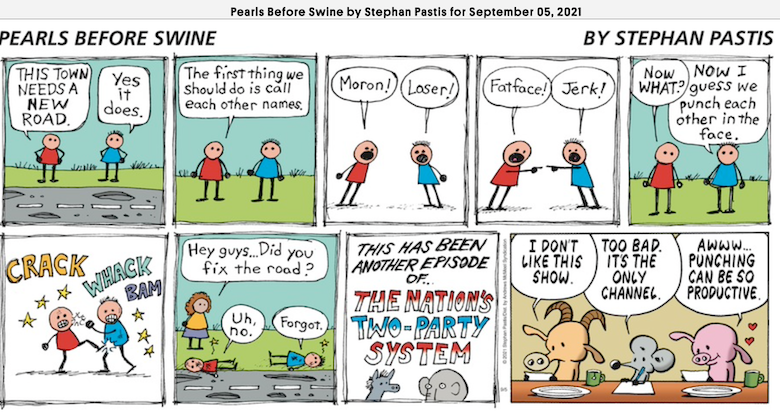
It has long been clear that the Republican party in Congress, aided by some in the Democratic party, has a straightforward strategy: Block everything that does not provide benefits to the ruling class. By creating gridlock and impasses at every turn, they have sought to give the impression that government is useless. This is part of their greater strategy of creating a sense of voter apathy among the less affluent so that they will wash their hands of government and thus be less likely to vote.

In the August 16, 2021 issue of the New Yorker, Louis Menand writes that given the chance, government can do many things that are of great benefit to many people and he points to a two-year window that demonstrates this.
[Read more…]

How do pandemics end?

In an effort to curb the rise in infections and deaths due to the spread of the Delta variant of covid-19, Joe Biden has announced sweeping measures to try and turn the tide. He has mandated that all federal workers and contractors be vaccinated and that all businesses with over 100 employees do the same. He has greatly reduced the options available for not getting vaccinated, especially for federal workers.

In his most forceful pandemic actions and words, President Joe Biden on Thursday ordered sweeping new federal vaccine requirements for as many as 100 million Americans — private-sector employees as well as health care workers and federal contractors — in an all-out effort to curb the surging COVID-19 delta variant.

Speaking at the White House, Biden sharply criticized the tens of millions of Americans who are not yet vaccinated, despite months of availability and incentives.facilities receiving federal benefits will also face the same requirements, he said.

The expansive rules mandate that all employers with more than 100 workers require them to be vaccinated or test for the virus weekly, affecting about 80 million Americans. And the roughly 17 million workers at health facilities that receive federal Medicare or Medicaid also will have to be fully vaccinated.

Biden is also requiring vaccination for employees of the executive branch and contractors who do business with the federal government — with no option to test out. That covers several million more workers.

[Read more…]