
So this started with ribose phosphate, glutamine derived ammonia and formate forming a 5-membered ring, then bicarbonate bound a nitrogen and moved to a carbon, aspartate bound the bicarbonate and left its nitrogen behind, another formate bound the same nitrogen as the bicarbonate did before moving and closed a 6-membered ring by binding to the nitrogen. We have a complete purine, IMP.
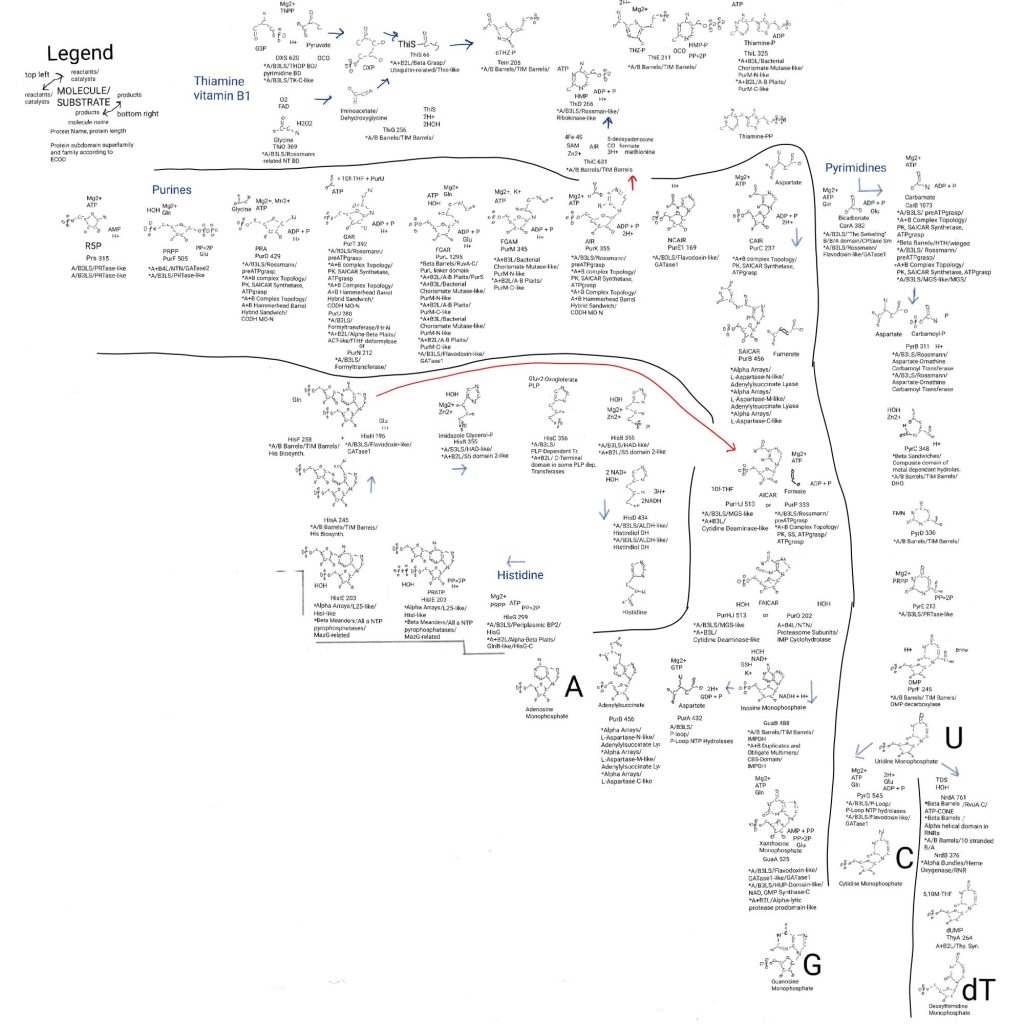
But IMP is not in DNA or RNA unless made by editing enzymes so this isn’t done. This last stage of purine biosynthesis, stage 5, is 2 parallel sets of 2 reactions that give AMP and GMP. These are equivalent with respect to the origin of life no matter how much I want to make assumptions about which came first. IMP came first if anything, but the surrounding environment may have pushed things towards AMP or GMP (or XMP, below, or things that don’t exist anymore).
I’ll start with AMP synthesis to get the hard part out of the way. The hard part are the P-loops that were mentioned in my last post as one of the oldest groups. I like to write down all of the things and sift out patterns.
Stage 5a.1: aspartate binds again.
Again aspartate is bound by it’s nitrogen, this time to the carbonyl carbon (C=O), and again just a phosphate is needed. More reasons to think about an aspartate accumulation step in molecular evolution. Evolution made things fun and complicated by having a GTP used for this reaction.
The protein that does this is in the A+B3L architecture bin, the P-loop domains-like X bin, and P-loop domains-related homology bin. Finally in the P-loop containing nucleoside triphosphate hydrolases topology bin we find PurA as adenylosuccinate synthetase.
When I click into that topology bin I see why this is the hard one. There are many many P-loop nucleoside triphosphate hydrolases (things that separate parts of nucleotides with water, the phosphates here). It’s worse than the Rossmann domains. And guess what, they might be related.
On the emergence of P-Loop NTPase and Rossmann enzymes from a Beta-Alpha-Beta ancestral fragment. Longo 2020
And that’s what happens when something is an old protein domain, there are lots of kinds in lots of proteins. The following paper is suggestive about the oldest purpose of the P-loops, phosphate control. They looked at P-loops from many proteins and created a minimal fragment that maintains its activity.
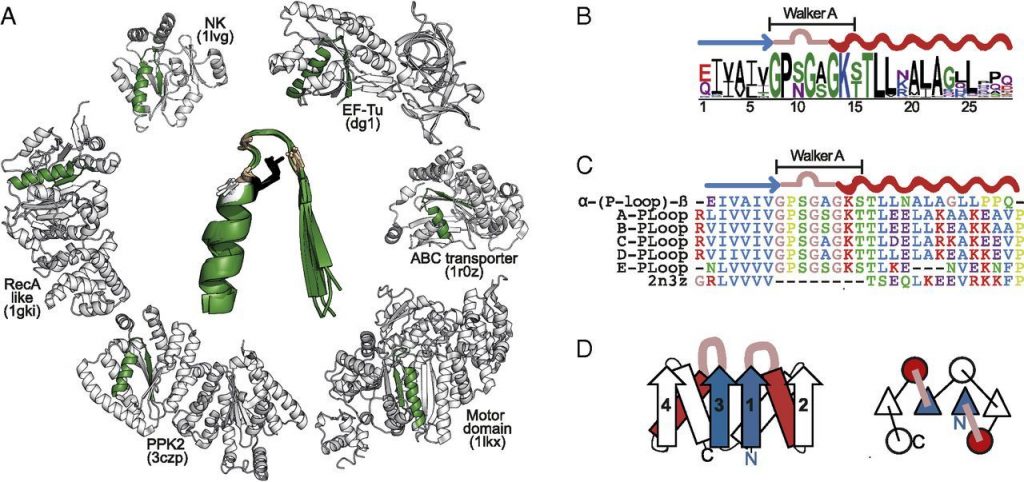
They got it down to 8 amino acid residues.
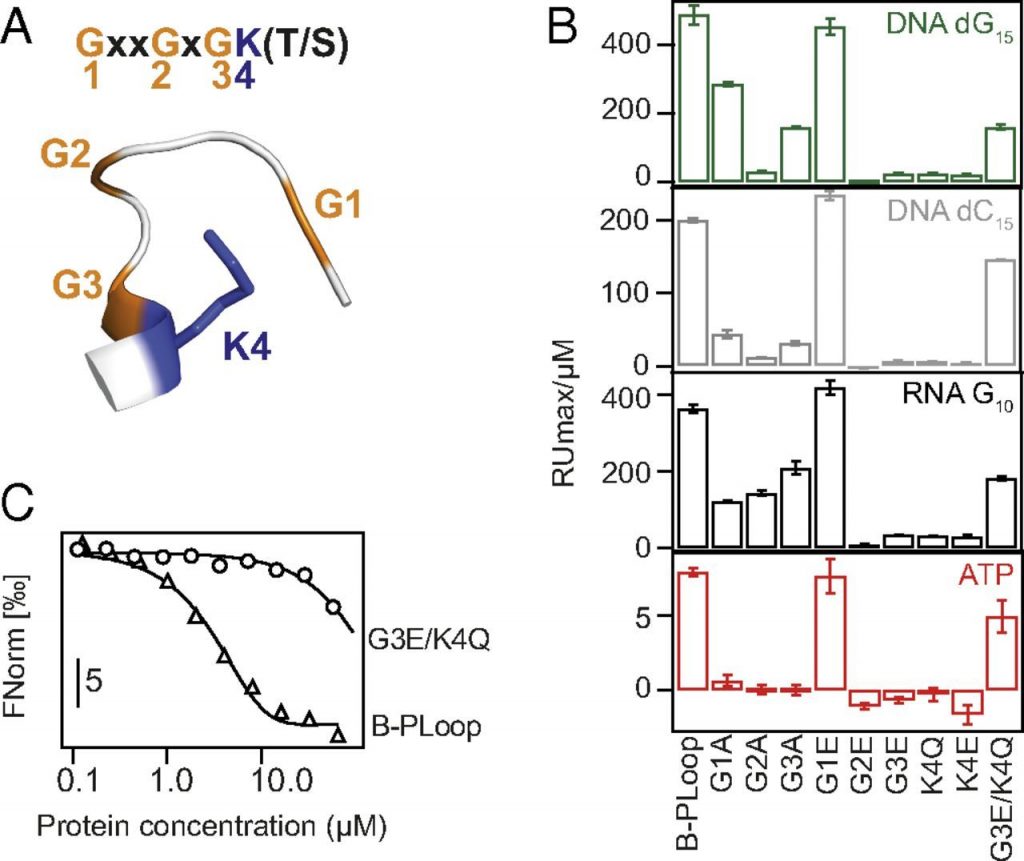
Simple yet functional phosphate-loop proteins. Romero Romero 2018
Another by the group above looking at Rossmans and P-loops looked at the most ancient domains and found phosphate interaction to be the most basic theme.
There’s little more I can do here, phosphate is so basic and widespread in biology that I’ve little trouble believing every use of phosphate can be in these proteins, active site chemistry, mechanical changes to a protein, changing charge, creating or blocking a binding site…
Still some things occur so often on ECOD that they have repeat family bins with increasing numbers and that is worth mentioning. Sulfotransferases show up repeatedly. So do helicases. Bits of molecular motors dynamin, kinesin, myosin… Iron transport and Iron-sulfur cluster binding proteins.
Polyphosphate kinase 2, Ppk2 seems significant since a store of phosphate is needed for all of this. And there are ATP synthase components.
Formyltetrahydrofolate synthase, FTHFS is what cells use to make RNA since it creates the 10-formyl tetrahydrofolate used to make purines.
It took to almost the end of purine biosynthesis for something truly ancient to show up, and that’s ok because all the rest of purine biosynthesis just needed a single phosphate to work. I can imagine primordial phosphate dispensers accumulating and releasing phosphate in ways where that phosphate can do work without needing a compartment in a protein. A mineral compartment could work fine.
Stage 5a.2: aspartate leaves as fumarate. AMP is synthesized.
It’s PurB again, the same as the last post. That was quick, life was lazy and used the same protein to do it again. It’s worth noting that PurB does not remove aspartate as fumerate in arginine biosynthesis (arginosuccinate).
Stage 5b.1: adding water to IMP.
GuaB has 2 domains. The general reaction is adding water to IMP so it has 2 carbonyl groups, making XMP. Xanthosine monophosphate. What is interesting is that it uses niacin which is based on aspartate and has a biosynthesis pathway similar to pyrimidines. The ring is made and then it is put on ribose to make a proton/electron dispenser/acceptor.
TIM barrels
The first domain is in the A/B Barrels architecture bin, the TIM Alpha Beta barrel X group, and TIM Barrels for homology and topology. This is another hard group because there are so many. This is the 3rd ancient family in these posts after the Rossmans and P-loops. A barrel of 8 repeating A/B segments. Once evolution hit on this it did a lot with it.
TIM barrels confuse me. According to one source I found up to 15 different reactions are catalyzed by this family and it’s the shape that seems conserved.
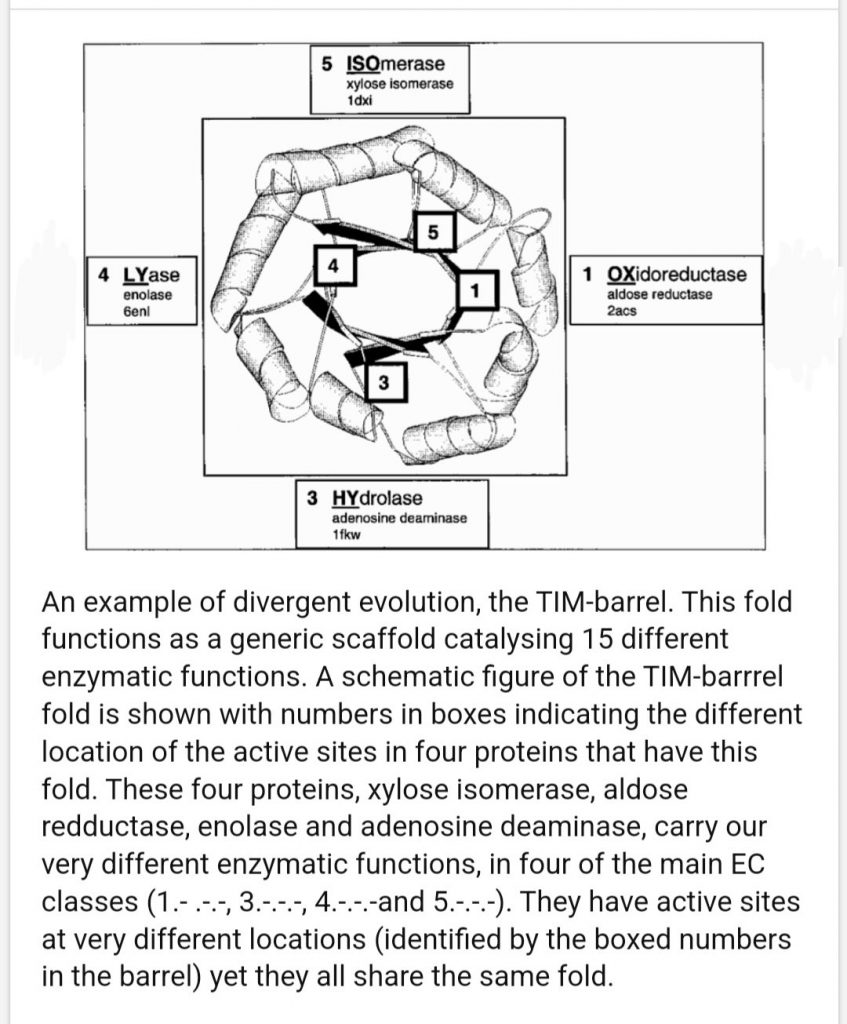
Roles of Specific Peptides in Enzymes. Meroz 2007
Evolution is thought to emphasize the progression from a quarter to a half barrel.
Hidden Sequence Repeats: Additional Evidence for the Origin of TIM-Barrel Family. Ji 2016
So what does shape benefit here? The best I can think of is concentration of things near active sites in that central pore, or multiplication of active sites.
Skip this paragraph if you want to avoid a big list. Significant proteins include: Methylenetetrahydrofolate reductase (makes folate with a 5-methyl), RNAseP, ThiC (makes the big ring of thiamine from purine AIR), Dihydrodipicolinate synthetase (lysine biosynthesis), Quinolinate phosphoribosyl transferase (makes niacin), pyruvate kinase (last step of glycolysis, does a substrate level phosphorylation), glutamate synthase, enolase (glycolysis), Nicotinate phosphoribosyltransferase (adds ribose to the niacin ring), Fructose-bisphosphate aldolase (glycolysis), DAHP synthetase (first step of aromatic amino acid biosynthesis), Type I 3-dehydroquinase (aromatic amino acid biosynthesis), Triosephosphate isomerase (glycolysis, the “TIM” in “TIM barrel”), pterin binding (folate-like), RuBisco large chain (modern photosynthesis carbon acquisition), PdxJ (makes pyridoxal phosphate), ThiG (makes the thiamine 5-membered thiazole ring), Ribulose-phosphate 3 epimerase (makes xylulose phosphate), CO dehydrogenase/acetyl-CoA synthase delta subunit, and lots of things that bind S-adenosyl-methionine.
CBS domain
There is a second domain buried inside of the TIM barrels. This domain is in the “A+B duplicates and obligate multimers” architecture bin, and then the “CBS domain” X, homology and topology bins. According to Interpro CBS domains pair to form single globular domains (called Bateman domains) and GuaB naturally has 2. These domains seem to bind things containing adenylate (adenine) making this a potential regulatory site or a site that binds the adenine of the NAD (niacin) the protein uses to move electrons around.
Stage 5b.2: glutamine provides another ammonia.
GuaA, GMP synthase, works like the other enzymes providing ammonia via glutamine. The ammonia pops off and the phosphate from ATP is used to bind it to the carbon that binds the original carbonyl from IMP. This protein has 3 subdomains.
GATase domain.
This one has been seen before. It’s the GATase1 domain in the Flavodoxin-like bins covered previously. So I’ll refer back to that section.
The next subdomain is new. It’s in the A/B3LS architecture bin, and the “HUP-domain-like” X, homology and topology bins. HUP domains seem to have to do with hydrolysis of the alpha-beta bond of ATP which would leave AMP and diphosphate (the three phosphates of NTPs are labeled alpha, beta, and gamma counting from ribose).
Here’s another list. HUP domains are found in: adenylyl and cytidyl transferases (bind adenosine and cytosine to things, including making niacin). NAD synthase. Glutamine, methionine, lysine, tyrosine, tryptophan, arginine, leucine, isoleucine and valine tRNA synthases. Pantothenate synthase (coenzyme-A), FAD synthase, arginosuccinate synthase, a sacrificial sulfur transferase (LarE, the protein has to be regenerated before it works again), universal stress protein (USP), an Na/Cl/K cotransporter, asparagine synthase, ThiI (thiamine biosynthesis), electron transfer flavoprotein domain, Phosphoadenosine phosphosulfate reductase (PAPS), ATP-sulfurylase and (makes APS which becomes PAPS).
Alpha-lytic protease prodomain-like.
Alpha-lytic protease prodomain is a part of a protein that cuts proteins (protease) that has to be removed before it is active (prodomain). But beyond that GuaA might not be related to anything else in there, it’s in its own homology bin all by itself and is listed as a dimerization domain (so 2 of these proteins interact) making this part done.
And that is it for part 5. Hopefully when I was looking in bins I didn’t ignore anything important. I have 1 more post that puts all of this in a larger context.
Geometry Dash Lite rewards persistence, as players must repeat stages countless times to memorize movement sequences, creating a rewarding feeling when mastering difficult jumps and transitions.
The Greater Gardening of 2026 sounds so futuristic, but it’s all about buying potatoes. I mean, who would have thought that IMP comes first in purine biosynthesis
Geometry Dash SubZero’s chilling graphics, strong beats, and fast-paced courses plunge you into action. Perfect timing and reflexes are essential—one mistake means starting over.
The connection between the ancient P-loop architecture and the fundamental need for phosphate control really puts the complexity of modern nucleotide synthesis into perspective. It’s fascinating that such a complex process like purine biosynthesis can be traced back to such minimal, functional fragments like those 8-residue loops. That Longo paper is definitely going on my reading list to better understand how those basic beta-alpha-beta motifs managed to branch out into so many diverse protein families.
This post is solid, learned a lot from it, thanks for sharing. Really enjoyed this post, you explained the topic clearly and it was easy to follow.
Honestly, this was such a good read. I really liked how you didn’t just stay on the surface but actually explained the thinking behind it. You don’t see that kind of depth in blogs very often. Thanks for writing this.
This was a solid read. I like how you got straight to the point but still left me with something to think about. Feels rare to come across a blog post that’s simple and thoughtful at the same time. Thanks for putting this out there.
This is a fascinating deep dive into purine biosynthesis! Your analysis of the biochemical pathways really sheds light on how complex and interconnected these processes are. As someone who’s worked in biochemistry, I appreciate your clarity.
The focus on how IMP serves as a central hub before branching into AMP and GMP really highlights how complex the origins of these pathways must have been. It’s fascinating to see the connection between the P-loop NTPases and those ancient, minimal ancestral fragments; the idea that such a vital, complex function could trace back to a simple 8-residue phosphate-binding motif is mind-blowing.
Purine biosynthesis, protein relatives, Part 5… My brain feels like it’s trying to assemble a 3D puzzle with a microscope after just reading that title! Seriously, this is a deep dive into the fascinating, intricate world of biochemistry. Hats off to anyone who can keep all those patterns straight!
This is a fascinating deep dive into purine biosynthesis! It’s incredible to see the detailed breakdown of each stage and the connections to ancient protein domains.
The article on purine biosynthesis is fascinating, but I needed a break from biochemistry, so I switched to playing Freak Circus—it’s a fun way to unwind with intriguing character routes.
I love how organized and detailed this is. Very informative!
The article dives deep into purine biosynthesis, but I’m curious—why isn’t IMP directly used in DNA or RNA? For a break from biochemistry, check out this circus adventure to explore character routes and endings. Both topics are fascinating in their own way!
The step by step approach is perfect. Very helpful and practical.
This is a really dense and informative read on purine biosynthesis! I appreciate the detailed breakdown of the P-loops and their ancient origins. It’s fascinating to think about how these basic structures evolved. If you ever need to create visual aids for these complex pathways, a tool like online image editor could be helpful for layering diagrams.
Fascinating read on purine biosynthesis and its relation to proteins. For more in-depth information, check out scritchy scratchy.
Thanks for the deep dive into purine biosynthesis! I liked how you traced the ring formation from ribose phosphate and glutamine, and the parallel AMP/GMP steps. It makes the link to thiamine and histidine pathways clear.
Interesting read on how purine biosynthesis builds from ribose phosphate, glutamine ammonia, and formate, then branches to AMP and GMP. I liked the note about IMP not being directly in DNA/RNA unless edited.
I really enjoyed reading about the step‑by‑step build‑up of the purine ring from ribose phosphate, glutamine ammonia and formate. The way aspartate and bicarbonate shuffle nitrogens was especially clear, and linking it to thiamine and histidine pathways made the big picture click.
Interesting read on how purine biosynthesis builds from ribose phosphate, glutamine ammonia, and formate, linking to thiamine and histidine pathways, then splits into AMP and GMP. The explanation of the ring‑forming steps was clear and engaging.
Interesting read on how purine biosynthesis builds from ribose phosphate and glutamine, linking to thiamine and histidine pathways. I liked the clear step‑by‑step description of the ring formations and the parallel AMP/GMP final stage.
Interesting read on how purine biosynthesis builds from ribose phosphate to AMP and GMP. I liked the detail about the parallel steps and the connection to thiamine and histidine pathways. Thanks for sharing!
Nice overview of purine biosynthesis! I liked how you traced the ring formation from ribose phosphate and formate, and explained the parallel AMP/GMP steps. The connection to thiamine and histidine pathways was a cool touch.
I enjoyed reading about how purine biosynthesis builds step‑by‑step from ribose phosphate and simple molecules, forming those 5‑ and 6‑membered rings. The parallel routes to AMP and GMP made me think about early metabolic flexibility.
Thanks for the detailed walk‑through of purine biosynthesis! I loved how you traced each step from ribose phosphate to the parallel AMP/GMP branches and linked it to early life chemistry. Very clear and thought‑provoking.
the detailed tracing of the purine biosynthesis pathway, especially the transition from imp to amp and gmp, is methodical. the connection drawn to ancient p-loop domains and their proposed role in phosphate control adds a compelling evolutionary dimension. the references to recent studies help ground the speculation in current research. it’s a dense read, but the step-by-step logic is clear.
I used to think of purine biosynthesis as a strict, linear pathway, so seeing it framed through broader relational patterns with other proteins is refreshing. It makes me wonder if this kind of comparative network view could simplify how we teach these metabolic connections in introductory biochemistry courses.
Wow, I didn’t think purine biosynthesis could be such a rollercoaster of complexity! If only there was a way to make all this biochemical chaos easier to digest, like with a good movie night or something—maybe check out this source for a distraction while you’re at it: FMovies.
This deep dive into purine biosynthesis Stage 5 is absolutely fascinating! The way you’ve traced the parallel pathways from IMP to AMP and GMP, and the evolutionary connections to thiamine and histidine pathways, is genuinely mind-blowing. The analysis of P-loop NTPases as one of the oldest protein domains — with their minimal functional fragment of just 8 amino acid residues — really puts into perspective how ancient and fundamental phosphate chemistry is to life. The TIM barrel discussion is particularly compelling; the idea that this architecture emerged from quarter-barrel to half-barrel progression and then diversified into 15+ different catalytic functions is a beautiful example of evolutionary tinkering.
I’ve been getting into casual browser games lately while reading through complex biochemistry papers and waiting for molecular visualization software to render. Head Football has become my go-to — it’s this simple physics-based soccer game that’s surprisingly addictive for quick breaks. My bioinformatics colleagues and I compete for high scores during our virtual journal clubs, and it’s become a fun way to reset between intense discussions of protein topology and ECOD classification. The matches are short enough that I never miss a new preprint alert or a structural biology update!
That observation about GuaA’s HUP domain and its connection to tRNA synthetases and NAD/FAD biosynthesis really highlights the deep evolutionary relationships between nucleotide metabolism and the rest of central metabolism. Can’t wait for Part 6 where you put it all in the larger context. Thanks for this incredible series — Primate Chess continues to be one of the most intellectually rewarding reads in the biosphere!
Wedding Venues in Chattarpur and MG Road. List of in Chattarpur, Banquet Halls, Hotels for Party destinations in Chattarpur and MG Road Ever thought of enjoying a multi-theme Wedding Function while being at just one destination? If no then you must not have visited Chattarpur & MG Road Farmhouses.
the detailed breakdown of the purine biosynthesis pathway, especially the focus on the p-loop domains and their evolutionary significance, is quite thorough. the connection drawn between aspartate’s role and potential molecular evolution steps is a compelling angle. the references to recent papers like longo 2020 and romero romero 2018 help ground the theoretical discussion in current research.
Loved this tour of purine biosynthesis—like watching enzymes run a relay where carbon and nitrogen keep passing the baton.
The repeated use of aspartate in these reactions is striking and makes me wonder how early in evolution that amino acid became so central to purine assembly. Play pokepath tower defense Online for free
The pattern of aspartate repeatedly donating nitrogen in purine synthesis really highlights how central that single amino acid must have been in early metabolism. AI Detect Your Content
The repeated use of aspartate to donate nitrogen in purine synthesis really makes a strong case for that amino acid being a central player in early biochemical evolution. Play Pressing Under Pressure
The repeated use of aspartate in purine synthesis, even at this late stage, really drives home how a few core biochemical building blocks get reused over and over in central metabolism. Use Flux 2
The way aspartate keeps showing up as a nitrogen donor in these pathways makes me wonder if early life had a particular abundance of it that shaped these metabolic choices. Use Image to Image
The recurrence of aspartate donating nitrogen at multiple steps makes me curious whether its chemical stability offered a selective advantage in early metabolic networks. Play Peggy's Post
The way aspartate keeps appearing to donate nitrogen at different steps really makes it look like a foundational building block in early metabolism. Find AI tools on Novatools
I find it fascinating how aspartate keeps reappearing in these biosynthetic steps, almost like a modular part that evolution repurposed multiple times. Use Home Design AI
The recurring role of aspartate here really drives home how a single simple molecule can serve as a versatile building block across multiple stages of early metabolism. Play Finn's Fishing Bonanza Online
The reuse of aspartate at this late stage, after it already donated nitrogen earlier in the pathway, shows how evolution conserves and repurposes simple metabolic logic. Play Chudways Online
The recurring use of aspartate to donate nitrogen in purine synthesis really suggests it was a key player in early biochemical evolution. Play CaptchaWare
The repeated use of aspartate in these purine reactions really makes me wonder if it was one of the earliest amino acids available in prebiotic chemistry. Play Her Trees
It’s interesting that aspartate shows up twice in purine biosynthesis, which might hint at its importance as a building block in early biochemical evolution. Play Splunko Drip
The repeated use of aspartate in purine biosynthesis, first in IMP formation and then again in AMP synthesis, really stands out as a pattern worth exploring further. Play Trees Hate You
The parallel paths to AMP and GMP from IMP suggest that early life maintained flexibility in nucleotide production rather than committing to one purine first. Play Idols Of Ash
The way aspartate keeps appearing as a nitrogen donor in these pathways makes it seem like early biochemistry relied on a few versatile building blocks over and over again. Use Reveedo Generate images and videos
The repeated use of aspartate to donate its nitrogen at different stages really drives home how much early metabolism must have recycled a small set of simple molecules. Play Brush Jjaemu
The recurring use of aspartate in both early and late stages of purine biosynthesis suggests it played a foundational role in ancient metabolic networks. Play Castle Busters
The way aspartate keeps showing up at different stages of purine biosynthesis really makes you wonder if early life had an excess of it and evolution just found multiple uses. Play Klifur
It’s striking how aspartate keeps reappearing as a nitrogen donor in these ancient pathways, suggesting it was a readily available building block in early biochemical evolution. Play Cobb Can Move
The repeated use of aspartate as a nitrogen donor in both early ring formation and later AMP synthesis really drives home how central that single amino acid must have been to early metabolic evolution. Play Scooby Doo Creepy Run
The repeated use of aspartate in different steps of purine biosynthesis seems like a clue that early metabolism relied heavily on a few key amino acids. Play Don't Sleep With The Fishes
The fact that aspartate appears again in stage 5a.1, just like in earlier purine steps, reinforces how central this single amino acid was to early biochemistry. Play Death Spiral
The repeated use of aspartate in both the core purine synthesis and then again in AMP formation really drives home how ancient and versatile that amino acid must have been in early metabolism. Play Name 100 Women
Really interesting deep dive into the purine synthesis pathway—I always get lost in the P-loop connections, so seeing the AMP/GMP branching laid out clearly helps. The way you compare molecular origins to a team-building strategy is a killer analogy. It honestly reminds me of the mental simulation behind drafting a perfect roster, like trying to get every pick to fit together for an unbeaten season. I’ve been tinkering with a similar challenge on the lately, and the same “what comes first?” reasoning applies. Great read, looking forward to the next part.
Your breakdown of the P-loop families and their relation to purine synthesis is fascinating—especially how you trace the parallel paths to AMP and GMP. It really highlights how convoluted molecular evolution can be, and I appreciate the clarity on aspartate’s repeated role. I’m not a biochemist, but these structural insights make the origin-of-life questions more tangible. Speaking of pixel-perfect structures, I’ve also been looking for a simple way to generate little square avatars for my science discussion forums, and I found that creates them easily without any signup. It’s nice to have a small visual identity when posting in comment sections, even on a deep topic like this one.
This is a really deep dive into purine synthesis! It makes me think about how complex life’s building blocks are, and how scientists are piecing it all together. I’ve been exploring some related topics myself on Choicer Voicer, it’s fascinating stuff.
This was a great walkthrough of a dense pathway. The progression from ribose phosphate, glutamine-derived ammonia, and formate forming the 5-membered ring, through bicarbonate and aspartate additions, to the closed 6-membered ring that gives IMP really highlights how modular purine biosynthesis is. Your point that “IMP came first if anything, but the surrounding environment may have pushed things towards AMP or GMP” makes me wonder whether prebiotic chemistry could have energetically favored one branch over the other, or whether the split only became meaningful once proteins took over catalysis.
The section on stage 5a.1—where “aspartate binds again” to the carbonyl carbon and GTP is consumed—clarifies why you called AMP synthesis the hard part. The fact that PurA, adenylosuccinate synthetase, hides inside
By the way, I found some related content on my site that might interest you: https://hoopervault.com
I really enjoyed this step-by-step reconstruction of how the purine ring gets built. Your description of the early chemistry—ribose phosphate, glutamine-derived ammonia, and formate forming the 5-membered ring, then bicarbonate shifting to a carbon and aspartate leaving its nitrogen behind—makes the whole pathway feel like a logical puzzle rather than a list of enzyme names. And closing the 6-membered ring with another formate binding the same nitrogen the bicarbonate used is one of those elegant details that’s easy to miss in a standard textbook diagram.
The branching from IMP to AMP and GMP is where it gets really interesting. You note that IMP likely came first, and that the environment may have pushed things toward AMP, GMP, or even now-vanished intermediates. That ambiguity is refreshing. The part I kept returning to was Stage 5a.1, where aspartate binds again to the carbonyl carbon and a GTP is required. The fact that PurA lands in the P-loop NTPase topology bin explains why you called it the hard part. With so many P-loop hydrolases out there, separating true homology from convergence seems nearly impossible.
The Romero-Romero 2018 paper you cite is especially striking: an 8-residue phosphate-loop fragment that still shows activity. That really supports your framing of P-loops as ancient phosphate-control modules. And the Longo 2020 suggestion that P-loop NTPases and Rossmann enzymes might both descend from a Beta-Alpha-Beta ancestral fragment makes me wonder whether we’re looking at two divergent solutions to the same primordial nucleotide-handling problem.
Your “sift out patterns” method reminds me a lot of how modular skill systems work in other domains—combining older components and seeing what functional identity emerges. For anyone who enjoys that kind of experimental building, https://hoopervault.com is a fun basketball legend builder where you draft iconic skills and piece together a custom Hooper. It’s obviously a very different world from purine biosynthesis, but the same pleasure of assembling a coherent whole from modular parts is definitely there.
One question: do you think the minimal P-loop fragment points more toward an RNA-world phosphate-transfer ancestor, or does the Rossmann connection make a shared Beta-Alpha-Beta ancestor for nucleotide metabolism more likely? I’d love to see that comparison explored in a future post.
This was a clear and relevant take on general biochemical patterns in purine biosynthesis and protein relatives. part 5. This framing makes related references like ai ad generator feel more naturally connected.
This post covers lots of practical AI resources. If you like image remixing, you should check out [whisk image generator](https://whiskai.io/).
this detailed breakdown of the final stages of purine biosynthesis is quite thorough. the focus on the p-loop domains and their ancient, fundamental role in phosphate interaction is a compelling point. it’s interesting to see the evolutionary connection drawn between p-loop ntphydrolases and rossmann domains, suggesting a very deep shared ancestry. the references to the minimal functional fragments in the cited papers add a concrete layer to the discussion of molecular evolution.
What a satisfying payoff to this series — watching IMP get assembled piece by piece (ribose phosphate, glutamine-derived ammonia, formate closing the 5-membered ring, bicarbonate shuttling from nitrogen to carbon, aspartate leaving its nitrogen behind) and then realizing the cell still isn’t done with it. Your point that IMP “is not in DNA or RNA unless made by editing enzymes” is a great reminder that the pathway’s endpoint isn’t the biopolymer itself, but a branching intermediate. I also appreciate your intellectual honesty about AMP vs. GMP — refusing to assume which came first just because it’s narratively convenient is exactly the kind of discipline origin-of-life discussions need.
The P-loop section was the highlight for me. The Romero Romero 2018 result you cited — boiling a P-loop down to just 8 amino acid residues while retaining activity — is genuinely striking. If phosphate binding is truly the “oldest purpose” of these folds, that reframes a lot of the Rossmann/P-loop relationship debates. The Longo 2020 paper you linked suggesting both emerged from a shared beta-alpha-beta ancestral fragment fits neatly with that picture: an ancient fragment optimized for phosphate handling, later elaborated into the dizzying diversity of NTP hydrolases you describe as being “worse than the Rossmann domains.”
One question that’s nagging at me: if the minimal P-loop fragment is functional, has anyone tested it in a reconstructed, stepwise version of the PurA (adenylosuccinate synthetase) reaction environment — i.e., does the 8-residue fragment show any specificity toward the aspartate-bound intermediate, or is it purely generic phosphate binding? That might help distinguish whether the ancestral role was metabolic catalysis versus just nucleotide/phosphate sequestration.
Also, your method of “write down all of the things and sift out patterns” resonates with me — it’s the same impulse behind tools that let you see two representations of the same structure side by side, like I’ve been using https://notabridge.app for comparing numbered notation and staff notation while learning to read both fluently. Patterns only pop when you can view the mapping directly. Would love to see the same side-by-side treatment applied to the topology bins you keep navigating — maybe a future post could map the P-loop bins against their Rossmann counterparts visually.
Thanks for this detailed walkthrough of stage 5, especially the P-loop and TIM barrel context around PurA and GuaB. The phosphate-control angle helped me connect IMP to AMP/GMP conversion more clearly. I found a nice visual explainer on minuteCryptic that made the parallel AMP/GMP steps easier to follow alongside your post.
The transition from IMP to AMP and GMP and the breakdown of ancient P-loop domains provides great insight into how conserved core metabolic mechanisms are. When reading through such detailed structural biology breakdowns, using thevoicerchoicer to listen through notes and research summaries has been a very handy way to keep track of all the enzyme families.
Fascinating analysis of the purine biosynthesis pathway, especially how PurB is reused to convert aspartate into fumarate for AMP synthesis. For quick research tools and reference resources, I often use pinpointanswertoday.io to organize findings and verify related biochemistry data.
The recurring role of aspartate as a nitrogen donor throughout purine biosynthesis really highlights how molecular evolution favored modular and reusable metabolic building blocks. For exploring reference materials and queries, zipanswer is quite useful.
Thanks for this detailed walkthrough of stage 5, the way you trace AMP and GMP synthesis back through P-loops and TIM barrels really helps make sense of such a dense pathway. I especially liked the point about phosphate handling being such an ancient theme that shows up everywhere. Working through complex patterns like this reminds me of puzzle solving — lately I’ve been unwinding with word500, which similarly rewards recognizing small repeating patterns to solve the bigger picture.
Thanks for this detailed walkthrough of stage 5, especially the contrast between PurA/PurB for AMP and GuaB/GuaA for GMP. The part about minimal 8-residue phosphate-loops and TIM barrels as concentration scaffolds really clarified why phosphate handling shows up everywhere. I was comparing notes with a summary I found on pinpointtodayanswer and your explanation of HUP-domain ATP hydrolysis tied the pieces together much better.
Fascinating breakdown of stage 5, especially the P-loop minimal fragment work and the TIM barrel evolution part. The way you traced IMP to AMP/GMP with PurA/PurB and GuaB/GuaA really clarifies the phosphate handling theme. I was testing pattern memory with songfinderbylink and it reminded me how repetition helps map complex pathways like these. Thanks for collecting the Longo 2020 and Romero 2018 references in one place.
Thank you for this thorough walkthrough of stage 5 of purine biosynthesis. Your explanation of the P-loop NTPases and the TIM barrel section for GuaB really helped clarify how AMP and GMP diverge from IMP. I was comparing notes on phosphate handling while reading via queensanswer and your point about minimal phosphate-binding fragments makes the ancient phosphate-dispenser idea much more intuitive.
Thanks for walking through stage 5 so carefully, the part about the 8-residue phosphate-loop fragment and the TIM barrel pore really stood out. I was trying to picture how concentration near the active site could work and sketched some diagrams for my notes using aianimewallpaper for background visuals, which actually helped me follow the AMP vs GMP branches more clearly. Curious if you think phosphate handling alone could have preceded the full barrel architecture?
this detailed breakdown of the final steps in purine biosynthesis is helpful, especially the focus on the aspartate accumulation step and the evolutionary significance of the p-loop domains. the connection drawn between p-loop ntphydrolases and rossmann domains, referencing longo 2020, provides a clear perspective on the deep evolutionary origins of these protein folds. the mention of the minimal functional fragment from romero 2018 is a particularly concise way to illustrate the core function.
The breakdown of the modular evolutionary steps from IMP to AMP and GMP is really illuminating, especially the part about the ancient P-loop architecture and phosphate control. Seeing how conserved structures like TIM barrels and HUP domains get repurposed across different enzymatic functions really highlights how economical nature is with functional protein folds. Thanks for putting together such a detailed series on purine biosynthesis!
The explanation of how IMP branches into AMP and GMP using distinct enzymatic families like P-loops and TIM barrels offers great insight into primordial biochemical evolution. Very informative breakdown! Check out the kidatthe back as well.
The breakdown of Stage 5 and the evolutionary trajectory of ancient domains like P-loops and TIM barrels is really well explained here. The insight regarding minimal functional phosphate-binding fragments in P-loops and how such basic motifs diversified into essential nucleotide synthesis machinery is especially intriguing. Looking forward to reading Part 6 to see how the whole picture comes together.
Fascinating breakdown of Stage 5 purine biosynthesis! The discussion on P-loops as ancient phosphate dispensers and the evolutionary divergence of TIM barrels really helps tie metabolic pathways to structural biology. When unwinding after reading detailed biochemistry articles, I enjoy testing my music memory on songless unlimited. Looking forward to your synthesis in Part 6!
Looking for a quick way to download a public VK video or Clip, I found this site: VKDownloader
The intricate detail on IMP formation is striking, especially the parallel stages for AMP and GMP. It makes me wonder about the energetic constraints in early life; could the reliance on GTP for AMP synthesis hint at specific available energy sources that favored its formation over GMP, or vice-versa, before more complex cellular machinery evolved? Managing complex biochemical pathways like this often reminds me of the challenges in streamlining creative workflows, which is why I find text to video AI tools so useful for visualizing abstract processes.
It’s fascinating how the purine biosynthesis pathway, especially stage 5, involves such intricate steps. I’m curious if the specific GTP requirement for AMP synthesis in Stage 5a.1, as you mentioned, could imply an earlier metabolic dependence on GTP availability in early life scenarios. It’s complex, but anyone building complex workflows might find a free video generation platform like ours useful for visualizing these processes. Slightly off topic, but if you ever deal with free video generator, free video generation platform is what I ended up settling on and it has saved me a fair bit of time.
It’s interesting how the text highlights the parallel pathways for AMP and GMP synthesis, suggesting a lack of early preference. I’m curious if the specific requirement of GTP in Stage 5a.1 for AMP production implies that GTP was significantly more abundant or easier to synthesize than its counterpart in the primordial soup. Anyone juggling complex sequences and workflows might find professional visual creation tools helpful for mapping out intricate processes.
Fascinating breakdown of the chemical pathways. It makes me think about how these foundational, intricate patterns on a micro level mirror the larger cosmic blueprints we see in astrology, like how a specific Chiron degree can point to the core wounding and healing patterns in a natal chart. Everything seems to have a precise starting template.
This breakdown of purine biosynthesis makes the P-loop’s evolutionary role much clearer—especially how those tiny 8-residue motifs underpin such complex functions. For deeper dives into related systems, I’ve found Aniimo helpful for visualizing biological frameworks in context.
The insight on P-loops serving as ancient, minimal phosphate-control modules—especially boiling down to an 8-residue functional fragment—is such a compelling observation. When tracing modular ancestral fragments across divergent topologies like P-loops and Rossmann folds, having clear visual mappings and structural diagrams makes all the difference in understanding how these catalytic scaffolds evolved. The way PurA and PurB are repurposed here really underscores how early biochemistry recycled efficient building blocks rather than inventing entirely new machinery. Really looking forward to seeing how you synthesize all these architectural patterns in the next part!
The article suggests IMP precedes AMP and GMP. Given that IMP requires ribose-5-phosphate, glutamine, and formate, while AMP/GMP synthesis involves aspartate and high-energy phosphates like GTP/ATP, it makes me wonder about the relative availability of these precursors in early Earth conditions. Could the specific cofactor requirements for AMP/GMP formation, particularly GTP in Stage 5a.1, have been a bottleneck or a pointer towards a more established biochemical system? Anyone needing to quickly generate visual aids for complex processes like these might find a text-to-song creator useful for breaking down information into digestible formats.
The detail on IMP synthesis, particularly the sequential addition of formate and bicarbonate, makes one wonder about the stability of intermediate molecules. Were they truly transient, or did specific environmental conditions stabilize them? It’s a fascinating puzzle. For those needing to quickly flesh out creative concepts, exploring an AI music creation suite can be surprisingly effective for generating initial ideas and sonic palettes.
The description of aspartate binding to the carbonyl carbon in stage 5a.1 is striking—it highlights how a single amino‑acid side chain can dictate the direction of the reaction, suggesting an evolutionary pressure to stabilize that intermediate. This detail underscores the complexity of purine biosynthesis and the pivotal role of P‑loop enzymes in early metabolic networks.
The inverter in PDF Dark is free and needs no account, which is rare for this particular job.
It’s interesting that IMP is presented as the precursor to AMP and GMP, requiring ribose phosphate, glutamine, and formate. I’m curious if the relative scarcity or complexity of synthesizing these initial components in a prebiotic environment would have posed a significant bottleneck compared to the later stages involving aspartate and high-energy phosphates. For anyone needing to quickly conceptualize intricate molecular pathways or complex processes visually, an AI video animation tool can be surprisingly effective for generating explanatory sequences without needing footage.
Worth a look if you need something like Ideogram 4 without rebuilding everything. Ideogram 4
Great breakdown of the general biochemical patterns in purine biosynthesis — tying the enzyme families back to their protein relatives really clarifies how the whole pathway fits together. The substrate channeling and feedback regulation in these routes never stop being impressive. Untangling interconnected systems like this is exactly the kind of mental exercise I enjoy, so I often keep a few quick logic and pattern puzzles around (2v2 io); they scratch that same itch of spotting how the parts connect.
The article’s focus on the biochemical pathways is fascinating. I was particularly struck by the mention of GTP being used in Stage 5a.1 for AMP synthesis. This implies a certain level of metabolic complexity was already in place, which makes me question the very earliest stages of nucleotide formation. Could simpler, non-enzymatic reactions have produced usable nucleotides before such energy-intensive pathways evolved? It’s a complex puzzle, and for anyone needing to quickly organize such intricate scientific data, the batch tool I use has been instrumental in streamlining my research notes. Slightly off topic, but if you ever deal with music creation tool, the batch tool I use is what I ended up settling on and it has saved me a fair bit of time.
The article’s dive into the energetic requirements of purine biosynthesis, especially the shift from simpler precursors to complex cofactor-dependent steps like the GTP usage for AMP synthesis, really makes one think about the environmental pressures that might have favored certain biochemical pathways in early life. It’s fascinating how such intricate processes could have emerged from basic chemical reactions. On a related note, for those who find themselves needing to quickly prototype musical ideas, I’ve found that an AI music generation tool has been invaluable for rapidly sketching out full songs with lyrics.
This take on General Biochemical Patterns is worth saving. So this started with ribose phosphate, glu. I especially liked the practical examples, and https://gamemeta.org is a related note I found useful.
the detailed breakdown of the purine biosynthesis pathway, especially the focus on the p-loop domains and their ancient evolutionary role, is fascinating. the connection drawn to phosphate control as a fundamental biochemical theme provides a clear structural perspective. the references to the minimal functional fragments in the cited papers are particularly insightful for understanding protein domain evolution.
“General Biochemical Patterns in Purine Biosynthesis and Protein Relatives. Part 5” does a good job connecting the context to the next action. That’s rarer than it should be. https://trellis-2.net/
After reading “General Biochemical Patterns”, I liked how practical the whole piece feels. So this started with ribose phosphate, glu. One related page I keep coming back to is https://hoopervault.com; it adds another useful angle.
Useful breakdown of General Biochemical Patterns. So this started with ribose phosphate, glu. The advice is easy to apply, and a related resource like https://teaatlas.app fits the same topic well.
I got a few useful ideas from General Biochemical Patterns. So this started with ribose phosphate, glu. If you are exploring the same topic, https://saxstart.com is worth a look as a complementary resource.
The notes in “General Biochemical Patterns in Purine Biosynthesis and Protein Relatives. Part 5” match what I’ve been seeing in practice — good to have it written down. https://pomelli.page/
The notes in “General Biochemical Patterns in Purine Biosynthesis and Protein Relatives. Part 5” match what I’ve been seeing in practice — good to have it written down. https://pikaai.art/
The notes in “General Biochemical Patterns in Purine Biosynthesis and Protein Relatives. Part 5” match what I’ve been seeing in practice — good to have it written down. https://higsfield.io/
The notes in “General Biochemical Patterns in Purine Biosynthesis and Protein Relatives. Part 5” match what I’ve been seeing in practice — good to have it written down. https://king-ai.net/
The notes in “General Biochemical Patterns in Purine Biosynthesis and Protein Relatives. Part 5” match what I’ve been seeing in practice — good to have it written down. https://trellis3.net/
“General Biochemical Patterns in Purine Biosynthesis and Protein Relatives. Part 5” stays on the problem long enough before jumping to tools. That pacing helps. https://pippit.org/