
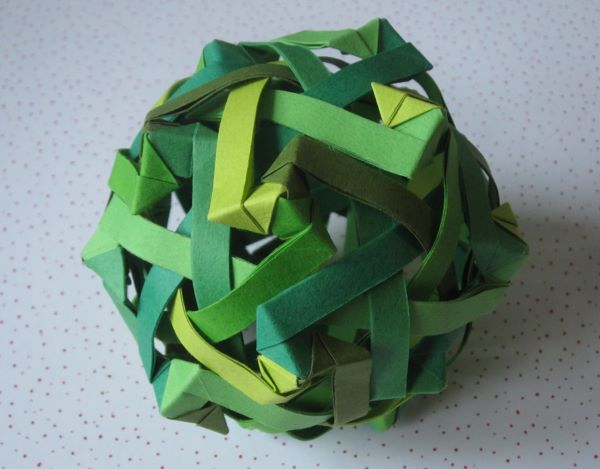
Icosahedral Weave, designed by me
I spent an inordinately long time designing this model in 2024, so let me talk about it.
In modular origami, there are many models that have exactly 30 units in them. Some examples from my own blogging: 1, 2, 3, 4, 5, 6, 7. Why 30? Because the model follows icosahedral symmetry. Each unit connects two adjacent triangular faces of the icosahedron. So each unit corresponds to an edge. An icosahedron has 30 edges.
Alternatively, the model is structured like a dodecahedron. Each unit connects two adjacent pentagonal faces of the dodecahedron. So each unit corresponds to an edge of a dodecahedron. A dodecahedron also has 30 edges.
So I like to think of ways to mix up the formula. The central idea here is, what if we connect non-adjacent faces of the icosahedron? What if we connect non-adjacent faces of the dodecahedron? You still have 30 units, but the units are interconnected in an entirely different way.
My first success with this idea was the Woven Kusudama, inspired by a Meenakshi Mukerji design. It’s a dodecahedron that connects non-adjacent pentagonal faces. But I wanted to do it again with an icosahedron, so I set to work designing something. Here’s what the design looks like:
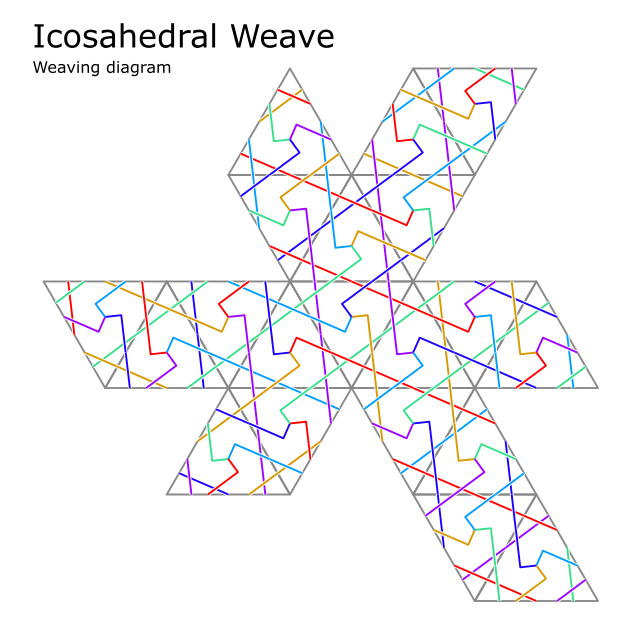
Each colored line represents a single unit. Each unit spans 6 faces of the icosahedron. At each end of the unit, there’s a connection to other units (depicted here as propeller shapes).
In order for this to work, the units need to be very long and very thin. But otherwise, they’re very simple. The folding diagrams fit into a page. But! I don’t recommend for the faint of heart. This is a very advanced model.
Here’s what a model might look like in the middle of folding:
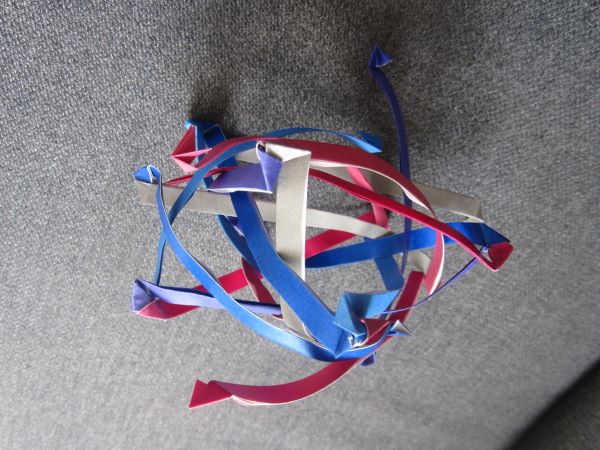
A prototype in progress
Every time you add a new unit, it needs to go over and under the other units in a very specific way. It needs to follow the weaving diagram exactly. But it’s hard to match the weaving diagram to this chaos. After about 10 units have been added, each additional unit becomes a difficult spatial puzzle. Spatial reasoning is a regular component of modular origami, but these puzzles are real stumpers.
In designing this model, I went through several prototypes.
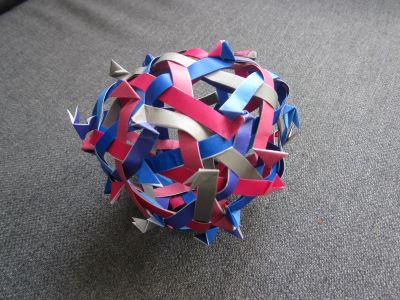
The first prototype. Never completed, because at the end the paper got too strained.
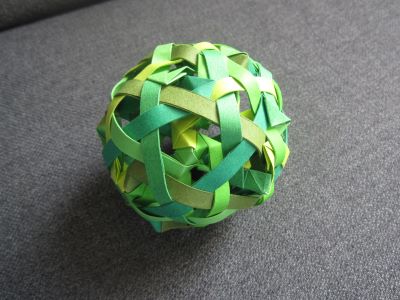
The second prototype. Never completed, because the paper got too strained. But I reused the same units and adjusted the weaving diagram to make the final model.
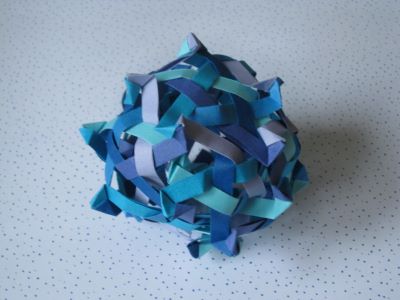
The third prototype. I was able to complete this one, but it was very distorted at the end, like a squashed ball. Though flawed, I kept this prototype around, it’s delightful.
The problem that many of these prototypes suffered, was that they wouldn’t quite connect at the end. In order to follow the weaving diagram, the strip would have had to bend and swerve impossibly. I tried addressing this with different unit designs, but still couldn’t quite get it to work. In the end, I solved the problem by changing the weaving diagram (swapping which crossings were over or under). This felt like a bit of a compromise, like I was breaking my own rules. But then I can’t even explain what the rule was in the first place, so I guess it’s fine.
So you can see why this model took months and months to design. But you know I loved doing it.
The funny thing is that more recently I realized I could simplify the design, using only 6 units. I’ll share that another time.
I love this, especially the way the joins form ‘studs on the surface, but the whole is beautiful.
Wow this is really cool!
It can be simplified to 6 units? And it would still be an icosahedron?
No, the 6 unit version is a tetrahedron. Would have been useful for faster prototyping.
Ooooh nice, and the units still go across 6 faces (so the same face more than once)?
They go across 4 faces.
Symmetry considerations limit how the units can connect. In the icosahedron, you could *try* connecting units across 3 faces. But then, you’d end up with an incomplete icosahedron, including only 8 of the 20 faces… essentially making a cube instead.
I should say, the number of faces is ambiguous, because it depends on which polyhedron is considered. If you take the dual of the tetrahedron (which is another tetrahedron), the 6 units only cross 2 faces. You can also consider the icosahedral weave as mapped onto the surface of a docahedron, and each unit only crosses 2 faces in that case.