Somehow, I produced three good-looking, intelligent, worthy children, and they’re now producing beautiful grandchildren.

I’m not sure how this works. I suspect my wife had something to do with it.

Somehow, I produced three good-looking, intelligent, worthy children, and they’re now producing beautiful grandchildren.
I’m not sure how this works. I suspect my wife had something to do with it.

I was contacted by someone who said there are simmering complaints in the comments sections at Patheos — some are seeing heavy-handed filtering, in particular, that comments discussing Beliefnet or Patheos itself are getting blocked. You can see some of those concerns expressed in comments to this post by Ed Brayton. I don’t comment on that network, so I haven’t seen it myself.
Interestingly, there is a precursor to this concern from 2017. Several Patheos bloggers jumped ship back then, concerned that the religious conservatives who owned the network were meddling with the content.
Yvonne Aburrow, one of the writers who left Patheos, summed up the feelings of some of the writers: “If there are to be blog aggregators or multi-blog hosting sites, they need to be independently-owned, collective, and egalitarian. I (and many others) are just not comfortable with the corporate world being able to control our content, especially if that corporate world is too closely linked with the evangelical Christian right.”
Huh. Interesting. We recently killed the advertising on Freethoughtblogs (which was managed by Patheos!) because it was pathologically annoying and getting in the way of our ability to just write, at the expense of all of our revenue…yeah, we’re writing for you for free right now. I guess we’re living the dream of Ms Aburrow, but it also means we put a damper on any expansion plans for a while.

We spent the afternoon largely engaged in moving our Parasteatoda females into larger, roomier quarters, using 5.7L Sterilyte containers, and then cutting up cardboard boxes to make frames inside the containers for them to build on. We discovered that the 10-can mini-can pop cases were exactly the right size to fit inside, so we zipped over to the grocery store and purchased way too many cases, just so we could get the cardboard. I bought most of it for my research student, who requested Mountain Dew — he’s sharing the bounty with his roommates, so it will be all my fault if a swarm of college students wired on caffeine rampage through the town tonight.
Yesterday, Mary and I went to Pomme de Terre Park, and has been our custom, prowled around looking for spiders. We found a magnificent Larinioides living in a tin shed down by the river, and caught it and brought it home. Look at it! It’s huge and beautiful!
[Read more…]




Do we really want a delusional old liar in the presidency again? Joe Biden is making ridiculous claims.
Speaking at a campaign stop in Ottumwa, Iowa, on Tuesday he discussed losing loved ones before making his promise.
“A lot of you understand what loss is and when loss occurs, you know that people come up to you and tell you ‘I understand’ if you lose a husband, a wife, a son, a daughter, a family member,” he said. “That’s why I’ve worked so hard in my career to make sure that — I promise you if I’m elected president, you’re going to see the single most important thing that changes America, we’re gonna cure cancer.”
No, we’re not.
I understand that cancer is an important personal issue to him, and I would approve of a candidate promising to invest more in biomedical research. If he had actually listened to doctors, if he had any understanding of cancer at all, he’d know that cancer isn’t one disease, it’s a moving target with a billion alternative strategies for evading treatment, and that by its very nature isn’t going to be susceptible to a magic bullet approach. It requires incremental improvements in management and treatment and diagnosis, and even then, sometimes the best doctors can offer is going to fail. He is promising snake oil. He isn’t paying attention to the advisors he ought to be listening to. He sure as hell isn’t personally going to deliver on that promise.
He might as well stand up on that podium and promise that he’s going to cure all viral diseases, eradicate all bacteria, end global climate change, end world hunger, emerge victorious from all wars, and colonize Mars, all between the years 2020 and 2028. No, he’s not. He looks stupid and glib and shallow doing it, too.
I wasn’t going to vote for him in the primaries anyway, but he’s doing his damnedest to make it difficult to vote for him if he wins the Democratic nomination. Which I earnestly hope he doesn’t.


In their mad flailing about to defeat the bad PR about how their site is a haven for racists and misogynists, while trying carefully to avoid alienating anyone who might be bringing them buckets of money, Twitter managed to ban David Neiwert. You know, the David Neiwert, the journalist who has been carefully documenting the rise of the rabid right for decades, who is no friend to these extremists?
Neiwert shared with The Daily Beast the appeal he sent to Twitter:
“My account was suspended because of the photo of the cover of my book in my profile. This book, ‘Alt-America,’ is a history of the rise of the radical right in the United States over the past 30 years. It naturally has an illustration featuring KKK hoods because that is its subject. I am one of the nation’s leading experts on this subject, and it is insane that you would suspend my account because of this photo. I refuse to remove it on principle.”
Alt-America: The Rise of the Radical Right in the Age of Trump was published in 2017 and chronicled the trajectory of far-right and white supremacist groups since the 1990s. Neiwert had used the cover illustration on his Twitter profile without trouble since the book was published.
The problem here is that Twitter insists on implementing the cheapest, most superficial, most easily gamed methods to sniff out bad actors on their medium, meaning that the dishonest thrive and the forthright are silenced. This is not a good sign that they’re getting a grip on the infection they’ve enabled.
I wonder if I’ll get banned for posting the same cover image?


Justin Bieber ludicrously challenged Tom Cruise to a battle…so it’s a thing now. You have to pick a famous person who is 31 years older than you to a fight. That’s getting a bit tricky in my case, since I’ve got to find someone who is 93 years old. Fortunately, I have a contender: Elizabeth the Second, by the Grace of God, of the United Kingdom of Great Britain and Northern Ireland and of Her other Realms and Territories Queen, Head of the Commonwealth, Defender of the Faith. She’s 93 years old, exactly right.

I think I can take her. Pretty sure, anyway. If I win in a trial by combat, do I get to take over her throne?

I got some excellent suggestions from Nicholas DiRienzo for raising spiders, which is why it’s good to get information online, and also why I’m going to the American Arachnology Society conference this weekend. You can get started with reading stuff, but there’s no substitute for hearing it straight from the experts.
We checked out the couples we’d put together in larger spaces yesterday, and sadly, I caught one in the act of cannibalism…poor guy. We separated them. Then I rummaged in my collection of zebrafish containers, and found some 5.7L Sterilyte containers, a bit smaller than Dr DiRienzo recommended, but we’ll give them a try. We moved a few females into them right away so they can start getting used to the expanded digs. We’re going to also add some cardboard liners, once we find a box that fits.

I was initially daunted about the space required — it was appealing to just have oodles of spiders in a small incubator — but once I started stacking these things, I realized I could pack maybe as many as 50 females into the space I’d previously used for my zebrafish setup. Sorry, fishies, it’s now an arachnid facility.
My summer student, Preston Fifarek, has wisely chosen to name the female spiders after characters from Game of Thrones. Males are going to get Lord of the Rings names. I’ll be interested to see how well Cersei takes to Bilbo.

The Legion of St Ambrose looks like a gang of video game cosplayers. They threaten to dab you.
The cowardly, those who countersignal, do-nothings, traitors, the enemies of Christ, and the enemies of those who serve Him shall be dabbed on. pic.twitter.com/Ftf0fqxbvw
— Legion of St. Ambrose (@AmbroseLegion) June 8, 2019
They also have some kind of manifesto online. It’s the usual theocratic noise: church schooling, patriarchy, mandatory Christianity, anti-“bankers” (we all know what they mean by that) and of course, white nationalism.
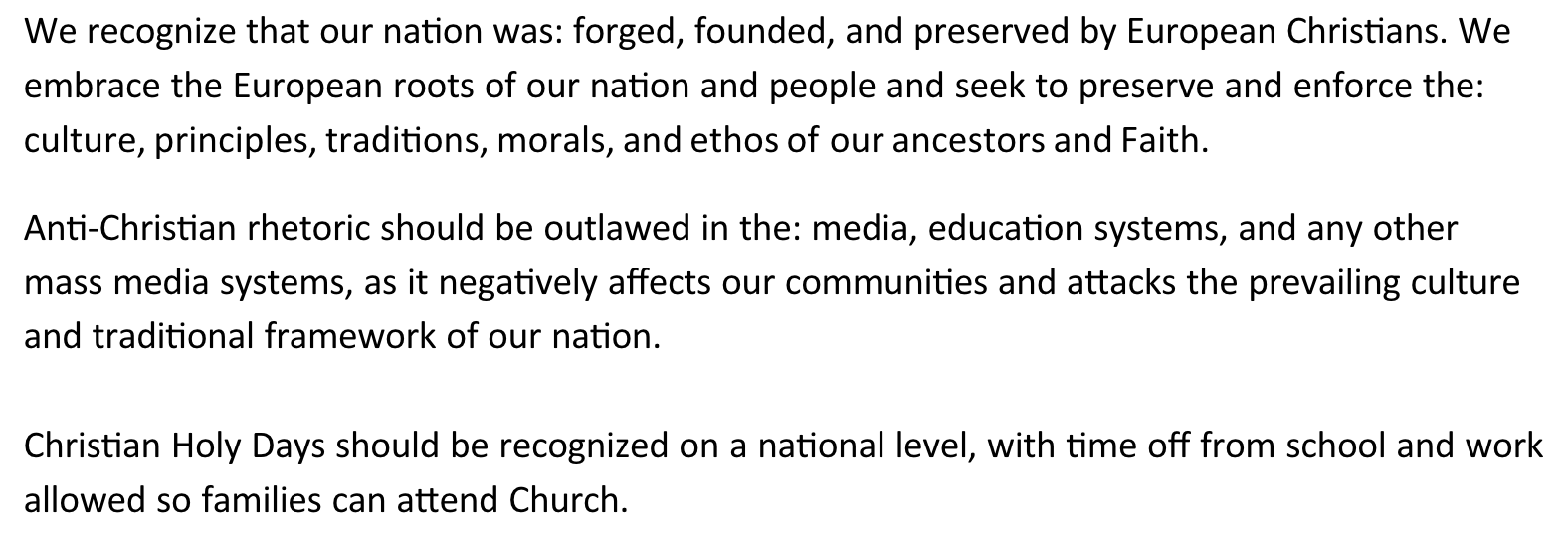
An interesting twist: they’re “environmental”, meaning they want to ban pesticides, GMOs, and factory farming. They also think healthcare should be a right, but they also want to emphasize “natural” medicines. No more private prisons, either, but also no abortions, ever.
It’s a novel evolution of Christian conservatism. The funny costumes make it hard to take them seriously, though.