I don’t understand a thing linguists say

Oh man, I got lost fast in this discussion. Anyway, there was an old Sumerian joke going around the interwebs a short while ago. It was totally incomprehensible.

Someone who is apparently an expert in Sumerian (I assume, I have no idea, they could be a highly skilled bullshitter) took the original text apart in an extremely detailed fashion on Twitter. I’ll just have to trust them. Follow the thread if you want to see the train of logic and obscure Sumerian grammatical rules. But they do come to a conclusion, an interpretation of the joke that actually makes sense.

I think it might be the oldest known Dad Joke.

Sooooon

A reader sent in this video of a grass spider laying eggs and building an egg sac. Spiders can be very maternal, although they seem to lose interest once all the babies emerge, and these are ubiquitous grass spiders. My lawn is finally free of snow thanks to a warm spell last week, and I’ve been checking it out every morning for the first grass spiders to put up their tents and cover the grass with their habitations.

If I have any complaint about grass spiders, it’s that maybe they’re too prolific. Over the course of the summer, they’ll expand their empire from the grassy bits down low to the sides of my house, usually by the avenue of expanding up the sides of the water spouts, and by August they’re displacing my favorites, Parasteatoda. But right now, I hope they’re getting busy and filling the place with mosquito-and-gnat eating predators.

What is death, anyway? And how do we tell?

Sometimes, I wonder about philosophers. I can sort of see that considering counterfactuals and even absurd premises is useful and can generate novel insights, but I wonder at how some can adopt the weirdest assumptions. As in this paper, How to Tell If Animals Can Understand Death, which begins like so:

It is generally assumed that humans are the only animals who can possess a concept of death.

Now that is just bad writing. Passive voice, broad statement as fact, no supporting evidence…but mostly, who assumes animals can’t have a concept of death? Not me. Not the general public. I doubt that most ethologists think that. There are far too many empirical observations of animals fearing death, or behaving as if grieving, or avoiding the dead. I think most mammals have an understanding of death; other groups, like birds and reptiles, probably do but are harder for people to read, and may have a very different concept of what death is.

The great mystery is whether spiders have a concept of death, or are simply content to be bringers of death to others.

Anyway, after that initial off-putting sentence, the rest of the paper is much better and more interesting, and is trying to bring some rigor to how we evaluate the conception in non-human animals. I can get into that.

It is generally assumed that humans are the only animals who can possess a concept of death. However, the ubiquity of death in nature and the evolutionary advantages that would come with an understanding of death provide two prima facie reasons for doubting this assumption. In this paper, my intention is not to defend that animals of this or that nonhuman species possess a concept of death, but rather to examine how we could go about empirically determining whether animals can have a concept of death. In order to answer this question, I begin by sketching an account of concept possession that favours intensional classification rather than mere extensional discrimination. Further, I argue that the concept of death should be construed as neither binary nor universal. I then present a proposal for a set of minimal conditions that must be met to have a concept of death. I argue that having a minimal understanding of death entails first expecting a dead individual to be alive, and then grasping its non-functionality and irreversibility. Lastly, I lay out the sort of observational and experimental evidence that we should look for to determine whether animals have the capacity for a minimal comprehension of death.

I appreciate that the concept of death is nonbinary. In particular, what comes to mind is that some religious people don’t have a grasp on it — they think the dead people are still alive in some other realm! — so if we demanded that the concept entails an absolute, definitive appreciation of non-existence, then we’d have to argue that some humans lack a concept of death. The author considers that in the paper, and I think it’s fair to say that a concept of an afterlife complicates the understanding of death, but doesn’t negate it.

Contrary to what is often assumed by animal ethicists, the concept of death should not be viewed in binary terms. Possessing a concept of death is not an all-or-nothing matter but rather something that is subject to gradation. This becomes clear once we consider the case of human children, who do not acquire a concept of death overnight. In fact, the scientific consensus is that it takes them an average of 10 years to fully master the concept of death (Kenyon 2001), but we credit them with some understanding of death before they reach this stage. If we accept a gradation in the case of human children, we should also accept it in the case of animals.

So let’s break down what a thorough understanding of what death is would entail. See, this is where philosophers shine, in organizing the ideas!

1. Non-functionality: death implies the cessation of all bodily and mental functions.

2. Irreversibility: dead individuals cannot come back to life.

3. Universality: all living things, and only living things, die.

4. Personal mortality: death will also apply to oneself.

5. Inevitability: eventually, all living things must die.

6. Causality: death occurs due to a breakdown in the bodily functions.

7. Unpredictability: it is impossible to know in advance the exact timing of death.

That’s where the nonbinariness is relevant. I would say that I personally accept all seven, probably most of you do too, but I know people who would reject many of those points, yet still understand the idea of death. They don’t reject them with good reason, of course, but because of some a priori commitment to supernatural beliefs. So the author distills this list down to a minimal collection of behaviors characters of individuals who understand death.

A creature can be credited with a minimal concept of death once she classifies some dead individuals as dead with some reliability, where ‘dead’ is understood as a property that pertains to beings who:

(a) are expected to have the cluster of functions characteristic of living beings, but

(b) lack the cluster of functions characteristic of living beings, and

(c) cannot recover the cluster of functions characteristic of living beings.

Not addressed: I wonder, then, if by these criteria someone in a vegetative state should be considered “dead”. I know, nonbinary again, but something that might be tested/applied in humans.

All right, now it’s time to apply these ideas to animals. What would we expect to see if an animal understands death? There is a long list of things to look for, but to keep it simple, I’ll just consider how they apply to spiders, as a test case.

1. Varied behaviour towards corpses

This one is a little unfair to spiders. The idea is that the subject should exhibit some confusion about how to respond to corpses, but to a spider, which is primarily a tactile animal, a dead animal more or less becomes invisible and ceases to exist. That they can still feed on immobilized prey suggests there is more complexity than that, though.

2. Unhygienic/maladaptive behaviour towards corpses

Interesting. Disposing of or burying corpses is indicative of a hard-wired response, while maladaptive diddling of dead bodies implies that their behavior is not hardwired, and suggest the possibility that they could acquire more complex ideas about death. Hmm. I’ve seen spiders drag corpses into their nests and festoon the place with the bodies of their prey, so maybe this is a positive for them.

3. Different treatment of corpses vs. asleep individuals

Recognizing the difference between asleep and dead (or comatose and dead?) sounds like an important concept. But what does a sleeping spider look like? I can’t tell. Can they?

4. Investigative behaviour towards corpses

Hey, you wanna see a dead body? When a spider finds a dead animal, and hoists it into her nest in the same way she would a bit of bark or a leaf, is that curiosity? I don’t know.

5. Aggressive behaviour towards corpses

Nope, I don’t see that in spiders. If they can’t eat it or mate with it, there’s no reason to fight it.

6. Caring behaviour towards beings with limited functionality

In spiders? Ha ha, no.

7. Mourning behaviour towards corpses

This one is tricky. The author cites returning repeatedly to corpses, or in the case of primates, carrying dead infants around. My spiders don’t exhibit parental care (other than the fact that they don’t eat newborns, which is a generous notion of “care” — I was a good daddy because I didn’t gnaw on my children, either), but sometimes their nests look like graveyards.

8. Eventual ignoring or abandoning of a corpse

No fair! It’s a sign of understanding when they haul a dead baby around, but also when they throw the dead baby aside? OK, spiders are very good at ignoring corpses.

9. Age or experience-relative difference in behaviour towards corpses

As animals mature and gain experience, their treatment of the dead may change, indicating that their behavior is learned. I haven’t seen that in spiders — the babies are ravenous little beasts, the adults are ravenous big beasts. They’re also so short-lived and usually solitary, so they don’t have the opportunity to learn.

While I appreciate the effort, I think one problem here is that the author is more familiar with domesticated mammals than more alien species. Can you compare, for instance, the concept of death between carnivores and herbivores? How does a vulture view death? How do you practically assess the concept of death in a solitary ambush predator that doesn’t engage in the kinds of social interactions we take for granted? Maybe spiders are acutely aware of the meaning of dead vs alive, in the sense that it is their business to make live things dead, but they don’t have the kind of behavioral repertoire that would allow us to assess that fact.

I guess I’m just going to have to ask them this morning.

You have to stop & think … who would invite Madison Cawthorn to an orgy?

Cawthorn made a surprising admission: he has been invited to an orgy by Washington fat cats he previously admired.

Whoops. We can exempt a whole slew of liberals from the suspect list, since he wouldn’t have admired them. I don’t know what criteria orgy hosts use to select their guests — I’ve never held one or been invited to one, which feels a little bit like an embarrassing admission about me — but I suspect most people on the left side of the aisle find his views repulsive.

So now the guessing games begin. Which Republicans are staging orgies in the Capitol?

(This is not a very titillating thought exercise. If you’re trying to suppress your libido, just picture a Republican sex party in your head, all interest in sex will vanish quickly.)

I’ve never been to Mississippi. I guess I never will.

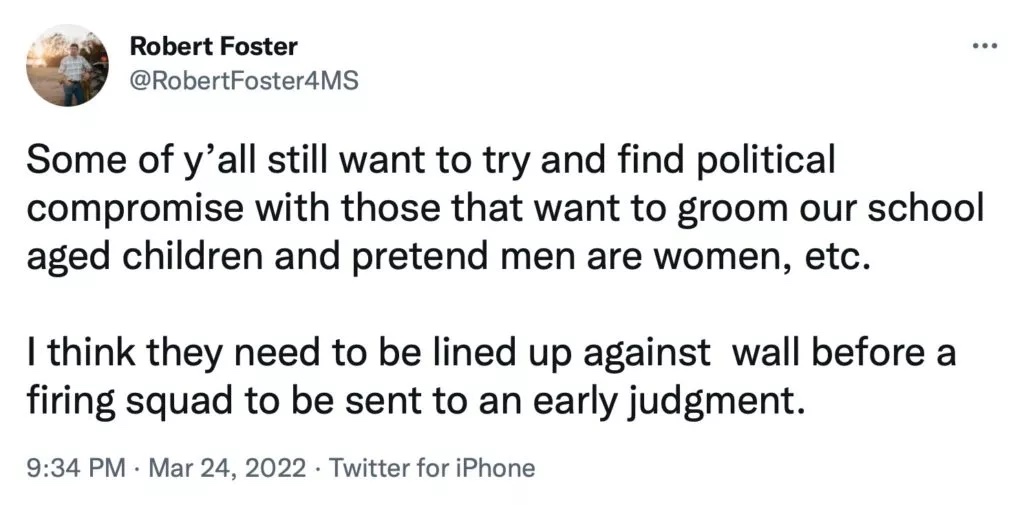
There are politicians there who want to murder me.

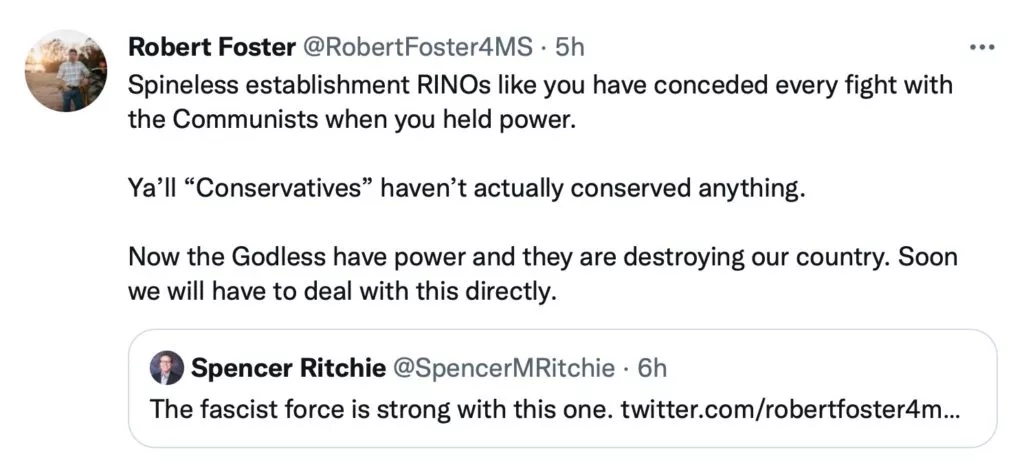
Robert Foster, a former Mississippi House lawmaker who lost a 2019 bid for governor, is using his social-media platform to call for the execution of political foes who support the rights of transgender people.

He ran for governor of the state. He lost. But he still got 18% of the vote — I am not reassured at the thought that about a fifth of the state didn’t find that automatically disqualifying.

This guy wants to kill me for being an atheist, too.

Do I need to mention that he’s a Republican?

The pandemic must end so my father’s ghost can rest

I know, it’s nowhere near ending, especially since policy-makers make stupid policies to appease right-wing nitwits. But I have a personal reason for getting this over with.

I had to shave off the beard so masking is more effective. This means that I have to regularly use a razor. Therefore, I have to use shaving cream. So I’m standing in the bathroom with a can of Barbasol in one hand, I look in the mirror, and instantly I am transported back half a century, and there’s my dad, teaching me how to shave off the unsightly sparse shrubbery sprouting from my face. He’s laughing, because I had no idea how much shaving cream to use, and had a gigantic mass of the stuff I was smearing on in great thick glops, making a big mess.

That memory comes roaring back every time I have to shave. There I am in the moment I’m about to dispense the stuff, and there’s the ghost of my father, hovering over my shoulder, chuckling and monitoring how much shaving cream I’m using. I don’t mind seeing Dad again, but then I have to disappoint him by using only a judicious quantity.

And that’s my personal reason for wanting the pandemic to end: so I can stop shaving, and stop triggering that memory, and stop letting my father down. Alternatively, I suppose I could indulge him and splat a big ol’ cream pie in my face every morning.

You knew it was going to come down to this

Goddamn Texas Republicans. Now they’re saying it out loud.

Should Texas punish abortions by putting teenage girls and women to death? Or not? That’s the current debate in the Republican Party of Texas, where outlawing abortion is no longer a question of “if” or “when” but a question of whether to kill women for getting one.

They’re trying to pass a heinous bill.

A Texas lawmaker has filed a bill that would abolish and criminalize abortions, leaving women and physicians who perform the procedure to face criminal charges that could carry the death penalty.

The legislation, filed Tuesday by state Rep. Bryan Slaton, does not include exceptions for rape or incest. It does exempt ectopic pregnancies that seriously threaten the life of the woman “when a reasonable alternative to save the lives of both the mother and the unborn child is unavailable.”

“It is time for Texas to protect the natural right to life for the tiniest and most innocent Texans, and this bill does just that,” Slaton said. “It’s time Republicans make it clear that we actually think abortion is murder. … Unborn children are dying at a faster rate in Texas than COVID patients, but Texas isn’t taking the abortion crisis seriously.”

The only abortion crisis is that these assholes want to ban it. Would you be surprised to learn that this same representative wants to roll back all of the pandemic prevention measures in the state? He thinks no one is dying of COVID, but that more “unborn children” (there is no such thing) are dying than…zero.

This bozo is eager to start killing adult women, though. Gotta get the body count up somehow.

How about if we just call it “The Homophobic Space Telescope”?

I learned three disappointing things about NASA today. There’s been an ongoing kerfuffle over the name of the James Webb Space Telescope, because Webb presided over a remarkably homophobic culture at the agency. Now internal documents about the debate over naming it have been revealed.

Internal NASA documents obtained by Nature reveal fresh details about the agency’s investigation last year into whether to rename its flagship James Webb Space Telescope (JWST). A group of astronomers had led a community petition to change the name, alleging that the telescope’s namesake, former NASA chief James Webb, had been complicit in the persecution and firing of gay and lesbian federal employees during his career in the US government in the 1950s and 1960s.

I already knew all that. Those aren’t the new disappointments.

One was that this problem goes all the way back to 1969, when a judge ruled on a firing case.

Although the documents reveal that key decisions were made in meetings and not over e-mail, they still show agency officials wrestling with how to investigate the allegations and control public messaging over the controversy. As early as April 2021, an external researcher flagged wording from the 1969 court ruling to NASA officials. It came in the case of Clifford Norton, who had appealed against being fired from NASA for “immoral, indecent, and disgraceful conduct”. In the decision, the chief judge wrote that the person who had fired Norton had said that he was a good employee and asked whether there was a way to keep him on. Whomever he consulted in the personnel office told him that it was a “custom within the agency” to fire people for “homosexual conduct”.

“I think you will find this paragraph to be troubling,” wrote the external researcher to Eric Smith, the JWST’s programme scientist at NASA in Washington DC. “‘A custom within the agency’ sounds pretty bad.”

Troubling? You think? The NASA personnel office considered it customary to fire anyone exposed as gay?

That’s old news, you say. What isn’t old is how the modern agency carried out their investigation.

The second disappointment is that they contacted 10 straight astronomers who said discrimination against gay people wasn’t a problem, and that was part of their ultimate decision to bury the controversy. Does anyone else see a problem with their methodology?

And then the third surprise.

The revelations about NASA’s decision regarding the JWST come at a time of increasing concern over the way the agency handles issues of identity. Earlier this month, employees at the agency’s Goddard Space Flight Center in Greenbelt, Maryland, were told that they would no longer be able to include pronouns, such as she/her or they/them, in their display names in agency computer systems. After the move was discussed on Reddit and the astronomy community reacted negatively on other social platforms, NASA put out a statement that employees could continue to include pronouns in their e-mail signature blocks.

How authoritarian of them. So this month the administrators were openly transphobic, while pretending that oh no, they were never ever homophobic? I don’t think I believe them, especially since they tried to hide their findings.

I never thought I’d sympathize with a church

This is an amazing photo series of an abandoned church in Ontario, documenting its decay over a decade. I feel ya, church.

It’s got the appearance of an apocalyptically sudden departure — there’s an old open bible in the pulpit, with a pair of reading glasses casually left on top. It’s like one day they were holding services, and the next day every one was gone, never to return.

Also interesting how it falls: it starts with a little water leak in the roof, leading to mold and rot spreading across the ceiling, and then one winter, ka-boom, the roof caves in.

It’s reminding me that maintenance is important. Little problems lead to big problems lead to complete system collapse, so tend to those little problems as you go.

(Speaking of which — this was a bad winter for me, with annoying tendinitis issues basically crippling me for months. I got these new shoes with a good fit and great ankle support two weeks ago, and it’s almost miraculous how much better I feel, walking around fairly freely now with barely a twinge. Appreciate your mobility while you’ve got it, it’s awful when a little problem messes you up. Get good shoes. Patch those roof leaks.)