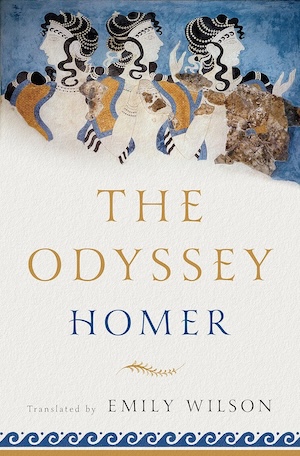
Emily Wilson has written a review of Christopher Nolan’s The Odyssey! She’s the author of an excellent translation of Homer’s The Odyssey, one that Nolan himself mentioned as an inspiration, so she is one of the best qualified people to judge the movie.
She starts off diplomatically.
Christopher Nolan’s $250 million action movie version of Homer’s ancient Greek poem is an entertaining way to hide from the high temperatures for a few hours. Nolan’s trademark jumps and twists in the narrative structure are relatively easy to follow, and appropriate for The Odyssey, a narrative of tales nested in tales. My teenagers had a good time. Unlike some of Nolan’s other films, The Odyssey is not boring, thanks to the source material, which is impossible to mess up entirely. It’s a family-friendly audiovisual spectacle, like an elaborate Fourth of July fireworks display – and with about the same level of narrative and emotional depth.
Uh-oh. I think she had mixed feelings about the movie.
As in his previous films, Nolan is interested in the discontinuities of space and time, in magic, tricks, craft, technology, rivalry, substitution, masks, miscommunication, what we remember and what we choose to forget. Yet again, survival is portrayed as a kind of triumph. Yet again, there are long, claustrophobic scenes of drowning and near-drowning, and technically impressive episodes in which buildings are engulfed in flames and vehicles explode. Yet again, we watch a male character’s desperate quest to recover and/or avenge a female love object. I had hoped that Nolan’s affinity with these Homeric themes might push him to new creative heights, and enable him to conjure more believable characters. But The Odyssey features his usual combination of grandiosity and superficiality. Without a tub of wax for my ears – which Himesh Patel’s ever anxious Eurylochus, Odysseus’s doomed right-hand man, uses to sail safely past the Sirens – I was exposed to the full din of thumping sticks, staffs, swords and clashing armour, thunderbolts, crashing waves, grunts, screams, toppling palaces and burning temples. But unlike Matt Damon, the wax-free Odysseus who is tied to the mast as he is conveyed past the Sirens (naked ladies reclining on some uncomfortable-looking rocks), I gazed at the shipwrecks and bloodbaths without any agony of emotion. My eyes stayed dry, even for Argos the dog – whose adorableness as a puppy is predictably amped up to suit our animal-loving times. If only the human characters had been treated with such serious attention.
It’s been playing at the Morris Theater for going on two weeks, and one thing I’ve noticed while working concessions is how loud this movie is. Thumping, shrieking, clanging at high volume while I’m trying to take a popcorn order — it’s been an epic struggle. But yes, I agree about the flatness of the characters. One of the most notable moments of acting in the film is when Ann Hathaway’s Penelope cuts loose and expresses the complexity of her feelings — anger, resentment, confusion — to Tom Holland’s Telemachus, but mostly she’s seen as a quiet, reserved figure behind a screen.
I also expected more from Argos. In the movie, the suitors toss the old dog onto a dung pile, and when Odysseus returns, the dog notices…and simply dies. Blink and you’ll miss it. It was an opportunity to humanize Matt Damon’s Odysseus, and it was allowed to pass.
Another complaint: the Americanization of the violence.
But the representation of Odysseus as a reluctant warlord makes a nonsense of the movie’s imagined world. We are not shown that war or killing are bad, only that good men sometimes feel bad about it – a very different point. Any serious depiction of violence, ancient or modern, must show the perspectives of the victims as well as the perpetrators, and the Homeric poems easily clear the bar – but Nolan doesn’t. The Trojans are dehumanised by their masks; we know none of them by name or face. The hands of Odysseus and Telemachus are bloodied only by the most righteous, computer-game modes of killing, and we feel no pity or horror at the deaths of their victims, whether Trojans, giants, suitors or slaves. During the sack of Troy – which he supposedly organised – Odysseus gazes around in bewilderment and horror, as if he has never seen a massacre before.
I just finished reading a translation of The Odyssey last night — Emily Wilson’s, in fact — and that jumped out at me. In the bloody massacre of the suitors, as Odysseus goes on his killing spree, Homer doesn’t dwell on the gore, but instead names each man as they are murdered, and sometimes goes on to talk about their fathers, and maybe some notable feature of their character. Many of them are terrified and beg for mercy. It’s a much more impactful way of dramatizing the slaughter, rather than showing a knife going into Antinous’s throat.
The book also details many events that the movie omitted. I’d forgotten what a compulsive liar Odysseus was. Multiple times he lies to people he encounters, giving his cover story about being from Crete, with elaborate details about his background. When he finally meets Penelope again, the first thing he does is spin a long story about his alias, all of it entirely unnecessary, but “liar” is one of his epithets, so I guess he has to do it.
Also omitted from the movie is his treatment of the female slaves who slept with the suitors. He gets his head household slave to rat them out, puts them to work cleaning out all the dead bodies and gore in his palace, and then pitilessly hangs them so they die kicking and struggling. It’s not a pretty story, but fortunately, Matt Damon did not have to deal with such complications.
Wilson has her gripes, especially with the screenplay, but still ends on an upbeat note.
Despite all this, the release of The Odyssey is still an event to celebrate. In what we are told is the streaming era, this epic is bringing audiences back to cinemas. In what we are told is a time of declining literacy and the ‘death of the humanities’, translations of The Odyssey, including mine, are flying off the shelves. Some of those who buy the book or show up in cinemas to watch Tom Holland may go on to study ancient Greek. Perhaps the film will persuade a few college administrators not to cut their literature, language and history departments. Nolan, who studied English at University College London – where students still study The Odyssey as a first year ‘foundational text’ – is doing his best to get the general public reading again, and I am grateful.
The movie got me to re-read The Odyssey, so I’m an example of that. I’ve always championed the importance of the humanities in education, so nothing new there, and sorry, no, I’m not going to study ancient Greek, but maybe more people will.
It’s a great essay from an expert. If it’s too long for you, Wilson has also posted an abbreviated bullet-point version of her main points on BlueSky. Also do see the movie — your local theaters appreciate it — but I think it would be a good idea to bring earplugs.