
There are 6400 Starlink satellites in low-Earth orbit right now, and Musk wants to launch more than 10,000 more; there are a half million more proposed by competing companies, like Amazon. Each one weighs about 800kg. Regularly, here’s what happens:
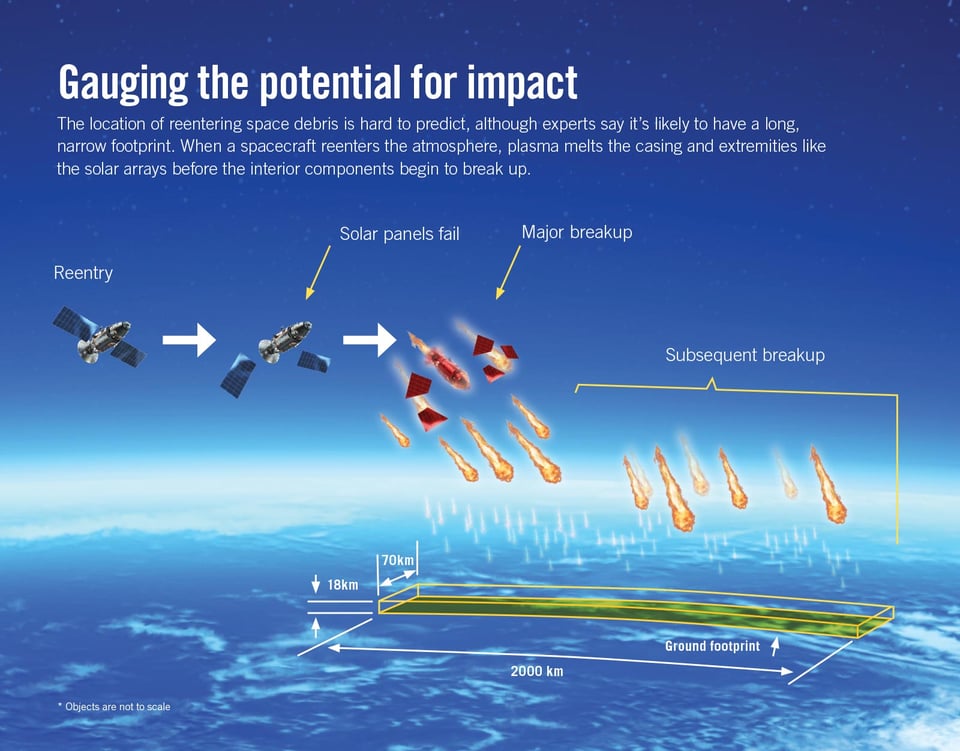
This adds up.
Due to the large number of short-lived satellites, at its peak deployment, Starlink’s mega-constellation will require 29 tons of satellites to enter the upper atmosphere every day. That’s nearly equivalent to a car entering our skies every hour.
A ton an hour is trivial on the scale of an entire planet, but the danger is that it could come crashing down on a plane flying through the debris.
I’m also thinking…that’s a ton of high-end electronics launched at great expense being vaporized every hour. It’s an extravagant, dangerous waste.

Would you rather Musk launched those satellites into orbits that took thousands or millions of years to decay? As it stands, potential Starlink space junk is in short-lived orbits that decay in about five years, which seems like a reasonable response to the Not-In-My-Earth-Orbit protesters worried about a Kessler syndrome.
Kessler syndrome anyone?
beholder @1: “short-lived orbits that decay in about five years, which seems like a reasonable response”
https://freethoughtblogs.com/pharyngula/2024/01/07/infinite-thread-xxx/comment-page-3/#comment-2210230
https://freethoughtblogs.com/pharyngula/2024/01/07/infinite-thread-xxx/comment-page-3/#comment-2210232
Akira MacKenzie @ 2
We are already at the edge of Kessler syndrome. Satellites are being directed to subtly alter orbit all the time to reduce the risk. Imagine if a big geomagnetic storm causes the satellites to shut down so they cannot receive instructions for evasive action anymore…
birgerjohansson @4: “Satellites are being directed to subtly alter orbit all the time”
https://freethoughtblogs.com/pharyngula/2025/10/01/infinite-thread-xxxvii/comment-page-6/#comment-2286704
Reminded of Armored Core 4. The planet is irradiated with toxic Kojima particles from all the industry and mech fighting and the wealthy elite have retreated to high altitude “cradle” aircraft arcologies to stay above it. One game ending has the crisis forgotten so that the contamination eventually rises up to affect the cradle people. The other involves destroying a massive network of satellites that prevent space travel and the hope that humanity will find another way to live among the stars.
It’s Armored Core, so I’m appropriately cynical about that fictional world’s chances. AC4 needed an ending where everyone agrees to ban Kojima particle generators, but true to the franchise, environmentalism doesn’t stand a chance when the world’s run by mega corpos.
The candle is burning at both ends.
You can’t really have Kessler syndrome at such a low altitude; in the worst case, waiting a few months clears it out.
The issue would arise if there were that much space junk at higher altitude where it takes on the scale of years or worse to clear out. It’ll be years before the tech bros argue for putting millions of birds up there.
@3 Sky Captain
Cold matter doesn’t spontaneously decompose into a bunch of charged ions, so that’s not as big of a deal as it sounds like. My body out-“weighs” the free electrons in a typical bolt of lightning (15.0 C) by about 500,000, which would only pose a problem if I were entirely converted into a plasma by a far more energetic process.
https://freethoughtblogs.com/pharyngula/2025/12/30/infinite-thread-xxxviii/comment-page-1/#comment-2288328
Back in the 80s, Max Headroom (the tv show, not the ‘character’ that everybody remembers more) predicted this. They had the idea of a ‘Skyfall Festival’ (oddly coinciding with Mardi Gras, of course – why make a new holiday when you can hijack an existing one?). Basically on that holiday, all of the corporations with dead/dying satellites up there (so yeah, they also predicted that corporations would have thousands, not just a handful that was common in the 80s) would down them. Safely into ocean waters, of course, but such that they could be seen in the sky like a meteor storm.
just one of dozens of things that show predicted would happen “20 minutes into the future” that’s actually happened or is so close…
CA7746… @ # 5: … no magic here, it’s just avoiding collisions by moving a Starlink satellite every 2 minutes.
From which it should be easy to calculate how many moves a given satellite can make before it runs out of fuel. Unless the richest/most egotistical technofascist on Earth has a fleet of orbital refueling tankers ready to launch, with every one of his sats having matching hardware, we should probably start investing in adamantium umbrellas Real Soon Now.
Correction, closer to 2.3 trillion. It’s not an impressive number by itself if you understand that charged particles can be very strong and very tiny.
beholder @9 “Cold matter doesn’t spontaneously decompose”
Wikipedia – Atmospheric entry, Environmental impact
If you happen to have a part of a Starlink satellite land near you, pick it up and transport it to DC.
Late at night, dump it in the Reflecting Pool.
Hilarity ensues.
CA7746, the magnetosphere is outside the atmosphere. #3 was worried about the former, not the latter.
I’m talking about more energetic processes than that. Processes that, were they to spontaneously decompose an entire 800 kg of Starlink satellite into its constituent nucleons, remove the electrons, and keep the remaining charged ions more or less in the same location, would vastly exceed the mass-energy of the satellite itself. You don’t want that. It would make Earth go kaboom.
You’re fearmongering about peanuts. PZ was correct when he said this is trivial on the scale of an entire planet.
“Suppose you put a conductive shell (satellite debris) around a spherical magnet (Earth). Outside the shell, the magnetic field goes to zero due to shielding effects. […] we might actually be doing this to our planet”
Not correct.
the magnetic field of earth is static. static magnetic fields go right through conducting shells. plus, the debris isn’t really a shell. it is made up of lots of particles, not a continuous shell.
Isn’t starlink the only part of spacex that is actually making money?
I suspect that is the main reason Musk is pushing on the “starship”.
It would allow starlink to use the heavier version 3 satellites (reports range from 1200–2000 kg) that support more connections.
beholder @17: “I’m talking about more energetic processes than that. […] constituent nucleons […] this is trivial on the scale of an entire planet.”
Wikipedia – Dusty plasma
From the original research paper:
https://freethoughtblogs.com/pharyngula/2025/01/03/infinite-thread-xxxiv/comment-page-9/#comment-2258840
Conflating the ionosphere (very top of the atmosphere) with the magnetosphere and the atmosphere (ablation zones!) is flawed, CA7746. Tsk.
Relevant protection zone for charged particles from the Sun is the magnetopause, way out in space.
(Not to be confused with the ozone layer, which blocks UV, which are photons, and is in the stratoshere)
—
Ah, the music of the spheres!
John Morales @21: “Conflating the ionosphere (very top of the atmosphere) with the magnetosphere and the atmosphere (ablation zones!) is flawed […] the magnetopause, way out in space”
Wikipedia – Geospace
Conductivity Modulation of Magnetosphere-Ionosphere Coupling (2024)
Impacts of Ionospheric Conductance on Magnetosphere-Ionosphere Coupling (2023)
Journal of Atmospheric and Solar-Terrestrial Physics – The magnetosphere–ionosphere system from the perspective of plasma circulation: A tutorial (2006)
Are you somehow suggesting you are disputing me, CA7746?
This started with us having to wear spacesuits because of the loss of the magnetosphere (#3).
“a new reason to worry. […] disintegrating in Earth’s atmosphere […] will create a massive layer of conducting, electrically charged particles around our planet. ” was your initial claim.
(Your habitus of citing articles but NEVER EVER editorialising or coupling them to any claims is, well, notable; argumentum ad adductionem does not cut it)
Live tracking of the SpaceX booster’s lunar impact linked here :
https://freethoughtblogs.com/pharyngula/2026/06/28/infinite-thread-xxxx/comment-page-3/#comment-2308350
Nothing particularly new historically but still intresting to see or at least follow online.
^ Different sky and object falling so tangential I know but still. An hour or so till impact.
After time of impact of that SpaceX booster now and no sign of anything dramatic or, actually, at all.
Not surprised given the scale of booster vs Moon and lack of oxygen and fuel remaining in the rocket stage.
There’s probly an extra small crater added to the “magnificent desolation” as Buzz Aldrin described it but even finding it among all the others is going to be hard.
@ StevoR
As I’m sure you’re aware it’s not the “scale of booster vs Moon and lack of oxygen and fuel remaining” it’s the kinetic energy given the mass and velocity.
https://www.cbsnews.com/news/spacex-rocket-moon-collision/
@1 beholder
I think he is suggesting it would be better to not launch them at all, as it is an absurdly wasteful technical solution and should be crimanalized as environmental terrorism.
The potential impact on the ozone layer of putting nanoparticles of metals, particularly aluminium, into the stratosphere through satellite deorbiting is not known. The aluminium particles can produce aluminium oxide or hydroxide, which can interact with hydrogen chloride (largely a hangover from CFCs) to produce aluminium chloride. This, unlike hydrogen chloride, is easily broken down, creating free chlorine that can interact with ozone. Metal aerosols may also encourage the formation of high-altitude polar clouds, which catalyse ozone-destroing reactions. But what the hell, what does the ozone layer matter compared to maintaining and growing Elon Musk’s fortune?
Starlink is one of those ideas that some people are likely to point at as an example of how clever Musk is. But Iridium pioneered the constellation communication satellite concept in the late ’90s, currently using 76 satellites in a higher orbit
i made the Kessler Syndrome in under 12 parsecs.
NASA Space news noted in a recent article here :
https://nasaspacenews.com/2025/01/urgent-warning-kessler-syndrome-could-collapse-modern-technology/
Summary sub-headings of that
.- Active Debris Removal
.- Improved Satellite Design
.- Space Traffic Management
.- International Collaboration
That last one is already looking so iffy on so many fronts gioven the clashing Trumpian, Putiin & Xi agenda’s and animosity & general state of things.
Had Kamala’s multilateralism prevailed a couple of years ao now obvs things would be very different but here we are instead..
Also Scott Manley has this recent 18 mins long clip –
It’s Official, There Are Too Many Satellites! on aslightly different if tanegntially related issue.
Then there’s the problem of light pollution and satellite tracks and what they are increasingly doing to our night skies.
There was a good recent article on the Kessler effect and how close we are to it happening on the space dot com site too but I’m struggling with that site being very slow to load, nearly crashing my old desktop (?) (anyone else finding that lately) and tried but couldn’t seem to find it again just now. Folks with better google-fu & machinery may do better here now that they know that?
StevoR @35: This article loaded okay for me today on desktop and mobile. I’ve not otherwise been there lately. On-site search did lag a couple seconds the first time.
Space.com – ‘Crash Clock’ reveals how soon satellite collisions would occur after a severe solar storm
^ That article neither links or names the paper nor the clock site (2.5 days now). Co-author Sam Lawler’s announcement is @5 (not obvious bc I’d snipped the clock in this thread). Almost all the blue body text leads to other Space.com articles. Yet they did externally link to ESA for ancillary detail.
starlink is an abhorrent, arrogant destructive project from launch to crashes to contamination of earth. Based on research, it is impractical, slow and way too expensive.
Also, with the absurd number of satellites, they are just asking for the Kessler syndrome to happen.
The CRASH Clock’s alarming satellite collision predictions highlights the real-world risks of Kessler syndrome, urging immediate action to safeguard orbit.
https://spectrum.ieee.org/kessler-syndrome-crash-clock>/i>
(I haven’t had time to read all the comments. If I’m repeating someone, I apologize.)
@24 StevoR wrote: Live tracking of the SpaceX booster’s lunar impact linked here :. . .Nothing particularly new historically but still intresting to see or at least follow online.
I reply: Sure, just dump all your garbage on the moon, pretty soon it will be earth’s secondary garbage pile. Great idea!
I don’t want to monopolize the comments, So, here is my last for this article. We took a poll. And, all our organization’s members agree: Hoping that all the muskrat’s projects self-destruct SOON might just save our planet! These articles further support that.
New crater likely to form around SpaceX rocket debris that slammed into the moon
https://www.cnn.com/2026/08/04/science/spacex-rocket-moon-impact
NASA puts Crew-13’s launch-pad escape in the hands of the 11-times-recalled Cybertruck
https://www.techspot.com/news/113345-nasa-puts-crew-13-launch-pad-escape-hands.html
Now, I’ve got to get back to work on converting a client’s laptop to Linux.
Tim @31:
Lower orbit means and dish-to-satellite means Starlink has quite different characteristics; a far lower latency (up to 45ms vs up to 900ms) and a much higher bandwidth (roughly 1000x) data transfer. And Iridium is a heck of a lot more expensive.
Think of the diff as that between dial-up and ADSL.
I’ve often wondered if the answer to the Fermi paradox is that civ’s simply stop using electromagnetic radiation so inefficiently. If, as say opposed to fibre optics for instance, you are transmitting a shitload of signal not to your target but instead blasting it into space, you are wasting it. It might also be that there is something inevitable about a kessler syndrome, and civ’s simply cannot get a signal out after it happens. Or they modulate neutrinos or something instead and we can’t detect it.
We’ve been transmitting for a hundred years or so, we might keep going for a hundred more. Or 10,000 more. But if we stop eventually on that sort of scale, that is still not much more than a camera flash. Perhaps we have simply missed that flash from elsewhere.
Oh, errr, satellite comms = electro magnetic radiation being wastefully blasted into space is the relevance here…