Ken Ham brags about his websites

I really should stop linking to these bozos, since they don’t ever bother to link to any sites outside their incestuous coterie of jebus-wanking apologetics sites, but I cannot resist. Ken Ham is bragging about his web traffic, and it’s rather pathetic.

• In 2010, the Answers in Genesis main website had more than 10 million visits for the first time (10,225,465 visits, previously 8,726,503–a 17% growth) from more than 5 million unique visitors (5,445,617 unique visitors, previously 4,650,206–a 17% growth).

• The Creation Museum website had more than 1 million visits for the first time (1,079,290 visits, previously 899,890–a 19.9% growth).

• The Answers Vacation Bible School (VBS) website had more than 100,000 visits for the first time (110,767 visits, previously 34,231–a 223% growth), with almost half a million page views (476,551 page views, previously 122,301–a 289% growth).

Oooh. Millions are big numbers. But just to put it all into perspective, some random low-ranking non-entity of a godless college professor in the most rural part of Minnesota gets about 25-30 million visits per year, and yeah, it’s growing every year. And his site links regularly to AiG, meaning a lot of the visitors to Ham’s precious empire are there to laugh at him.

And I’m not bragging — I know I’m dwarfed by the really big players, and that web hits are not instruments of self-validation. You can get lots of traffic by being one of the dumbest punching bags for national stupidity on the web, after all, just like Answers in Genesis. That his traffic isn’t even close to a mere blog tells you that biblical literalism possibly isn’t all that popular a draw.

Don’t vote for Tim Pawlenty!

Our awful ex-governor, Tim Pawlenty, is officially exploring a run for the presidency. Don’t do it, America. He’s what happens when you look behind the scenes at bad character actors from Prairie Home Companion and discover that they’re actually knee-jerk Republicans with no intellectual curiosity at all and talents that are only a step above performing in a morality play in their local conservative church.

The man says Ronald Reagan personified America! So the United States is a senile B-movie actor with militaristic fantasies, and who can be upstaged by a chimp? Why does he hate my country so?

Imagine a perfectly spherical sacred cow…

The BBC is reporting the imminent extinction of religion. This is an end result to be hoped for, which just makes me all the more critical, and I have to say up front that this is the work of mathematicians, engineers, and physicists modeling sociology. It’s interesting stuff that looks at the very biggest picture without addressing the details, and it could very well be entirely true, but I’m always going to be a little bit suspicious of academics crossing boundaries that much. Sociologists are not stupid people; I’d like to see more of them pick up on this mode of analysis, and then I’ll trust it more.

You can read the paper for yourself, it’s available on arxiv, and it’s not a piece of crackpot pseudoscience; it analyzes gross historical trends away from religious belief in diverse regions around the world, and fits a reasonable curve to the pattern using an extremely simple model of group dynamics. The simplicity of the model is the troubling part — I’m a biologist, I don’t believe in simple any more — but the fact that the model works well for at least the selected regions is a little reassuring. Here’s the short summary of what they did:

Here we use a minimal model of competition for members between social groups to explain historical census data on the growth of religious non-affiliation in 85 regions around the world. According to the model, a single parameter quantifying the perceived utility of adhering to a religion determines whether the unaffiliated group will grow in a society. The model predicts that for societies in which the perceived utility of not adhering is greater than the utility of adhering, religion will be driven toward extinction.

The data look wonderfully clean, too.

i-edc406d0750653a2c940d4944ef1f534-relextinct.jpeg

(About that rescaled time axis: the data from different regions show different rates of the deconversion process, with timescales from decades to centuries; they all fit their model with different parameters for the perceived utility of religion. The rescaling shows that the model provides a good fit to all of the data, but you can’t use this to predict the date of the worldwide Atheist Rapture — it’ll happen at different times in different regions.)

The authors also express reasonable reservations. I was wondering about these questions, myself.

Our assumption that the perceived utility of a social group remains constant may be approximately true for long stretches of time, but there may also be abrupt changes in perceived utility, a possibility that is not included in the model. We speculate that for most of human history, the perceived utility of religion was high and of non-affiliation low. Religiously non-affiliated people persisted but in small numbers. With the birth of modern secular societies, the perceived utility of adherence to religion versus non-affiliation has changed significantly in numerous countries, such as those with census data shown in Fig. 1, and the United States, where
non-affiliation is growing rapidly.

That is a real concern. Their mathematical models are built around a parameter called perceived utility, ux, which they extract from the overall data — it’s not something that can be measured directly in individuals or populations, but is derived from historical trends and then used to calculate future trends, which is a little bit circular. I’d be more confident in their prediction if perceived utility had some independent measure that could be used in the curve fitting.

And of course, as they note, it’s not at all certain that that perceived utility will remain constant — it can’t have, for one thing, or the process of deconversion would have started a long time ago, we’d be further along the curve, and we’d all be atheists now. And unfortunately, the work doesn’t address the interesting question of what caused the historical shift in the perceived utility of religion, and without that, we can’t know what kind of factors might cause it to shift back.

I’ll still hope the math is a good predictor of the fate of faith.

You add +10 to your saving throw against nuclear bombs!

I think I read this in a Dungeons & Dragons manual. It’s a magic spell called Agnihotra that puts a shell around you to resist nuclear fallout when an atom bomb goes off, only in this case, it’s real…well, as real as the delusions of a freaky Hindu mystic can make it, which isn’t very. But at least it’s illustrated and explained!

i-df4854c82e87e7db6956f9634ba23811-agnihotra.jpeg

When a nuclear device is detonated, it gives rise to raja-tama predominant vibrations of the Absolute Cosmic Fire element. Discordant subtle sounds accompany these frequencies. These subtle sounds have a subtle harmful effect on the mind and intellect of the people in the vicinity of the nuclear attack. It can range from depression, to negative thoughts, to fogging up of the intellect.

When the ritual of Agnihotra is performed, it gives rise to sattva predominant vibrations of the Absolute Cosmic Fire element. The fire created from Agnihotra disintegrates the raja-tama particles and therefore purifies the environment at a spiritual level. It also creates a subtle protective sheath around the person performing the ritual. This sheath is highly sensitive to anything related to the Absolute Cosmic Fire element and from the subtle dimension this sheath looks reddish.

The raja-tama predominant Absolute Cosmic Fire particles (emanating from a nuclear device detonating) strike in a very harsh and callous manner. The protective sheath intuitively knows in advance when they are coming near it and as a reflex action it sends the Absolute Cosmic Fire frequencies from within it towards the raja-tama predominant particles with tremendous force. This destroys the raja-tama predominant Absolute Cosmic Fire particles which give rise to the sound frequencies. As a result, the destructive Absolute Cosmic Fire from the detonated nuclear device loses its power.

I think the author has only recently discovered the word “subtle”, and kind of likes it even if he isn’t 100% clear on what it means. This is also the first time I’ve heard that one of the serious effects of fallout is that it emits sounds that make you depressed.

In addition to subtle diagrams, there are subtle tables that tell you the degree and duration of your protection depending on your spiritual level (see, I told you! It’s D&D!) It doesn’t, however, tell you how they determined the degree of protection from fallout that you get — they must have sent teams of mages into radiation filled chambers to get the LD50. It is also unfortunately missing the specification of the material components required to cast the spell; you probably need to pay up some cash to get all the details. But who wouldn’t want to make sattva vibrations to zap the raja-tama particles?

Jen McCreight gets to experience Minnesota!

Living in paradise, the Pacific Northwest, has probably spoiled her, so it’s good that Mother Nature is preparing for her visit. Right now, Minnesota is looking horribly bedraggled and grubby — we’ve been thawing, slowly, over the last few weeks, so the snowpack burying us has diminished by a foot or two, and what’s left is the filthy black dirty detritus covering everything, with a few exposed brown patches here and there. But nw we hear that temperatures are about to plummet again, and a snowstorm is on the way, timed to arrive just when I’m picking her up! She’ll get to experience the range of exquisite torments Minnesota offers us, with the exception of the bugs. She’ll have to come back for that in July.

Anyway, Jen McCreight is touring the state, visiting Minneapolis, St Cloud, and of course, the cultural center of our fair region, small town Morris. She’ll be speaking here on God’s Lady Problem: Breaking up with abusive supernatural beings, at 6:30 in HFA 6 on Wednesday, 23 March. We’ll be having a slumber party at my house that evening, with my daughter Skatje also planning to be in town, but before that, I’m sure we can make a run out to Old No. 1 for some conviviality. Come on out and hang out!

If the weather allows, of course. We might be snowed in for a while. I hope she’s prepared.


Jen’s full schedule, in case you don’t want to travel to the cultural mecca on the west side of the state to see her:

Tuesday, 3/22
St. Cloud, MN
7:00pm in Atwood, Cascade Room
720 Fourth Ave South
Host: Secular Student Alliance at St. Cloud State University
Facebook event

Wednesday, 3/23
Morris, MN
Host: UM Morris Freethinkers
Part of Pride Week programming, woo!
6:30pm in HFA 6

Thursday, 3/24
Minneapolis, MN
7pm in Murphy Hall 130
206 Church Street SE
Host: Campus Atheists, Skeptics and Humanists (CASH) at UM
Facebook event

The Credulity of Americans is Unquenchable (with bonus poll!)

The Credulity of Americans is Unquenchable
by Juno Walker

An evangelical pastor and his wife are making money off their 11 year-old son’s book about his near-death experience. If you think I sound cynical, you’re correct; unfortunately, it seems there are far too few Americans who share my skepticism.

But first, a little background about the story: the son, Colton, was rushed to the hospital for emergency surgery for a burst appendix. Upon coming to, the boy recounted how “he had died and gone to heaven, where he met his great-grandfather; the biblical figure Samson; John the Baptist; and Jesus.” He said he even noticed that Jesus’ eyes were a sparkly blue. (Now, keep in mind that Jesus was a Jew, and while it’s not impossible for him to have blue eyes, the boy’s description more closely mirrors the typical Anglophilic portrayal of a long-haired, pasty-white Jesus with a goatee. Also keep in mind that Colton was only about 4 years-old when he had his “vision.” Do you think the images of Jesus he had seen up to that point would portray Jesus as a typical Jew of his day, or as an Anglo-Saxon hippie with blue eyes?)

Colton’s 163-page book has sold astonishingly well: there are currently more than 1.5 million copies in print, and it is on the New York Times best-seller list for two weeks now. Clearly many Americans have a strong need for this type of feel-good rubbish.

What’s not clear is whether he actually had a near-death experience, per se – I haven’t read the book (I refuse to spend money on it), and this article in the NYT isn’t clear; it merely says that he woke up from surgery and claimed he had died. Colton’s parents believe him, of course. They believe him so much that they published this book for him. And although Colton’s father says he was simply hoping for the publisher to break even, and that he plans on giving away most of the royalties, he is in fact keeping some of the money for “home improvements.” Well, there’s a nice plus. But as a Christian – and as a pastor – wouldn’t that money be better spent for the poor, the homeless, the sick, or other Christian goals?

Now, every parent wants to believe their kid. No parent wants to intentionally belittle and condescend to their child. And, given the parents’ religious faith, it’s easy to see how they are inclined to credulity.

But isn’t it more likely that something else is at work here? I mean, when you become a Christian, you make a commitment to a set of beliefs, a dogma, and the nature of a dogma is that you can’t doubt it and believe it at the same time. For example, a Christian can’t claim to be a Christian and doubt that Jesus was the son of God, or that he was raised from the dead. That’s the essence of being a Christian – at least from an evangelical point of view. And the typical believer can’t venture too far into the exegetical disputes over literal versus metaphorical interpretations; the theological ground there is too shaky – the fate of his eternal soul depends on it!

So the temptation to believe what would otherwise be met with a healthy skepticism and gentle patronization (e.g., if Colton woke up and said he died and met Alexander the Great), is so strong as to blind one from the more obvious explanation. The parents, of course, claim that Colton made reference to things that “there’s just no way he could have known.” The example they give is that the mother had had a miscarriage but never told Colton about it; but Colton had referenced it directly. This is a common refrain among those who have had near-death experiences.

But we know that our brains absorb a lot more stimuli via our senses than our “conscious minds” can register. I don’t intend to get into a discussion of consciousness – other than to say that no one really knows how to explain it yet – but there is literature out there documenting research and experiments related to human perception and human memory – but all too few people read this stuff.

And for all you parents out there – how many times have you been surprised at something your child has repeated to you that you were convinced they never could have known? How many times have you heard them parrot something that you swore they couldn’t hear or couldn’t understand?

What’s particularly sad is the effect this experience will have on Colton himself, as well as the effect his book will have on other credulous families with children. For his part, Colton, 7 years later, “now plays the piano and trumpet, is fascinated by Greek mythology, listens to Christian rock and loves Nebraska football.” That seems innocuous enough; but listen to what he says about his book: “”People are getting blessed, and they’re going to have healing from their hurts…I’m happy for that.”

He’s happy that people will believe a delusion as long as it makes them feel better. We are breeding generations of children who will gladly accept a lie instead of truth, so long as it makes them feel good. But one day, at some point in their lives, they will have no recourse to any real resilience in times of real crisis; they’re used to digesting the superficial bromides and platitudes our culture relishes. They won’t be able to digest a truly harrowing physical or psychological experience.

And don’t get me started on the further dampening of scientific curiosity and thinking this type of anecdote permits – and almost encourages.

And you know that if Colton were born a Buddhist, he would have seen the Buddha; if he were born a Muslim, he would have seen Muhammad; and if he were born a Hindu, he would have seen Krishna – or any of the other myriad deities in the Indian pantheon.

Stories like this one, especially when presented uncritically in a venue such as The New York Times, makes me truly pessimistic about the future of humankind.


By the way, there’s a poll by the Today show on this subject. Help it out.

Do you believe in heaven?
Colton Burpo had a near-death experience at the age of 4 during which, he says, he not only sat in Jesus’ lap, but met a sister lost to a miscarriage and his late great-grandfather — things of which he could have had no knowledge, his parents say. Do you believe there is a heaven?

64%
Yes.

28.6%
No.

7.3%
I’m not sure, but I hope so!

Clarifying tetrapod embryogenesis, accurately

Clarifying tetrapod embryogenesis, accurately
By OldCola

[Note from pzm: The text of this one is a little rougher than I like, but the content is interesting and addresses the claims of a character who has been lurking about here for a while, and whose work I’ve criticized before. If nothing else, I’d also like to see a few science posts submitted as guest articles, so think of this as priming the pump.]

The article, “Clarifying tetrapod embryogenesis, a physicistʼs point of view,” by V. Fleury, hasn’t steered the revolution expected by Fleury in evo-devo. Two years after the publication, cited by one (Fleury himself), the article seems to have being more useful to clarify the way he perceives the world, then anything related to the tetrapods embryogenesis. And the most useful elements are to be found on the Web, not in the article per se. Direct questions remain unanswered, critics are threatened by legal action for defamation, and hierarchical superiors are solicited to politely ask the critics to STFU.

While Fleury must be aware by now of major flaws in the way he represented several of the articles he used as sources of information, and of several inconsistencies of his model and the way he extrapolates his own data, he doesn’t seem to have done anything to correct them. The article remains available unchanged, a shame for EPJ AP editorial board (and Editor-in-Chief Dr Drévillon B. in particular), sufficiently shameful at least for the guy who invited the review, for Fleury to avoid disclosing his name.

A new element comes to complete Fleury’s quest:

The pattern of tetrapods exist in the platonician space of forms, just like the sphere. You can write its essence without evolutionnary arguments.

V. Fleury, Dynamic topology of the cephalochordate to amniote morphological transition: A self- organized system of Russian dolls, C. R. Biologies (2011), doi:10.1016/j.crvi.2010.11.009

During evolution of vertebrates a sequence of events is empirically observed: first, animals are bilateral, but they have no heart, no head, and no surrounding bag during development (these primitive animals are called cephalochordates [1]).


From the very first phrase of the Introduction, you know hope that no biologist read the manuscript before it was accepted for publication. And certainly not any evo-devo person, which would be the right choice for a referee for this kind of subject.

Cephalochordates are certainly not vertebrates and they certainly have a head, the sub-phylum being named after the fact that the notochord extends into that head. One may think that Fleury misused the word “head”, meaning “skull” or whatever, but if you read the French summary of the paper you do get the same information, Cephalochordata don’t have a “tête” (French for “head”).

And he dare give a reference! But if you had the courage to read his previous article (for a review) you may be familiar with the strange way Fleury reports his readings (at least the way he understood them), in an absolutely surreal way, including data from his own lab! If not, there is a brand new example in this one (see below).

By the title you may have expected to read about comparative embryology/anatomy that will enlighten you on the relations between the body plans of cephalochordates and amniotes. If so, you will be deceived. Fleury focuses entirely on chicken embryos, hoping to prove experimentally the existence of some kind of order in the ontogeny of the chicken that reflects an order in the phylogeny of chordates. The reading is interesting not to learn anything about evolution or embryology (or physics by the way), but to see how an a priori can lead someone to mess up things badly. Fleury observes the world through a keyhole shaped by Plato a long time ago and he seeks some equivalent of the Holly Grail: a way to write the essence of the pattern of tetrapods without evolutionary arguments, as it “exist in the platonician space of forms“, while avoiding being embarrassed by the bullshit produced by embryologists, geneticists or evo-devo people.

The aim of this work is to support that “the formation of amniotes would be a deterministic attractor of a physical process over a flat visco-elastic plane,” and that the formation of the heart and the chorion (you should pronounce it amnios to make sense) are the consequence of the body’s growth along the anteroposterior axis.

Thus, any embryo with the amniotic (and chorionic) cavity formed before the beginning of gastrulation would falsify Fleury’s model definitively. I’ll come to that later.

While aware of the lateral folding of the embryo around an antero-posterior (AP) axis, Fleury avoid to discuss it as his model don’t explain it. Cardiac tubes are formed as mirror structures at both sides of and parallel to the AP axis, they migrate to the midline where they fuse to form the heart and they are already pre-determined to produce almost fully developed hearts if by some mutation their migration to the midline is impaired. Cardiac formation is not caused by the the cephalic fold renamed “cardiac fold” by Fleury.

The fact that the cephalic and caudal folds forming the anterior and posterior intestinal portals are distant in time by almost 24 h doesn’t bother him and his model lack any modality that would explain the latency for the formation of the posterior intestinal portal. On the contrary, he manage to represent the two folds as the result of the AP axis extension in a single schema, as being the consequences of a single phenomenon, “[f]or the sake of clarity“. He is not at his first temporal jump of embryonic structures, even of imaginary ones.
What kind of physicist could have reviewed the manuscript without requiring some kind of explanation about this particularity?

There is nothing really new in his description of the development of the chicken embryo, except the errors and omissions which make it unusable. One may prefer a classic textbook, published a while ago: Patten, B.M. (1920). The Early Embryology of the Chick. Philadelphia: P. Blakiston’s Son and Co. You can browse through it at UNSW Embryology pages, where the scans of the illustrations are of much better quality.

Some data may be interesting for people interested by the dynamics of the embryo formation, the article being based on time lapse videos of the developing embryo. There is no much of it and the graphics seem to report on single experiments (no number of observed embryos given, no variance bars on the graphics). What is really new for me, is that Fleury found a way to report a “rate of variation of the radius” of an ellipse, with a major vs minor axis ratio of ~1,5 (fig 3, a, 0′), giving a single value! Any mathematician around to explain us this?

As Fleury decided to rename the formation of the subcephalic pocket “cardiac fold”, and he was seeking some symmetry at the caudal region, he also renamed the subcaudal pocket “cardiac fold” and he triumphantly mention the “aneural heart” of the hagfish as an evidence of the power of prediction of his model. Now, the caudal heart of the hagfish is just a pair of specialized structures on the caudal veins, parallel to the AP axis, as the primitive heart tubes, separated by a cartilage septum and they are innervated! Jensen, in the Introduction of his paper clearly explain the anatomy of the circulatory system of the hagfish and what elements are innervated, or not. Either Fleury didn’t bothered reading the paper or he is simply unable to understand what he is reading (or both, your guess). It would have be nice if he had read the paper, because he passed over the existence of the portal heart and of what some people call the cephalic hearts of the hagfish (specialized gill musculature which propel the blood through the arterial circulation). There is even an illustration for people bored by textual explications (fig 4). Such a little animal, so many hearts and not enough folds to explain them. Unnerving.

Patten starts his Introduction by a very wise advice:

The only method of attaining a comprehensive understanding of embryological processes is through the study and comparison of development in various animals.

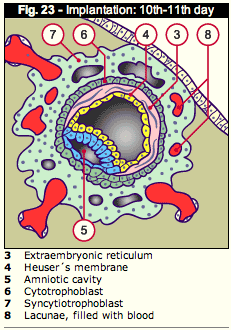
As I said, any embryo with the amniotic cavity formed before the beginning of gastrulation would falsify Fleury’s model definitively. Let me present you an artist’s rendition of Dr Fleury at his early youth, second week of development

Capture d'écran 2011-02-21 à 18.24.47.png

.

The illustration is from the online Human Embryology course notes (clic the image for the full page). I’m not sure they had in mind Vincent Fleury when they draw this cartoon, but it’s the best I can offer you: A cute embryo with his amniotic cavity lined with cells from the epiblast and his primary yolk sac lined by cells derived by the hypoblast. The Heuser’s membrane is still attached to the extraembryonic reticulum.
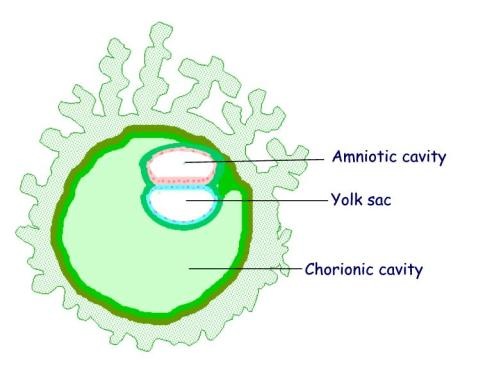
A few days later, the secondary yolk sac had formed and the chorionic cavity was installed.

DF0AC65B-3FA5-4C5B-AA9A-405F4C654DE4.jpg

At this stage little Vincent was still bilaminar with fully formed amniotic and chorinic cavities.

Those of you interested to learn about embryo’s folding can also visit Folding of the germinal disk and the generation of the abdominal wall, in which case the comparison of the two foldings (cephalo-caudal and lateral), animation is a must for the visitor, and certainly for Fleury.

How sad that a great model from an experimentalist working all day with embryos, goes down the drain after being confronted to elements of chapter 5 of a Human Embryology textbook.

Several questions come in mind in this situation, the first one being: who the hell reviewed the manuscript. Not a biologist, probably not a physicist (he should have ask for a mechanism explaining the delay of formation of the caudal fold). Not a second year student of biology or medicine neither; she would have spotted the problem with the amniotic and chorionic cavities subito presto.
Fleury’s precedent paper was an invited review by one of the editors of a journal of physics. You can’t blame the guy for being unable to understand the bunch of errors the review contains. OK, you can blame him for not having a specialist’s opinion on the final piece of work. Misplaced trust. And sometimes, some physicists are just pissed-off by life scientists. Fleury didn’t even dared to give his name.

This time, the journal is a publication of the French National Academy of Science and it displays “Biologies” on the cover. Shame on them. Until this paper is retracted who would trust the “Development and reproduction biology” section of the journal, or the journal at all? I wouldn’t, would you?

“Therefore, this suggest” is one fabulous transition.

The Methods section of the paper may be interesting if you plan a few experiments with chicken embryos, but dramatically incomplete. The most interesting part is missing: the references of the software and the method Fleury is using for PIV, which gives him astonishing images. I would like to be able to check by myself, previous interpretations of experimental data, even the ones generated in his lab, by Fleury being as much surreal as his usual stuff. Hopefully he could complete this section in the comments of this post.

In Heart formation, Fleury undergo to explain how the heart is formed by the heart fold. Here is the first part where it goes really bad. I can understand the frustration of a physicist who would like to have more data concerning the biomechanics of the process, and hopefully somebody else than Fleury will go for them. But there is no need to reinvent the wheel, there are nice descriptions of the movements by which the heart tubes are forming, how the lateral folding of the embryo make them join along the anteroposterior axis and describing their fusion to produce the unique heart tube [1]. Certainly, the 125° rotation of the heart fields and the lateral folding of the embryo necessary for the normal cardiogenenic process are not perpendicular to the anteroposterior axis and doesn’t fit Fleury’s model, but it isn’t reasonable to just ignore them. You can’t just ignore what it doesn’t fit your model to make it sound plausible.
Anyway, even the fusion of the primary heart tubes doesn’t seem to be necessary to support the development and morphogenesis of the heart, up to some point: “a highly differentiated four-chambered mammalian heart” in the case of Foxp4 mutant mice embryos [2].

The point of junction of the cardiac tubes do travel caudaly along the anteroposterior axis of the embryo, but that’s just the point of junction…

An interesting description of the heart formation can be found in a relatively old textbook: The Early Embryology of the Chick (pp 68-72, fig. 26 & 27, with emphasis for fig 27) [3]

For those who will take the time to read the paper, please pay attention to the part discussing the role of chemotactic forces ; Fleury didn’t managed yet to understand morphogenic gradients and that most of them are embedded into the cells and the extracellular matrix.

You may need to go through the whole section about the Chorion formation to understand that Fleury discuss just about the amniotic folds of the chorion and completely ignores the rest of it. It’s just that it isn’t folded in the right direction for his model. On the other hand the amniotic folds of the chorion are folded in the right way and Fleury carefully studied the ways the meet around a single point. Not only it’s weird how he doesn’t discuss the lateral part of the amniotic folds (absolutely necessary to form the amnios and the dorsal part of the chorion), but not perpendicular to the anteroposterior axis, but somehow he manage to found a single rate of variation of the radius of an ellipse!

Patten [3] offers a series of diagrams showing the growth and foldings of the somatopleure which form the amnios, from transverse sections of the embryo, in fig 30 and from longitudinal sections in fig. 32. That gives a global image of the tissue growth, in all directions, not just the keyhole presentation Fleury is giving in his article.

While Fleury is aware that the cephalic and caudal amniotic folds appear at different developmental stages, he present their occurrence as being caused by the “extension of the median axis” without explaining what may be the mechanical causes for the delay of almost 24h for the apparition of the caudal amniotic fold. “For the sake of clarity” he present them in the same figure (4b of his paper) as if they occurred in the same time. As much clarity as usually.


1. Heart Field: From Mesoderm to Heart Tube, Radwan Abu-Issa, and Margaret L. Kirby, Annual Review of Cell and Developmental Biology Vol. 23 (2007): 45-68, doi: 10.1146/annurev.cellbio.23.090506.123331

2. Advanced Cardiac Morphogenesis Does Not Require Heart Tube Fusion, Shanru Li, Deying Zhou, Min Min Lu, Edward E. Morrisey, Science Vol 305 (2004): 1619-1622, doi: 10.1126/science.1098674
3. Patten, B.M. (1920). The Early Embryology of the Chick [link to scans in pdf at archive.org]. Philadelphia: P. Blakiston’s Son and Co. You can browse through it at UNSW Embryology pages, where the scans of the illustrations are of much better quality.


V. Fleury, Dynamic topology of the cephalochordate to amniote morphological transition: A self-organized system of Russian dolls, C. R. Biologies (2011), doi:10.1016/j.crvi.2010.11.009