The world is full of naive people who think we’re going to be immortal some day soon, in spite of all the evidence that says no (Kurzweil is a prominent example of such techno-optimism, as is Aubrey de Grey). It’s not just bad biology, it’s also bad physics, as Peter Hoffman explains. We’re all made of parts that are constantly being battered by thermal energy as an essential part of their operation, and damage accumulates until…we break down. This is unavoidable.
If this interpretation of the data is correct, then aging is a natural process that can be reduced to nanoscale thermal physics—and not a disease. Up until the 1950s the great strides made in increasing human life expectancy, were almost entirely due to the elimination of infectious diseases, a constant risk factor that is not particularly age dependent. As a result, life expectancy (median age at death) increased dramatically, but the maximum life span of humans did not change. An exponentially increasing risk eventually overwhelms any reduction in constant risk. Tinkering with constant risk is helpful, but only to a point: The constant risk is environmental (accidents, infectious disease), but much of the exponentially increasing risk is due to internal wear. Eliminating cancer or Alzheimer’s disease would improve lives, but it would not make us immortal, or even allow us to live significantly longer.
The article points out that we can accurately model mortality with only a few general parameters, and they’re rather fundamental and physics-dependent — we can tweak the biology as much as possible, but the underlying physical properties are going to be untouchable.
I would add, though, that while the mortality curves he shows are inevitable, biology can stretch and contract them, and we do have measurable variation in different species that shows that there is a kind of scaling factor to the curves in biological diversity — it’s not as if every species that lives at the same average temperature have identical life expectancies! Even within the human species, there are genetic variants that affect longevity, and clearly different life-style choices influence mortality, even though we’re every one of us ticking along at roughly the same 37°C. So please, yes, we can reduce the incidence of heart disease and cancer, and get a longer average lifespan…but even if we were to eradicate those major causes of mortality, we’re all going to get up around the century mark, and then we’re going to plummet off a cliff because of all the accumulated cellular damage and declining physiological efficiency.
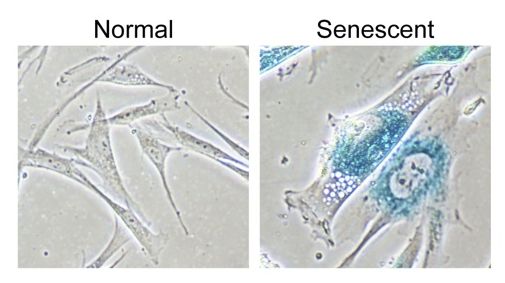
By the way, one odd thing when I tried to find an illustration to accompany this post: I searched on “aging”. Almost all the photos on the web illustrate women by a huge margin. I am forced to conclude that only women suffer from the ravages of age; men simply get mature. But at least it’s one topic that women get to dominate!