No rest for the wicked

Didn’t I just say “Woo hoo” yesterday? False alarm. Scarcely do I clear one set of major tasks away than another set rise up. I already mentioned that I was going to be the speaker at the Humanists of Minnesota banquet on Saturday evening. I neglected to tell you all that I’m leaving for the University of Michigan tomorrow to give the keynote at the Genetic Programming Theory and Practice Workshop.

I know virtually nothing about genetic programming, so this is a wonderful opportunity to learn something about it.

Since I’m certainly not going to be able to tell them a thing about genetic programming, I’m planning to tell them a little about my own skewed perspective as one of those metazoan-centric fans of developmental processes. I’m hoping they might learn a little something from me, and that we’ll all have some fun with ideas about embryos. Here’s my very brief abstract:

A developmental biologist’s view of evolution

The ongoing integration of molecular genetics, developmental biology, and evolution (the field of evo-devo) is stirring up new ideas and new questions. I will tell a few stories from the evo-devo literature that illustrate the importance of the principles of developmental plasticity and developmental constraint on evolutionary trajectories — showing that these are two competing and complementary forces operating on multicellular organisms. My argument is that the contingencies of developmental architectures may well be as significant a force on evolutionary histories as selection.

Next week I get to slack off. No, wait, there’s also…

Morbid tales to engage the student body

Greg Laden puts an interesting twist on the question of how many hominin fossils we have: the question should be, “how did they die?”. We seem to have evolved from a species that was primarily a prey item on predators’ grocery list, to one that succumbed most often to disease, to one where mortality was driven by violence (and now, at least in our prosperous corner of the world, where senescence exacerbated by sloth and gluttony is the common cause of death.)

He’s right. The cool questions our students ought to be getting excited about have nothing to do with the nonsense the Discovery Institute wants them to discuss.

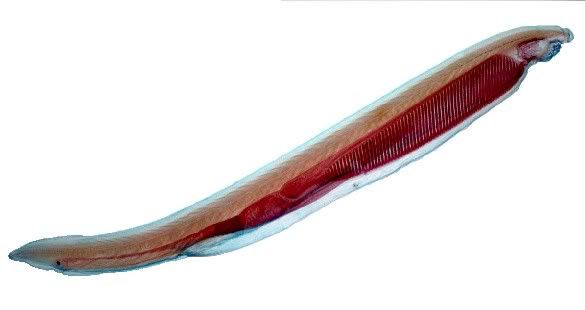
We have the brains of worms

Way back in the early 19th century, Geoffroy St. Hilaire argued for a radical idea, that vertebrates and most invertebrates were inverted copies of each other. Vertebrates have a dorsal nerve cord and ventral heart, while an insect has a ventral nerve cord and dorsal heart. Could it be that there was a common plan, and that one difference is simply that one is upside down relative to the other? It was an interesting idea, but it didn’t hold up at the time; critics could just enumerate the multitude of differences observable between arthropods and vertebrates and drown out an apparent similarity in a flood of documented differences. Picking out a few superficial similarities and proposing that something just looks like it ought to be so is not a persuasive argument in science.

Something has changed in the almost 200 years since Geoffroy made his suggestion, though: there has been a new flood of molecular data that shows that Geoffroy was right. We’re finding that all animals seem to use the same early molecular signals to define the orientation of the body axis, and that the dorsal-ventral axis is defined by a molecule in the Bmp (Bone Morphogenetic Protein) family. In vertebrates, Bmp is high in concentration along the ventral side of the embryo, opposite the developing nervous system. In arthropods, Bmp (the homolog in insects is called decapentaplegic, or dpp) is high on the dorsal side, which is still opposite the nervous system. At this point, the question of whether the dorsal-ventral axis of the vertebrate and invertebrate body plans have a common origin and whether one is inverted relative to the other has been settled, and the answer is yes.

[Read more…]

Kevin Padian explains macroevolution

The gang at the NCSE have put together Padian’s testimony at the Dover trial with the slides he used. You may have already read the transcript, but with the figures added it acquires a whole new dimension — it’s basically a wonderfully done primer in the basics of macroevolutionary biology. Next time some creationist tries to simper at you that he accepts microevolution, but that there’s no evidence for macroevolution and he refuses to believe it, point him at this page. It’s aimed not at scientists, but at the judges and lawyers at a trial, so it’s eminently comprehensible to any intelligent layman … and it crushes the bogus rejection of macroevolution that they are so fond of using.

Twisty maze of duck oviducts

I’m sure you’ve already heard about it, so I’m a little redundant to bring it up — Carl Zimmer has a spiffy article in the NY Times about duck phalluses. No, that’s not quite right; the most interesting part of the story was the bit about duck oviducts. Female ducks have been evolving increasingly convoluted oviducts to baffle the efforts of duck rapists to inseminate them, and male ducks have been evolving concomitantly long phalluses to thread the maze and deliver sperm to the ovaries.

I’d heard about these huge intromittent organs in ducks before, but this is another fascinating revelation: it took a woman scientist to suggest that maybe, just maybe, they also ought to look at what’s going on in the female ducks, and then the whole wonderful story of coevolution of these structures emerged. It’s actually a rather embarrassing instance of a scientific blind spot, where the biases of the investigators led them to overlook an important component of the story.

Conway Morris at Baylor

This is cool: Simon Conway Morris gave a talk at Baylor, and Cody was there. Conway Morris is a smart fellow who does some very interesting work, and now I learn that he’s also a charming speaker — even though I completely disagree with his conclusions, I wish he’d come a little farther north so I could listen to him. I’d most like to hear him talk about Cambrian and pre-Cambrian paleontology, but it sounds like he’s instead lecturing specifically on the ideas where he’s most wrong, his belief in the overwhelming power of natural selection (or perhaps, design) to drive convergence. Convergence happens, of course, but Conway Morris seems to favor sifting the evidence for similarities and ignoring the differences, and divergence happens, too.

[Read more…]

Simon Conway Morris and Life’s Solution: it’s tea.

i-ccbc028bf567ec6e49f3b515a2c4c149-old_pharyngula.gif

I’ve finished Simon Conway Morris’s Life’s Solution: Inevitable Humans in a Lonely Universe(amzn/b&n/abe/pwll), a book I’ve mentioned before and promised, with considerable misgivings, to read thoroughly. I didn’t like his ideas, I thought he’d expressed them poorly before, but I’d give his book on the subject a fair shake and see if he could persuade me.

My opinion: it’s dreck.

[Read more…]