
The Remake of The End of The Greatest RPG of All Time isn’t really a remake, nor an RPG. It’s a puzzle game with a metafictional narrative.
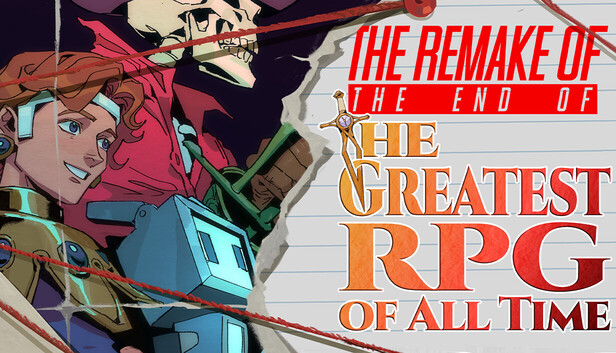
Source: Steam
You get plopped down into the final dungeon of an RPG. You can’t make any progress because the combat relies entirely on creating combos from specific sequences of moves. The characters allude to events that already happened, but it’s difficult to tell what’s going on. The game contains many unpolished elements, such as missing textures or collision boxes and awkward block-pushing mechanics. The way to progress through the game is by finding pages from the instruction booklet. Essentially it’s a game of finding the passcode, skinned as if it were an RPG.
The puzzles are decent enough, but I’m more interested in discussing the game’s narrative. Through audio logs, FMV sequences, and secrets, you learn about who made this remake and why? And what exactly is a remake of? The narrative touched on many of my interests, about the motivations for art, its commercialization, and misinterpretation. (This analysis will include a few spoilers, but not many, only as needed.)
Video game theft
The titular remake is revealed to be the work of Lucas and Jacob. They knew each other as kids, and had bonded over this RPG. Later in college they were both in the same game design course, and given that the original IP owners had long disappeared, they decided to remake the RPG they loved as kids. Implicitly, this explains why they only remade the end of the game, because they needed to scope down for their class. Implicitly, it explains why it’s buggy and unpolished.
But how is it that we’re playing a student project? Another character named Noah somehow steals the source code of their game, and decides to publish it on Steam, selling it for $18. Noah also made modifications, inserting himself into the game. As you progress further, Noah has an increasing presence, as he inserts FMV clips of himself in every room. He’s very indignant about the project he stole. How dare the developers ruin the greatest RPG of all time? Also, what even is the greatest RPG of all time, and why hasn’t anyone heard of it? They must have made the whole thing up!
Noah’s bit is pretty goofy. But something I learned as a hobby game dev, is that video game theft is a real phenomenon. I don’t mean piracy (which you are welcome to do in the privacy of your own home) but actual theft accompanied by resale.
Back in 2025, someone made a free game called Diapers Please for a one-week game jam. Later, the developers discovered that the game was published without their permission on the iOS store, under the title My Baby or Not! The game went viral on TikTok, and made tens of thousands of dollars for the thief. The devs explained that they had virtually no recourse. They could not recover the money. Apple made it quite difficult to report the thief, and they had to report it many times as more copies were made. Though the story of the theft got them attention, and encouraged them to further develop the game, it’s not clear whether this will translate into sales.
Obviously, Noah isn’t a realistic portrayal of video game theft. In practice, I doubt that thieves pay much attention to the games they stole, and they certainly insert video clips of themselves commentating the games. I believe thieves are running scripts to steal games en masse, hoping that just a few stolen games go viral. But though Noah may not be realistic, I really like him as a villain. He’s an absurd juxtaposition between the video game thief, and entitled gamer.
Later, it’s revealed that one of the original devs permitted the theft to continue, because he agreed with some of what Noah was saying. That’s one of the strange emotional beats of artistic theft. It’s terrible, but possibly validating, because it shows that someone cared.
The commercialization of art
“Remake” is a word that has a lot of negative associations. So much media today is focused on established IP, full of endless sequels and remakes. Remakes often feel like a way to cash in on an IP without coming up with any new ideas on their own. At the same time, whenever a remake is made, there are complaints that it falls short of the original. By increasing graphical fidelity, they have made it muddy or uncanny. By adding quality of life features, they removed important points of friction. By changing absolutely nothing, they have made a game that fails to live up to childhood memories.
Is The Remake about any of that stuff? Arguably, it’s not. Lucas’ and Jacob’s remake is not the product of a large studio cashing in on established IP. It’s two students in a garage working on a class project. It’s more akin to a fan remake.
But the interesting thing is that Noah reads the class project like it’s a commercial remake. While Noah is aware that it’s a student project motivated by nostalgia, he seems unable to judge it by anything other than commercial standards. And of course, Noah himself has turned it into a commercial project under his ownership, and is trying to sell it as such. So Noah turns around and advertises the game on Reddit, where he gets a bunch of negative reactions describing it as ugly and scummy. And yes, I suppose that’s what would happen if you took someone’s fan remake and tried to pass it off as a commercial remake.
(There’s a metatextual irony here, since The Remake of The End of The Greatest RPG of All Time is in fact a commercial project, even if the in-universe remake is not. The game has a certain level of in-universe jank, but there’s also real jank that many reviewers have justifiably complained about. For example, there’s an accessibility option to invert camera controls, but I found that this option would reset every game session! Parsing the real jank from fictional jank can muddy the narrative and create frustration.)
Something that may go underappreciated, is that we are, right this moment, in a non-commercial art space. I come from a blogging tradition where most people had no expectation of making any money. While bloggers have had their share of vying for popularity and clout, it has never come with the desperation of someone trying to pay their bills. Not all art forms are like that. Video games are not like that.
Most game dev communities are full of people promoting their game, accusing each other of promoting their games, and closely following video game marketing guru Chris Zukowski. People are motivated by money even if they never see a cent. People who are not motivated by money still have to engage with the dominant lens used by players, devs, and distribution platforms. In a world where hobby art and commercial art coexist, doesn’t it only make sense to judge them by similar standards? A player doesn’t owe the artist pity engagement just because they’re not backed by money. Yet, if we want a society that produces art, we need hobbyists, we need students, we need people interested in the art for itself.
The game doesn’t explore all these ideas; a lot of this is me projecting my own concerns and interests. But I appreciate a story that concentrates my anxieties about art into a goofy villain who doesn’t get it.
At the end of the story, Noah decides to physically go to the Game Developers Conference, so he can livestream a confrontation with Lucas. So we have this caricature of an entitled gamer, trying to confront a game developer that he himself has caricatured. But when Noah gets there, reality sets in. These are real people. Noah’s words fail, and the livestream goes off.
i feel the tension less as i’m not selling anything yet, very much not looking forward to it. to me the main dimensions of the subject are as follows:
–
> american economic desperation. in this country we are told a lot about how you just need a clever idea, a gimmick, one cool trick that will help you break through the surface. the surface you’re breaking is seldom understood. the character tom in office space embodies this, with his jump to conclusions mat. he says the guy who invented the pet rock “made a million dollars.” he sees the surface as privilege, comfort. most of us don’t even have basic economic security, so that’s the real barrier, and hardly anything can really get you through. yet i still feel this, still find myself daydreaming, losing my own self-skepticism to imagine i could “make a bank full of money.” fuck me, it’s a terrible instinct. infantile.
–
> bourgeois elitism. if you made money, it’s because you’re better than people who didn’t. particularly if you made money by art, you are one of the magic people, the golden ones who have earned the pat on the head from the invisible hand. making money off art means you are more deserving of freedom from class struggle (ie daily fucken life) than the proles. another message we get from youth, always phrased differently, less venal, but adding up to the same thesis in our subconscious minds.
–
we’re programmed by the crapitalist agenda, as much a malignant and intractable feature of our society as patriarchy, to be scabs, class traitors, dreamers signing up for casting couch rape and “swimming with sharks” style emotional torment. i think the majority of people working as artists are destroying themselves for nothing, and being shit to other people for the same. under our current economic system the best thing you can do is acquire the zen of “easy come easy go,” do your art for love of art, and if that love is failing, change what you’re doing.
it ain’t always gonna work, but being born poor means a lot of your needs aren’t going to be met in life, and artistic fulfillment is one of those things. gotta accept it and deal, until the revolution comes.
i should say tho, good article, thanks. it’s like watching a video essay on something I’ll never partake, but there’s interest to be had in the ride. i’m half curious about that guru zukowski. what’s his deal?
Chris Zukowski runs a website and blog (and paid courses) called “How to market a game”. By all accounts he’s very data driven and knows what he’s talking about. Still kind of offputting how much people hang onto his every word.
I basically stopped following gamedev circles. I’m not putting much time into it anyway, and the spaces aren’t pleasant. Your comment is on point. Thanks.
thanks for the scoop on that scene. I’d be dipping on it too… mm i’d be curious about william and abe’s opinions as well since they’re doing the small author thing. i wouldn’t impose to bug them about it tho.