
Fake eagles don’t sound like that

A-lHXbXCAAAAxTg

Probably also faked: the sweater looks completely ‘shopped. Via Ed Lam.

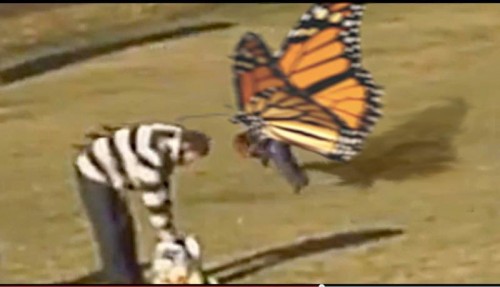
I held forth on the fake eagle video thing at some length over here at KCET yesterday, but there was something I didn’t mention there that irked me about the hoax: in the recap part, where the “amazing footage” of the “eagle” “catching” the “child” gets “replayed” in slow “motion,” the filmmakers dubbed in a bit of sound effect right at the moment where CGI talon hit virtual toddler.

And of course it was a red-tailed hawk call. It always is, It doesn’t matter what bird of prey is in a film: the SFX guys will always dub in a red-tailed hawk call. 

Not that the red-tail sound was a dead giveaway: during the 45 minutes or so in which I was somewhat taken by the hoax in I was prepared to grant that perhaps the videographers just did a clumsy, misguided dubbing job, for much the same reason that nature YouTubers always seem to want a horrible music track to cover up their occasionally interesting footage. But it was the same kind of mistake as inflating a CGI osprey to eagle size and calling it a golden and expecting birders to believe it for a second.

In case you’ve never seen a bird of prey represented in video and have no idea what I’m talking about, here is a red-tailed hawk’s call:

By way of comparison, here’s what golden eagle vocalizations sound like:

Bald eagles have calls you might well mistake for a gull’s:

[Update: in comments, otrame offers a more characteristic adult bald eagle call.]

Almost without exception, the red-tailed hawk call is what the sound engineers will use. I do know of one such exception. In the 2010 remake of Clash Of The Titans, which I suspect most people here watched solely for the Kraken and the releasing thereof, there was a scene where Zeus and Perseus were having a difficult father-son moment. Perseus is recalcitrant, whereupon Zeus transforms himself into an eagle and flies away. And that eagle doesn’t “keeeer” — he peeps. Like a golden. Honestly, that one moment of verisimilitude was worth the preceding hour. I was impressed that they got that one detail right. Though the Kraken did disappoint.

Exemplary efforts like Clash Of The Titans aside, it seems like there’s a secret world law governing natural sounds in TV and film that requires all raptors sound like red-tailed hawks. All rats squeak incessantly. Horses whinny while chewing placidly. Tropical rainforests in Africa and South America always have kookaburras in them. And as soon as you start to pay attention to how things actually sound in the real world, that kind of mistake unsuspends your disbelief pretty damned quickly. It’s a bit like having a scene where John Wayne is leading a wagon train westward to Oklahoma City, and they pass the Tetons on the way.

It’s the natural world version of illiteracy, and it makes those of us who know a few things wince.

Terraforming the easy and fun way with desert plants

I spend a lot of time paying attention to threats to the organisms that live in the desert, and what with all the environmental bad news available online these days that can be pretty damned depressing. This past weekend, though, I was reminded that there is actually hope for the future. Centuries from now we may well find that desert plants, especially those that now live within a day’s drive of Los Angeles, have a vital role to play in making yet-undiscovered planets habitable.

I was reminded of this while re-watching a set of documentary films describing the terraforming of an entire complex system full of dozens of more or less habitable planets, in many cases using entire vegetative suites once native to the California desert. I’ve gone back and taken some screenshots of these films to illustrate some of the ways in which the terraformers used desert plants, and they — along with discussion of the terraformed vegetation –are below the fold.

[Read more…]

The best thing I’ve read today

I know it’s early, but I expect it to be the best thing for a few days yet. David Byrne writes about his love affair with sound, and I came away from it feeling like I’d both learned something new and that it fit well with other ideas I already had — it was a revelation to see how well music and evolution fit together.

Because music evolves. Byrne’s thesis is that it evolves to fit its environment (sound familiar?), and that you can see the history of a genre of a music in its sound. It’s all about the spaces it was played in, which shapes the kind of sound can be used effectively…and he makes the strong point that you can’t fully appreciate the music of a culture or a time when you transpose it to a different space. He goes through all kinds of music, from medieval chants (cathedrals!) to hip hop (cars!). The iPod isn’t just a passive delivery system for generic music, it influences how music will sound — ear buds represent a completely different sonic environment from a cluttered dance club.

Apparently, David Byrne is an Ecological Developmental Biology kind of guy. I like him even more already.

Because that’s what eco devo is all about. Development and environment are all intertwined, with one feeding back on the other — species are products of the spaces they evolved and developed in, and cannot be comprehended in isolation. It’s one of the weird things about modern developmental biology, that we preferentially study model systems, organisms that have been able to thrive when ripped out of their native environments and cultured in the simplified sterility of the lab. My zebrafish live now in small uncluttered tanks with heavily filtered water; their environment is like iPods, simple, streamlined, focused with relatively little resonance. The zebrafish evolved in mountain streams feeding into the Ganges, in lands seasonally flooded by great monsoons, a vast and complicated opera hall of an environment. A wild zebrafish and a lab zebrafish are two completely different animals.

Oh, look. I have a new metaphor for issues I’ve been thinking about for some time. Thanks, David Byrne!

I might just make his essay part of the readings for my developmental biology course next term.

A curious bit of frivolity

There’s this game called Minecraft (oh, have you heard of it?) which is a kind of world-builder game — you gather resources like wood and ore and meat, and you craft stuff out of it. I’ve learned something odd about it.

You gather wool from sheep. You can make colored wool with dyes.

Nice revelation: you can dye whole sheep and harvest colored wool from them. That was unexpected: it grows back in the color you dyed it. That’s not physiological!

And then…if you dye a sheep and then breed it to produce more sheep, the color breeds true. Dye two sheep lime green, and you can generate a whole flock of lime green sheep.

I don’t know whether to be appalled or delighted. It opens the door to exploring rules of Lamarckian inheritance, except there doesn’t seem to be any room for any kind of selection or predation or variation in anything that affects survival or reproduction. Someone tell the game makers to get a biologist as a consultant, there are possibilities here!

(I hear I can breed wolves, too, but I haven’t tried it. Do they vary in any interesting ways? Can I select for sheep-eating wolves?)

The Dark Knight Rises

I saw this new Batman movie last night, and it was fairly good: complex and twisty and dark, mostly, the way I like ’em. It was far from perfect though, so I’ll send you off to this review that lays out the very same problems I had with the movie. No spoilers, it’s safe!

It doesn’t mention one big problem I had with the ending, though, and this one is a bit of a spoiler, so I’m putting it in rot13: Ongzna cbvfbaf bprnaf naq ungrf svfu! I just cringed at the solution to one terrible problem, which treated another serious issue cavalierly.

Also, the ending sets up the possibility of sequels, which is getting mildly annoying. Maybe these stories have roots in pulp serials, but I’d kind of like to see a story with a real ending someday.

Portland, Oregon is having a humanist film festival!

I wish I could be there. The Humanist Film Festival is happening on 26-28 October, and they’re looking for submissions. If you’ve got anything that fits their categories, send them in soon. They’re looking for films that speak to humanist themes, including:

  • Reason, Critical Thinking and Skepticism (such as claims of the paranormal, critical thinking education, rational living, etc.)

  • Ethics and Human Wellbeing (including human rights, women’s rights, gay rights, rational ethics, challenging scriptural ethics, sex education and attitudes about sex, etc.)

  • Science and the Natural World (e.g. science appreciation, science education, evolution, global warming, pseudo-science and pseudo-medicine etc.)

  • Freedom of Thought, Speech and Critical Inquiry

  • Challenging the Claims and Value of Religion (e.g. anti-apologetics, education about atheism and atheists, uncovering problems with religion, etc.)

  • Separation of Church and State

  • Joie de vivre and human thriving (art and aesthetics, living the good life, human progress etc.)

And here’s their mission:

The Portland Humanist Film Festival is an outreach event designed to broaden the understanding and acceptance of a secular, humanist world view. It specifically addresses audiences who are friendly to our views but who are not necessarily familiar with atheism or humanistic ethics, or why we value reason and scientific thinking. The Film Festival presents these themes through an accessible, entertaining medium.

Got any suggestions? If you’re a godless filmmaker, think about sending them something!

The wages of pseudoscience

I completely missed the disgraceful hokum the Animal Planet channel aired last week, Mermaids: The Body Found, a completely fictional pseudodocumentary dressed up as reality that claims mermaids exist. You can watch it now, though, until Animal Planet takes it down.

It’s genuinely awful. Total nonsense, gussied up with more nonsense: would you believe it justifies the story with the Aquatic Ape gobbledygook? Brian Switek has torn into it, and of course Deep Sea News is disgusted. How could the channel have so disgraced themselves with such cheap fiction?

Here’s the answer:

ANIMAL PLANET SLAYS WITH BEST-EVER MAY IN NETWORK HISTORY

— Monster Week’s MERMAIDS: THE BODY FOUND Made Mighty Splash with More Than 3.4 Million Viewers —

(May 30, 2012, Silver Spring, Md.) – Animal Planet devoured the month with its best May ever, earning its strongest performances in both prime and total delivery among all key demos, including prime deliveries of 681K P2+ (+7%), 508K HH (+7%), 330K P25-54 (+21%), 301K P18-49 (+12%) and 193K M25-54 (+30%), and total day deliveries of 456K P2+ (+13%), 355K HH (+10%), 215K P25-54 (+26%), 203K P18-49 (+13%) and 120K M25-54 (+32%).

Animal Planet’s May victory was propelled its first-ever Monster Week (the week of May 21), featuring MERMAIDS: THE BODY FOUND, which made a huge splash at the “tail” end of the week. MERMAIDS: THE BODY FOUND delivered nearly 2 million viewers (1.96M P2+) for its premiere, making it the most-watched telecast since the Steve Irwin memorial special in September 2006. The two-hour premiere scored a 1.3 HH rating and helped rank Animal Planet #2 in the timeslot, including 960K P25-54 (0.9), 482K M25-54 (1.0) and 477K W25-54 (0.9). The subsequent late-night airing of MERMAIDS: THE BODY FOUND earned the title of Animal Planet’s most-watched late-night telecast ever, delivering nearly 1.5M viewers (1.46M P2+), bringing the combined viewership to more than 3.4 million viewers. MERMAIDS: THE BODY FOUND encores Thursday, May 31, from 8-10 PM ET/PT.

Brace yourselves. More of this will be coming…unless more of us protest by turning off the Animal Planet channel altogether. They’ve just been rewarded for epic dishonesty with peak traffic; what lesson do you think they’ll learn from this?