
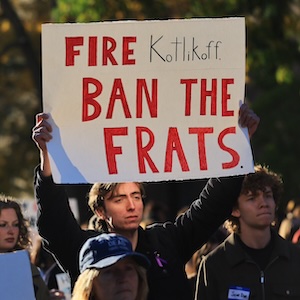
The Guardian asks, “Fraternities are the most likely place for US campus rapes. Should they be shut down?“
What a stupid question. YES.
It’s a lengthy article that goes through all the problems with the fraternity system — the alcoholism, the hazing deaths (two annually!), the rapes. I kept reading for the positive reasons, and they give a few. One is the threats.
“All the Greek alumni would have pitchforks, and it would be a whole debacle rather than kind of letting this play out in the press and then just going back to business,” said Lucy Taylor, a University of Maryland graduate and the creator of the podcast Snapped about the sordid history of fraternities and sororities.
Another is a variant of that threat.
“When you get rid of Greek life, you get rid of some of the most passionate people that cared about the school, right? And so why would someone like that donate to the school if the school is eliminating something that was a key part of their time at Cornell?” he said.
This is similar to the argument in favor of college sports, and ultimately it’s all about money. Fraternities and sports are orthogonal to the function of universities and education, and they should only be tolerated as long as they don’t interfere with the education students are supposed to be there for.
No good reasons for frats are given other than platitudes from North American Interfraternity Conference, a trade association of fraternities.
Hillary Brewer, the organization’s chief communications officer, did not respond to a question about whether sexual misconduct is pervasive at fraternities but stated in an email that they “are an accelerator for success in college and beyond. They create lifelong connections to the campus, community and friends.”
You don’t need frats to make connections and friends, especially not since the connections are with the kind of people who favor elitism, abuse, and misbehavior.
Shut them all down.

Just in. Two students at a Swedish boarding school have been prosecuted for a hazing ‘ceremony’ that involved SA.
Even without fraternities, older students find excuses for being bastards.
Lock them up.
Silver lining: today students are more likely to expose unacceptable behaviour.
When I was an undergraduate, a Sociologist professor said the purpose of fraternities and sororities was endogamy, i.e. so white middle and upper class people would marry other white middle and upper class people.
They are closed dating and social pools at the colleges and universities.
At the time and probably today as well, they were known for being highly racist and classist.
Strangely enough, Google search agrees with this.
It should be noted that the Greek system can and does serve multiple purposes. It’s a built in social group, a place to live, and a place to get drunk at parties.
@1 birgerjohansson
In my understandindg it would be impossible to ban fraterneties in sweden due to the “constitutional” right of freedom of assosciation. But ofc. The university wouldn’t be required to help them in any way, i don’t think.
I read about these organisations in of Feynman’s books of anecdotes and was disgusted by their behaviour. After these revelations I’m appalled.
They should change, and I’m quite okay with universities using the threat of shutdown to enforce that change.
But they need not be all bad…
Back in my student days I joined a student social club (mixed male/female) with a very strict no-hazing policy. Had a lot of fun there, made lots of friends. It was ideal for me, as I’d transferred into 2nd year (so most my classmates already knew each other and had friends etc…) and I’m not the quickest friend maker.
I was in National Honor Society in high school: maintain GPA and report hours of community service to a teacher, something that looks good for college. That’s all it entailed. No networking; I was vaguely aware of other students in it. In the first days of college, an “Honor Society” invited me to a crowded ceremony with something to recite IIRC. Greek letters I think.
I thought I was a member. I never heard from them after that. No meeting/event announcements, no warnings of losing membership for lack of service. I figured it was passive like HS honor roll, except there weren’t “you’re still in” GPA notices of an honor roll either. Nothing when I graduated.
Frats and sororities seem to have never taken off in Canada. My undergrad school, Queen’s University at Kingston (Ontario) banned them in 1933 as being contrary to maintaining a unified school spirit. I can attest that in the late 1970s school spirit seemed just fine to me, and I think remains so fifty years later. So the second objection cited in the OP is stupid.
#6: I was even worse than you: I wasn’t involved in any sports or clubs in high school, and was pretty much a nobody as far as popularity goes. I scored really, really high on the SAT, though, and practically every college in the country was sending me scholarship offers. So who needs to be social? No one, as long as you’re pretty smart.
Also, once I accepted a college, I suddenly started getting invites from all of the frats that wanted someone to pad their mean GPA.
@PZ: I vaguely remember seeing a few letters like that in my early years. I did well on the SAT and ACT, so I guess I was a target, too.
In Japan, schools encourage various clubs at different age levels. There is a minimum number of participants to register, but they apparently can book locales for their activities and pursue their hobbies. This seems wholesome but I know no details, I learned about it from anime.
(I doubt many real clubs include a time traveller, an alien, an ESPer and a human with the reality-bending abilities of an Elder God -there is really an anime like that).
PZ @8: “So who needs to be social?”
*sigh* Then school ended. u.u
The article quoted someone:
“When you get rid of Greek life, you get rid of some of the most passionate people that cared about the school, right?…”
But getting rid of fraternities doesn’t get rid of the students in them. They are still admitted to the college, but just join other groups. So the enthusiasm and the willingness to donate later is equally available.
Unless the author believes that people apply to a college because of the fraternity, and that without fraternities the students would not go to college at all. Maybe that’s not a bad thing. If one percent of fraternity members would avoid college without the fraternity, I would guess that the extreme 1% of fraternity people are the troublemakers who ruin things for the other 99%. So I think that even most fraternity members would benefit from the college not attracting the worst antisocial activists.
My college had student houses of about 100 people that worked as social clubs as the college did not allow fraternities, and I think that was better for everyone.
In the late dark ages I was in a social house (not a frat) and it was fun to be with like-minded people. Intentional communities are the post-university version of that same thing. There occasionally is a fraternity out there that does the same.
I wonder how you allow those, without the hazing and raping that frats are best known for.
@2 Raven
Some years back, the anthropologist Jules Henry argued that pretty much the whole of the educational system in the U.S was designed, intentionally or not, to reproduce the social class system. Poor kids got ghetto schools; wealthy families sent kids to private prep schools. Even in “middle class” public schools the track system sorted out students into academic tracks versus ‘commercial’ tracks or even “general” tracks (which mapped on to family social status). Upper class kids went to Ivy League schools and middle class kids went to state colleges. Lower class and blue collar kids didn’t attend college, though some used “junior college” to get training rather than education.
The GI Bill after WWII allowed for some upward social mobility, as [white] veterans could use their benefits to pay for a college education they would not have been able to achieve otherwise, but the system still did a better job of reproducing class status rather than improving it — Marvin Harris documented this in the 1980s through Bureau of Labor statistics.
In Germany, fraternities have long been associated to the far-right. It is horrible to see that the far-right is on the rise here again, and I do hope that the new Nazi party will be forbidden as soon as possible. Otherwise, I have to hope that I gain scientific recognition as soon as possible, so that I can leave the country. The German far-right is dangerous.
@15 drdrdrdrdralhazeneuler wants to leave Germany.
I reply: I understand your disgust and desire to ‘distance’ yourself from the farrightwingnuts and fascist frat rats. However, I recommend you look into Canada or some other more civilized country. Because the untied states (mis-spelling intended) is a fascist, plutocratic police state you should avoid. I know, because we are stuck here.
If you don’t leave Germany, at least promoting your civilized values system by example will be a positive thing.
One more point: It’s sad that frats use Greek letters when you think about how not all, but, many in ancient Greece were involved in such academic, philosophical and intellectual lives.
But, in answer to the question: Yes, ,dump the frats. But, create a disciplined replacement in organizations that promote growth in civilized social and intellectual activities.
@15 drdrdrdrdralhazeneuler
As @16 said, avoid the United States. My sibling and I are pursuing German citizenship because we think it’s less likely to go Nazi than the U.S. (and is currently in the EU). We’ve already passed early 1933 here, you have a much better chance than we do. Canada will probably fall if the U.S. far right stays in power.
Australian unis don’t have fraternities, yet manage to “create lifelong connections to the campus, community and friends.”
If a Grizzly bear or even just a Black bear showed on a University Campus it would be darted or trapped and then removed and relocated because it was a danger. Frats are are a danger, so they should be removed and relocated in the middle of nowhere. If they are in the area or the university, students should keep the same distance away as they would use in avoiding a bear.