Congratulations to Nick Fish

He’s been named as the president of American Atheists, succeeding David Silverman. He’s a good, safe choice, having been involved in AA’s affairs for years, and he’s always come across as one of the good guys in my conversations with him — keeping in mind that we’re both white men, and we have the remarkable ability to see each other in the best possible light. In terms of experience alone he was probably the best candidates, although I do wish the committee that appointed him had put a higher priority on diversity.

I thought this comment on the announcement was a good one, though.

I thought this was a perfect opportunity for American Atheists to appoint a woman and / or minority as president. I just can’t get excited about another white dude.

Yeah. I have nothing against Nick, but at a time when atheists need to find common cause with other social justice movements to remain relevant, he’s got an uphill climb in front of him. He will have to work twice as hard to overcome the stereotype that a white dude is going to be privileged and blind to the major conflicts in his movement. He doesn’t have to — it’s really easy for us to coast — but he’s not going to make a mark if he doesn’t work to correct the stigma of atheism.

I have a suggestion for him. Start with that announcement. Right after the comment I quoted above, there is a triggered dude sealioning away about racism against white people. He’s going on and on. Someone at American Atheists, not necessarily Nick Fish, ought to stomp on that crap hard. That’s the kind of idiocy that has to be nipped in the bud, or it’s going to get worse…has been getting worse.

Then there’s another kind of comment.

Well hopefully he won’t be a liberal cuck!

I hope he will be. But if AA is just going to allow that kind of toxic noise to pollute the discussion, he’s doomed no matter what. Shut it down.

Then there’s a bunch of comments that really surprised me.

They could have picked a good-looking one !

Why did they have to use the photo with a mean looking face? Is that really what we want to say about who we are?

Is it just me or he looks creepy

Wow. Criticisms of his appearance? Good luck dealing with those assholes, Nick.

And finally, these twits:

I didn’t know my atheism had a president?

“Named” as new President? I really don’t care. I’m sure the stocks won’t be sky-rocketing over this news. But, was he named president, or voted in as president? I don’t recall seeing a ballot. Didn’t Castro call himself President too?

American Atheists is a professional organization, emphasis on organization, with rules and responsibilities and officers, so god damn fucking of course they have members with specific roles. I am so fed up with these clueless atheists who are so stupidly against any and all authority that they refuse to acknowledge the importance of expertise and regulations and duties within a function unit above the level of the individual. Someone has to do the work, dudes, and clearly it ain’t gonna be you shit-shovelers. You don’t like it, you don’t have to be a member.

I know there is going to be disappointment that a woman or minority did not get this prominent position. But to overcome that setback in opinion, the next step is to crack down on the racist/misogynist element in organized atheism. Be an accomplice with the minority community that is poorly represented in the leadership to take steps in the right direction, and maybe we’ll all see you as an asset.

Also, don’t use your authority as a way to canoodle. Just generally good advice all around.

Still baffled over the historicity of Jesus stuff

Oh, good, now we have an argument. After my discussion with Eddie Marcus, others have joined battle: Neil Godfrey and Tim O’Neill in the comments.

I’m agnostic on the subject of the historicity of Jesus, in that I can be whipsawed back and forth depending on who I listened to last. What I was interested in was a much more general topic. What are the criteria a professional historian would use to assess the status of a named figure from the past, when lacking any direct documentation from that person’s life? How do you separate legend from human being? There’s no denying that there is a remarkable mass of unbelievable legend wrapped around this Jesus guy, but if you peel away the myths bit by bit, will there be any vestige of a person left? Or, alternatively, there is not enough solid information to make a distinction, but is the most parsimonious, reasonable explanation is that there was a man, around whom the myths accreted?

As I said at the beginning of the video, I DON’T KNOW. I’m coming at it from the perspective of a completely different discipline, one with its own approaches to dealing with historical events, so I keep trying to find correspondences between how a biologist would infer a species with no fossil imprint, and how a historian would infer a person with no contemporary documentation. I also don’t know if that’s an appropriate analogy to make. So far, I’ve heard a lot of arguments.

One common one that nobody sensible is making is that the miracles and powers were true supernatural events. There are lots of people who insist on that literalist interpretation, and I dismiss them out of hand — fortunately, most of the historians are also willing to ignore those claims. I don’t consider the argument that the supernatural phenomena described in the Bible mean a human Jesus couldn’t have existed to be particularly credible. I think George Washington probably did lie now and then, and that some claim he never told a lie, which is unlikely, does not imply that Washington didn’t exist.

Another common argument is the one from the absence of contemporary accounts. Absence of evidence is only evidence of absence if you’ve got so much other data that the hole becomes obvious, and the ancient historical records are almost as tatty and bare as the fossil record. We’re not going to find Jesus’ birth certificate, or even his gravestone…which is true for virtually everyone from the ancient world. We’re lucky that we even have third person accounts from decades after his death of this hypothetical individual.

Here’s one from the historical Jesus side that I also don’t find persuasive: that it is the consensus of historians that he existed. Unfortunately, there is a strong alternative explanation for that, in that most of these historians are imbedded in a culture that insists as a matter of dogma that Jesus was real. This is a deep bias. You can tell me that most historians agree, but then I have to ask, what percentage of those historians are Christian? It’s why I find atheist historians more convincing on this subject (and the atheist historians are split!), although even there I have to watch out for a negative bias.

Another one that induces a mild cringe is the parsimony argument — let’s apply Occam’s Razor! Then the simplest hypothesis is that there was one man who got the whole religion rolling. I can sort of agree, except we might differ on who that man was. Was it a Jesus? Or was it that wandering evangelist Paul? Or was it the mystery man who wrote the first of the gospels? I’m inclined to agree that these religions start with a singular vision, by comparison with the modern faiths of Mormonism and Scientology — that there is often a first prophet who crystallizes something that becomes canon.

To counter that, though, we have other other examples — the Second Great Awakening and the Burned-Over District, for instance. Joseph Smith was one man, but he was just one among many who were stirring up radical revisions of religious thought. Was the ancient Middle East just another fermentation chamber, with all kinds of weird ideas bubbling up, so that pinning the credit/blame for Christianity on one man is a misrepresentation of the emerging ideas? Wouldn’t it be reasonable to assume that early Christianity was made by weaving together strands from multiple sources? (also note: you can believe that but still credit one real person as the inspiration.)

This was one moment in the discussion with Eddie Marcus that caught me off-guard. I suggested that one way to infer if there was a singular ancestor to Christianity was to compare it to other other beliefs arising out of roughly the same area and time, and ask if there were unique elements to make it unlikely that it was part of a general pattern. I’m basically saying that we should look for apomorphies that set it apart. To my surprise, he said no, and I’ve read other writers who say there was this likely mass of oral tradition and this complex set of written literature at that time that made for a fertile medium for religious ideas to sprout. It seems to me that is an argument against a singular author of the Christian faith.

One final question I have for anyone who wants to argue about this: does it matter? We do have solid historical evidence from the mid- to late- first century CE that there was a community of people who identified as Christians with a diverse body of literature that they regarded as true stories of their prophet. That’s the anchor point. Then we have almost two millennia of history shaped by these beliefs. That’s what matters, and no one, atheist or Christian, is going to dispute that. Then there is the question of what happened in the earliest few decades after the putative death of the hypothetical prophet. That’s an interesting phenomenon from a historical and sociological and psychological perspective, but until the physicists get off their butts and invent a time machine, we don’t have a way to resolve anything in that window of time with the necessary level of detail.

What we’re left with is battling sides. Christians, who have a stake in professing the reality of the founder of their religion, are arguing that of course there is good evidence for his existence. I disagree. There is reasonable inference, which is not the same as direct evidence. Meanwhile, atheists have what they consider an easy way to undermine the supernatural claims of Christians: show that he never existed, and poof, Christianity collapses with its foundation gone. They can’t do that, either. They can question the hypothesis, which is a good thing, but they’re not going to be able to demonstrate the falsity of the idea, and the louder they insist that their evidence of absence is true, the more they undermine their credibility.

Barring the invention of that time machine, that is.

So, what has David Silverman been up to lately?

The Washington Post has a longish article on l’affaire Silverman. It’s a bit unsatisfying, because we still don’t know the specifics of what American Atheists considered a good reason to fire him, and he denies everything.

But where it gets interesting and more than a little dismaying is when it starts listing all the problems in the atheist movement. I remember the days when you’d go to a meeting and there all these enthusiastic, diverse people who were thrilled to just be there and meet like-minded peers…and now the ones who are most enthusiastic are dudebros who see it as an opportunity to bash feminazis with other dudebros. It’s taken a lot of joy out of the movement.

A couple of interesting points, though: 1) David Silverman is the first and only atheist to face any consequences at all for his behavior from an atheist organization. All the other sleazoids are still doing just fine, are still getting invited to speak at conferences, are still drawing a crowd. 2) All of the accused deny all wrong-doing, no matter how solid the evidence. The Bart Simpson approach seems to work: rape or harass someone, then just say, “I didn’t do it,” and among atheists, you’re golden.

Here’s the depressing section of the article.

Organized secularism has been struggling with charges of misogyny, sexism and sexual harassment for almost a decade. The problem went public in 2011 when a then-little-known atheist blogger, Rebecca Watson, described unwanted sexual advances from a man at an atheist conference who followed her into an elevator and to her hotel room.

Correction: Watson was a well-known atheist blogger, active on Skepchick and SGU, and frequently invited to speak at conference…like the international conference where this event occurred. Also, the man didn’t follow her to her hotel room. But the rest is deplorable truth.

She was flooded with both supportive and haranguing comments. World-renowned atheist Richard Dawkins told her to “stop whining” and “grow up.” Dawkins — whose appearances at secularist gatherings can make or break attendance — has been called out multiple times for sexist statements but remains much in demand as a speaker.

Richard Carrier, a science historian and popular secularist speaker, has both apologized for and denied accusations of unwanted sexual advances at secularist and atheist events. He has been banned from at least one conference.

Michael Shermer, organizer of the popular Las Vegas Skepticon event, has denied allegations of sexual harassment and assault from several women, and remains editor of Skeptic magazine and a top speaker at secularist events.

Most recently, cosmologist Lawrence Krauss, another star speaker and best-selling author, was suspended in the spring by Arizona State University for what it described as a decade of inappropriate behavior, some of it at secularist events.

Sikivu Hutchinson sums it all up.

The alleged misconduct of these leaders, “was tacitly co-signed by an atheist leadership that is largely hostile to social and gender justice and complicit in the marginalization of women’s issues,” said Sikivu Hitchinson [sic], an activist who is often critical of organized atheism on the subject of women and people of color. “The atheist movement is no different from other male-dominated bastions in which sexual harassment and predatory behavior toward women are part of the culture.”

Ah, those heady days when I was blind to the injustices implicit in the movement, and could just think happy thoughts and be optimistic about the future. Why did you people have to open my eyes and ruin it all for me?

Maybe because it wasn’t so great for many people who didn’t happen to be old white cis heterosexual men.

It’s called “Kook Magnetism”

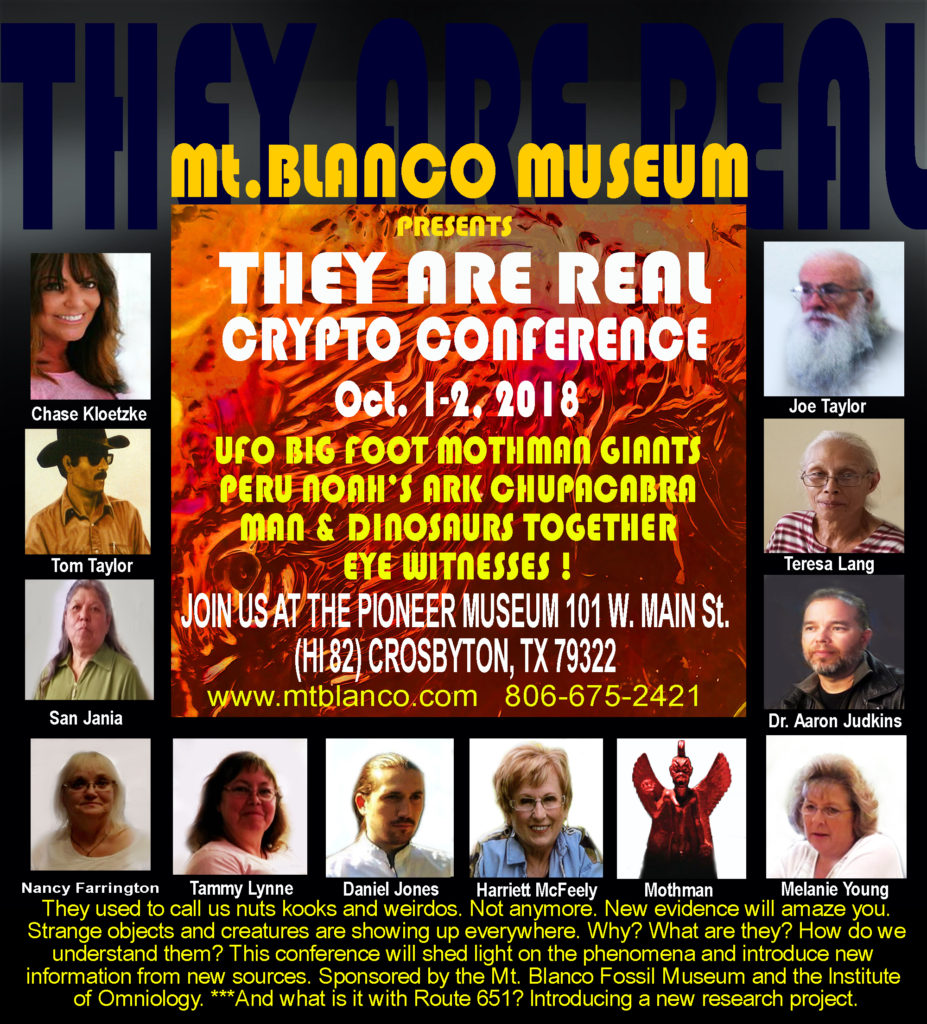
Oh, boy, another conference: The “They Are Real” Crypto Conference to be held at the Mt Blanco Creation “Museum” in Texas. Everyone ought to go, it’s cheap at $30. I’d go, except I’m on a greatly truncated budget this year — someone tell Aron Ra he ought to attend, he’s right there somewhere in the small state of Texas, too.

I don’t know who any of these speakers are, except Joe Taylor (loony proprietor of the Mt Blanco Creation Museum) and Mothman (I’m impressed that they got it as a speaker). Not even Google knows who they are; there are so many Tom Taylors and Daniel Joneses that they just get lost in a sea of names, and seem to have done nothing to make them stand out. OK, I could find Kloetzke on the basis of her unusual name — she’s a UFO investigator. And Judkins works with Carl Baugh, somehow.

But look at the topics! UFO BIG FOOT MOTHMAN GIANTS PERU NOAH’S ARK CHUPACABRA MAN & DINOSAURS TOGETHER EYE WITNESSES! PERU is a rather large topic that isn’t necessarily nuts, but I think that’s being used as a code word for ANCIENT ASTRONAUTS and BAD ARCHAEOLOGY.

I also like that line, They used to call us nuts kooks and weirdos. Not anymore. Sorry, guy, we still do, and you still are.

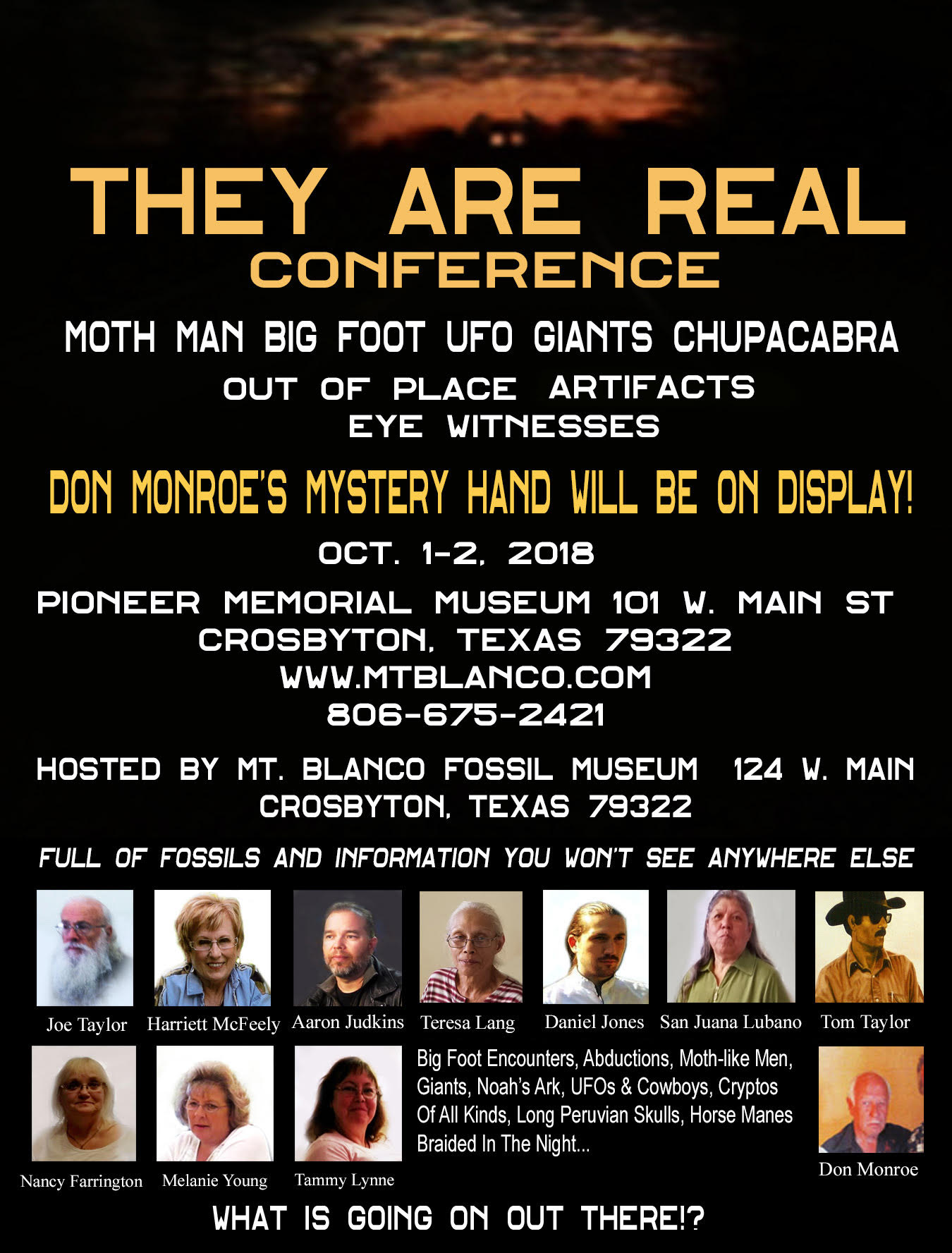
You want details? They sent more in an email.

Moth Man, Big Foot, UFOs, Chupacabra, Giants, Peruvian Skulls, Noah’s Ark – “THEY ARE REAL!” These are the speakers’ topics for the October 1-2, 2018 They Are Real Conference, to be held in Crosbyton, Texas at the Pioneer Memorial Museum, 101 W. Main ST. Crosbyton, Texas 79322, 806-675-2421, www.mtblanco.com

MOTH MAN: There will be eye-witnesses. FIVE sightings of the very strange and terrifying Moth Man in Crosbyton alone. A woman hit one and dented her car. It was as tall as a man but had wings. When she approached it, it stood up and flew away. Another one chased a pick up at high speed at Sundown, Texas. News reports of them terrorizing towns in West Virginia and Iowa have surfaced.

BIG FOOT: How many bullets does it take to stop an eight-foot-tall Big Foot? The man who knows will tell you at the conference. What do they eat? Do they leave gifts? The Big Foot Lady and her neighbor will tell all about it. Are they human??

UFOs: Two cowboys saw a UFO in Blanco Canyon. What did it do? What did another cowboy see that convinced him he was not seeing a known aircraft?

CHUPACABRA: This weird vampire dog called the “goat sucker” and the “hell dog” in Mexican folk lore was just what they said it was. It was not a myth. The Mt. Blanco Museum in Crosbyton, had the best specimen of El Chupacabra. The carcass of it and a coyote were both examined in a University lab to see exactly what it is. They’re not a mangy coyote. Tom Taylor will describe the one he encountered in Lubbock, Texas.

NOAH’S ARK: You’re daring death to climb Mt. Ararat searching for Noah’s ark. Aaron Judkins did just that and got a Hollywood film crew to go with him! He will explain how hard the whole ordeal was.

ELONGATED SKULLS OF PERU: No American has spent more time with these very strange, very long skulls from Peru than Joe Taylor, curator of the Mt. Blanco Fossil Museum. With their having only one parietal bone, instead of two – (the two halves of the top of the skull) – and then having sometimes two dozen extra bones in the skull, it is easy to see why so many researchers wondered if they were alien instead of human. Taylor says, “Spending weeks with those skulls studying them in order to mold them and having made accurate reproductions of them has given me insights that I wouldn’t have had otherwise.” He was part of the LA Marzulli WATCHERS team and Brien Forester, that recently did a press release on the DNA results of these skulls. Accurate casts of them will be on display at the conference. Heard of the Star Child Skull? Researchers were convinced it was alien. The woman who owns it will be here to talk about it. An exact cast will be on display.

THEY ARE REAL is a conference to educate people, especially those who are reluctant to even discuss these strange phenomena. “The TV series Ancient Aliens talks about a lot of these subjects, but their view is pretty one-sided”, said Joe Taylor who is the organizer of the conference. Taylor continued, “I know some of the people on that show and they don’t give the whole story.” They bring in the Bible, but their take on it is skewed. Several of the skulls and artifacts I have worked on somehow show up in the show and on many websites. It irks me that they throw around fantastic dates on these objects that I know are not true. Thus, our conference.”

YES, THERE’S MORE – The mummified hand will be on display. It’s not human. It’s not a bear… It came from Big Foot country. What is it? Don Monroe is a true living Indiana Jones. He will be here to discuss the hand and so many incredible adventures that your head will spin!

Still, what makes this interesting is how they just smoosh up a wild collection of miscellaneous bad ideas, all unrelated to each other, and toss them all in a sloppy pot of conspiracy theory and bible worship and magic monsters, and each speaker probably has their own ludicrous obsession, but as I’ve seen at other events, no one will disagree with anyone else, regardless of how foolish their hypotheses are. It ought to be called a credulity conference.

Dinner at the Petersons’

I think I’d pass. Following the lead of the daughter, Mikhaila Peterson, she and her father, Jordan, eat a diet that consists entirely of “beef, salt, and water”, and they never, ever cheat. Well, not exactly. Mikhaila admits I can also, strangely enough, tolerate vodka and bourbon, which is nice — one does wonder what else she can tolerate.

Jordan Peterson admits to also drinking club soda, which, after being told is just water, he feels compelled to clarify.

“Well, when you’re down to that level, no, it’s not, Joe. There’s club soda, which is really bubbly. There’s Perrier, which is sort of bubbly. There’s flat water, and there’s hot water. Those distinctions start to become important.”

Context! Speaking precisely! It’s all very important! What you eat, not so much.

The author of the article asked an expert about the consequences of an all-beef diet.

“Physiologically, it would just be an immensely bad idea,” Jack Gilbert, the faculty director at the University of Chicago’s Microbiome Center and a professor of surgery, told me during a recent visit to his lab. “A terribly, terribly bad idea.”

Gilbert has done extensive research on how the trillions of microbes in our guts digest food, and the look on his face when I told him about the all-beef diet was unamused. He began rattling off the expected ramifications: “Your body would start to have severe dysregulation, within six months, of the majority of the processes that deal with metabolism; you would have no short-chain fatty acids in your cells; most of the by-products of gastrointestinal polysaccharide fermentation would shut down, so you wouldn’t be able to regulate your hormone levels; you’d enter into cardiac issues due to alterations in cell receptors; your microbiota would just be devastated.”

While much of the internet has been following this story in a somewhat snide way, Gilbert appeared genuinely concerned and saddened: “If she does not die of colon cancer or some other severe cardiometabolic disease, the life—I can’t imagine.”

I’m also thinking of the consequences of a lack of fiber, and the strain on your kidneys, and of a 26 year old with severe gout. Beef and alcohol, that’s what you’re going to get. Unless, of course, you’re just like the Breatharians, who claim to live on air and sunlight, yet have regularly been caught cheating.

But he says he never ever cheats! Well, that’s exactly what a cheater would say, and isn’t it odd that he asserted that when no one had accused him of doing so?

I thought this was the meat of the article, the real conflict in what they’re promoting:

The popularity of Peterson’s narrative is explained by more than its timeless tropes; it has also been amplified by the fact that her father has occasionally cast his spotlight onto her story. Jordan Peterson’s recent book, Twelve Rules for Life, includes the story of his daughter’s health trials. The elder Peterson, a psychologist at the University of Toronto, could at first seem an unlikely face for acceptance of personal, subjective truth, as he regularly professes the importance of acting as purely as possible according to rigorous analysis of data. He argued in a recent video that American universities are the home to ideologues who claim that all truth is subjective, that all sex differences are socially constructed, and that Western imperialism is the sole source of all Third World problems. In his book, he writes that academic institutions are teaching children to be brainwashed victims, and that the rigorous critical theoretician is morally obligated to set them straight.

He demands adherence to an objective truth, but happily wanders off into the weeds on the basis of anecdotes. Actually, if you ever listen to his lectures, all he’s got are subjective opinions that spring out of the twisty morass of his brain, so it shouldn’t be surprising that he’s endorsing dietary quackery. What he says has an extraordinarily tenuous connection to what he does.

My daughter is roughly the same age as Mikhaila Peterson. I’m proud of how Skatje turned out sensible and reasonable and living a well-balanced life, although she’s probably not going to get as rich off bunkum with as little work as Mikhaila.

Also, my daughter is a vegetarian, which kind of makes her the anti-Mikhaila.

I thought physicists were required to know math?

I guess not. Although maybe it’s only a requirement if you’re not a creationist physicist, as Jeffrey Shallit describes.

But wait — Shallit is all cranky about the math, but I had to look at the original post, and there’s more. He’s complaining about species boundaries!

“Species” are not very well defined. Paleontologists work from bones, naturalists work with dead specimens, geneticists work with DNA, and ecologists work with living communities. Each group has its own definition, and very often they are in conflict with the others.

This one always gets me. So the creationist is saying, ‘species boundaries are fuzzy and ill-defined, therefore my claim that species are fixed and unchanging is validated, and evolution is false’. Yeah no.

Boy, I haven’t looked at Uncommon Descent in ages. It’s still a clueless loon factory.

How did this get published?

The Journal of Phylogenetics & Evolutionary Biology, despite the fancy name, must not have much in the way of standards because they published this article, Genome Size and Chromosome Number Relationship Contradicts the Principle of Darwinian Evolution from Common Ancestor. It’s bizarre. The authors have a deep misconception about evolution and they just run with it right into crazyland.

They seem to think there is some kind of progression in chromosome number — that life is supposed to go from some low chromosome number in primitive organisms, to a much larger number in ‘advanced’ organisms, and they have just discovered…chromosome numbers are scattered all over the place! Therefore evolution must be false, because humans are supposed to have the biggest number!

The human genome was located at 4/6 away from the controversial common ancestor genome and 2/6 away from the largest detected genome. Results of this study contradict the principle of Darwinian evolution from common ancestor and support the independent appearance of living organisms on earth. This will open the door for new explanations for the existence of living organisms on earth based on genome size.

Shocking, huh? It’s not as if you can find this fact in introductory genetics textbooks. Oh, wait, you can!

So these guys have some archaic notion of progressive evolution, and also have this strange idea that the number of chromosomes is indicative of complexity. I don’t know where they get that idea — you won’t find that in any of the genetics or evolutionary biology textbooks.

They’re very explicit about it, too. I don’t know how this could have gotten past a reviewer, unless they paper wasn’t reviewed at all (it wasn’t edited in any way, either — the typos and poor grammar are everywhere.)

It is certain that a genome controls the organism structure and development therefore; the genome is expected to evolve before the evolution of the organism. So, based on Darwinian evolution from common ancestor, we expect gradual change (increase) in genome size from the assumed common ancestor (smallest detected genome in this study, Buchnera sp.) to the largest detected genome (P. aethiopicus). Based on this assumption, human is expected to have the largest genome because it is the most recent and the most developed species on earth [30-32] and consequently is expected to lie at the end of genome size evolution curve. In addition, according to the Darwinian evolution from common ancestor, the gradual increase in genome size must be correlated with gradual increase or decrease in chromosome number (chromosome number evolution) as well as with organism evolution. The location of human genome among other genomes based on genome size and chromosome number (Figure 2) confirms that there is no correlation between genome size of species and their emergence on earth (genome evolution). This rolls out the idea that human genome evolved from smaller pre-existing genome. It is well documented that the genome size of an organism does not reflect its structural complexity which raised the question about what mechanisms led to these huge variations in genome size [33]. This was described as the ‘C-value enigma’ [6]. In addition, finding diploid plants with larger genome size than human genome raises a cloud of doubt about the sequence of appearance of living organisms on earth.

I had to look up citations #30, #31, and #32, to find out what fool made the argument that humans are the most recent and the most developed species on earth. More surprises!

30. Elhaik E, Tatarinova TV, Klyosov AA, Graur D (2014) The extremely ancient chromosome that isn’t: a forensic bioinformatic investigation of Albert Perry”s X-degenerate portion of the Y chromosome. EJHG 22: 1111-1116.

31. Elhaik E, Tatarinova TV, Klyosov AA, Graur D (2014) The extremely ancient chromosome that isn’t: a forensic bioinformatic investigation of Albert Perry”s X-degenerate portion of the Y chromosome. EJHG 22: 1111-1116.

32. Royer DL (2006) CO2-forced climate thresholds during the Phanerozoic. Geochimica et Cosmochimica Acta 70: 5665-5675.

There are some lessons to share with my science writing students.

  • The fool in question is Dan Graur, author of the book Molecular and Genome Evolution. He’s going to be so surprised!
  • That’s a good trick to pad your citations, listing the exact same article twice. I guess that makes your point doubly powerful.
  • I’ve read those first two (one) paper(s). They make no such argument. I didn’t know you could just sprinkle your paper with irrelevant citations with no connection to your claims.
  • Speaking of which, the third (second) paper is about climate change, not human evolution.

I don’t think the Journal of Phylogenetics & Evolutionary Biology is going to be on my routine reading list.

Beware the trap of imagining that you are a logical, rational human being

This is my sabbatical year, so I’m not going to be getting those fawning adoring messages

from any students this year. I am so accustomed to being held in reverence, as a kind of saint, like this:

“I only now [received] your beautiful and exquisite message… I thank you for your infinite understanding and sensitivities which are always beyond measure.”

Those are the words of Nimrod Reitman, in an email to his Ph.D. advisor, Avital Ronell, a professor of German and Comparative Literature at New York University. As many now know, Ronell was found by NYU to have sexually harassed Reitman.

Oh, wait. I never get those. It could be that I’ve never written a “beautiful and exquisite message” — I tend to be brief in email — or it could be that Ronell built a cult-like relationship with her professional dependents. That’s an ugly outcome, and part of a deplorable pattern. Your students are not your acolytes, and that sort of behavior should be discouraged, a point the author of the article makes strongly. But then, unfortunately, he goes on to write this:

Many commentators on social media express have expressed familiarity with the kind of dynamic at play in the Ronell case. Yet I did notice that many of these commentators were not in academic philosophy.

I suspect that the culture of argument in academic philosophy helps counter tendencies towards sycophancy. We show respect to each other by posing the best challenges we can to each other’s ideas. Putting tough objections to philosophical heroes is something we are trained to (love to) do.

Well, gosh, good thing the mode of thinking in my discipline makes that behavior unlikely. We are above all that, so it’s unlikely to be a problem for us.

I’ve heard that kind of argument so many times before, and it’s a sign that someone in that discipline is about to fail spectacularly. “We’re skeptics, we rigorously criticize bad ideas so that’ll never happen to us” or “We’re scientists, science is objective and impartial so abusers can’t thrive in our ranks,” and then whoops, boom, pratfall.

I’ll go so far as to say that having the attitude that the culture in your little domain of thought makes you immune to the foibles of those other poor thinkers over there is exactly the kind of arrogance that makes you susceptible to failure. It’s a fallacy to think that rationalism makes one resistant to bad ideas — we’re all human here, which means we’re all going to fuck up. Rationalizing away your fuck-ups just means you’ll repeat them, and make them increasingly worse.

At least, that’s what I’ve learned from many decades of involvement in groups with a tendency to praise their own rationality. It’s not a promising development.