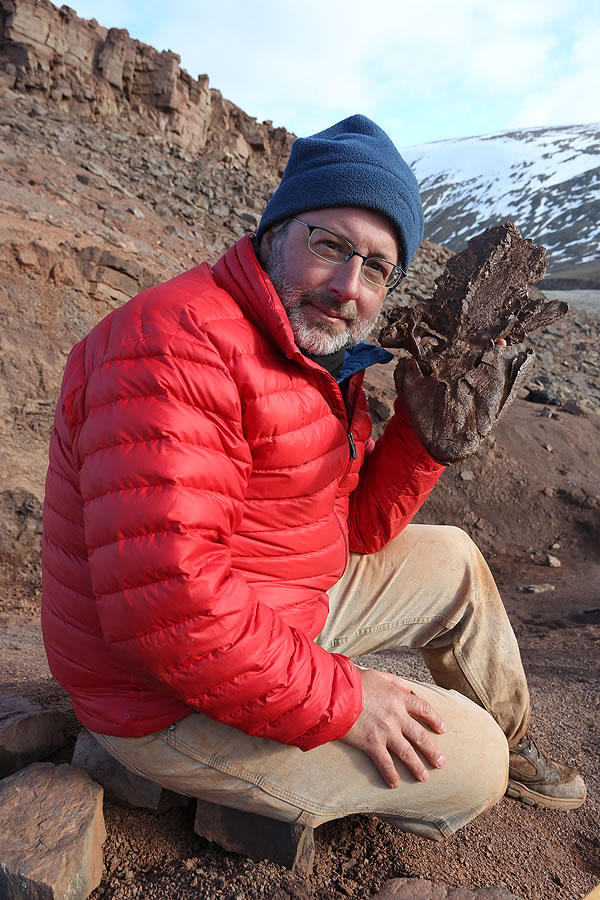
I keep telling you, you’re a big fish

shubinandfriend

Nobody believes me. Well, not nobody…but Ray Comfort sure was incredulous, and I’m always getting these querulous complaints from people. Now, though, I can just tell them to watch Your Inner Fish, the PBS series that will be coming to your television in April.

You can’t wait? No problem. PBS has already made available an informative web site with video excerpts, interactive demos, and a classroom guide. You can see it all now! I’ve been perusing it for the last hour, and it’s all very well done.

Hmmm…and this summer, my colleagues and I have to put together a high school curriculum for teaching evolution…a good chunk of my work might already be done for me here.

I get mail

Another one today? I just had to offset the lunacy of the earlier post by sending my thanks to Leo from Texas, who sent me a nice long letter telling me about all the things he liked in The Happy Atheist. Yay! Fans!

Also, the audio book is in the works, and I’ll let you know when it’s available. I didn’t read it, though: Aron Ra did the honors. So another Texan…maybe that state isn’t so bad after all.

Cothran’s execrable offerings

Martin Thomas Cothran, apologist for Intelligent Design creationism, takes Jerry Coyne to the woodshed for criticizing a book he hasn’t read.

Consider Coyne’s recent article, "The ‘Best Arguments for God’s Existence’ Are Actually Terrible," which appeared in the New Republic. The article takes the form of a refutation of the arguments in David Bentley Hart’s new book, The Experience of God: Being, Consciousness, and Bliss. Coyne admits that he has not actually read the book, but nevertheless concludes its arguments are unsound. He claims that Hart’s conception of God is "immune to refutation," and therefore that "Hart’s argument fails …."

Yet, if you actually read Coyne’s article, he comes right out and says he’s not discussing the book, but the ideas that other fans of Hart have promoted, and the general theological approach to defending god-belief. Coyne even promises to read Hart’s new book to see if there are any new arguments in it, which I think is a terrible mistake. When will we learn? We’re constantly told that this book or that book is the very best argument for god ever made, and then we read it, and it’s awful and the same old noise.

So I visited Martin Cothran’s restaurant, and told him to give me the best thing on the menu.

PZM: That is quite possibly the worst ham sandwich I’ve ever tasted. It’s inedible. Give me a minute, I have to go rinse my mouth out.

MC: That is not just a ham sandwich; it is a specially spiced sandwich ala Ken Ham. We take a slice of cheap lunchmeat and spread a layer of runny yellow feces from a diarrhetic baby on top. But yes, you’re quite right, it’s terrible. It’s a bad sandwich. Here, let me get you the best meal in the house…

PZM: OK.

Gah, that’s even worse! What the hell is that?

MC: That is Plantinga’s Deep-Fried Dog Doody. Delightful mouth feel, crunchy on the outside, gooey in the center. But I understand, really, it’s a miserable excuse for a snack. I shouldn’t have given it to you. Here’s something that is simply delightful, I’m sure you’ll agree…

PZM: OK.

<sprays countertop with the gritty contents of his first spoonful> Take it away, take it away, I can’t believe I put that in my mouth!

MC: What? That was Karen Armstrong’s Homestyle Catbox Casserole! Everyone loves it. But then, it’s comfort food for the masses, I can understand how a discerning palate like yours would find it unsatisfactory. Here, I have something far more refined…

PZM: OK.

Wait. No. That reeks. I can’t even get within 10 feet of that slimy mess.

MC: I understand. It’s Anselm’s Ontoexcremental Pudding, and it is an acquired taste. We take thousand year old outhouse samples from an English monastery, let it ripen while passing philosophers make sporadic additions to it, and when it reaches a particularly high aroma, serve. It’s a poor excuse for a dish, much too old and much too overdone, and rather patently absurd. Of course you don’t like it. But I’ve been saving this next treat for a special customer…

PZM: OK.

No, just no. <Spits out unpleasant brown wad into his napkin>

MC: Ooops. That really is just the straight, undistilled stuff, Poop Tartar, from a recipe I got from Al Mohler. Baptist cooking isn’t to everyone’s taste, I understand. I should have known! You’re a scientist! I have exactly the thing for you!

PZM: OK.

Hmm. Looks like a cookie. <nibbles delicately at the edge> Ick. Tastes like shit.

MC: Exactly! It’s an Intelligently Processed Cow Pie! We take shit, run it through a cuisinart until all the texture is gone, pour it into a very sciencey beaker, and then microwave it until it’s a hot, bubbling, tarry goo, then we pour it onto a greased cookie sheet and bake it until we have a solid, perfectly circular disk of uniform shit! It’s very high tech. But you want character in your food, not just the same old thing you get at the Science Commissary, right?

PZM: OK.

A chocolate milkshake? Finally, something I can enjoy? <pause, then gagging/wretching noises<

MC: Lennox’s Fecal Frappé sometimes has that effect. Dreadful stuff. Apologies. I really should have served you the greatest dish in my entire restaurant from the very beginning. Try this delicious dessert, and bon appetit!

PZM: OK.

<plunges spoon into large quivering blob, it explodes, splattering the interior with flecks of slime and an impossibly vile stench.>

MC: Amazing, isn’t it? Hart’s Fart Pudding is one of our most expensive treats: we start with just the tiniest amount of prime poop, and then we whip and froth it up into this delicate airy confection with the voluminous gasses expelled from the digestive tract of a long-winded philosopher. Too light? Perhaps you would like to try some of our chewy D’Souza’s Dung Rolls…?

PZM: Uh, you know…do you have anything that doesn’t have shit in it?

MC: Well, there’s Miller’s Mud Balls, those don’t have much shit in them. Or Hedge’s Revenge. Spicy!

PZM: I think…I think maybe I’ll just pass on everything.

MC: What? That is an unethical position! How can you reject a meal without first tasting it? Every item on my menu is better than every other item on my menu, and I can keep churning out new shit recipes all the time. You have to shut up and keep shoveling!

PZM: Bye. I’ve learned enough.

MC: McGrath’s Mierda? Nürnberger Nuggets? Stone’s Scheiss Soup? Garrison’s Gut Goo? You can’t leave until you’ve tasted them all! Coward! You’ve only tasted the weakest of my fabulous foods!


Oh, no. It’s another Cothran, but the stupidity of the younger is indistinguishable from that of the elder.

Plantinga!

I should pay more attention to the Digital Cuttlefish — apparently, the recent rash of “Plantinga!” in my in-box might be because Plantinga has an interview on the NY Times Opinionator, and it’s making the same stupid argument my correspondent gabbled at me.

DC has taken care of the gist. Let me point out one thing that jumped out at me, bizarrely. It’s his rejection of Russell’s Teapot.

Russell’s idea, I take it, is we don’t really have any evidence against teapotism, but we don’t need any; the absence of evidence is evidence of absence, and is enough to support a-teapotism. We don’t need any positive evidence against it to be justified in a-teapotism; and perhaps the same is true of theism.

I disagree: Clearly we have a great deal of evidence against teapotism. For example, as far as we know, the only way a teapot could have gotten into orbit around the sun would be if some country with sufficiently developed space-shot capabilities had shot this pot into orbit. No country with such capabilities is sufficiently frivolous to waste its resources by trying to send a teapot into orbit. Furthermore, if some country had done so, it would have been all over the news; we would certainly have heard about it. But we haven’t. And so on. There is plenty of evidence against teapotism. So if, à la Russell, theism is like teapotism, the atheist, to be justified, would (like the a-teapotist) have to have powerful evidence against theism.

<blink, blink> Seriously? He rejects the Russell’s Teapot idea because he can only imagine a methodologically natural process for launching it into orbit, and because we lack concrete physical evidence of the technological apparatus for putting it in space, we have evidence that it doesn’t exist?

Alvin Plantinga, go look in a mirror.

If that is sufficient cause to dismiss the space teapot theory (which I’d agree with, actually, and I suspect Russell would, too), then the complete absence of evidence for the origin of a god; the conflicting stories about the nature of these gods; the frivolity of the supernatural manifestations of these gods; the lack of a natural framework in which to explain the machinations of these hypothetical gods; all that is evidence against theism, and justifies the rational rejection of god-belief.

Also, here’s Russell’s own account of the teapot.

Many orthodox people speak as though it were the business of sceptics to disprove received dogmas rather than of dogmatists to prove them. This is, of course, a mistake. If I were to suggest that between the Earth and Mars there is a china teapot revolving about the sun in an elliptical orbit, nobody would be able to disprove my assertion provided I were careful to add that the teapot is too small to be revealed even by our most powerful telescopes. But if I were to go on to say that, since my assertion cannot be disproved, it is intolerable presumption on the part of human reason to doubt it, I should rightly be thought to be talking nonsense. If, however, the existence of such a teapot were affirmed in ancient books, taught as the sacred truth every Sunday, and instilled into the minds of children at school, hesitation to believe in its existence would become a mark of eccentricity and entitle the doubter to the attentions of the psychiatrist in an enlightened age or of the Inquisitor in an earlier time.

Notice that he does not postulate launch facilities in Siberia to put it into space — it just is, as if “affirmed in ancient books”. His whole point is that in the absence of corresponding evidence, with only the testimony of religious texts, you are justified in rejecting the teapot hypothesis.

So Plantinga willingly flips into pure materialist mode to dismiss a claim of an orbiting teapot, and then happily flips back into supernaturalist mode when he wants to believe in a god, and he doesn’t even notice. Some philosopher.

I’m not even going to try to puzzle out the rest of the interview. Too much exposure to Plantinga causes brain damage, as the state of his fans testifies.

I get email: Jesus’ hairstyle edition

For some unknown reason, there has been a recent spate of weird people shouting “Plantinga!” at me. Has he said something idiotic lately that has inspired his idiotic fans?

Hi Paul. I hope you are well and having a good week. I am writing to you from the vicinity of Kremlin in Moscow, Russia.
What is the origin of human faculty of reason? What authority or what reliability and warrant has our reason?
How can it be that what goes on in our tiny heads can give us anything near a true account of reality?

How can it be that a mathematical equation thought up in the human mind of a mathematician, can correspond to the workings of the universe out there?

You Paul essentially obliged to regard “thought” as some kind of neurophysiological phenomenon. For atheists pure blind chance is at the very root of evolution that produced such neurophysiology. Why should anyone think for a moment that the beliefs caused by that neurophysiology would be mostly true? After all if the thoughts in my mind are just motions of atoms in my brain – a mechanism that arisen by mindless random accidental unguided processes, why should I believe anything it tells me – including the fact that it is made of atoms. American philosopher Alvin Platinga sums it up: “If Paul is right that we are the product of mindless unguided natural processes, then he has given us strong reason to doubt the reliability of human cognitive faculties and therefore inevitably to doubt the validity of any belief that they produce – including Paul’s own science and his atheism”
Thus, atheism undermines the very rationality that is needed to construct or understand or believe in any kind of argument whatsoever – let alone scientific one. Reducing “thought” to nothing but neurophysiology leads to the demise of science, rationality, and belief in truth itself. There is no rational basis for truth. Science and truth are left without warrant.
By contrast, what is found in ancient Jewish manuscripts is coherent in its explanation of why the universe is (scientifically) intelligible. It teaches that God is ultimately responsible as Creator, both for the existence of the universe and the human mind. Human beings are made in his image: the image of a rational personal Creator; and that is why they can understand the universe, at least in part
And I think you’ll be happy to know that someone in Wales, United Kingdom, saw Jesus recently. It’s actually a true story in the context of a 5-year scientific study carried out by Dr Penny Sartori. Here is her 1-hour long presentation about it, given at a conference in US.
http://www.btci.org/bioethics/2012/videos2012/vid2.html
It also been published in a journal. Here is the link if you prefer to read about it
http://www.iands.es/bibliografia/Sartori_Fenwick.pdf

I don’t think Plantinga is actually talking about me — I suspect my correspondent made up the quote, cobbling together phrases Plantinga has said. But this is all just Plantinga’s stupid argument that basically claims that you can’t get order out of chaos; that something that arose by chance cannot possibly ever acquire properties that are ordered and rational. It also ignores the fact that even an irrational mind can develop orderly processes that allow it to discern and interpret patterns in the universe around it. His idea requires Plantinga to also ignore the fact that no one says evolution or neurophysiology are products of pure chance alone. But then who cares? Plantinga is quite possibly the dumbest philosopher on the planet. You might as well write to me citing Joel Osteen as your infallible authority — I’ll just laugh and laugh and laugh.

But I did read the cited paper anyway. It’s junk. It’s an anecdotal story of one patient’s lapse into unconsciousness and the happy and familiar confabulation he came up when he woke up. That’s it. It’s published in the “Journal of Near-Death Studies,” which sort of tells you what level of credibility it has, and it’s by Penny Sartori, NDE crackpot.

Long story short: Cancer patient in organ failure lapses into unconsciousness, and recovers three hours later. He then says that he saw his father and Jesus, and described medical procedures that were done while he was out cold. Furthermore, he was miraculously healed of a congenital condition.

The story falls to pieces pretty quickly, though. The medical procedures he described? 1) A doctor checked his pupillary response by flashing a light in his eyes, 2) a nurse swabbed drool from his mouth with a suction catheter, and 3) another doctor peeked around the curtains surrounding his bed.

Yep, that’s it. Mundane events in the world of the hospital. And he doesn’t even get the details right, but the author of the paper just ignores any deviation.

The consultant checked that the patient’s pupils were reacting by shining a light into them. He remarked, “Yes, they’re reacting, but unequal.” The patient reported hearing the doctor saying, “There’s life in the eye” or “something like that.” This was inaccurate, although this highlighted his interpretation of what was said and was a good comprehension of what the consultant meant.

Inaccurate, but a good comprehension, so she ticks that off as one of her three examples of veridical confirmation. That’s the level of quality we’re talking about.

As for the magical healing, the patient was born with cerebral palsy that caused a constricture of his right hand; the muscles were in spasm so he couldn’t open it. After a traumatic event in the hospital in which his brain was fried by anoxia, he could open his hand! You know, that is not at all surprising, and can easily be explained by purely physical events — we don’t need to invoke Jesus.

By the way, the only interesting thing in the account is that the patient claims Jesus has long, black hair, which needed to be combed. Yeah, you finally meet Jesus, and what do you do? Criticize his hairdo.

You can talk about the Nye/Blackburn debate here

I watched it, and I was unimpressed. Blackburn had a smirk on her face that was baked in rock solid; Nye couldn’t close the deal; the moderator was trying so hard to be “fair” to both sides when Blackburn was full of shit. I just about threw something through the TV screen when she made that absurd argument that CO2 has only gone from 320ppm to 400ppm. Lying with a smile; it’s what the right wing frauds are great at.

Let’s look at the positive benefits of carbon! Yeah, and let’s look at the benefits of ocean-front property in central Pennsylvania.


Here’s an antidote.

Hey, why couldn’t they get someone like Peter Sinclair to debate that congressfool?

Free CONvergence passes!

Trust me. You don’t want to be in Minnesota in February — only the hardiest and most foolish people can survive it. Minnesota in July, though, is a whole different thing, and I suspect that even a soft, pampered Texan might be able to cope with a visit to the north then.

And 3-6 July, in Bloomington, Minnesota, is where CONvergence takes place, which hosts the annual Skepchickcon science track. You want to come to Minnesota for that.

To help you get there, Surly Amy is giving away convention passes — just follow the link, make a comment, and add the line “ADD MY NAME TO THE HAT”. That’s it. You’re in the drawing for a free convention pass.

Then you just have to show up in Minnesota. In July. Not yet, you’ll regret it if you’re so eager that you show up this early. Wait a few months for us to thaw out.