I thought they went extinct. But here’s one from the debate on gay marriage in the Washington state legislature.
(Episode CCXCIX: Secular America).

I thought they went extinct. But here’s one from the debate on gay marriage in the Washington state legislature.
(Episode CCXCIX: Secular America).

Did you know that Rick Santorum thinks atheism leads to beheading people?
“They are taking faith and crushing it. Why? Why? When you marginalize faith in America, when you remove the pillar of God-given rights, then what’s left is the French Revolution. What’s left is a government that gives you rights. What’s left are no unalienable rights. What’s left is a government that will tell you who you are, what you’ll do, and when you’ll do it. What’s left, in France, became the guillotine. Ladies and gentlemen, we’re a long way from that. But if we do, and follow the path of President Obama and his overt hostility to faith in America, then we are headed down that road.”
Which led me to a crazy thought…maybe the atheist symbol should be a little guillotine. I understand there’s a peculiar trend in religions to use an execution device as a fashion statement, so it would fit right in.
It would also be of some practical utility to cigar smokers.
And what overt hostility to faith does Obama have? Did you see his prayer breakfast remarks? He’s so fucking pious I don’t want to vote for him.

I was raised in a house with a large property far from any city, where the night sky alone provides you with all you need in order to begin dealing with the fact that the universe is….. really freaking complicated. I would play outside on a regular basis, digging in the ground, taking apart plant life, searching for new creatures in my pond, and almost every time I’d learn something new. When I was first really introduced to religion by one of my best friends I was about 9. I went home and told my parents about this idea that my friend’s family had about this guy who hangs around behind the scenes and takes care of all the stuff we can’t understand. They as usual kept their own beliefs out of my way and encouraged me to explore this new concept and build my own opinion. When I approached my friend about it he said that I could attend church with him and his family one day. When I asked what church is all about he told me, you get up early Sunday morning, go to a building with a bunch of other people and listen to a man talk about a book for an hour or two. I declined without a moments hesitation, Sunday was one of my only two days off from school where I could play at home where I felt comfortable. I was fine with not knowing the supposed secrets of the universe, as long as I could explore it on my own.
My interest in religion disappeared for years, I never felt that it effected me. I saw it maybe as a fine and easy to understand placeholder for reality through the ages until science came along. My aforementioned friend and I were perfectly fine without speaking about religion, going on around 17 years now and he’s never once pushed anything on me. Him being my only window to religion for many years I thought that was the case for all of the religious community, they had a belief as a family, it made them feel good, but they didn’t literally believe every word and didn’t try to change my life with it.
It wasn’t until later on that I started to get a bigger picture, that there’s plenty of people who do take everything in their bible literally and without evidence, something I cannot even imagine doing. In my opinion if you want to get a deep feeling from a book, pick up a science text, read about the solar system, evolution, quantum mechanics, it all seems like fiction or even magic, the deep feeling comes when you realize that it has real evidence in it’s favor. If I read something new it almost takes me back to when I was a kid and I’d find something I’d never seen before on my property. When I hear of those from the religious community, for instance teaching children to ask dead end questions like “were you there?” when in the presence of a moon rock and told it’s age, I almost get personally offended. Asking creative questions is how we move forward, if everything is already explained as magic, we stall. I became an atheist from a previously apathetic standpoint because of miseducation, a reason quite benign in comparison to the atrocities I now realize are carried out in the names of gods all over the world on a daily basis. I am an atheist because I fear for our future and refuse to be associated with those who would see those fears come to realization, whether unconsciously, or with the best of intentions.
Will
Canada

You may recall that a Christian group in Bath called “Healing on the Streets” was going about claiming that faith could heal all sorts of ailments: “Ulcers, Depression, Allergies, Fibromyalgia, Asthma, Paralysis, Crippling Disease, Phobias, Sleeping disorders or any other sickness”. They got slapped down for making false claims, as they should have been.
Brendan O’Neill is outraged — this is a violation of freedom of religion! And then he goes on to make a really good analogy.
This is an outrageous attack on freedom of religion, on the basic right of people to express central tenets of their faith. Of course, the authorities have a role to play in keeping a check on the scientific claims made by businesses in their ads. If, for example, Pepsi suddenly announced that a can of its pop can cure backache, that should be challenged; likewise, companies that spout homeopathic claptrap can reasonably be asked to provide evidence for their claims. But the state and its offshoots have no business whatsoever sticking their snouts into the expression of a religious conviction, into the public articulation of faith, which is precisely what the HOTS leaflet was. Monitoring claims that are made in an explicitly scientific fashion is fine, but policing the expression of an inner conviction, of a profound belief in the healing qualities of God, is ludicrous and authoritarian. Not content with policing the public square, the ASA, it seems, now wants to monitor men’s souls too.
Well, yes, that’s a really good example. If Pepsi profited by selling more cans of pop by plastering them with misleading medical claims, that would be wrong, and it would be society’s responsibility to act to protect its more gullible members from predatory lies. But when HOTS tries to profit in its evangelical efforts by lying about their medical benefits, that isn’t offensive behavior because…? “Inner convictions” doesn’t cut it. There are plenty of scams going around with devout proponents — homeopathy, balance bracelets, libertarianism, crystal healing — but we don’t exempt them from laws against fraudulent advertising because their middle management is willing step up and say “I really, really believe”. Why does religion get this free pass?
Here’s another thought experiment. What if the CEO of Pepsi has a conversion experience, sees a vision of Jesus, and Jesus says unto him, “Lo, high fructose corn syrup is the true nectar of the gods, it’s all we drink up here in heaven. It’s what makes us immortal!” Could Pepsi now slap a new label on their cans that says “Now with eternal life!”?
What if all of their ads featured a charismatic preacher with big teeth and big hair and tap-dancing angels all singing about how Pepsi was Jesus’ favorite drink? Would that be sufficient evidence of “inner conviction” and justify any medical claims Pepsi might want to make?

We have some additions to FtB: Biodork, a sciencey/skeptical nerd from Minneapolis (have you noticed how much of a seething hotbed of godlessness Minnesota is?) and Love, Joy, Feminism, a blog by a happy escapee from the quiverful movement.
You should go read them now.
You will never escape freethoughtblogs now, will you…we shall achieve total world domination soon. The logo redesign is in progress, but I’m thinking now it ought to be a burning eye, staring out at you from the top right corner of every page.

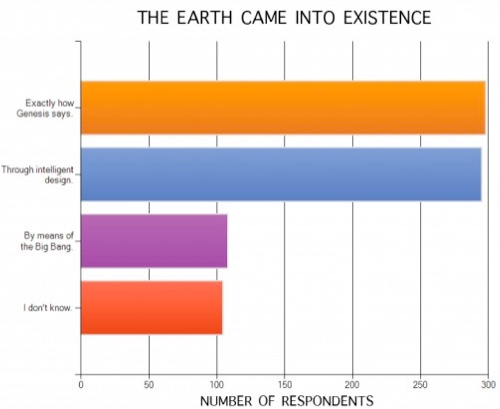
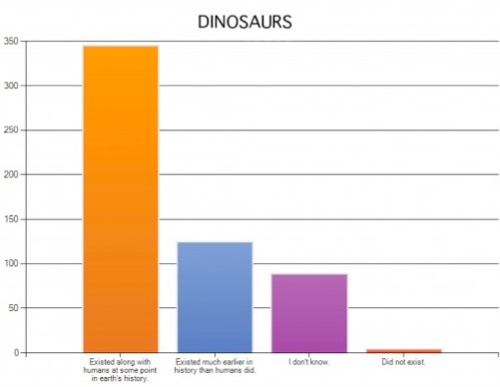
I wish I’d had these data yesterday. I gave a creationist-bashing talk, and my introductory slides were intended to show the generally deplorable state of science education in this country. I used some national data, but what would have been more dramatic would have been to use something local and even more extreme. Walla Walla University, a Seventh Day Adventist college, did a survey of student views on origins. There is lots and lots of data in chart form on that page, and all of it is depressing and disgraceful.
Perhaps you wonder how many students think a magic man in the sky did it:
Or how many students stopped learning about science when they stopped watching the Flintstones:
Or whether these devout kids find the clergy sufficient, or have deluded themselves into believing their wacky ideas are supported by science?

I thought about raging about how WWU wasn’t doing their job as a university (but clearly, they’re doing great as a church), but then I was stopped short — what would a similar survey at other American colleges look like? What does the student body at my university think? I dread finding out.
But I want to find out. Hey, student freethought groups out there, here’s a project suggestion for you all: do a similar survey. Put together a questionnaire, table at your student union and gather respondents, and post the results somewhere. The reward is that you’ll almost certainly make your science professors cry.

As a child, it never occurred to me to doubt the existence of god. I’m not sure I even realised it was optional. When I was ten, after my mother’s remarriage, we started to attend my stepfather’s church, in which he was (and is) a very active member. This church is well known in Edinburgh for being ‘charismatic’ and ‘evangelical’, by which I mean that the organ had been dispensed with in favour of guitars and there was a lot of swaying and clapping of hands. They were very into the alpha course.
Every summer, the church would organise a retreat at a large house somewhere in the country for a week of prayer and bible study, and my older sisters and I were always taken along. The worst of these was when I was 12; that was the memorable year when the ‘Holy Spirit’ was sweeping through the land (or at least through the evangelical churches). For a week I was stuck in a remote house in the highlands of Scotland while everyone around me was filled with the holy spirit and started swaying, shaking, falling down and speaking in tongues. I spent most of the week hiding.
Around this time, I started to read a lot of old myths – Greek, Roman, Egyptian, Celtic and so on. It occurred to me that those people who had worshiped Isis thought they were right just as sincerely as I did about Jesus. And once I’d acknowledged that question, what about Muslims or Hindus? I asked my stepfather – how did we know that we were right? He told me that it was just a matter of faith (which was honest of him), and I accepted that answer. And I believed in god – but not unquestioningly. I had doubts. I saw so many contradictions in the world, so many things that didn’t make sense thought the lens of faith. But I ignored the contradictions and assumed I just didn’t understand. Perhaps we needed god to set off the big bang, I wondered. And perhaps he nudged evolution along.
Ultimately, what saved me was science. It never occurred to me to doubt that evolution is true and I never really believed that creationists existed until the horrifying day when I discovered that my mother and eldest sister (both highly educated, otherwise intelligent women) are creationists.
And one day, I finally caved to my doubts and actually considered a question that had been hanging around at the edge of my consciousness for years. It’s accepted among most Christians that humans are the only human beings to have souls. Dogs, cats, horses, goldfish – nothing. Chimps, nothing. We assume the Australopithecines had no soul. So what about Homo habilis? Or Homo erectus? No. So when had the soul appeared? Which individual was the first Homo sapiens and had the first soul? Of course, I knew that was a ridiculous question. But it had to be asked, because if there was no soul, there could be no afterlife. No heaven, or hell. And if there was no afterlife, there was no god, and it was all an invention of people who were afraid of death, and so convinced themselves that they would live forever.
Of course, that wasn’t all, and it look me a while to completely let go of my faith, but it’s gone now. I miss it sometimes. The idea that there is an omnipotent being out there who loves you and will do anything for you is incredibly comforting. But I’ll take what I have now – the ability to see and appreciate the world as it actually is and nothing more – over a lie any day.
Annabel
United Kingdom

It’s going to be a long busy day on Thursday — I’m flying off to this event tomorrow, and I think I just sort of step off the plane to be whisked off to the auditorium to start babbling.

And yes, I seriously guilted Jen into owing me a beer for missing my talk. It’s only a 5 hour drive from Seattle to Pullman! She could just hop in a car right after lunch and blow off Friday, no problem.


