Poor little baby. But he shouldn’t jump out a window — he should get on the floor of the stock exchange and scream hysterically. And maybe poop his diapers.
Pharyngula
Evolution, development, and random biological ejaculations from a godless liberal

Poor little baby. But he shouldn’t jump out a window — he should get on the floor of the stock exchange and scream hysterically. And maybe poop his diapers.

My wife sent me this photo, and was intrigued. The water boatman sings through its penis, and sings very loudly — 105 decibels from an animal that’s only a few millimeters long (no word on the length of its penis). I have received subtle signals that I am…inadequate. Does anyone have any suggestions? Should I get an implant of one of those mini-iPods? Or perhaps even an iPod Touch?

(via National Geographic)
(Also on Sb)

A study in the Journal of the Royal Society of medicine has assessed the effectiveness of health care in 19 western countries and come up with a simple ranking system: a measure of the the number of lives saved relative to expenditures proportional to the GDP. One parameter, called the GDPHE, or GDP Health Expenditure was a measure of how much money the country was sinking into health care per citizen; by dividing this by the mortality rates, they got a measure of the effectiveness of the health care system.
This is a ranking system, and I have mostly a hyper-competitive American audience, so you all want to know whether you win or not, right? You want the data that shows that the US is #1! And here it is, the one result that shows us at the top of the ladder, our average health care as a function of GDP.

Look at that: we don’t just win, we win big, leaving our closest competitor, Germany, in the dust. We spend 125% of the money Germany does per person. Does it feel good, America? We are tossing bigger buckets of money into health care than anyone else.
But now for the number that really matters, the GDPHE ratio. How many lives are we saving with all that money? Here’s the answer. Look at the last column, which is the ratio of money spent to lives saved.

Oops. We’re…#17. We’re almost the worst — thanks, Portugal and Switzerland, for neglecting the medical needs of your citizenry more than we do.
Our health care is miserably inefficient, and we pour extravagant sums of cash into it, but you might ask whether it works at all. And the answer is a bit of good news, yes, it does. This study also compared death rates over time and came to the conclusion that, in the US, more than half a million people are alive today who would not have been with the medical care we offered 25 years ago. Medicine in the US is good, it’s just far more economically wasteful than it ought to be.
I’m still thinking I ought to retire to Ireland.
(Also on FtB)

A study in the Journal of the Royal Society of medicine has assessed the effectiveness of health care in 19 western countries and come up with a simple ranking system: a measure of the the number of lives saved relative to expenditures proportional to the GDP. One parameter, called the GDPHE, or GDP Health Expenditure was a measure of how much money the country was sinking into health care per citizen; by dividing this by the mortality rates, they got a measure of the effectiveness of the health care system.
This is a ranking system, and I have mostly a hyper-competitive American audience, so you all want to know whether you win or not, right? You want the data that shows that the US is #1! And here it is, the one result that shows us at the top of the ladder, our average health care as a function of GDP.

Look at that: we don’t just win, we win big, leaving our closest competitor, Germany, in the dust. We spend 125% of the money Germany does per person. Does it feel good, America? We are tossing bigger buckets of money into health care than anyone else.
But now for the number that really matters, the GDPHE ratio. How many lives are we saving with all that money? Here’s the answer. Look at the last column, which is the ratio of money spent to lives saved.
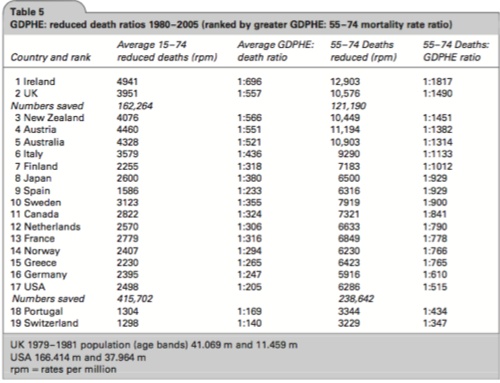
Oops. We’re…#17. We’re almost the worst — thanks, Portugal and Switzerland, for neglecting the medical needs of your citizenry more than we do.
Our health care is miserably inefficient, and we pour extravagant sums of cash into it, but you might ask whether it works at all. And the answer is a bit of good news, yes, it does. This study also compared death rates over time and came to the conclusion that, in the US, more than half a million people are alive today who would not have been with the medical care we offered 25 years ago. Medicine in the US is good, it’s just far more economically wasteful than it ought to be.
I’m still thinking I ought to retire to Ireland.
(Also on Sb)

Those crazy Swedes, bustin’ into song over the weirdest things…like “it’s all the gays’ fault”.

I just learned that Sean M. Carroll is live-Blogging Curiosity, the new television program that asks whether gods exist. Hawking comes out strongly with a confident “NO”. But now they have this horrible, awful post-show panel where they bring in weasely theologians to sow confusion. Carroll is also on the panel, and seems to be the sole rational, godless voice.
If you aren’t watching it on TV, you’re in luck — you’ve escaped the blithering nonsense pouring out of John Haught’s mouth. Read Cosmic Variance instead.

This is a wonderful video debunking the Kalam Cosmological Argument. What I really like about it is that it takes the tortured rationales of theologians like William Lane Craig, who love to babble mangled pseudoscience in their arguments, and shows with direct quotes from the physicists referenced that the Christian and Muslim apologists are full of crap.
(via Skepchick.)
(Also on FtB)

This is a wonderful video debunking the Kalam Cosmological Argument. What I really like about it is that it takes the tortured rationales of theologians like William Lane Craig, who love to babble mangled pseudoscience in their arguments, and shows with direct quotes from the physicists referenced that the Christian and Muslim apologists are full of shit.
(via Skepchick.)
(Also on Sb)

Mr. Lambertsen wishes to reopen a prior conversation.
Dear Mr. Myers:
Inasmuch as…
1. The theoretical analyses of Kaila and Annila (Proceedings of the Royal Society A, vol. 464, 3055-3070, 2008) and Karnani, Pääkkönen, and Annila (Proceedings of the Royal Society A, vol. 465:2155-2175, 2009); and
2. The empirical findings of Goldbogen, Calambokidis, Oleson, Potvin, Pyenson, Schorr and Shadwick (Journal of Experimental Biology, vol. 214, 131-146, 2011)
all corroborate my 2007 theory that, in its most general form, natural selection works diametrically in opposition to the argument codied by the Principle of Least Action,
would you be so kind as to publish a retraction, if not an apology, for your [offensive and self-serving] blog titled “Word Salad — with Math?”
Without delay?
The favor of a prompt reply is requested.
Kindest regards,
R. H. Lambertsen, Ph.D., V.M.D.
Dear Mr. Lambertsen:
I took the trouble of looking up the papers you recommended, Natural selection for least action, The physical character of information, and Mechanics, hydrodynamics and energetics of blue whale lunge feeding: efficiency dependence on krill density, and alas, while I can see how they are relevant to fragments of formulae in your thesis, they don’t in any way support the whole. In particular, they don’t explain how the evolution of the craniomandibular articulation in baleen whales was the enabling mutation that permitted the occurrence of free will, what this has to do with Einstein’s special theory of relativity, the significance of the death of the largest blue whale known on 20 March 1947, and how you tie all these disparate observations into the conclusion that humanity is about to undergo a speciation event. I looked in particular in the paper on lunge feeding for evidence that George W. Bush stole your driver’s license, as you claimed in your paper, to no avail.
Given these deficiencies in your sources, I feel no need to retract my original blog post, Word salad, with math, let alone apologize for it.
I must also point out that your paper lacked a legend, or even a reference in the text, for this climactic figure, which I’m sure must explain everything. Your recent paper recommendations do nothing to enlighten me, either. It’s rather symptomatic; perhaps if you stepped back from your work and looked at it with a more critical eye, you might notice that it looks like an incoherent splatter of manic non sequiturs and random regurgitations of mathematical formulae, all spruced up with colorful charts that don’t actually contribute to the substance.

I would like to do you the courtesy of suggesting a reference for you, in that esteemed source, Wikipedia: it’s called the Streisand Effect.
With swift reply and the greatest concern for your health,
P.Z. Myers, Ph.D.

Hey, look, James Randi has seen an integral number of orbits around the sun! Everyone congratulate him today.

Also note that I actually have a t-shirt with his face on it.
(Also on FtB)
