
The Probability Broach, chapter 23
We’ve gotten almost to the end of TPB without a car chase. Especially since this is a society with no speed limits or safety regulations, that’s a heck of a missed opportunity to show some good old high-speed carnage. Fortunately for us, L. Neil Smith is about to rectify that.
Win and his friends are headed toward Denver—”Saint Charles Town” in the North American Confederacy’s parallel geography—to get sufficiently close to Madison’s hideout that they can use their Probability Broach to jam his, thereby preventing him from bringing armies or nukes through the dimensional portal.
They’re taking Ed’s hovercraft, riding along “Greenway 2000”, one of the North American Confederacy’s superhighways. Smith describes it as resembling a rounded W—two parallel troughs, one for each direction, covered with “mutated crabgrass” and packed with machinery underneath the ground to supply “guidance, information and entertainment”, as well as induction power for vehicles that propel themselves that way.
They’re flying down the Greenway at 355 miles per hour, with Ed’s super-advanced vehicle navigating autonomously for the most part, when they notice another car approaching rapidly:
A long slender shape flew beside us, paralleling the right-hand road crest, perhaps twenty-five feet off the ground, and dropping to our speed.
“I was an idiot!” Ed growled. “So busy watching Madison it never occurred to me he’d be watching us! Hold on!”
The aircraft pulled ahead, suddenly veered to the left, plopping clumsily into the roadbed. It wobbled a little on its rapidly inflating skirt and rode the camber down ahead of us.
…A rear section of the intruder gaped open—the turbulence inside must have been unbearable—the ugly nozzle of a weapon pointed at us. Ed slammed on the brakes, fishtailed wildly, while the barrel ahead spouted flames. Our windshield starred; a deafening whistle shrieked through the car.
Obviously, the bad guys subscribe to the Imperial Stormtrooper school of marksmanship, so none of our heroes are hit. But the other car is right in front of them, effectively brake-checking them and forcing them to slow down, giving them no chance to outspeed their adversary and get away.
“Any way we can shoot back?” I yelled.
Ed jerked the wheel through evasive maneuvers, skidding up the right bank, then slowly back to the center. “No! If he keeps slowing, we won’t have enough momentum to climb the bank. He’ll have us trapped!”
Still no government help!
In these final chapters of the book, it’s more and more noticeable that Win and his friends are completely on their own. Couldn’t the Continental Congress have given them something? A small force of volunteers? An honor guard to escort them? Couldn’t the delegates have passed the hat to pay for some armed bodyguards, even?
But no. For all their selflessness in warning the NAC of its collective danger, the good guys got nothing whatsoever in return.
Then again, Win and his friends seem as if they’re equally to blame. An earlier passage alluded to “road company traffic cops”, so such things must exist here in some form. Despite this, they don’t attempt to call 911, or whatever the local equivalent is, when they’re being shot at.
Is it because the idea just didn’t occur to them in the heat of the moment, despite characters like Ed and Lucy being NAC natives? Or—a darker interpretation—is it because these private cops won’t intervene in 300-mile-per-hour shootouts, but only turn up afterwards to clean the blood off the highway and ticket the survivors?
I’ve said it before, but for a book that was supposedly written to make the case for anarcho-capitalism, TPB doesn’t paint a very appealing picture of this society. Smith tells us that the NAC is a thoroughly peaceful and civilized place, but then he turns around and writes a scene like this, depicting the highways as Mad Max death courses where another driver might open fire on you in a fit of road rage, and if that happens, there’s not even anyone you can call to rescue you.
Worse, the protagonists are all but defenseless against this attack. Given that everyone in the NAC is so gung-ho about weapons, you might think Ed’s car would have bulletproof windows or built-in guns a la the Batmobile, but it doesn’t.
Instead, Win tells Ed to open the rear hatch and then try to pass the other car so he can get a clear shot at them. Ed comes up with a clever way to do it:
Engines bellowed above the hurricane inside the car. We surged forward, upward, yanking my ears down to my belly-button, and left the ground with a lurch. The other car passed beneath us, then we were down with a bump… I climbed off the floor and rested my gun on the seat back, sighting as the hatch flopped wildly in the wind.
…I laid the glowing dot on a shadowy figure at the controls, pumping the trigger as fast as I could. Slapslapslap! My own side window disintegrated, glass and chrome spouted from the other car, smoke began to pour out. They slowed, spilling dense black clouds, swerving desperately for an off-ramp.
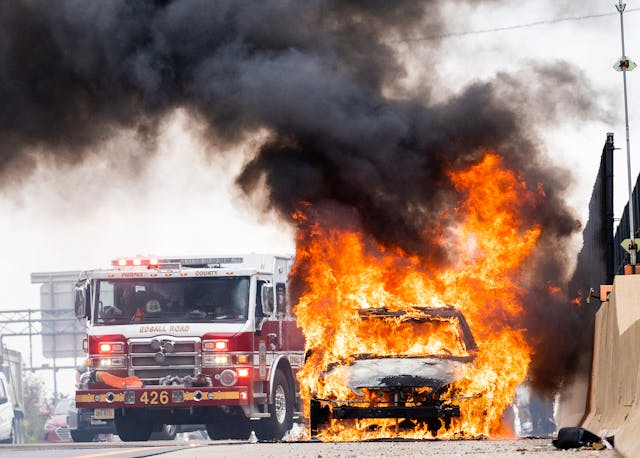
They didn’t make it. The car glanced off a concrete pillar and came apart, smearing itself down the right embankment. Burning shards and a wall of smoke dashed across the road.
It’s the classic Hollywood car-chase scene, through and through. All it’s missing is the single burning wheel rolling out of the wreckage.
It’s not clear who the driver of the other car was—presumably it was another of the Hamiltonians’ disposable henchmen—but what’s especially confusing about this scene is how Madison found out that Ed, Win and the gang were on his tail. He certainly doesn’t have a spy among the protagonists.
Also, this scene implies that Madison was aware they were coming for him, but that isn’t true. As subsequent events in this chapter will show, he has no idea what the good guys are planning and ends up being caught totally off guard. I’m sure Smith didn’t intend this reading, but it’s plausible that Madison actually had nothing to do with this encounter, and this is just a normal Tuesday morning commute in the NAC!
New reviews of The Probability Broach will go up every Friday on my Patreon page. Sign up to see new posts early and other bonus stuff!
Other posts in this series:
“But no. For all their selflessness in warning the NAC of its collective danger, the good guys got nothing whatsoever in return.”
Up until this point I’d thought Smith was a little nuts but clearly if Congress won’t act to save America’s heroes, he’s right! I am completely converted to anarcho-capitalism!
My interpretation of the road company cops is the same as yours: they’re protecting property, not people. Then again, you’d think security on the roads would be a selling point for people to drive them. Then again, who needs them in the law-abiding NAC where everyone packs a peacemaker?
Despite this, they don’t attempt to call 911, or whatever the local equivalent is, when they’re being shot at. Is it because the idea just didn’t occur to them in the heat of the moment, despite characters like Ed and Lucy being NAC natives?
I suspect a major reason for this is that libertarians like Smith believe, at some level of “thought,” that calling on Big Gummint for help means you’re a pussy. And Smith’s heroes are NOT PUSSIES GODDAMMIT!!! Libertarians don’t just hate government, they also hate anyone who needs, expects or thinks it’s a good idea for government to help them with something. Like most libertarian “ideas,” this is just a grownup-sounding version of a childish thought-pattern, in this case “tattletales are always bad!” Plus the laughable delusion that people who want government assistance are all a bunch of cowardly collectivist Lilliputians, desperately trying to tie down all the big brave Individualist Makers because they’re just terrified of all the wunnerful things the Makers would do if they were truly unleashed.
If anyone ever makes a movie of this rubbish, it would probably be rated “I” for “eyeroll.”
What if this is actually just revenge for them terrorizing a child’s birthday party?
“induction power for vehicles” – who built and paid for that? If it’s a for-profit company, how do they insure their customers are the only ones who can access it?
Adam, as you’ve covered Ayn Rand’s thoughts on art in The Fountainhead you might enjoy my post on objectivist comics creator Steve Ditko following in her wake: https://atomicjunkshop.com/steve-ditkos-final-concept-for-marvel-an-armored-objectivist-hero-called-iron-rand/
Oh lord, Ditko. One of the folks who, along with Kirby, really formalized a lot of the look of Marvel comics at the time, until he went too far off the deep end for the other people there. (This was a guy who not only refused to collect an award because awards were a way to distract artists into fighting each other instead of doing their best work, he berated the person who collected it on his behalf and insisted that they give it back. … Was that Colleen Doran? Need to look that up.)
Though I’d say you could make a good argument that Ditko did more to try to turn Objectivism into a coherent philosophy than Rand herself ever did.
(And I haven’t read your article yet, that was just from my own recollections. Ditko got weird in his later days.)
No, my mistake, it was Deni Loubert (founder of Renegade Press and Dave Sim’s ex-wife) who got told to give back the Comic-Con International Inkpot Award in 1987.
“I was an idiot!” Ed growled. “So busy watching Madison it never occurred to me he’d be watching us! Hold on!”
Hey, I agree with Ed. It’s stupid to think your opponent is just sitting around twiddling his thumbs, and not actively considering how to thwart you (even in this case, where up to now, Ed and gang have been self-thwarting in many ways). Ed should sue his author for making him pull such a silly move.
Some of this makes sense in this fight. At 300+ mph it’s highly unlikely that anybody will have time to intervene before the fight is over. Calling for help is too slow. Fragile vehicles at those speeds means the fights probably over in seconds. The villain using a flame thrower makes sense against a hovercraft also, it’s a good weapon to take out the skirt. Why they dropped into the road at all when they had a plane is strange but if they didn’t have any other weapon then it might be the only practical way to attack.
Considering the non-military vehicles and the lack of armor or armored windows there is no reason not to shoot at each other through the windows, no need to open a door.
Why are they still just armed with pistols at this point? This is a country where you can stop at a neighborhood store and buy some sub-machine guns, assault rifles and a sniper rifle, if not a rocket launcher.
For a near anarchy government they have a surprising number of well organized large scale systems that would have taken a fortune and some organizing body to get going.
It does seem strange that, in a world where anyone can buy any kind of weapon, we never see anyone in this book carrying or using a weapon larger than handgun size.
It’s cargo cult anarcho-capitalism! Ayn Rand did it too. They seem to believe that, even in a world with no government, all the state-funded infrastructure they’re used to would just magically appear whenever they’d need it.
“Also, this scene implies that Madison was aware they were coming for him, but that isn’t true. As subsequent events in this chapter will show, he has no idea what the good guys are planning and ends up being caught totally off guard. I’m sure Smith didn’t intend this reading, but it’s plausible that Madison actually had nothing to do with this encounter, and this is just a normal Tuesday morning commute in the NAC!”
Perhaps the Highly Independent henchmen (of the evil collectivist/authoritarian group, who would never have such things as discipline or communication systems) forgot to, or didn’t bother to notify their superiors/bosses/clients that Win and his friends were on their way. Though with the convenient level of (in)competence shown by Madison and his immediate henchmen so far, it’s possible the latter just never checked their messages.
So, I just had a memory of a detail of this 350+ mph car (hovercraft) chase/pistol fight. Win’s .41 Magnum appears to score hits on the bad guys’ vehicle, but with little effect. Ed passes him his own pistol, which apparently messes up the bad guys’ car so much that it goes careening off the road (or at least got through a bulletproof windshield that had stopped a .41 magnum, which is a pretty powerful pistol). This means Confederates are basically free range wandering around with hand cannons that in our world could probably stop some armored vehicles (Bradleys, not necessarily Abrams) in our world.
That doesn’t seem optimal, especially in a world where authority seems to come from plata y plomo, if you will.
Now I’m also remembering Lucy’s ancient /50 chasing away the bad guys’ hoverbuggy after Win’s .41 magnum did nothing to it in the early stages of the book. Who’s responsible for stray bullets and how do they figure out whose gun it was in a world where no one’s allowed to ask for any of your identifying information?
I’m starting to think this book might work better if you look at it as either:
*A cozy village mystery scaled up to global levels but written by an admirer of Ayn Rand, Robert Heinlein, and loose cannon police procedurals.
or
*A dystopian satire on what Mr. Smith seems to be actually writing earnestly, albeit a rather unsubtle one.
Given that Mr. Smith actually ran for President on the Libertarian ticket one year (he was on the ballot in Arizona instead of whoever the national candidate was due to a dispute between the local and national party), I’m going with earnest.
The funniest part is that a society capable of building a 355 mph automated highway apparently hasn’t figured out how to keep its passengers safe! And the possibility that Madison had nothing to do with the attack makes the whole thing even more absurd. Imagine surviving a high-speed gunfight only to discover it was just another Tuesday morning commute.