More bonus! Global Secular Council on Twitter shyly calls me a racist. I love this group!
Butterflies and Wheels
Gnu atheism, women's rights, internationalism, universalism, and gossip

More bonus! Global Secular Council on Twitter shyly calls me a racist. I love this group!
I was going to move on today, so as not to be a big mean ol’ bully to the Global Secular Council, but then I read yet another of its Twitter responses to me and found that moving on would not be possible.
It was alternating between rebuking me for judging them “by the color of their skin” and saying they are working hard on diversity. Well that’s unclear. What do they mean by “working hard on diversity” if it has nothing to do with “the color of their skin”? “Diversity” is simply a (very stale by now) buzzword used for the purpose of avoiding the mention of race (aka “skin color”) or sex or national origin etc etc. The Twitter account seemed to want to have it both ways – to sneer from a great height at talk of “skin color” while still patting itself on the back for “working on diversity.” (Then there’s a separate question of why it didn’t do this “working on diversity” before it went live instead of after – a question I also asked and got no real answer to.)
So I asked.
@SecularCouncil Which is it? You hate judging by skin or you work hard on diversity?
PZ takes a look at the Global Secular Council Debut and compares how that’s being run to how he and Ed thought about Freethought Blogs when they were setting it up.
Will they be effective? I looked at their Issues page, and it’s rather high-mindedly vague. For instance, one issue isInternational Human Rights. I’m glad they’re for ‘em, but after a scant 3 paragraphs that consist of platitudes, they present their summary:
POLICY RECOMMENDATION: The U.S. government should apply political pressure whenever possible to countries violating their international human rights obligations.
So, the Global Secular Council’s advice is that the US should do something about it?
Originally a comment on To I, to she, to he, to they
So, quite aside from anything else here (and FTR, I completely agree with you about this org): I’m sick of ‘ideological’ being a dirty word. Having a coherent, connected set of principles that inform how you think is not a bad thing. Having words and concepts and ways of understanding based on them that frame your politics at large is a good thing.
What’s clearer to me by the day (and one of the reasons my blog’s called Godlessness in Theory) is that the limp, illiterate brand of skepticism proffered by many of the GSC’s people, which prides itself on being ‘rational’ and ‘evidence-based’ at the loss of any context anywhere, is un-ideological to a fault.
When we regularly have to explain to you the value of philosophy and sociology, the best definitions of sex and race, the actual relevance of empire to the way we talk about religions (all secular in-fights from the past year) and countless other fundamental things… that’s not a sign you’re being a Tru Skeptic and resisting Orwellian brainwashing. It’s a sign you’re failing to think in enough depth.
This is the music Lauren played 3 minutes before each talk or panel was scheduled to start, as a signal to everyone to come in and sit down and be quiet.
Schoolhouse Rock: Women’s Suffrage Movement
And there’s their About page.
Every ideological movement has a policy center. Republicans have The Heritage Foundation, New Democrats have the Progressive Policy Institute, Libertarians have The Cato Institute, and Secularists have the Global Secular Council.
First, well, no. Ideological movements don’t usually have just one policy center. Also, not all participants in the movements take any one center to speak for them. Second, “ideological” is usually used as a weapon in this “movement” – feminists are constantly accused of importing an “ideology” into the crystalline purity of the atheist or skeptical “movement.” That’s complete bullshit, of course, but it’s still rather funny to see this group so cheerfully identifying itself with an ideology.
With these organizations as models, Global Secular Council is the international policy research and resource center for atheists, humanists, and other secularists who speak out for science and reason instead of religion and faith.
They’re adding stuff, the Top of Their Field geniuses at The Global Secular Council. We get to watch them add stuff.
They’ve added a page for something called The Bella & Stella Foundation, which has a link at the bottom of the Team page. It’s some sweet whimsy-whamsy so that we’ll know they don’t take themselves too seriously. (Right, because a few US/UK white guys declaring themselves a Global Council has no trace of taking themselves too seriously.)
Also…
Here’s how the left margin of their Twitter account looks.
 Oh really? My and our resource center for international policy? Really?
What makes it that? Who says it’s that? How can it possibly be that?
There’s not a trace of internationalism in their lineup. Not a whiff. There’s not one person who’s not pale, when internationally and globally, a lot more people are not pale than are pale. This joke of a “Global” council looks as if some twenty or thirty conceited Yanks and Brits have gotten together to reinvent the East India Company. I suppose Shermer wants to play the John Stuart Mill part, since Mill used to take his trousers off every day when he got to the office.
Oh I see the “Global” Secular Council (populated exclusively by Anglophones from the US and the UK plus one Swedish guy) has a Twitter account. I just replied to its “We’re live!” tweet by asking what makes them “Global”. I don’t suppose they’ll reply but I would really like to know.
But also interesting is that in that tweet they included the original of the front page masthead photo that we’ve been talking about. It’s different, and different in an interesting way.
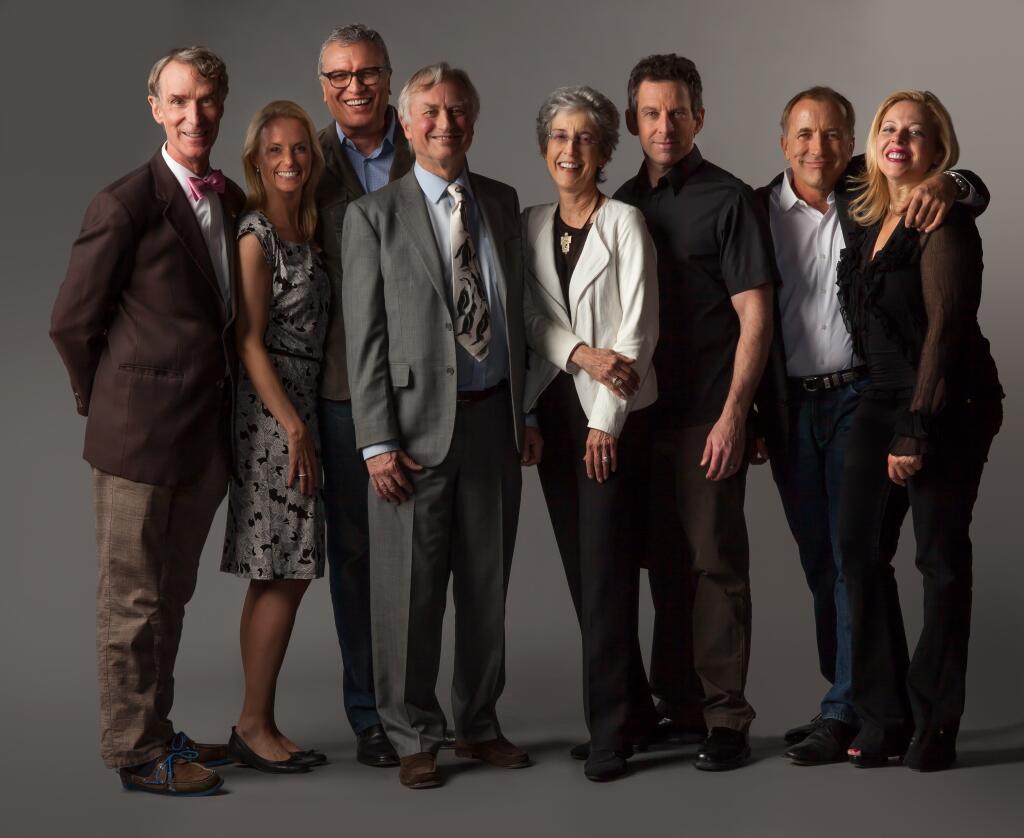
See there? On the opposite end from the Shermer-Rogers end, there’s Bill Nye – but apparently they like the Shermer grab so much that they feel it’s worth the price of not showing Bill Nye on the masthead. They want the first thing people see to be Shermer grabbing a woman and mugging like a frat boy, rather than Bill Nye not grabbing or mugging.
Strange choice.
Lots of people are talking about Laura Hudson’s article in Wired on how to curb online abuse. I liked this bit in particular:
Really, freedom of speech is beside the point. Facebook and Twitter want to be the locus of communities, but they seem to blanch at the notion that such communities would want to enforce norms—which, of course, are defined by shared values rather than by the outer limits of the law. Social networks could take a strong and meaningful stand against harassment simply by applying the same sort of standards in their online spaces that we already apply in our public and professional lives. That’s not a radical step; indeed, it’s literally a normal one. Wishing rape or other violence on women or using derogatory slurs, even as “jokes,” would never fly in most workplaces or communities, and those who engaged in such vitriol would be reprimanded or asked to leave. Why shouldn’t that be the response in our online lives?