All the President’s Bots

Trump appears cranky. It’s raining New Jersey, so he can’t golf work, which leaves him with no choice but to hate-watch CNN. Vets are angry with him, his policies are hurting his base, the polls have him at his lowest point since taking office, foreign diplomats view him as a clown, and he has nothing to show for his first six months.

He still has friends, though.

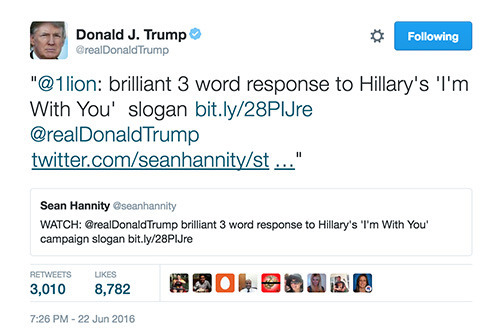
"@1lion: brilliant 3 word response to Hilary's 'I'm With You' slogan. @realDonaldTrump twitter.com/seanhannity/"Aww, at least one person likes Trump!

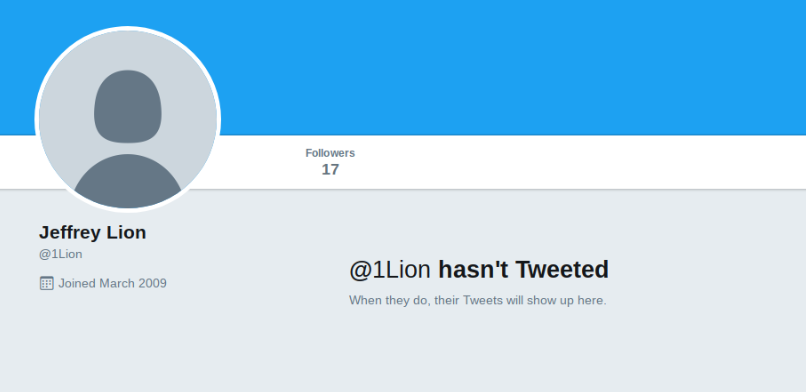
ilion on Twitter: STILL hasn't made a single Tweet.

… or maybe not? As an old Cracked article pointed out, Trump had a habit of quoting Tweets that didn’t exist, from people who just joined Twitter or were obvious bots. It was an easy way to make himself look more popular than he was, and stroke his ego. He put this to rest after winning the presidency, but that appears to be changing.

In a tweet on Saturday, President Donald Trump expressed thanks to Twitter user @Protrump45, an account that posted exclusively positive memes about the president. But the woman whose name was linked to the account told Heavy that her identity was stolen and that she planned to file a police report. The victim asserted that her identity was used to sell pro-Trump merchandise.

Although “Nicole Mincey” was the name displayed on the Twitter page, it was not the name used to create the account. The real name of the victim has been withheld to protect her privacy.

The @Protrump45 account also linked to the website Protrump45.com which specialized in Trump propaganda. All of the articles on the website were posted by other Twitter users, which also turned out to be fakes. Mashable noted that the accounts were suspected of being so-called “bots” used to spread propaganda about Trump. Russia has been accused of using similar tactics with bots during the 2016 campaign.

The “Nicole Mincey” scam was remarkably advanced, backed up by everything from paid articles pretending to be journalism to real-life announcers-for-hire singing her praises.

So the latest thing in the Trump resistance is bot-hunting. It’s pretty easy to do, once you’ve seen someone else do it, and the takedown procedure is also a breeze. It also silences a lot of Trump’s best friends.

If only we could do the same to Trump.

Faux Calls for Debate

Much has been written about that (sadly too common) “manifesto” from a Google employee. I’d chip in with a dissection of their claims about the biological capabilities of women, but I’ve already done so, multiple times. I also haven’t seen anyone bring up that women were essential to early computation, but again I’ve touched on that angle already.

So instead, I’ll settle for boosting one of the more interesting takes. Take it away, Dr. NerdLove.

This isn’t really about the memo itself but more in how people treat others, esp. other people who they fundamentally oppose.

First: the positioning oneself as being rational. In cases like this? It’s enshrining “This doesn’t affect me” as “value-neutral”.

It’s easy to say “This is is a topic that should be debated” when it’s not something that will touch you at all.

The superiority of Genesis vs Super Nintendo is a debate. EMACS vs [Vim] is a debate. Virtue of flat currency vs. fiat currency: debate.

“Your gender means that you’re biologically incapable of doing this job and should never have been hired” isn’t a fucking debate.

(Especially when it’s someone who doesn’t understand biology, gender roles, etc. saying this)

It’s easy for someone who has no skin in the game to say it should be “debated” because the outcome doesn’t affect them at *all*.

Let us also be real: this person doesn’t actually mean “debate”. Just as when eggs demand debate on Twitter, they don’t mean debate.

They aren’t asking for a structured discussion about whether someone has the biological capability to write code. They want to gish-gallop.

This isn’t going to be about changing minds or opinions. This is about playing to an audience and making enough noise to shut the others up.

This is why it’s so often framed as “if you won’t discuss this with me, your ideas are weak”. It’s about endurance and frustration.

In this case “whomever quits participating first” is framed as the “loser”. Not “there’s no point b/c this isn’t in good faith”.

These “debates” inevitably turn into goal-post shifts and fire-hose torrents of bullshit (gish-galloping) until the other person leaves.

Dr. NerdLove has more detail, but you get the basic gist: that manifesto isn’t calling for debate, any more than the creationists who make the same maneuver. This is about legitimizing a viewpoint that is illegit on its face, and hounding you until you pack up and leave. Don’t fall for it.

Sex Around the World

Oh, Jerry Coyne. I’m amused with his defense of a sex binary

In Drosophila and humans, the two species with which I’m most familiar, the behavior, appearance, and primary and secondary sex characteristics are determined almost completely by whether the chromosomal constitution is male (XY) or female (XX).

… since, like most such “scientific” defenses, he immediately turns around and shoots it in the foot.

Yes, there are a few exceptions, like AIS, but the various forms of that syndrome occur between 1 in every 20,000 to 1 in only 130,000 births.  Is that “too many examples” to all0w us to say that biological sex is not connected with chromosomes? If you look at all cases of intersexuality that occur in people with XX or XY chromosomes (we’re not counting XOs or XXYs or other cases of abnormal chromosomal number), the frequency of exceptions is far less than 1%. That means that, in humans as in flies, there is almost a complete correlation between primary/secondary sex characteristics and chromosome constitution.

Ah yes, chromosomes determine human sex except in the 0.05% to 1.7% of cases where they don’t. Brilliant logic, that.

But it’s easy to get trapped by your filter bubble. The internet is a lot bigger than North America, after all, and other places have their own view of sex. Take Sweden, for instance, where it’s  government policy to avoid teaching gender stereotypes. One kindergarten made headlines not too long ago by declaring itself “gender-neutral.” As the founder put it,

00:10:10,909 –> 00:11:03,329
I’m going to show you what we call the “whole life spectra.” We tend to divide this life spectra into two pieces, one for boys and one for girls. More often pink is for girls, and blue is for boys. When we call a boy “cool” and “strong,” and to girls we more often say that they should be “helpful,” “nice,” “cute,” we have different expectations [for how they behave]. We take away this border, and we don’t separate into “boyish” and “girlish,”  we give the whole life spectra to everyone. So we are not limiting, we are just adding. We are not changing the children, we are changing our own thoughts.

That video is worth watching, as it follows around two gender non-conforming kids with an intersex “ma-pa.” The few bigots on screen seem right out of 1984, claiming that expanding or eliminating gender stereotypes somehow constrains kids in some mysterious fashion. Every kid, in contrast, is either at ease with gender role fluidity or made uncomfortable when asked to label their gender.

But even Sweden appears behind the curve when contrasted with the Khawaja Sira of South Asia.

For centuries, South Asia has had its own Khawaja Sira or third gender culture. The community, identifying as neither male nor female, are believed by many to be “God’s chosen people,” with special powers to bless and curse anyone they choose. The acceptance of Khawaja Sira people in Pakistan has been held up internationally as a symbol of tolerance, established long before Europe and America had even the slightest semblance of a transgender rights movement.

But the acceptance of people defining their own gender in Pakistan is much more complicated. The term transgender refers to someone whose gender identify differs from their birth sex. This notion is yet to take root in Pakistan and the transgender rights movement is only beginning to assert itself formally. Now, some third gender people in Pakistan say the modern transgender identity is threatening their ancient third gender culture.

The problem is that the Khawaja Sira are allowed to exist within South Asian culture because they renounce both male and female gender roles, thus don’t challenge either. Trans* people, on the other hand, reject the role assigned to the Khawaja Sira and invoke the male or female one instead. This upsets every gender’s apple cart. It doesn’t help either that the Khawaja Sira in Pakistan have recently fallen onto hard times, facing increasing bigotry and hate; the increasing number of trans* people feels like an invasion of “Western” ideals, at a time when their community is ill-equipped to cope.

But do you remember hearing about Oyasiqur Rhaman, the atheist blogger murdered in Bangladesh? His murderers were outed by a courageous “hijra,” which is similar in meaning to “Khawaja Sira” but not quite the same.

Transgender people occupy an unusual social stratum in South Asia, where conservative societies still consider same-sex intercourse to be a crime but also allow the existence of a third gender — a well-established category that dates back to the age of the “Kama Sutra.” Nepal, Pakistan, Bangladesh and India have all legally recognized the existence of a third gender, including on passports and other official documents.

In India, in fact, “kinnar” freely mixes gender identity with non-binary sex. Compare and contrast this with Mexico’s “muxes,” who are called a third gender but in practice act more like trans* women, and Balkan sworn virgins who are more like trans* men. There’s no intersex component to the latter two, so lumping everybody under the banner of “third gender” or “transgender” is quite misleading.

Our binary view of sex and gender seem terribly archaic (which is ironic, as it may be a recent invention). It should not be controversial in North America to have a non-conforming parent or be raised in a genderless environment, yet it is. We could learn a thing or two from the rest of the world, especially when it comes to sex.

“Science Is Endangered by Statistical Misunderstanding”

He’s baaaaaack. I’ve linked to David Colquhoun’s previous paper on p-values,[1] but I’ve since learned he’s about to publish a sequel.

Despite decades of warnings, many areas of science still insist on labelling a result of P < 0.05 as “significant”.   This practice must account for a substantial part of the lack of reproducibility in some areas of science. And this is before you get to the many other well-known problems, like multiple comparisons, lack of randomisation and P-hacking. Science is endangered by statistical misunderstanding, and by university presidents and research funders who impose perverse incentives on scientists. [2]

[Read more…]

Transgender People, Sexuality, and Attraction

Shiv’s knocked it out of the park again. Her post is a long and thorough discussion of Laci Green‘s batshittery, and defies easy summation. Maybe this paragraph is representative of the whole?

Remember the earlier contrast between theory and practice when it comes to trans women’s bodies? Jones also does sex work. The primary audience for her porn is straight men. Jones has spent the past few weeks being inundated with abuse over the idea of anyone finding her attractive all the while people are shelling out cash for her sexualized pics and clips. Performative declarations about how unfuckable I am brush up against my reality, where I spend my weekends doing naked things that are illegal in many countries across the world (ifyouknowwhatimean). It’s two different conversations happening at the same time, and one of them looks–if you’ll pardon my French–fucking silly. “Ur ugly” is the discourse of children and playgrounds.

Hmmm, no. These two?

Hint number one that we’re dealing with an expression of prejudice: Green can’t decide who the subjects are, unless she’s suddenly started believing that (cis) lesbians and (cis) straight men are the same. Badly misapprehending Jones’ tweet would have at least supported her conclusion that trans women are trying to coerce straight men, but instead she comes out of left field by making it about (cis) lesbians. That she saw no contradiction in these premises suggests to me she is starting with her conclusion and working her way backwards.

Hint number two that we’re dealing with an expression of prejudice: Green uses “lesbian” as mutually exclusive with “trans YouTuber.” Neither cis lesbians that can be attracted to trans women, nor trans lesbians, exist. Apparently.

Nope, that’s worse. Tell you what, just read the thing. It’ll make you reflect on your views of attraction and sexuality, most likely, and that alone is worth it.

P-values are Bullshit, 1942 edition

I keep an eye out for old criticisms of null hypothesis significance testing. There’s just something fascinating about reading this…

In this paper, I wish to examine a dogma of inferential procedure which, for psychologists at least, has attained the status of a religious conviction. The dogma to be scrutinized is the “null-hypothesis significance test” orthodoxy that passing statistical judgment on a scientific hypothesis by means of experimental observation is a decision procedure wherein one rejects or accepts a null hypothesis according to whether or not the value of a sample statistic yielded by an experiment falls within a certain predetermined “rejection region” of its possible values. The thesis to be advanced is that despite the awesome pre-eminence this method has attained in our experimental journals and textbooks of applied statistics, it is based upon a fundamental misunderstanding of the nature of rational inference, and is seldom if ever appropriate to the aims of scientific research. This is not a particularly original view—traditional null-hypothesis procedure has already been superceded in modern statistical theory by a variety of more satisfactory inferential techniques. But the perceptual defenses of psychologists are particularly efficient when dealing with matters of methodology, and so the statistical folkways of a more primitive past continue to dominate the local scene.[1]

… then realising it dates from 1960. So far I’ve spotted five waves of criticism: Jerzy Neyman and Egon Peterson head the first, dating from roughly 1928 to 1945; a number of authors such as the above-quoted Rozeboom formed a second wave between roughly 1960 and 1970; Jacob Cohen kicked off a third wave around 1990, which maybe lasted until his death in 1998; John Ioannidis spearheaded another wave in 2005, though this died out even quicker; and finally the “replication crisis” that kicked off in 2011 and is still ongoing as I type this.

I do like to search for papers outside of those waves, however, just to verify the partition. This one doesn’t qualify, but it’s pretty cool nonetheless.

Berkson, Joseph. “Tests of Significance Considered as Evidence.” Journal of the American Statistical Association 1942;37:325-35. International Journal of Epidemiology, vol. 32, no. 5, 2003, pp. 687.

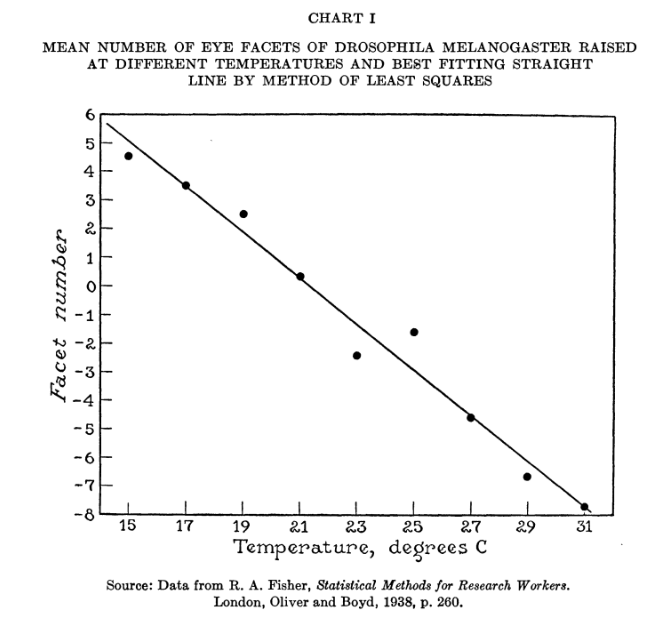
For instance, they point to a specific example drawn from Ronald Fisher himself. The latter delves into a chart of eye facet frequency in Drosophila melanogaster, at various temperatures, and extracts some means. Conducting an ANOVA test, Fisher states “deviations from linear regression are evidently larger than would be expected, if the regression were really linear, from the variations within the arrays,” then concludes “There can therefore be no question of the statistical significance of the deviations from the straight line.”

Berkson’s response is to graph the dataset.eye facets vs. temperature, Drosophila Melangaster, graphed and fit to a line. From Fisher (1938).

The middle points look like outliers, but it’s pretty obvious we’re dealing with a linear relationship. That Fisher’s tests reject linearity is a blow against using them.

Jacob Cohen made a very strong argument against Fisherian frequentism in 1994, the “permanent illusion,” which he attributes to a paper by Gerd Gigerenzer in 1993.[3][4] I can’t find any evidence Gigerenzer actually named it that, but it doesn’t matter; Berkson scoops both of them by a whopping 51 years, then extends the argument.

Suppose I said, “Albinos are very rare in human populations, only one in fifty thousand. Therefore, if you have taken a random sample of 100 from a population and found in it an albino, the population is not human.” This is a similar argument but if it were given, I believe the rational retort would be, “If the population is not human, what is it?” A question would be asked that demands an affirmative answer. In the hull hypothesis schema we are trying only to nullify something: “The null hypothesis is never proved or established but is possibly disproved in the course of experimentation.” But ordinarily evidence does not take this form. With the corpus delicti in front of you, you do not say, “Here is evidence against the hypothesis that no one is dead.” You say, “Evidently someone has been murdered.”[5]

This hints at Berkson’s way out of the p-value mess: ditch falsification and allow evidence in favour of hypotheses. They point to another example or two to shore up their case, but can’t extend this intuition to a mathematical description of how this would work with p-values. A pity, but it was for the best.


[1] Rozeboom, William W. “The fallacy of the null-hypothesis significance test.” Psychological bulletin 57.5 (1960): 416.

[2] Berkson, Joseph. “Tests of Significance Considered as Evidence.” Journal of the American Statistical Association 1942;37:325-35. International Journal of Epidemiology, vol. 32, no. 5, 2003, pp. 687.

[3] Cohen, Jacob. “The Earth is Round (p < .05).” American Psychologist, vol. 49, no. 12, 1994, pp. 997-1003.

[4] Gigerenzer, Gerd. “The superego, the ego, and the id in statistical reasoning.” A handbook for data analysis in the behavioral sciences: Methodological issues (1993): 311-339.

[5] Berkson (1942), pg. 326.

A Flurry of Science

“Think about being able to do all these experiments on the ground, from airplanes, from balloons, with citizen scientists. It’s pretty breathtaking,” said Lika Guhathakurta, an astrophysicist at NASA. Guhathakurta will shepherd dozens of scientific projects on Aug. 21, including polarized images of the corona, which help scientists measure its temperature; measurements of Earth’s ionosphere — the charged layer of the atmosphere that gives us auroras; spatial disturbances in the atmosphere caused by heat changes; and a whole lot more. (You can get involved, too. With an app called GLOBE Observer and a thermometer, you can collect data during the eclipse and submit it to NASA. And Google and the University of California, Berkeley, are asking for video and images, which they’ll stitch together into an “Eclipse Megamovie.”) Other scientists will be studying animals — creatures as small as grasshoppers and as big as hippos have been documented reacting to eclipses — and us, too. Humans are sure to have a wide range of responses, as we have since time immemorial.

I’ll admit, this comes as a bit of a shock to me. I thought that coronagraphs permitted really good science provided a scientist could grab some funding. Not so, though.

… coronagraphs usually block more of the sun than astronomers would like. Typically, a coronagraph covers an area around 1.4 times the radius of the sun, obscuring arguably the most important region — the one closest to the sun’s surface.

“That is sort of the missing link, the region where space weather is formed, where the corona gets heated, where the solar wind gets accelerated. … So that’s where we want observations to be pristine,” Guhathakurta said.

Which means that my US readers have an excellent opportunity to do some citizen science in exactly three weeks (well, 21 days and 11 minutes from when I post this). In addition to the above links, Space.com has a good rundown of how to safely observe the eclipse and NASA has tonnes more charts and info.

And remember, a solar eclipse was once considered a bad omen for a king or ruler.

William Browder and the Magnitsky Act

While a fair number of people have contributed to Pharyngula’s “Political Madness” thread, one of the top contributors is Salty Current.

I watched Bill Browder’s Senate testimony live the other day. Here’s the link to the recording.

This one is better, actually, but if you follow either link you’ll be treated to a nearly two-hour Congressional hearing featuring William Browder, who learned about corruption at the Kremlin the hard way.

In June of 2007 my Moscow office was raided by 25 officers from the Moscow Interior ministry…. I hired the smartest man I knew, a young man named Sergei Magnitsky… , to investigate who did what and how we could stop them. … he came back with an astounding conclusion… the purpose of stealing our companies was to try and steal our assets, which they didn’t succeed in doing, however they did succeed in stealing 230 million dollars in taxes to the Russian government, from the Russian government.

Magnitsky was arrested by the high-ranking officials, and tortured in jail for much of a year. This included denying or ignoring 20 requests for medical attention to take care of pancreatitis, which left him screaming in pain. Magnitsky was eventually moved to a jail with medical facilities, but (according to Browder) was instead beaten with batons until death. Faced with a government that gave state honours to the people involved, Browder successfully lobbied for the Magnitsky Act in the United States.

That’s just the beginning of the testimony, though. Browder goes on to discuss various murders, Natalia Veselnitskaya‘s role in all this, and the depths of corruption within the Kremlin. It’s riveting stuff, and worth the watch. Can’t watch? Don’t worry, they have a rough transcript below the video. Some of the highlights I plucked from it:

  • “There’s no such thing as a former FSB agent, it’s a lifetime commitment.”
  • Fusion GPS, which hired Christopher Steele to compile that infamous dossier, is claimed to have been indirectly hired by the Kremlin to spread lies about Browder. They deny it, but if Browder is correct then it suggests that dossier was commissioned by the Kremlin so they could discredit or blackmail Trump should they have the need.
  • “Nobody was talking about adoptions, they were talking about the repeal of sanctions so that Russian torturers and murderers could freely travel and keep their money in America.”
  • The Panama Papers contain a treasure trove of information about Russian connections, one of which involves a cellist worth 2 billion dollars.
  • Brower believes that by muscling oligarchs, Vladimir Putin was able to skim off 50% of their transactions for himself and become the richest person in the world.

And there’s a lot more where that came from.

Dead Again

The Senate on Friday rejected a new, scaled-down Republican plan to repeal parts of the Affordable Care Act, seemingly derailing the Republicans’ seven-year campaign to dismantle the health care law.

Senator John McCain, Republican of Arizona, cast the decisive vote to defeat the proposal, joining two other Republicans, Susan Collins of Maine and Lisa Murkowski of Alaska, in opposing it.

The 49-to-51 vote was a huge setback for the majority leader, Mitch McConnell of Kentucky, who has spent the last three months trying to devise a repeal bill that could win support from members of his caucus.

The truncated Republican plan was far less than what Republicans once envisioned. Republican leaders, unable to overcome complaints from both moderate and conservative members of their caucus, said the skeletal plan was just a vehicle to permit negotiations with the House, which passed a much more ambitious repeal bill in early May.

I’ve been following this vote closely, and it looked like a sure pass right up until they were scheduled to vote. McCain may have flipped back thanks to pressure from the Arizona governor. Whatever the case, McConnell has said it is time to move on and signalled he was willing to work with Democrats, to which Schumer agreed.

Breath easy, USians. Your health care system is safe for the moment. Well, safe-ish.