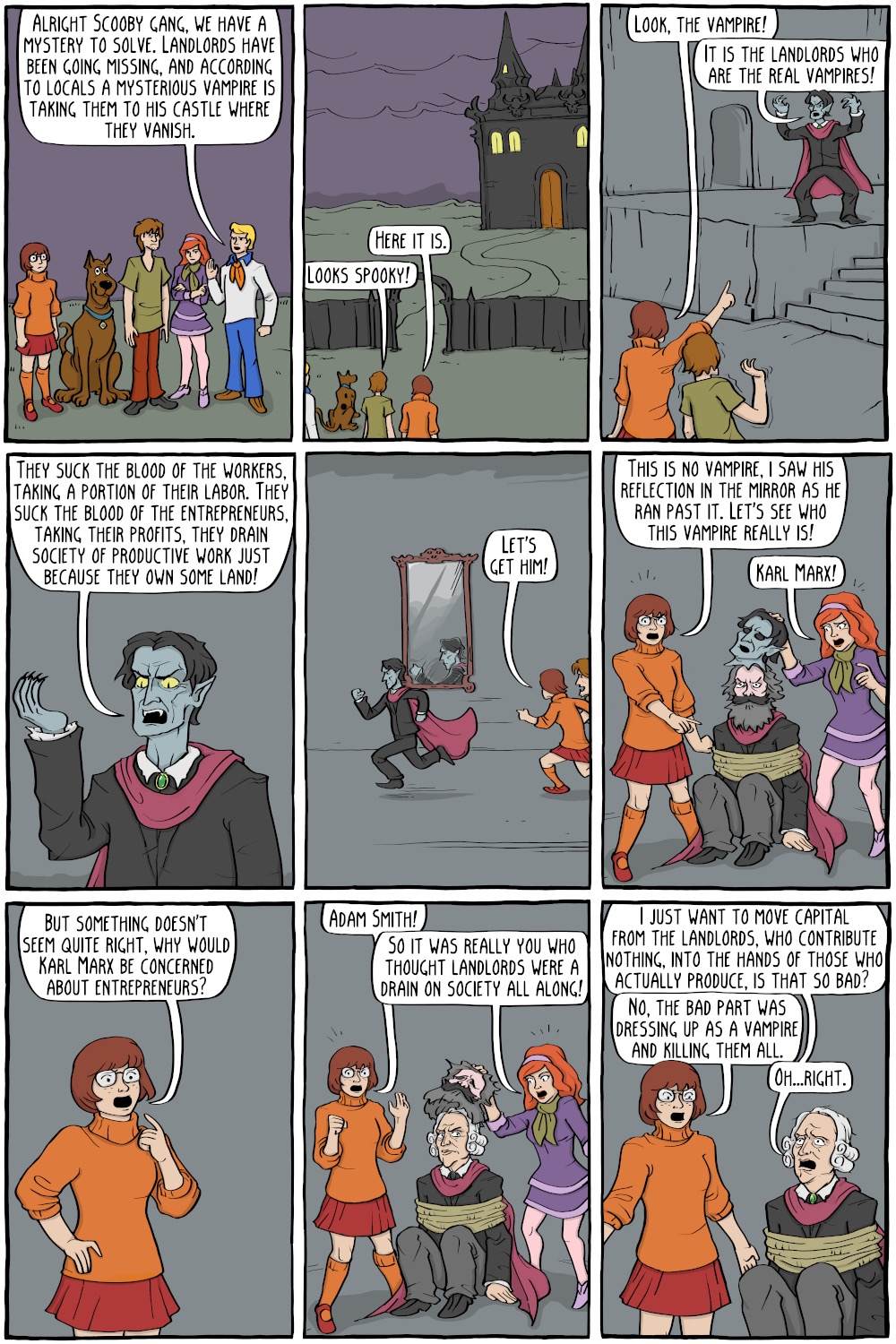
Jinkies!

Be sure to read the explanatory text on the site: “One of the large motivations for Adam Smith writing The Wealth of Nations was to convince people to try to move capital away from the unproductive landlords (who at that time were mostly comprised of very wealthy landed English gentry) into the hands of entrepreneurs and workers.” and “In short, when someone tells you that you are a dirty communist for saying landlords contribute nothing and merely drain society, remind them that the idea came first from Adam Smith.”

Please, someone use this to make Republicans go all head-explodey.

Welcome to real skepticism

Some anonymous guy wrote a popular blog post in which they proposed a radical new idea that the real mechanism of SARS-CoV-2 action was that the virus invaded red blood cells, displaced iron from the heme group in hemoglobin, and thereby both reduced the O2 carrying capacity of blood cells, and released large amounts of toxic iron. They had no expertise in medicine, molecular biology, or epidemiology, and their hypothesis was total bollocking nonsense. The post has since been taken down.

Now there is a thorough post up that utterly demolishes the original claim. I’m not a fan of the hyperbole of saying someone was “destroyed” by a blog post, but in this case, the word applies. The author is an MD/PhD with a specialization in the molecular biology of mammalian heme globins, and he tears into the claims at every level and burns them to the ground. It’s wonderfully entertaining, if you enjoy good science and despise quacks.

His conclusion also brings up a very good question: why do people promote pseudoscience?

The above discussion is by no means an exhaustive list of the blog post’s incorrect statements or conclusions. Nonetheless, I hope it has been sufficient to make clear that the blog post, and even the scientific article that likely inspired it, should not be viewed as a source of any meaningful insight into SARS-CoV-2, how it affects patients, or how the virus might be treated. What I still don’t know is why the blog post author, under a pseudonym, chose to present such an incorrect description of this disease and the underlying pathophysiology with such confidence. That they would go so far as to suggest treatments for the disease despite a lack of any medical training, and in virtually the same paragraph condemn “armchair pseudo-physicians” who push incorrect information, is truly mind-boggling. Tragically, whether it arises from genuine malice, unfounded arrogance, or just simple ignorance, this sort of misinformation about a deadly pandemic can genuinely put lives at risk, and it’s up to those of us who work in this field to fight back against it in whatever way we can.

I wish I understood this phenomenon myself. It comes up all the time in evolution debates — some clown makes grand, sweeping statements dismissing evolutionary biology, and when he gets quizzed on the subject, it becomes rapidly apparent that they know nothing about the subject, and their colon is packed with so much misinformation it’s backing up their throat and dribbling out their ears. Yet somehow the frauds get all the acclaim, get paid well, and bring in adoring mobs of followers who love to see the experts get dissed…oh wait. I think I might have just answered my own question. It’s all money and ego.

Note: there are also skeptics who are all about the money and ego. I’ve known a few.

Watch party on 30 April!

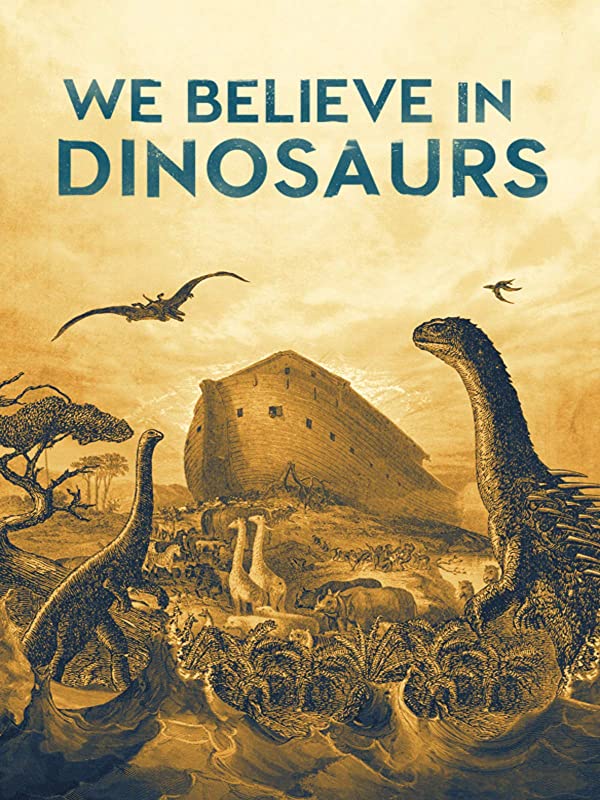
Mark your calendars — the makers of We Believe in Dinosaurs are hosting a watch party of their movie on 30 April. What that means is…

  • Sign up for a seat at the link. You’ll be sent a Zoom URL so you can join a group of people online.
  • Get a copy of the movie on your streaming service. It’s $3.99 on Amazon.

  • On 30 April, before 7pm, make popcorn, log in to zoom, get your movie queued up.

  • Precisely at 7, hit play, watch the movie and listen to commentary from the makers.

  • You can, I presume, use the chat feature to make text comments of your own.

If you’re wondering what the movie is about, it’s a documentary about Answers in Genesis’s Ark Encounter. He’d rather nobody saw it, so you’ll get the bonus thrill of pissing off Ken Ham.

Do economists have even more hubris than physicists?

It’s hard to believe, but it’s a valid question. Tyler Cowen demonstrates his arrogance by questioning the validity of epidemiology, and he asks a series of stupid questions that show how little thought he has put into the subject.

a. As a class of scientists, how much are epidemiologists paid? Is good or bad news better for their salaries?

You know, there’s this thing called “Google” which economists apparently haven’t heard about yet. If you look it up, it turns out that epidemiologists work in public health — which should already tell you they don’t get absurdly rich at this job — and they make on average about $69K per year. I would ask what the point of the question is. Does their salary say something about the accuracy of their conclusions? Because, near as I can tell, salaries under capitalism have nothing to do with intellectual rigor.

The employment of epidemiologists is not contingent on whether their results are good news or bad news, but on the quality and accuracy of their work. Why? Is it different for economists?

b. How smart are they? What are their average GRE scores?

Holy shit. Cowen reveals his own ignorant biases there.

Epidemiology requires solid skills in statistics and biology, neither of which are exactly easy-peasy topics. Their GRE scores were good enough to get them into demanding academic programs. There aren’t any shortcuts.

c. Are they hired into thick, liquid academic and institutional markets? And how meritocratic are those markets?

“Thick, liquid”? That sounds like economics jargon. I have no idea what he’s talking about, and I won’t pretend to know, unlike some.

I can say that academia is only loosely meritocratic. There are a lot of built-in cultural biases that mean we get some incompetent people, and some brilliant people get excluded. The question ought to be whether epidemiology is more or less meritocratic than economics. The evidence here says “more”.

d. What is their overall track record on predictions, whether before or during this crisis?

Crack an epidemiology textbook. There are a lot of variables and a lot of case studies. Unlike in economics, failed models tend to be rapidly discarded.

e. On average, what is the political orientation of epidemiologists? And compared to other academics? Which social welfare function do they use when they make non-trivial recommendations?

Fuck me. Like most educated academics, they probably skew liberal and Democratic. Their recommendations favor maximizing public health and minimizing death and illness. That’s their job. Economists seem to be much more twisted by flaky ideological concerns.

He has more questions, but I’ve had enough. What a chuzzlewit.

Vote for the lesser of two dotards

I agree with Rebecca. She’s voting for Biden because he’s somewhat better than Trump, but does not think that imposes an obligation on others to do likewise.

I’m making no predictions on the outcome of the November election. I know people are apathetic about voting at all, and are going to skip the election because they cannot bear to vote for a man who sexually assaults women, and that might depress Democratic turnout. On the other hand, Trump is such an egregious incompetent that maybe we could nominate an old stick and it would win. On the next hand over, on the basis of incompetence Trump should have been crushed in the last election; right now he’s busy fanning the flames of fear and xenophobia, and his party is engaging in widespread voter suppression, so maybe he’ll win. The president is not the product of a process that optimizes for the best person to do the job at all.

I don’t know what other people will do. My plan is to unenthusiastically vote for whoever runs against Trump, to hope they make a smart choice for the VP, and to hope Biden is at best a one-term president.

Provided with toys and spider scouting for boys

I wanted to get out and get some exercise today, and also see how the local spider populations are doing. It was not a great outing — the horticulture garden is closed, as is Pomme de Terre park, so the usual haunts where I can go for a nice long walk and see lots of varieties of habitats were inaccessible. I finally ended up at East Side Park, a small central city park, mostly mowed grass, kiddie play structures, and an assortment of picnic tables. Not the best sort of place for wild spiders. Also, it’s been a bit neglected during the pandemic. I saw lots of broken glass (someone snuck out there with the cooking sherry, I noticed), so not entirely the best place for kids right now.

I needed the exercise. I found I’m out of shape from my winter’s languor. I was either in a half crouch, stooped over, or standing on tip-toe holding up my camera, in order to take these photos, and I was trembling after 10 minutes, so I’d just aim and take a dozen photos hoping one of them would be usable.

The park does have a big ol’ band shell, though, and I crawled around that for a while and found 4 different species without looking too hard. It’s a rather grungy structure right now, needing a good power wash, and I found lots of webs clotted with dead insects, especially mosquitos, draped all over the walls. Most of them looked ancient, probably from last summer.

But there were a few new spiders living there! I found 4 species on the side of this one building and you can see the photos on Patreon and also on Instagram and under the #InverteFest tag and the Spiders of Minnesota page. I’m not hiding them, I’m just trying to avoid sticking spiders in the faces of arachnophobes here.