I think I missed a good critique of evolutionary psychology

I must have been taking a nap a couple of years ago. I just found this interesting discussion of EP by a psychologist, and I agree very much with it.

Evolutionary psychologists believe that the human mind works much like the body… that it is an information-processing system, with pre-specified psychological programs (or environmentally-triggered ones), adapted much like the rest of the body, to meet specific problems in our evolutionary past. Others, including myself, disagree with this definition of the human mind. While I would certainly agree that evolution had a profound role in shaping lower-level modular systems, including autonomic nervous system responses, reflex arcs, immune systems, complex motor control, systems related to sexual arousal, and so on, it does not make sense for us to assume that our more complex social behaviors were shaped in the same way, or that they would even depend on lower-level domain-specific systems that evolutionary psychologists so frequently assume to be the ‘ultimate’ causes of behavior. Neurobiologists Panksepp and Panksepp point out that while evolutionary psychologists may interpret psychological data in a way to fit with their preferred theory, the philosophical assumptions that are the foundation of that theory are not at all consistent with what we know about human neurophysiology.

[Read more…]

Friday Cephalopod: This is not a mammalian eye and brain

This is an octopus eye:

Octopus-Eye

This is an octopus brain:

octopusbrain

I have to point this out because the creationist Eric Metaxas said a remarkable thing:

But the octopus isn’t the only such miracle. “Convergent evolution” is all over nature, from powered flight evolving three times to each continent having its own version of the anteater. Think about that. As one delightfully un-self-conscious “Science Today” cover put it, convergent evolution is “nature discover[ing] the same design over and over.” Well, good for nature!

But as Luskin argues, there’s a better explanation for a tentacled mollusk having a mammal’s brain and human eyes. And that explanation is common design by an intelligent Engineer. And like all good engineers, this this one reused some of His best designs.

Umm, the octopus has a retina with the photoreceptors on the inner face, unlike mammalian retinae that have the photoreceptors on the side away from the light. The octopus has no blind spot, and the axons of the eye emerge all over the back of the eye; mammalian axons have to traverse the inside of the eye and exit at a spot with no photoreceptors. The visual receptors of the octopus use the rhabodmeric transduction pathway, and mammalian photoreceptors use the ciliary pathway.

What kind of ignoramus would suggest that the octopus has human-like eyes?

Maybe the kind with a small central ganglion wrapped around their esophagus? Nah, that’s an insult to molluscs.

Have I become an unwitting accomplice in the Rupert Murdoch machine?

I was horrified to learn that Rupert Murdoch had bought a controlling interest in that venerable institution, National Geographic. Jennifer Ouellette explains why this is such bad news.

What does Murdoch get for his $725 million? Under the terms of the deal, Fox owns 73% of the fledgling NPG, with the National Geographic Society controlling 27%. That’s…. a little worrying, despite the fact that each partner will have equal representation on the board and governance will be shared equally between them.

It didn’t take long for people to start voicing concern. Among other things, Murdoch is on the record as a hardcore denier of the fact that humans are causing climate change. Sure, he’ll insist he’s really more of a “climate change skeptic,” and not an outright “denier.” But he’s not fooling anybody, especially when he says stuff like this:

Climate change has been going on as long as the planet is here… How much of it are we doing, with emissions and so on? As far as Australia goes? Nothing in the overall picture.

Naturally there is some concern that Murdoch and his minions might be tempted to put pressure on the magazine regarding its editorial coverage, particularly on politically controversial issues like climate change. On that score, National Geographic editor-in-chief Susan Goldberg is toeing the party line, at least in her public statements. She says she thinks the deal will be “great for the magazine” and insists she’s been assured that 21st Century Fox will not interfere with the magazine’s content. Fox CEO James Murdoch and National Geographic Society chief executive Gary Knell both echoed that sentiment, swearing that there had never been interference with the content of the TV channels and the same would be true of the magazine.

[Read more…]

And now for an important philosophical question

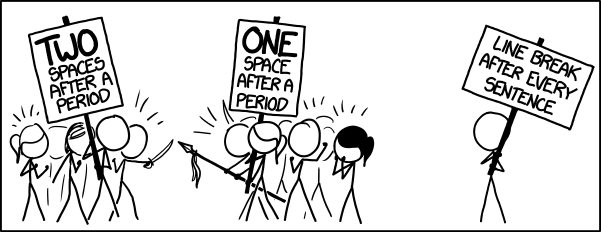
Should you use one space after a period, or two? I learned to type in the 1970s, on a manual typewriter, and our instructor was adamant that you must always press the spacebar twice at the end of sentence.

Fortunately, I learned the error of my ways in the 1980s (after I finished my Ph.D. thesis, which was printed on a monospaced daisy wheel clunker of a printer, and has double spaces everywhere): You may only use one space to separate sentences, or your readers will all scream and tear their eyeballs out, and bleed all over your copy.

There will be no argument on this matter.

Longer and wronger

I quite annoyed one of the authors of that “Kill All The Predators argument, who butted heads with me on Twitter and told me I had to go read this longer essay by Jeff McMahan which would address all my objections, because philosophers all seem to think that if they can babble long enough, they’ll ultimately be persuasive. Spoiler alert: it just made the problems with their idea wordier.

In particular, I was told to read section 3 and 4, which deal with objections to their argument. So I’ll just address that bit here, because I think their defense is dead with the second sentence.

[Read more…]

I am horrified at what goes on in philosophy departments, personally

predator

A couple of vegetarian philosophers with no knowledge of biology are alarmed…no, horrified at what’s going on out there in the wilderness.

The animal welfare conversation has generally centered on human-caused animal suffering and human-caused animal deaths. But we’re not the only ones who hunt and kill. It is true (and terrible) that an estimated 20 billion chickens were born into captivity in 2013 alone, many of whom live in terrible conditions in factory farms. But there are estimated 60 billion land birds and over 100 billion land mammals living in the wild. Who is working to alleviate their suffering? As the philosopher Jeff McMahan writes: “Wherever there is animal life, predators are stalking, chasing, capturing, killing, and devouring their prey. Agonized suffering and violent death are ubiquitous and continuous.”

They have a solution to this problem, though. We should humanely execute all predators. It’s the most ethical solution!

[Read more…]

Has the media no shame?

A terrible Rolling Stone interview of Trump really can’t get past the superficial crap: he’s rich. He’s number one in the polls. He’s gonna go all the way. The interviewer seems to have absorbed Trump’s perspective with all the exposure. It really needed a reporter who’d point out the problems with a political class defined by wealth, the media’s childish infatuation with poll position, and that coasting on gas and bluster isn’t substantive. But this is what we’ve got, and even in this tedious paint-by-numbers review, the full Trump ghastliness can’t help but erupt outwards.

When the anchor throws to Carly Fiorina for her reaction to Trump’s momentum, Trump’s expression sours in schoolboy disgust as the camera bores in on Fiorina. Look at that face! he cries. Would anyone vote for that? Can you imagine that, the face of our next president?! The laughter grows halting and faint behind him. I mean, she’s a woman, and I’m not s’posedta say bad things, but really, folks, come on. Are we serious?

No, we’re not serious. The fact that a loud, crass, profoundly stupid clown like Donald Trump is dominating the election news says that politics and the media in this country are not serious at all.

Homo naledi

I got up all bleary-eyed this morning, and before I got my first sip of coffee, the first thing I saw, blasted across Twitter and all the popular news sites, was the news that a new species of human, Homo naledi has been discovered in South Africa. They have the partial skeletons of 15 different individuals, over 1500 bones, all recovered from a single cave. They’re calling it a new and unique species, and further, they’re claiming that the site is a ritual burial chamber.

Whoa. Brain is whirling. This thing is all over the net, over night. Better drink more coffee.

OK, that’s better.

I’m a little put off by the abrupt and sensationalist appearance in pop news sites, but here’s the science paper. It’s published in eLife, an interesting journal I’ve written about before. It’s peer-reviewed, the lead authors have a respectable reputation, and it looks legit. It’s a real discovery: a cache of bones in a very difficult-to-reach, sheltered site. One of the fascinating bits of the story is that the cave is so inaccessible, reached through such narrow crevices, that all the bones were recovered by a team of women who were small enough to fit.

naledisite

No matter what, this is an impressive and exciting discovery. A whole small population of individuals, all found in one place? There are years of analysis waiting to be done. Here’s the holotype and the large collection of bones used in the first publication. Homo naledi is a small-brained, bipedal hominin, that’s for sure.

nalediholotype

Now for my reservations.

  • The researchers haven’t yet dated the specimens! We don’t even have a guess! That’s how preliminary this publication is. I can sort of understand wanting to get an exciting find like this published as soon as possible, but I have no idea where to place this species in the family tree now. Is it 3 million years old, or 300 thousand?

  • It’s been labeled as a new species, but is it? I’m not an expert on human evolution by any means, but it looks like it fits within the parameters of Homo erectus, and the authors note its close resemblance to H. erectus, but also insist that there are small, unique features to the skull. I’d want to see more input from other experts. It’s always tempting to slap a new species name on a new specimen, but I’d be just as thrilled if this turned out to be a comprehensive assemblage of a H. erectus group.

  • The news stories are all speculating that this is a ritual burial site, suggesting that our ancestors had certain cultural practices long before we expected. We can’t say anything about the timing, because we don’t know how old the site is! But there are some suggestive details. The cave is extremely hard to access (although we don’t know anything about accessibility when the cave was in use), and most interestingly, only H. naledi bones are found in the cave. That suggests it was not simply a rubbish pit, or that animal remains naturally washed into it. Ritual burial seems like a good explanation, except that these people had brains the size of an orange.

Most of the coverage right now seems gushing and uncritical, but I recommend the article in the Guardian, which has a good balance of enthusiasm and skepticism. I think it’s a great day for the science of human evolution, but the full details are going to take much longer and much more work to emerge. I’m looking forward to further reports. The world had better fund more anthropology/paleontology research so I don’t have to be kept waiting!