Signs of Spring (spider edition)

It’s an unboxing video! I hear those are popular. Only what I’m unboxing is a pair of spider egg cases.

Spoiler: I don’t find any spiderlings inside. I find evidence of them being there, in bits of molted cuticles, but nothing was moving. I’ll let them warm up for a few days and look again.

If you want to know more about how spiders overwinter, here’s a source:

Tanaka K (1997) Evolutionary Relationship between Diapause and Cold Hardiness in the House Spider, Achaearanea tepidariorum (Araneae: Theridiidae). Journal of Insect Physiology 43(3):271-274.

The relationship between diapause and cold hardiness of the house spider, Achaearanea tepidariorum, differed geographically. In a cool-temperate population, enhanced chilling tolerance and supercooling ability were observed in diapause individuals, whereas a subtropical population showed only chilling tolerance. Because this spider is considered to be of tropical origin, it would follow that the ancestral diapause of this spider was equipped with chilling tolerance, but not with an increased supercooling ability. It seems that the ability to lower the supercooling point evolved through natural selection in the course of expansion of this species to the northern climates.

Now I have an excuse to visit Florida on a collecting trip, to gather representatives of southern populations. Maybe I should go in, like, February.

One other thought I had about the barrenness of these egg cases: it’s like the Donner expedition. Maybe one of the ways spiderlings survive the long cold winter is by eating their siblings, and this winter was particularly harsh.

Discovery Channel is evolving into the Men’s Pulp channel

Several years ago, the Discovery Channel had this successful promotion featuring people singing “boom de yada” while doing awesome sciencey things, mostly. They were also promoting shows about fishing and blowing things up, but OK, it was sweet and memorable. It also featured brief clips of women doing things.

I guess they tried to repeat the success this year, only they forgot someone.

OK, all the stuff about manly men cleaning crab and driving cars and blowing stuff up again is…well, all right, it’s a way to get people interested in science, at least, even if it is only tangentially related to science. I try to be open-minded about approaches to stirring up enthusiasm for science. But it’s all men doing stereotypically masculine activities — there is precisely one woman in the whole thing, she doesn’t speak, she’s wearing skimpy clothing in a long shot as she walks through a forest. That’s it!

Come on, Discovery Channel. I know actual intellectual, thoughtful content isn’t on brand for you, but could you at least have a woman blowing up a truck while swimming with a shark or something?

It reminds me of all those men’s magazines from the 1960s which showed men in dangerous situations (everything in Nature is trying to kill you, you know, even turtles, and your role is to fight them off to rescue Your Woman). Discovery Channel is regressing. Maybe they should rename themselves the Saga or Argosy or True Men channel.

Tucker Carlson is simply a dumb, sexist bully

I got glasses in high school. It was great — I still remember marveling at all the things I could see. Apparently, objects 10 feet away from you aren’t supposed to be blurry. I also remember the school bullies having a blast laughing at ol’ four eyes, who was clearly a nerd now, with the final signifier in place.

Smarmy, sneering Tucker Carlson reminded me so much of those chickenshit bullies. He recently went on air to mock Chris Hayes for wearing glasses, which was a symptom now of being a feminist. Further, he spoke contemptuously of Alexandria Ocasio-Cortez, a woman and “29 year old former bartender” who dared to talk about science. Chris Hayes is what every man would be if feminists had power. I had no idea that forcing men to wear glasses even if they didn’t need them was on the feminist agenda; I guess we’re all going to be forced to get degrees from Brown University and a Harvard fellowship, too.

There was more. He compared Hayes to Ellen Degeneres, as if that was some terrible insult.

“He looks like Ellen, kind of a fusion show,” Carlson said. “But did you hear what he said? Our only hope for survival. Holy smokes. That is terrifying. Help us, Chris Hayes.”

That’s not what Hayes said, of course. He said that some saw the Green New Deal as the only way of protecting our way of life. But Carlson’s frequent shtick isn’t to engage with arguments on the merit, preferring, instead, to levy insults.

As he did when first mentioning Hayes.

“Chris Hayes is what every man would be if feminists ever achieve absolute power in this country,” Carlson said. “Apologetic, bespectacled and deeply, deeply concerned about global warming and the patriarchal systems that cause it.”

Let’s compare Carlson to what science says…or at least, what one correlational study found.

To measure this, the researchers looked at Google searches for terms that associated with that insecurity — erectile dysfunction, hair loss, “how to get girls,” etc. — and cross-referenced the frequency of those searches with voting patterns in 2016 and 2018.

“We found that support for [President] Trump in the 2016 election was higher in areas that had more searches for topics such as ‘erectile dysfunction,’ ” the researchers wrote in an article for The Post. “Moreover, this relationship persisted after accounting for demographic attributes in media markets, such as education levels and racial composition, as well as searches for topics unrelated to fragile masculinity, such as ‘breast augmentation’ and ‘menopause.’ ”

But maybe the fact that Carlson is bleeding advertisers is more relevant to his deep insecurities.

Also, if you’re going to sneer at someone who graduated cum laude from Boston University for not being competent to explain science, you might want to get your facts straight, and not misrepresent what was said. What was that about “3 million years of human history”? Homo sapiens is about 200,000 years old, and for most of that we don’t have a record that would count as ‘history’. Is he counting australopithecines in that history?

Baltimore is a lovely place to visit, a real arachnotopia

Especially with this new attraction, An Immense Concentration of Orb-Weaving Spiders With Communal Webbing in a Man-Made Structural Habitat. You had me at “Immense Concentration”, but then they doubled down with “extreme spider situation”.

In late October, 2009, the managers of the Back River Wastewater Treatment Plant in Baltimore, MD sought assistance in mitigating what they described as an “extreme spider situation” in their sand filtration facility. The building, consisting of almost 4 acres (16,099m2) under a single roof but with no side walls, had been prone to extensive colonization by orb-weaving spiders since its construction in 1993. However, the present infestation was considered worse than normal, and the facility’s maintenance and operations personnel had voiced concerns over the potential risk of bites.

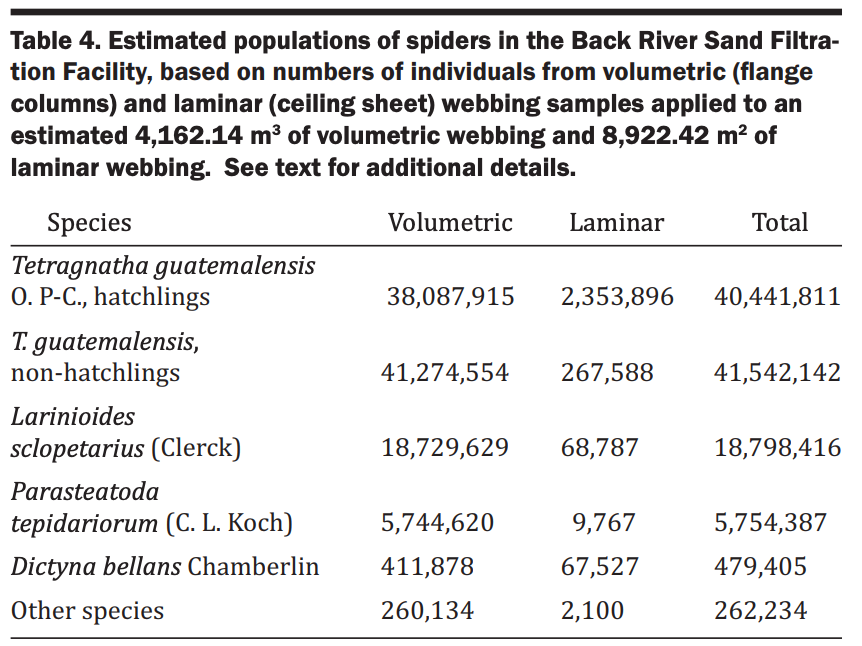
OK, I’m already gurgling with anticipation, but then the article is full of photos and graphic details about the magnitude of the webbing. It is amazing and beautiful. They used the volume of webbing and density of spiders to estimate the total population in this building.

Over 100 million spiders! And just yesterday I reported counting 63 in my garage. I feel so inadequate.

I said there were photos. Behold and be awed.

[Read more…]

Spider Update

It’s been a while since I had anything new to report — the colony is just sitting there, waiting for me to provide the ladies with some males, since they ate all of them. But we’re gearing up for a field season, so there were a few things I was able to try.

I’ve written up a protocol for our summer spider survey. It’s mainly a series of steps we’re going to carry out as we scan a garage, because consistency is important. We’re not going to be able to see every spider in every place — they’re sneaky, quiet little buggers — so we need to survey each environment in the same way, so that we can compare the residences, even if we know we’re going to miss animals. So Mary and I put on headlamps, plunged into our frigid garage and went through the motions to see how practical my plan was.

We didn’t expect much. It’s been a hard winter, and while today felt much warmer and the snow is melting, it really is still only 2°C, hardly happy weather for spiders, and not any better for their prey. We went spider hunting anyway.

As expected, there wasn’t much alive out there, maybe. The only spiders we saw were cellar spiders, Pholcidae, and they didn’t seem to be up to much. In fact, they might have all been dead. They were all inert and unresponsive to touch, but were still strangely plump and life-like, if still. They could be little frozen corpsicles, or possibly estivating. We couldn’t tell. We counted them anyway, if they looked intact and like, maybe, they’re going to rise from the dead at some point. It was all practicing the protocol, anyway.

The end result is that our cold and unpleasant and rather cluttered garage, 5.3m wide and 6.1m deep, has walls that are all covered with cobwebs, especially any part of the wall that is more than just a bare surface. If there was so much as a nail sticking out of a sheet of fiberboard, there was a cobweb on it. We counted a total of 63 zombie pholcids in that little space, and also found 11 egg cases of at least 3 different types. We’re starting to think our biggest challenge will be counting all the spiders in a reasonable amount of time once summer arrives with the mosquito season and the happy little beasts start fornicating fiercely.

One neat little surprise: along a back wall, there’s an area with a rack of shallow shelves, and Mary excitedly tells me that she has discovered spiderlings! I was skeptical and thought that was metabolically improbable given the ambient temperatures, but when I looked, sure enough, there were sheets of webbing in all of those shelves, and in all of them there was an explosion of tiny white dots with itty-bitty hairlike protrusions. They were of the right size, and that was the kind of scattering I’ve seen in newly hatched spiders in the lab, but I couldn’t imagine they might have survived a Minnesota winter, and they didn’t.

I twirled a patch of cobweb with the putative spiderlings onto a brush, and brought it into the lab, and sure enough…spiderlings. Well, the molted cuticles of many adorable baby spiders. Here’s a photo.

[Read more…]

How long does it take a man to collect his semen specimen in a busy infertility clinic?

That’s the question asked by this paper, How long does it take a man to collect his semen specimen in a busy infertility clinic? They have a clear motive, to figure out what factors might be reducing the throughput at these clinics. Guys, you’re taking up essential space and monopolizing the porn magazines! Ejaculate quickly and get out!

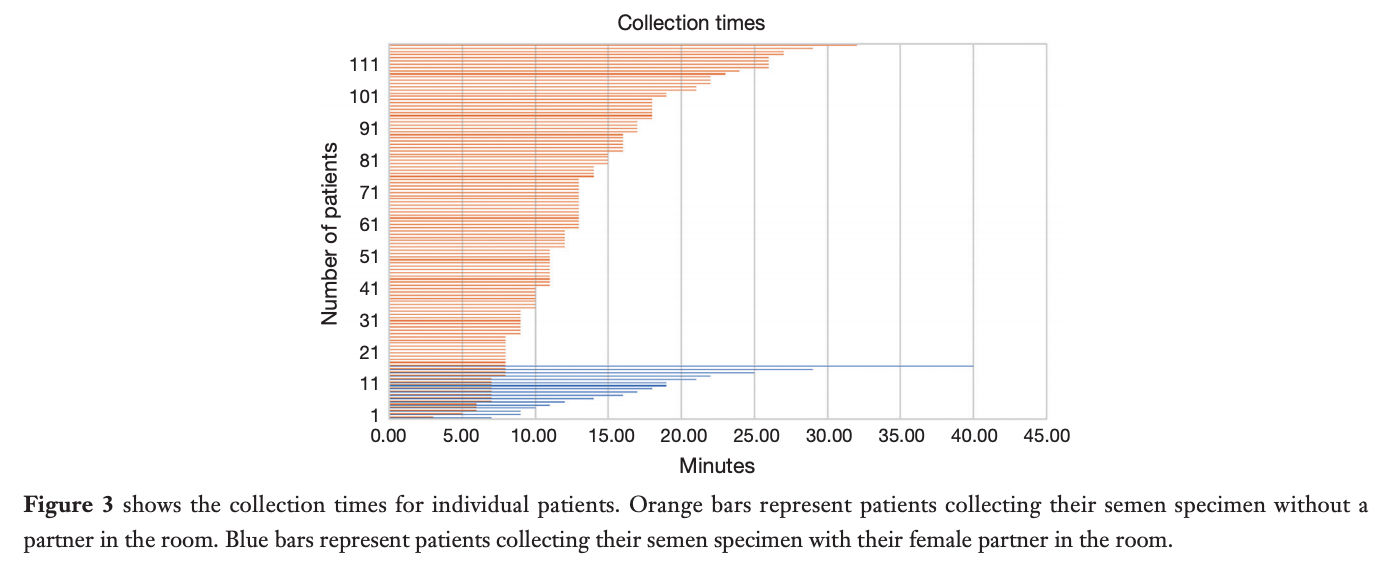
So they timed the men (the pressure!), and to answer the question: the median time was about 12 minutes, with a range of 3 minutes to almost 40 minutes. They only looked at two variables that might affect that time. One was whether the purpose of the visit was cryopreservation or not. The most common reason for giving a semen sample was to evaluate it for fertility issues; some people are there because they’re about to get a vasectomy or undergo chemotherapy, so they want to preserve a sample. Men ejaculating to preserve a sample take about two minutes longer, but I wouldn’t attach much significance to that, given the huge amount of variability and the small sample size.

The second variable was whether the men were attended by their female partner; if they were, it took about 4 minutes longer. Again, it’s impossible to read anything into that number. They aren’t examining the patients with so much as a questionnaire to figure out what’s going on. Go ahead, let your imagination run wild, but there’s no data here.

I am, however, deeply offended by how they plotted the data. This is a terrible chart.

Unforgivable. You’re supposed to compare the collection times between unattended men (orange) and men with their partners (blue), but it’s plotted by raw numbers of men — so all you’re really seeing is the difference in sample size. You have to imagine the blue bars stretched on the vertical axis to do any comparison — it should have been plotted by percentiles — and then the differences are small, and you can see that both groups have a substantial range. It’s very misleading. Bad graphing, bad.

I’m not impressed with their conclusion, either.

The only variable with a negative impact on the collection time was the presence of a female partner in the collection room. Our findings can aid in optimizing the scheduling of patients requiring semen collection in a clinical setting.

You know, you’ve got patients who are concerned about infertility, or are going to be treated for cancer, and there’s also some embarrassment about the situation. I think that how much time it takes them to spurt out a sample ought to be a low priority here, and it’s rather insensitive to be thinking that kicking partners out is to be considered as a way to “optimize the scheduling”, and given the degree of variability here I don’t think you can arrange matters to favor Mr Jackrabbit over Mr Slowhand, nor should you.

As we all know, if you really want to speed things up, the only solution is a rectal probe to deliver electroshock to the prostate.

That’s the fanciest Keurig machine I ever did see

Except it doesn’t make coffee. It does everything else important, though.

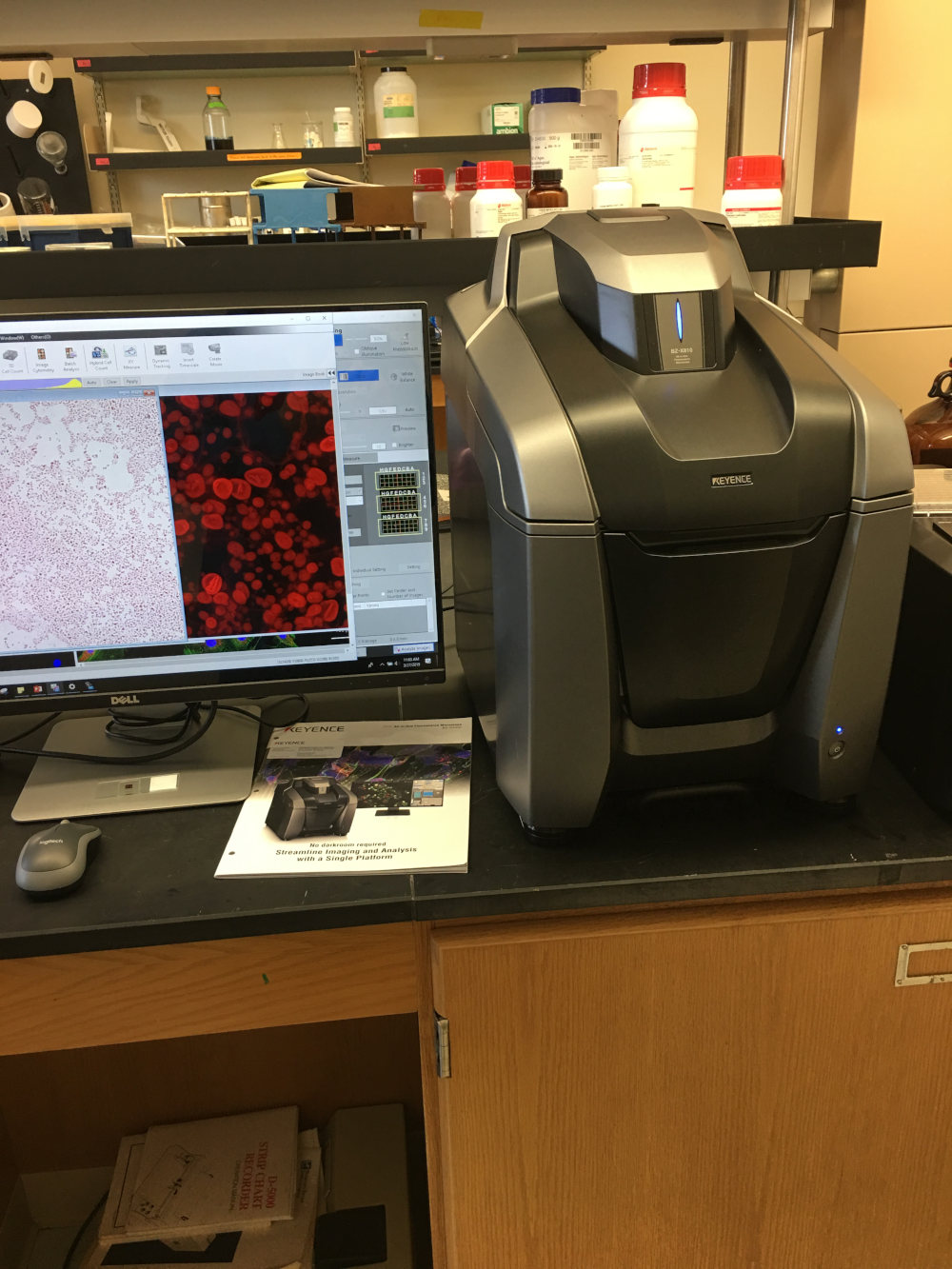
We got a demo this morning of this fancy new structured illumination microscope from Keyence. It actually looks like this:

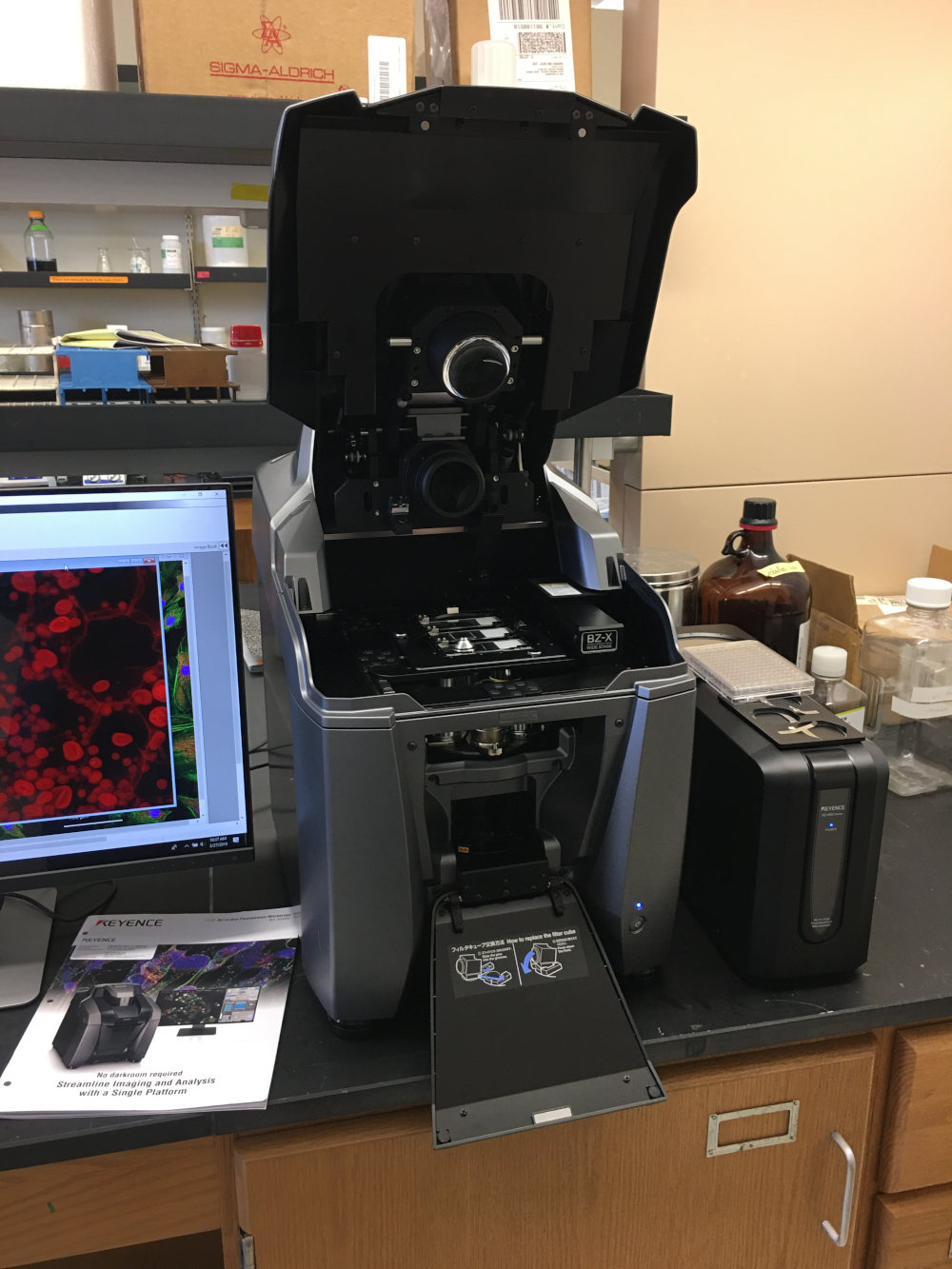
Oooeee, I’ve always wanted a cyborg in my lab. I was impressed. It’s modular and compact and robust, and fully computer controlled. I could see using this in our teaching as well as our research, because you just open it up…

…place your slides or well plates in the chamber, and then close it up and control everything from the keyboard. That removes the anxiety of undergraduates having to tinker with fragile optics and electronics, and makes it feasible to just put this thing on a cart and wheel it to different labs when we need it. And it takes beautiful images, does quantitative microscopy, all the kinds of things we would drool over.

And it’s relatively cheap at $50,000 for the base model. Keyence has adopted the DLC model of revenue, so you buy the core gadget and then additional features at extra cost. That actually makes a lot of sense for a small university like ours, where we could just pick up the minimum we need for our faculty’s focus.

“Just” $50,000. Maybe a little more if we decide that some of those extra features would be nice. Sure. I’m guessing I’m going to be writing an NSF grant proposal soon.

Or…if we just had a sugar daddy/sugar momma who wanted to make a tax-deductible donation to the University of Minnesota Morris, earmarked for biology discipline equipment, it would spare me a fair bit of work. We’ll even get a nice plaque made and bolt it to the side with your name on it. After all, if MIT and Harvard and the University of Toronto can get hundred million dollar donations, surely someone can invest 0.1% of that in an appreciative liberal arts college, right?

We’re not going to let you buy admission for your kid, though.

OK, I’ll write the damned grant proposal.

The perfect metaphorical image for spider taxonomy

One of the things I’ve been struggling with this past year has been spider systematics, and it has been frustrating. If I see one more taxonomic revision, I’m going to gag; every attempt to assemble a coherent picture of their evolution seems to be fragile and ready to fall apart. I don’t blame the scientists doing the work, I blame the spiders themselves for being diverse and complex.

However, I have never seen a diagram that so aptly illustrates the chaos of spider phylogeny unironically.

Schema of spider web evolution. A selection of orb web on a tree to demonstrate the various web types—this is certainly not a phylogenetic tree. Distant ancestors such as scorpions and more close ones such as mygalomorphs and ctenizids roam the ground, already using silk to line burrows and construct trip-lines. Further ancestral relatives (e.g., Eresus and Agelena) build their webs on the base of vegetation; a Dictyna web spans the fork of the tree. The right-hand branch contains (in order from its base) the webs of Stegodyphus, Uloborus, Hypotiotes, Deinopis, and Miagrammopes. The center branch holds a two-dimensional araneid orb web by Araneus. The left-hand branch holds a two-dimensional tetragnathid orb web by Meta. This branch also supports (upper left to right) derived orb webs by Theridiosoma and Scoloderus, and the minimalist Mastophora glue-drop web as well as (below on the extreme left) the highly derived three-dimensional webs by Achaearanea and Linyphia (adapted from Vollrath F. 1988. Untangling the spider’s web. Trend. Ecol. Evol. 3:331–35).

Whoa. It’s a schema of spider web evolution that is “certainly not a phylogenetic tree”. OK, what is a “schema” then? You’re using a tree structure as part of an explanatory framework, but the webs are drawn between the branches. How does that work, exactly? How am I supposed to interpret this diagram? What relationships are being elucidated? Am I just too old to be learning new stuff?

Why are there volcanoes erupting in the background?

Otherwise, it’s an informative paper. I’m beginning to think of some of their diagrams as an analogue to how Spider-Man will splat a blob of webbing in a bad guy’s face to shut him up or blind him.

I’m definitely going to have to go to the American Arachnological Society Meeting this year in June, just to hang about with some arachnologists and maybe absorb their attitude by osmosis or something, because I’m mainly just confused.

An inspirational story?

I was reading about Greta Binford, the spider-woman, and there’s a lot of good stuff here. I was a tiny bit put off by this bit, though:

Binford came late to the study of spiders, and without morbid predilections. She grew up on a small corn- and-soybean farm in west-central Indiana—“dull spider country,” she calls it.

I’m afraid Minnesota might be even duller spider country, and I’m a bit concerned about the lethality of our winters — it might be a very seasonal spider country. But that doesn’t make them less interesting. I’ve already got some ideas for experiments to test mechanisms our local populations have for coping. Also, even in winter I’m finding lots of spiders indoors, just not the species I was focusing on.

Binford is forgiven, though. She’s most interested in spider venoms, and that’s not a particular strength of upper midwestern spiders. I’m more into development and behavior, so there’s plenty to keep me occupied here.

But this bit rings true, for sure.

The key to good hunting, Binford said, was to have a “search image” in mind. Wolf spiders, for instance, can be found by their eye shine. When you train a flashlight beam over your back yard at night and see a faint glimmering in the grass, those might be spiders gazing back at you. Loxosceles tend to splay their legs like asterisks, and to gather in pockets of dampness—anything from the bottoms of rotting logs to the spaces behind steam pipes. “It reminds me of hunting for morels as a kid,” Binford said. “There’s a kind of Zen moment where everything falls away and there’s just you and the spider.”

The stairs led down to a long, open space, with pipes and wires hung low from the ceiling. Bits of graffiti flared into view, as our headlamps swung past, and strands of webbing caught at our faces. Most of it belonged to pholcids, or daddy longlegs, Binford assured me. Their venom is strong enough to kill a mouse, and they prey on other spiders, but their fangs are too small to hurt us. She played her beam along the bottom of a wall and held it on a Steatoda, a bulbous relative of the black widow, famous among arachnologists for turning radioactive and biting Peter Parker in the recent Spider-Man film. Then she stopped and scanned the room from end to end. “It’s like an Easter-egg hunt,” she said. The spiders were hiding in plain view.

I’ve experienced the same phenomenon! I’ve been walking these halls for years, totally oblivious to spiders, and now that I’ve started seeking them out, they’re everywhere! I find myself looking in corners, and window frames, and crevices, spotting cobwebs or fragments of chitin, and tracking down these little guys who share our homes and office buildings. If you’re an arachnophobe, I recommend not ever looking for them, or you’ll start spotting your nightmares all around you. Don’t develop that search image in the first place.

But don’t worry.

Spiders have a bad reputation, largely undeserved. The great majority aren’t venomous enough to harm us, or their fangs are too small, or their jaw muscles are too puny, or they simply see no profit in attacking large, indigestible creatures that can crush them with their toes. Unlike snake venom, which is designed to kill vertebrates, spider venom is almost always meant for insects. Its toxins can stop a hornet in mid-flight, but they lack proper targets in the human nervous system. “If we were wired for spider venoms the way insects are, we would be screwed,” Binford says.

She is studying Loxosceles laeta, a more potently venomous relative of the infamous brown recluse, which is infesting a Goodwill building in Los Angeles. I don’t know if you’ll find this part of the story reassuring.

When Binford milks laeta in her lab, their fangs yield about ten times as much venom as other Loxosceles’, and medical records suggest that their bites leave larger lesions. Yet, even if the Goodwill’s population spread across Los Angeles, it isn’t clear how much of a threat these spiders would pose. Laeta are easily as reclusive as their North American cousins. They keep to dark, quiet areas and shrink from human contact. When they do bite, the venom doesn’t always have an effect: some people’s immune systems aren’t sensitive to Loxosceles toxins. Five years ago in Lenexa, Kansas, a family of four trapped and killed more than two thousand recluses in their nineteenth-century farmhouse. Yet no one in the family suffered from a bite.

I would love to find a building with thousands of recluses lurking in it, but it’s not likely. They don’t seem to have taken to living this far north. But this might be one of the advantages of climate change, you never know.

We’re here to teach and do research

Would you like to spend 10 years in higher education getting an advanced degree so you can work part time at poverty level wages? That’s the situation many are finding themselves in, as this article on the adjunct crisis explains.

Nowhere has the up-classing of contingency work gone farther, ironically, than in one of the most educated and (back in the day) secure sectors of the workforce: college teachers. In 1969, almost 80 percent of college faculty members were tenure or tenure track. Today, the numbers have essentially flipped, with two-thirds of faculty now non-tenure and half of those working only part-time, often with several different teaching jobs.

Why this should be so is not immediately obvious. Unlike the legal and the traditional news industries, higher education has been booming in recent years. Nor does higher ed seem to follow the pattern of other industries being transformed by contingent employment. In his book The Fissured Workplace, David Weil of the Boston University School of Management (and currently the administrator of the U.S. Wage and Hour Division in the U.S. Department of Labor) writes that the growth of contingent employment is being driven mostly by firms focusing on their core businesses and outsourcing the rest of the work to contractors. But teaching students is—or at least is supposed to be—the core mission of higher education. That colleges and universities have turned more and more of their frontline employees into part-time contractors suggests how far they have drifted from what they say they are all about (teaching students) to what they are increasingly all about (conducting research, running sports franchises, or, among for-profits, delivering shareholder value).

It doesn’t really get into the declining support for state universities from our government, but yeah, I can see how that’s a good point. I am fortunate to be at a university where sports are a very low priority, and where teaching is much more important than research, and our percentages of tenure vs. non-tenure faculty makes us look like we’re living in 1969.

However, I don’t know that research represents a drift away from what universities are all about. Before WWII, universities were engines of basic research — professors were hired for their expertise in a field, which made them competent to teach a subject, but also meant they were trained for, committed to, and loved that subject, so of course research was an important role for them. Consider Edwin Conklin, for instance: he worked in an era before big government grants were a thing, was strongly invested in teaching, and every summer he skedaddled off to a marine biology laboratory to stare at sea squirt embryos, and even after he retired he was working, working, working in developmental biology. You are not going to hire great teachers who are competent to teach the most advanced topics in a field if you’re not willing to hire people who want opportunities to do research. It really is part of the job.

(By the way, during and after WWII there were changes made to increase the importance of basic research and tap into the talents at universities by throwing much more money at them — NSF and the NIH, for instance, skew universities’ perspective on the value of teaching vs. research. That’s not necessarily a bad thing, but the system is still trying to digest the changes.)

That, however, is also one of the ways the adjunct system is screwing over the professoriate. Adjuncts don’t get to do much research. They get assigned heavier teaching loads, and are paid so poorly that may have to moonlight at other jobs (or piece together more and more adjunct assignments), so they don’t get the opportunity to do the research that makes them valued for those more difficult, upper-level teaching assignments.

So don’t belittle the research role of universities. That shouldn’t go away. But I agree that there should be better integration of research with teaching and vice versa, and that adjuncts and part-time instructors ought also to be given the respect and opportunity and support their position deserves.