
There’s a scene in The Simpsons Movie that has become a regular in conversations about the world getting worse in various ways. Bart says, “this is the worst day of my life”, and Homer responds with a cheerful, “The worst day of your life, so far.” Naturally, this has been adapted for all sorts of situations, including the climate crisis:
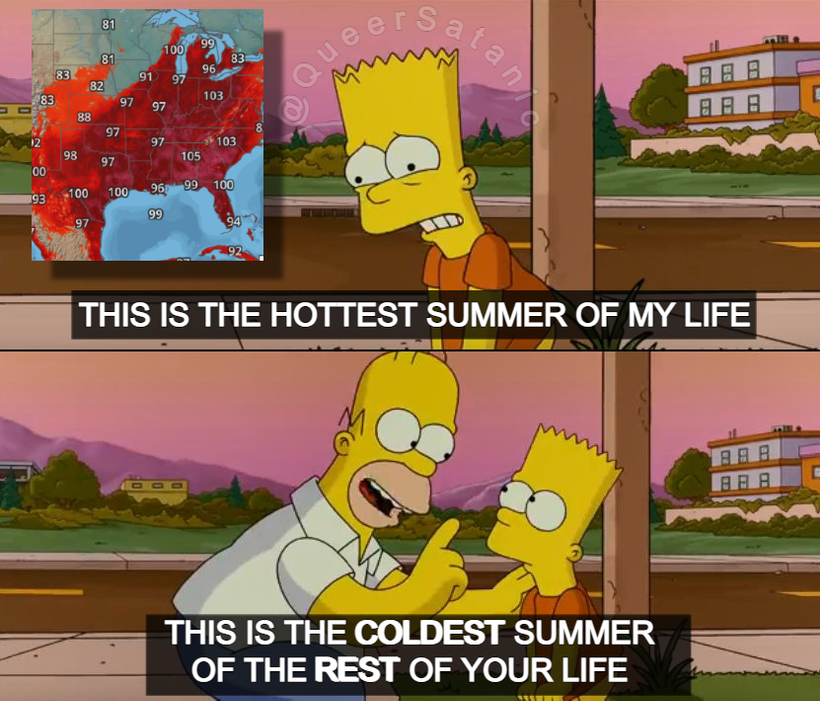
I like this meme. It’s a nice piece of gallows humor about the fact that the people running our world seem to be actively seeking our extinction, and so the planet is going to keep getting hotter, probably for centuries to come. There is a way in which this is entirely correct, and there is a way in which, for this particular summer, it is not.
The way in which it is correct is that the planet, as a whole, is getting hotter every moment. Over a decade ago, John Cook compared the rate of warming to the nuclear bomb detonated over Hiroshima. Specifically, the rate of warming was equivalent to detonating four of those bombs every second of every day, without pause. The rate has only increased since then.
I’m a little uncomfortable using one of the most horrifying war crimes in history as a unit of measurement, but the scale of what’s happening is beyond what most of us are able to hold in our little monkey brains, and the nuking of Hiroshima and Nagasaki gave us a way to convert these numbers into a human frame of reference.
Fortunately for us, the overwhelming majority of that heat is absorbed by the ocean. That means that it has felt gradual to most, and climate scientists have been unanimous in saying that we’d still have hot years and cold years, just an overall upward trend. More recently, it’s been harder to ignore that every year really is hotter than the last, and it looks increasingly likely that 2026 is gonna be a real doozy.
In January of this year, a research team published the results of a study of ocean warming in 2025. To use our measure of atomic explosions, the oceans absorbed heat equivalent to twelve per second, for every second of 2025.
And the Pacific ocean is about to give a lot of that heat back to the atmosphere.
As many of you are already aware, climate scientists are warning that this year will be the most intense El Niño since the 1870s. I want to dig, just a little, into what that means.
The first thing, going back to the meme at the beginning, is that after this ends, there will be a period that is cooler. “El Niño” refers to the warming phase of the Southern Oscillation that moves between warm phases and cool phases (called “La Niña”). The cycle is basically driven by the Pacific Ocean sloshing back and forth over the period of a few years. That means that the cycle isn’t going to just stop, so as we go into this warm phase, with whatever chaos it brings, please know that it will cool down, at least from our perspective. In terms of lived experience, this will not be the coldest summer for the rest of your life.
However, this will be a good demonstration of conditions we can expect more and more frequently as this century progresses. The more heat there is in the system, the better the odds of a major El Niño event. More than that, as the global temperature keeps rising, we will encounter conditions like what we’re about to experience much more often, and eventually we’ll have them as just the normal state of affairs, with hot phases of the Southern Oscillation being beyond anything humanity has experienced. I also want to note, as I have before, that even though events like this are really just redistributing heat that was already here, it will add to the momentum of global warming as a whole.
Now on to the short-term impacts. In 1877 and 1878, a massive El Niño event triggered a global famine that killed 50 million people. As news outlets have been reminding people, better technology and understanding of the world make it unlikely that the current event will be like that, but I think it will be devastating. The unfortunate reality is that most famines tend to be a matter of logistics and social constructs, rather than the absolute ability to feed anyone. Ireland famously exported more than enough food to feed everybody during the Great Famine, but the eugenicist government of the British Empire saw mass death among the Irish as a good thing, and valued the profits from commercial exports more than Irish lives. Even before modern agriculture really took off, famines tended to be the result of the ruling class’s reckless disregard for life, and their unwillingness to tighten their own belts, even as they blamed the poverty they created on their victims. Worse, famine has long been a weapon of genocide. That’s the case with the ongoing, Saudi-caused famine in Yemen (with US support), and the starving of Gaza (with US support).
As I’ve said many times before, we’ve been able to end world hunger for decades. What we lack is a system that values human life enough to do so. There may not be as big a food shortage as 1877/78, relative to our population, but the global economy is still governed by people who don’t value human life very much. In the case of the Trump regime, they’re also eugenicists.
Eugenics is basically the pseudoscientific idea of using selective breeding practices on human populations. A huge part of selective breeding is the sterilization or culling of individuals with “undesirable traits”, and to the fascists of the GOP, those traits tend to include any disability or neurodiversity, any form of Queerness, any form of left-wing thought, and also the roughly 87% of humanity that’s not “white”.
So I think it’s hard to predict. I don’t know if you remember, but when people first started talking about COVID-19 in late 2019, early 2020, most experts believed that it wouldn’t be as bad as it became. They believed that because we knew how to handle disease outbreaks. We knew how to use PPE, quarantine, lockdowns, and so on, and so it was just a matter of taking those steps, and either slowing or stopping the spread so we didn’t overwhelm healthcare systems while we worked on a vaccine.
It might have become a pandemic either way, but not every country was willing to take the economic hit of a real lockdown, and the folks running the US weren’t willing to risk the general public getting the idea that maybe the government could be making life easier on a daily basis.
And not only did the US government needlessly let hundreds of thousands die, they also interfered, along with US oligarchs, in the COVID responses of other countries. The US even resorted to piracy to shore up its greed-driven PPE shortage. The same people are running the US now, and have demonstrated their willingness to murder innocent fishermen, steal Venezuelan oil, and generally crash the global economy, apparently to serve Trump’s ego and Netanyahu’s fantasy of making Iran a failed state, and therefor not an obstacle to Israel’s imperial project. Whatever the climate does over the next couple years, we’re going into it with an oil crisis and a fertilizer shortage, neither of which needed to happen.
My greatest frustration with the world is that it could be so, so much better than it is, but our systems are governed by people who are either fine with destroying countless lives, or who actively enjoy it. Worse, there are far too many within the working class who have the same desire for power over others. We have yet to shake off the burden of rulers, and so we are still, in far too many ways, subject to their whims.
So there will be droughts, and heat waves, and flooding, and crop failures. Very likely, rich, developed nations will experience shortages and high prices, but not outright famine. That’s the way this thing tends to go these days. If people like Stephen Miller have their way, things will be worse. It will be used as an excuse to further limit food imports to the former colonies that have largely been forced to continue producing cheap goods for the global market, while importing large portions of the food they eat. I think it is likely to be a rough couple of years for humanity.
The US is a dying empire with global reach, and that tends to be a chaotic and violent period in an empire’s life. Adding a record-breaking global heat event to the mix could have a stifling effect on that chaos, or it could add fuel to the fire.
As always, those hit the hardest will be the people who are most vulnerable, and who had the least say in making the world the way it is.
And now I want to end on a slightly less gloomy note. A lot of people online have been wondering how we know about the 1887/8 El Niño, if we didn’t have satellites back then. I always enjoy the subject of how we know what we know, and when it comes to the climate of the past, it’s always cool stuff. In this case, we have a lot of records.
It’s important to remember, when we’re considering anything relating to the last few centuries, that global empires have been a factor since the 1400s. That means global shipping, navies all over the place, and the tracking of agricultural conditions across colonies. Any ship on the ocean needs to be aware of weather conditions, so they tracked them religiously. By looking at those records, we can form a picture of the global climate. There are also farm records, the notes of amateur naturalists, and paleoclimatology tricks like tree rings and sediment cores.
We have always been at the whim of the weather to one degree or another, so we’ve always tracked it to the best of our ability. The rise of civilization as we currently understand it was dependent on reliable seasonal weather patterns for regular mass production of food, and while I’ve long advocated that we start moving food production indoors, the dependence remains. Well, that period of stability is gone, and we’re just starting to get a taste of the new era.
It’s not a literally true claim, so that detracts. I mean, sure, the sentiment applies.
More than one level works better for such as me, because on its face it’s an unwarranted claim.
Pulling out the numbers at https://skepticalscience.com/4-Hiroshima-bombs-worth-of-heat-per-second.html —
>Over the past decade, the rate is 8 x 10^21 Joules per year, or 2.5 x 10^14 Joules per second. The yield of the Hiroshima atomic bomb was 6.3 x 10^13 Joules, hence the rate of global heat accumulation is equivalent to about 4 Hiroshima bomb detonations per second.
An earth diameter of 12,756.2km gives a disk of 1.3×10^14 m^2, so 2.5/1.3 is about 2W/m^2 over the disk, or 0.5W/m^2 spread over the whole 5e14m^2 surface. Overall it might be 4 Hiroshima’s/sec for the earth, but spread out on the local scale, that’s about a 2000W heater running continuously on every acre of land or water.
@John Morales – Yeah, “summer” has never been a matter of global temperature. Still, I like the opportunity to underscore the fact that despite our lived experience, the total amount of energy in the planet and its atmosphere keeps going up.
And it’s fun to reinforce the pattern of “if there’s a question in the headline, the answer is no.”
@Davex – Thanks for the breakdown! Atomic bombs are a dramatic visual, but honestly so is the idea of a landscape covered in a planetary grid of magically-powered space heaters.
Personally, I think that “crimes against humanity per second” is a perfectly valid metric for what we’re facing.
Oceanoxia, sorry. I know you know whereof you speak.
Not just to the chaotic nature of it, but to the https://en.wikipedia.org/wiki/Polar_amplification
>And it’s fun to reinforce the pattern of “if there’s a question in the headline, the answer is no.”
Ah, Betteridge. Too true.
https://en.wikipedia.org/wiki/Betteridge%27s_law_of_headlines
That doesn’t mean it’s gone, though, right? It’s in the ocean. As you point out, system at work mean that it will at some point come back out… but surely, even if it doesn’t, that’s not the end of the matter. The ocean(s) is not some infinite heat sink into which we can keep pumping energy and not worrying about it.
I remember reading years ago (in, I think, “Freakanomics”) a wacky scheme to reduce hurricane damage to the USA. Take a large inflatable ring, and dangle from its inner circumference a long, flexible tube of plastic – like a really long tubular bin liner. It supposedly doesn’t need to be particularly robust, since it won’t experience great shear forces. The ring would be design such that it wouldn’t flip over. The idea is that warm surface water sloshes over the side of the ring into the centre, and displaces water downwards along the tube. Water emerges at the bottom of the tube where the ambient water temperature is much, much lower. Gradually, there’s a migration of warmer water down the tube and away from the surface.
Of course, you don’t build just one of these things – you make thousands, and deploy them all across the Atlantic. Never mind the plastics in the environment for the moment – the point is you take the warm surface water that is the engine of hugely destructive hurricanes, and you gently, slowly, displace it down into the deeper ocean instead of letting it sit there making the wind blow.
And if it doesn’t work? You simply sweep up all your rubber ring/tube doohickeys and chalk it up to experience – it’s reversible as a process.
Except – and as an engineer I fairly quickly saw a small flaw in the plan – the energy has gone deeper, not been destroyed. That’s just physics. It’s kicking the can down the road, with a side order of “what is the effect of warmer water deeper down?”, to which the answer is surely “we have no idea”. I can see how kicking the can down the road gives you additional time to address the things that are causing the surface heating… but that wouldn’t happen, would it? The people responsible would simply take credit for abolishing hurricanes then get on with doing some more drilling/burning/whatever.
I haven’t made any attempt to find out if anyone ever actually tried this out at scale, but I’m guessing not since hurricanes still happen.
Anyone got any information or opinions on this idea? I
@sonofrojblake – You’re right. It’s all still in there, and it does affect us. The reason I call it “fortunate” is that it has bought us time. We haven’t used that time as I would have wanted, but if the oceans somehow didn’t absorb the heat, we’d be in much worse shape right now.
As to the effort to artificially cool the Atlantic, I’m no engineer but what you describe does seem like an incredibly bad idea on multiple levels. Futurama’s approach of carving ice off of Halley’s Comet to drop into the ocean every year might actually be a better idea in the long run.
If it did succeed in somehow forcing the ocean’s heat to lower levels, then I’d wonder about the stability of methane hydrate deposits, and deep-sea life.