This is our session at OrbitCon. At time of writing, OrbitCon is still live, and you can find all the videos here.
A Trivial Knot
Everything is simple except when not

This is our session at OrbitCon. At time of writing, OrbitCon is still live, and you can find all the videos here.
There’s a board game slash art piece called Train, where players shuffle meeples around in a train, until they come to the realization that the game is about shipping Jews to concentration camps. At this point, the players stop, usually shocked and disgusted with their own complicity.
But Train is a very unusual board game. Suppose we were playing another board game that involved putting brown disks, called “colonists”, onto plantations. Eventually, you put two and two together and realize that the “colonists” actually represent slaves, and you’ve been participating in trans-atlantic slave trade. Would you stop playing, feeling disgusted with your own complicity? Would you never play again? No, because you’re not playing an art piece, you’re playing Puerto Rico, one of the great classics of the Eurogame genre. So you just accept it as problematic, and play on.
It isn’t just Puerto Rico. Many Eurogames feature themes of colonialism, erasing or sanitizing its most evil aspects, like slavery, subjugation, or genocide. Instead, these games focus exclusively on the interests and perspectives of competing colonizing powers.
So, why do you think that is? Here I offer a bit of speculation.
The OrbitCon schedule is now online. You might say, “Yeah yeah, another conference I can’t attend.” But you can attend this one! It’s held online! This weekend!
I’ll be in a panel called “Ace/Aro Atheists“, held at 2:30 CDT Saturday, with Sennkestra and Emily Karp. Come join us!
“Aro” is short for aromantic, and “ace” is short for asexual (usually denoting the asexual spectrum). Yeah, last time I did one of these panels, somehow all the panelists were in romantic relationships. But this time all the panelists are aromantic-spectrum. That includes me–I’m both aro-spec and also in a relationship, funny that.
I have a lot of links this month, so I tried to organized them into themes.
Sexual violence & #MeToo
#MeToo is not all there is, and here’s why I’m not sharing my story – When activists like me criticize #MeToo, we’re not just hipsters trying to say, “we were fighting sexual violence before it was cool”. We’re trying to say that #MeToo was a step forward in terms of reaching a greater number of people, but in some ways a step back in the level of discourse. This is absolutely to be expected; whenever an important message reaches a new audience, it takes a step back to help people to catch up. In the public conversation, people keep on asking if #MeToo has gone too far, and my answer is that it hasn’t gone nearly far enough. This article talks about some things that #MeToo is missing.
Keep Your Acephobia Out of #MeToo, Jaclyn Friedman – Jaclyn Friedman, coauthor of Yes Means Yes, wrote an article about something she felt has been missing from #MeToo: a discussion of survivor’s sex lives, and how sex can be used to heal trauma. It’s true, this has been missing from the #MeToo conversation, but that doesn’t mean it’s missing everywhere. For some survivors, the narrative about sexual healing is so dominant as to be oppressive, especially for survivors who are ace. The sexual healing narrative must be paired with alternative narratives, where survivors do not have sex, and are not dehumanized for it.
When Boys Are Victims of Sexual Assault – This article has several first-person accounts of sexual assault from boys and young men. It seems that the experience interacts with masculinity in strange ways for many of them.
There have always been several gaps between new atheists’ self-image and reality. One gap that I have often expressed frustration with, is atheists denying that any atheist movement exists. You could argue the details about what it means to have a “movement”, but I heard such comments coming from people participating in atheist student groups in the heyday of new atheism. It’s a stubborn refusal to engage in self-understanding, a denial that there is any self to understand.
But today I want to talk about another gap. Atheists see themselves as having no heroes or leaders, and yet atheist celebrities are everywhere you look. This is a point that often comes up whenever an atheist celebrity falls from grace:
“Skeptics and atheists like to think they are above human foibles like celebrity worship,” Rebecca Watson, a prominent feminist skeptic, told BuzzFeed News. “In a way, that makes them particularly susceptible to being abused by their heroes. I think we see that over and over again.”
This is a problem composed of two opposites: (a) atheists see celebrity worship as a human foible that they have escaped, and (b) atheists are more susceptible to celebrity worship. And there are two opposite responses to the problem: (a) the tendency towards celebrities should be acknowledged, or (b) we must strengthen our resistance to celebrities.
The danger is that in focusing on just one response, we leave ourselves vulnerable to the other half of the problem. For FTB in particular, the danger is that we look at the downfall of our heroes and say to ourselves, “we’re moving beyond heroes”–without actually moving beyond heroes. By placing ourselves above celebrity worship, we may be replicating the original problem.
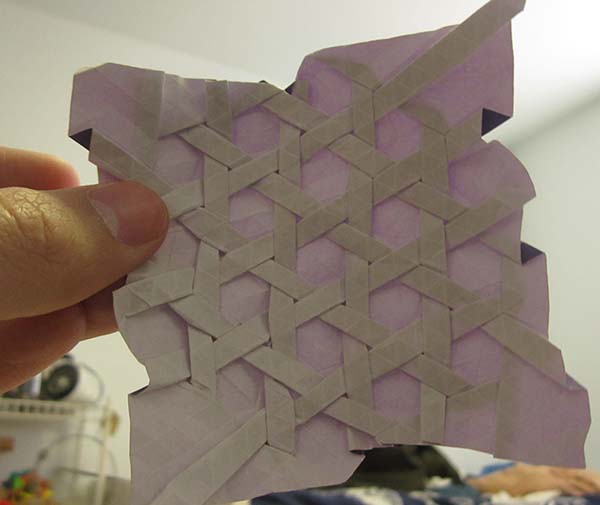
Basket Weave, by unknown
This comes from Eric Gjerde’s book, Origami Tessellations, although Gjerde says it’s a “common design”. It was one of the earliest tessellations I made, apparently dating to 2014. They were quite challenging to make at first. It might be interesting to fold another one just to see how much I’ve improved.
I remember people being very impressed by this one. I’d tell people, no it’s just one sheet of paper. The strips of paper that appear to be woven together are not actually continuous, that’s just an illusion.
I’m half White half Chinese Filipino, so some of my foods and food practices might be considered “ethnic”. But it doesn’t really feel like I’m doing anything strange. Instead, what it feels like is, gee, White people sure are strange. In particular, my fiancé has funny eating practices. It’s a constant source of in-jokes among us.
In the US, portion sizes at restaurants tend to be very big, and they get bigger at more expensive restaurants, up to a point. But for the most expensive restaurants, the trend reverses, and suddenly you’re getting a small piece of sea bass with a single piece of cauliflower and two mushrooms. These are the kinds of restaurants that my fiancé goes to with his family. They’re foodies. Eating with them is quite the experience. They spend the whole time talking about the food, selecting their favorite and least favorite among the dishes, expressing satisfaction or regret with their choices, comparing to the food they had at some other restaurant years ago. For a while, they were concerned that I didn’t like the food because I didn’t continuously lavish praise upon it. Yeah, I mean, I like the food but I’m not sure I’m capable of liking anything to such a degree.
One common pattern of praise went something like “these mushrooms perfectly complement the sea bass”. And it doesn’t sound like much, but the more I thought about it, the more it blew my mind. Because it seems to me, it doesn’t particularly matter what entree is paired with what garnish. It’s just the sum of its parts. But for my fiancé’s family, there’s some magical value not just in the food itself, but in the pairings of different foods. And I think it speaks to a totally different mindset, a different way of experiencing food. I suppose this is why each dish is composed of only a few parts, meticulously selected, and then exhaustively listed on the menu even when it’s just a sprig of parsley.
And I’m always thinking, where’s the rice? Rice plus anything–there you go, apparently I believe in magical food pairings too.