
Bad Puzzles

What is the difference between a puzzle and a real world problem? A puzzle is devised by someone, generally with the intent of making a pleasant experience for the solver. In contrast, a real world problem is not guaranteed to have a solution, not guaranteed to have a feasible path towards a solution, and is not guaranteed to be pleasant to solve.

Here is a simple math puzzle. Can you design two six-sided dice whose sum follows the same probability distribution as 2D6, but with different numbers (all positive integers) on their faces? Classic, totally possible.

Here’s a simple real world physics problem: Can you estimate Earth’s equatorial bulge from its rotation speed and gravity? I thought I could estimate this using geometrical considerations, but that gives the wrong answer. The correct solution must account for the gravitational field of the bulge itself, which can be calculated by decomposing it into spherical harmonics. Nobody wants to do that.

Puzzles do not always succeed at being enjoyable. Sometimes you waste a lot of time on a puzzle, and then when you look up the solution you think, “I was never going to get that one.” For example, one time I picked up a puzzle box on a friend’s shelf, despite my friend’s insistence that the puzzle was stupid. After messing around a bit, he showed me how to open it: he slammed it hard on the table to shake a magnet loose. I was never going to solve that one, because I happen to have reservations about slamming potentially delicate objects that do not belong to me.

[Read more…]

Islands of Insight teaches logic puzzles

Islands of Insight is a recent puzzle game taking place in a shared online world. This, by itself, is an extremely ambitious concept, because normally “puzzle” and “MMO” do not go together.  I know only of two other games that tried to be puzzle MMOs: Uru, a 2003 game in the Myst franchise that dropped the MMO aspect before commercial release; and Puzzle Pirates, another game from 2003 which is a “puzzle game” in the sense of Tetris.

There are three challenges facing a puzzle MMO: Puzzle games generally have small cult followings at best, whereas an MMO requires some level of mass appeal to be commercially successful. Puzzles are often solitary activities, whereas MMOs are social. Puzzles generally require careful bespoke design, whereas MMOs want endless content.

Did Islands of Insight succeed in squaring the circle, to create the Puzzle MMO? No, not at all. Despite the shared world, it’s not a very social game, and would work equally well solo. And while players seem to like it, it wasn’t commercially successful enough to support its development team.

But the game successfully addressed at least one of the challenges of the puzzle MMO.  They created over 10,000 puzzles with high quality standards to populate a large 3D world. These include perspective puzzles, mazes, hidden objects, moving block puzzles, and many more. I’d like to focus on the most numerous type of puzzle, the logic grid.

[Read more…]

Infinite Fractal Mazes

My previous post, “Solving fractal mazes” is a prerequisite to this one. Fair warning, this will be long and dense.

Fractal mazes contain infinite paths, but the only solutions permitted are finite. Some people find that disappointing. What’s the point of all that extra maze if we don’t get to traverse it? So my goal is to come up with a variant ruleset for fractal mazes that permits and formalizes infinite solutions. In fact, I will propose two distinct rulesets, provocatively titled Countably Infinite Fractal Mazes and Cantor Fractal Mazes.

[Read more…]

Solving Fractal Mazes

What are fractal mazes?

Fractal Mazes are a type of maze popularized (or invented?) by Mark J. P. Wolf, published in the Mathpuzzle blog in 2003. A fractal maze is a maze that contains nested copies of itself.

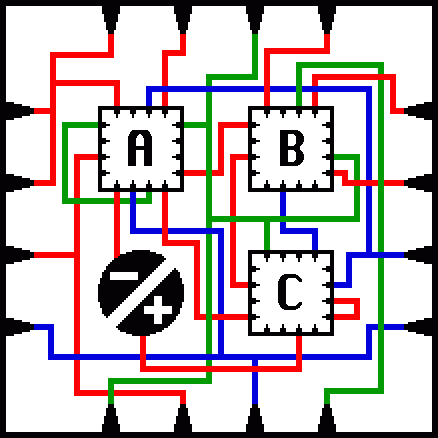
small fractal maze

“Small Fractal Maze”. Credit: Mark J. P. Wolf. Source: Mathpuzzle

Fractal Mazes are typically visually represented as a sort of circuit diagram. In the above image, the goal is to find a path between the “+” and “-” by following the colored wires. The wires are color coded in order to clearly indicate where paths cross over/under each other. The three modules, labeled A, B, and C, are each copies of the entire maze. However, the start and finish only exist in the largest copy of the maze. So however deep you go into the fractal, you must eventually climb all the way back up again.

[Read more…]

The Ant and the Universe

In my time as a puzzle enthusiast, one of the puzzles I encountered was called the ant and the rubber band. It was only later that I realized that this puzzle had some cosmic significance.

Problem Statement

We have an ant that is trying to crawl from one end of a rubber band to the other. But as the ant crawls, the rubber band also stretches out. The ant crawls one centimeter per second. The rubber band starts out one meter long, and stretches out one meter per second. This is one of those magical math rubber bands that can stretch indefinitely. Let’s just say the ant is mathemagical too. Will the ant ever reach the end?

At first glance, it looks bad for the ant. The ant crawls crawls one centimeter closer, but falls a whole meter back. So the ant is losing about 99 cm per second. That doesn’t sound like a path to victory.

[Read more…]

Good old puzzles

While I’m on the subject of bad puzzles from 1995, I want to briefly share one of my favorite good puzzles from the time. Around 1995, I received a book titled 100 Perceptual Puzzles by Pierre Berloquin. It’s apparently a newer edition of an older book titled 100 Geometric Games, copyright 1976.

The book contains a wide variety of puzzles, mostly of the sort that rely on pictures, or require you to draw pictures. Many people are familiar with the puzzle where you have a 3×3 grid of dots, and you’re asked to draw four straight lines through all the points without lifting your pencil. That puzzle is not in this book, and instead it includes multiple harder versions!

Other puzzles include: mazes, spot the difference, match moving puzzles, shape counting puzzles, and knot puzzles. The knot puzzles! I will share one knot puzzle.

[Read more…]

Bad Mensa puzzles

I have some questions about Mensa. It’s an organization founded in 1946 whose membership is restricted to people scoring in the 98 percentile of IQ. But IQ is a scientifically dubious concept associated with eugenics and racism, and many people who would qualify for membership probably have better things to do, so I wonder what their membership looks like. I also wonder to what extent it’s just a thing that people sign up for and forget about–maybe subscribe to a newsletter, buy a thing or two from their store.

But this story is more personal–and more petty. It’s the story of why I disliked Mensa from a fairly young age, even though I most certainly would have qualified for membership. See, I received a lot of puzzle-based gifts, and I always thought that those with Mensa branding were the crummiest of them all.

[Read more…]