
Perspectives on the apocalypse

Émile P. Torres has a provocative perspective on the historical views on Human Extinction. He breaks it down into five periods of general ideas about the possibility of humanity going extinct, and here they are:


(1) The ubiquitous assumption that humanity is fundamentally indestructible. This mood dominated from ancient times until the mid-19th century. Throughout most of Western history, nearly everyone would have said that human extinction is impossible, in principle. It just isn’t something that could happen. The result was a reassuring sense of “Comfort” and “perfect security” about humanity’s future, to quote two notable figures writing toward the end of this period. Even if a global catastrophe were to befall our planet, humanity’s survival is ultimately guaranteed by the loving God who created us or the impersonal cosmic order that governs the universe.

(2) The startling realization that our extinction is not only possible in principle but inevitable in the long run — a double trauma that left many wallowing in a state of “unyielding despair,” as the philosopher Bertrand Russell wrote in 1903. The heart of this mood was a dual sense of existential vulnerability and cosmic doom: not only are we susceptible to going extinct just like every other species, but the fundamental laws of physics imply that we cannot escape this fate in the coming millions of years. This disheartening mood reverberated for roughly a century, from the 1850s up to the mid-20th century.

(3) The shocking recognition that humanity had created the means to destroy itself quite literally tomorrow. The essence of this mood, which percolated throughout Western societies in the postwar era, was a sense of impending self-annihilation. Throughout the previous mood, almost no one fretted about humanity going extinct anytime soon. Once this new mood descended, fears that we could disappear in the near future became widespread — in newspaper articles, films, scientific declarations, and bestselling books. Some people even chose not to have children because they believed that the end could be near. This mood emerged in 1945 but didn’t solidify until the mid-1950s, when one event in particular led a large number of leading intellectuals to believe that total self-annihilation had become a real possibility in the near term.

(4) The surprising realization that natural phenomena could obliterate humanity in the near term, without much or any prior warning. From at least the 1850s up to the beginning of this mood, scientists almost universally agreed that we live on a very safe planet in a very safe universe — not on an individual level, once again, but on the level of our species. Though humanity might destroy itself, the natural world poses no serious threats to our collective existence, at least not for many millions of years, due to the Second Law of thermodynamics. Nature is on our side. This belief was demolished when scientists realized that, in fact, the natural world is an obstacle course of death traps that will sooner or later try to hurtle us into the eternal grave. Hence, the essence of this mood was a disquieting sense that we are not, in fact, safe.

(5) The most recent existential mood — our current mood — is marked by a disturbing suspicion that however perilous the 20th century was, the 21st century will be even more so. Thanks to climate change, biodiversity loss, the sixth major mass extinction event, and emerging technologies, the worst is yet to come. Evidence of this mood is everywhere: in news headlines declaring that artificial general intelligence (AGI) could annihilate humanity, and the apocalyptic rhetoric of environmentalists. As we will discuss more below, surveys of the public show that a majority or near-majority of people in countries like the US believe that extinction this century is quite probable, while many leading intellectuals have expressed the same dire outlook. The threat environment is overflowing with risks, and it appears to be growing more perilous by the year. Can we survive the mess that we’ve created?
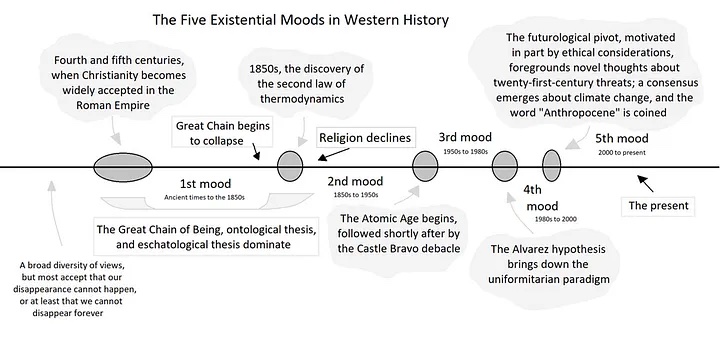
I don’t know — it seems to me the big shift was between (1) and (2), and (2) through (5) and more subtle distinctions about how and when the species is going to die. He also argues that these transitions are fairly sharp and clear, but really, Alvarez ended the uniformitarian hypothesis? I don’t think so. But then, I haven’t read his book yet.

Also, just to complicate things, there are a lot of people today who are stuck in the (1) mindset. He gives one horrifying example, of a man who got elected to the American presidency.

As I write in the book, end-times prophesies are both rigid and highly elastic, often able to accommodate unforeseen developments as if the Bible predicted them all along. Ronald Reagan provides an example. In 1971, while he was governor of California, he declared that,

for the first time ever, everything is in place for the battle of Armageddon and the Second Coming of Christ. … It can’t be long now. Ezekiel [38:22] says that fire and brimstone will be rained upon the enemies of God’s people. That must mean that they’ll be destroyed by nuclear weapons. They exist now, and they never did in the past.

For Reagan and other evangelicals, the possibility of a nuclear holocaust was filtered through the lens of a religious hermeneutics. Consequently, their mapping of the threat environment was completely different than the mapping of atheists like Carl Sagan and Bertrand Russell. The latter two did not see nuclear weapons as part of God’s grand plan to defeat evil. Rather, a thermonuclear Armageddon would simply be the last, pitiful paragraph of our species’ autobiography. Whereas for Christians, the other side of the apocalypse is paradise, for atheistic individuals it is nothing but oblivion. In this way, secularization played an integral part in enabling the discovery and creation of new kill mechanisms to alter the threat environment and, with these alterations, to induce shifts from one existential mood to another.

Man, Reagan was a batshit lunatic fuck, wasn’t he? And he thought a nuclear holocaust would be a good thing. When Torres says our current mood, that has to be interpreted as a rather narrow “our” because I think a scary huge percentage of the public don’t share that mood with us.

Today is Dungeon Adventure Day

As you must know, it’s legendary that universities are built on top of a network of tunnels full of steam pipes and cables and mysterious lost undergrads. My university is no different. We have one functional, accessible tunnel between the science building and the student union, but nothing else is easy to get to. We occasionally get a glimpse of more when the physical plant crew opens up a door to work on arcane things back in the mines.

Today, though, I made arrangements to get an official tour of the maze under our feet. The students and I are going to equip ourselves and enter the university’s very own dungeon. I don’t expect to find trolls or CHUDs or ancient artifacts or cunning, centuries-old traps that still work — ostensibly, we’re looking for the invertebrate inhabitants of the underworld. I know there are cockroaches down there, at least, but maybe spiders? Giant albino spiders lurking in the darkness?

One can always hope.

If I don’t make it back, all I know right now is that the access portal is somewhere on the east side of the humanities & fine arts building. I’ll expect you to organize a rescue party.

This. Is. CONSERVATISM!

It’s getting awfully gossipy up there in the highest governmental institutions. Boebert and Greene are fighting.

It’s no secret that the relationship between Marjorie Taylor Greene and Lauren Boebert has never been worse. They’ve yelled at each other on and off the floor. Greene recently called Boebert a “little bitch” to her face. And Boebert supported Greene’s removal from the Freedom Caucus.

But, lawmakers told The Daily Beast, the situation between the two is still even worse than most people think.

“A fistfight could break out at any moment,” Rep. Tim Burchett (R-TN) told The Daily Beast.

Can we get some hair-pulling, too? Screeching and clawing with long nails? Is this an episode of Housewives of Washington DC or what?

Another Republican lawmaker who is close to both Greene and Boebert told The Daily Beast that the situation was a tinderbox.

“You can’t have too many of these rifts for too long,” this lawmaker said.

Another GOP member suggested that one of them would destroy the other—they just didn’t know who would come out on top.

“They will be nailing that coffin shut,” this lawmaker said, “and one of them is still in there kicking and screaming!”

Rep. Paul Gosar (R-AZ) compared Greene and Boebert’s battle to that of a “two-way sword.”

“I just think that whatever is there, could be utilized both ways,” he said, adding that “people make decisions that they have to work and live by, and you kind of hate being in their shoes.”

After Greene called Boebert a “little bitch” to her face on the House floor, Greene was summarily booted from the House Freedom Caucus. And while Boebert could have probably helped save Greene from that embarrassment by defending her to the group, she instead chose to agree with fellow Freedom Caucus members, voting for Greene’s dismissal.

The “Freedom” Caucus was already a joke, with some of the worst people in congress gathering together to pressure everyone else to bow to their terrible politics, but this just makes it simultaneously worse and more laughable.

While the HFC was founded on not allowing showier, less serious conservative voices to join its ranks—like Louie Gohmert (R-TX) and Steve King (R-IA)—that thinking has been a thing of the past for years. The Freedom Caucus eventually even let Gohmert join its ranks. (Both members are now gone from Congress.)

By the time Greene and Boebert arrived in Congress just days before the Jan. 6 insurrection, the Freedom Caucus was allowing almost any rambunctious conservative to join. It had, after all, primarily become a pro-Donald Trump group and less of the ideological organization formed to fight for a more open process in Congress.

And now it’s a forum for petty high school drama. I hope this makes it less effective.

Remember when Congress was all about dignity and decorum? Nah, I don’t either.

How to make the medical establishment very angry

Just publish the truth about their history.

During the mid-nineteenth century, medical schools embraced a white supremacist belief in black inferiority and subhumanness. Racism was a social sport upper-class men played to solidify a professional identity rooted in whiteness (figure 1). These heinous ‘educational’ activities included torturing enslaved black people with ‘experiments’, graverobbing their bodies from cemeteries and attempting to detect whether they were faking illness while torturing them as ‘treatment’ (Willoughby 2016). This white supremacy persisted long after legalised slavery ended. The 1910 Flexner Report closed five of the seven black medical schools, preventing 35 000 black physicians from graduating in subsequent decades, amidst deadly black–white health inequities (Campbell et al. 2020). The American Medical Association (AMA) sanctioned this disregard for humanity, banning black physicians from local AMA chapters through the 1960s, thereby denying licensing, board certification and hospital privileges (Baker et al. 2008). This anti-black racism was nothing new. During the early twentieth century, organised medicine cultivated a symbiotic relationship with the Ku Klux Klan, promoting its white supremacist conceptions of race, gender, and sexuality and their related violence (Antonovich 2021). White psychiatrists diagnosed black men protesting during the Civil Rights movement with a dangerous ‘protest psychosis’. Pathologising black people’s resistance to oppression while normalising white people’s violently oppressive behaviour is a long historical arc. It is reflected in diagnoses like drapetomania from the mid-nineteenth century and the overdiagnosis of conduct disorder in racially minoritised children today (Metzl 2010).

That photo is genuinely horrible and shameful. The account is true, every word, and damning. Yet the article that was from triggered outrage from medical institutions. It shouldn’t. I like this comment from Dr Brandy Schillace, about how they should respond:

That’s how we build. That’s how we have real conversation and community. There is amazing relief, Grace, growth, in admitting we are wrong AND acknowledging that the wrong has deeply hurt others. Then both apology and amendment will be genuine, and accepted as such.

Ken Ham is a disingenuous fraud on climate change

I’m sorry, I feel stupider for having read this: it’s Ken Ham talking about climate change. He reports the headlines:

Shortly after the Fourth of July weekend here in the US, headlines proclaimed: “For the third day in a row, Earth’s average temperature breaks record highs.” Last week on July 5, 2023, the average global temperature (according to one university’s “Climate Reanalyzer,” “a tool that uses satellite data and computer simulations to measure the world’s condition”) was a record 62.8 degrees Fahrenheit (or 17.18 C), beating the “record” set on Monday. But is this really a record?

Yes.

But Ol’ Ken questions it.

…was last week really a record? Well, it might have been—but we don’t really know! Humans have only been recording climate data since the 1880s, and we’ve only had robust data since satellite data collection began in the 1970s. So we have no idea how warm the warmest day on earth was in all of the earth’s history! (But we do know, based on the fossil record, that the earth’s climate was much warmer before the flood!)

You idiot. We have over a century of robust climate records, and this was the highest temperature on record, therefore, yes, it was a record high temperature. Words mean things, you know. They weren’t saying this was the hottest the planet had ever been — that probably occurred about 4½ billion years ago, when the planet was a molten ball of rock — but the hottest since we humans have been carefully tracking the climate. OK, you fucking stupid charlatan?

But he goes on to top that disingenuous word game. He claims that he believes in climate change.

Not only do I believe in climate change, but I’m a climate change alarmist, and I do believe humans have caused climate change!

Except…just not the way scientists do, with their measurements and data and records. No, he believes in a coming Biblical catastrophe.

Well, I’m not referring to a supposed slight global temperature increase allegedly caused by humans burning fossil fuels. I’m referring to the ultimate catastrophic climate change everyone should be aware of when one day in the future, Jesus will return, and the earth (and the whole universe) will be judged with fire, and God will make a new heavens and earth.

He then goes on to say that humans are the cause of this coming catastrophic climate change, because of our sin in Adam…except he then goes on to say that we’re not going to be the cause.

So, man is not going to destroy the earth! We can boldly proclaim that humans aren’t going to destroy themselves or the earth because God is in complete control, and he will determine when the ultimate catastrophic climate change will occur. So, the climate change countdown clock is absurd! We need to understand and believe in climate alarmism in a biblical context.

This is a bait-and-switch game AiG plays all the time. They have multiple articles with titles like Science Confirms Climate Change and The Globe Is Warming, But It’s Not Your Fault! and I’m a Climate Change Alarmist! that, when you actually read them, are denying all the scientific evidence in order to claim that the basis of their belief rests entirely on Bible prophecy, and that, of course, the way to prepare for climate change is to pray and go to church and give Answers in Genesis your money. The only reason you should worry about environmental catastrophe is if you don’t fear God.

Lord, I despise these liars.

Mission: Impossible: Dead Reckoning: Part 1: A surfeit of colons

I saw this dog’s breakfast of a movie last night. Hated it.

  • It’s got a macguffin, a cruciform key that somehow will give the person who uses it control of an AI that can crack all of the intelligence agencies in the world. It does nothing in this movie. It’s just a small metal object that everyone has to chase, endlessly.
  • It has the most boring villain ever. A handsome man named Gabriel who, apparently at the behest of the AI, appears to stand handsomely in the middle of the action, doing pretty much nothing, except it turns out he’s a great knife-fighter in one scene.

  • There are car chases. They’re pointless exercises in chasing — they’re only motivated by the fact that someone has the macguffin, and someone else wants it. You want car chases? Go watch Baby Driver, which does them well and integrates them into the story.

  • There is a fight scene on top of a runaway train. Of course there is.

  • Ving Rhames is the stereotypical movie hacker. He doesn’t do anything but make portentous statements and announce that he’s going to hack a computer. He wiggles his fingers magically. Don’t worry, no one involved in writing this movie understands computers or hacking or AI.

  • Oh my god, the writing. It’s terrible. For instance, there’s a scene where a room full of intelligence bureaucrats who are reciting a summary of the problem. The thing is, it’s a series of sentences, and the individuals go around the room with each one saying one sentence in turn. People don’t talk that way. There are multiple scenes where the dialog is clumsy and unrealistic.

  • There is a stupid scene where Simon Pegg is sent on a side-quest to neutralize a tiny nuclear bomb. It turns out to be a puzzle game, with riddles. It’s like something you’d find in a video game. And then it turns out to be a fake bomb. The whole scene could have been cut without affecting the movie at all, except that they needed to give Pegg something to do.

  • The masks. I hate the fucking stupid masks, and the obligatory scene where a character pulls off a thick rubbery latex mask to reveal that he was some other character. Masks can’t do that, they’ll fool no one, but it’s a thing in these movies.

  • Tom Cruise, running. Running, running, running. He never arrives at a fight out of breath, though.

  • There are stunts done for the sake of being stunts. The stupid mask machine burnt out, so Tom Cruise can’t just disguise himself and walk onto a train, he instead chooses to jump off a mountain in a motorcycle and parachute into the moving train. Yeah, much more subtle and sneaky. No one will notice.

  • It is two hours and forty three minutes long, and it’s just part one.

  • In the next movie, they already have the macguffin part one, so macguffin part two will be a sunken submarine beneath the arctic ice cap, where the AI exists. I don’t care.

The best thing about Mission: Impossible: Dead Reckoning: Part 1 is that it cured me of any desire to see Mission: Impossible: Dead Reckoning: Part 2. Too late. It’s going to make a derailed train car falling off a cliff full of money.

The George Floyd murder only exposed a deeper rot in Minnesota

The Minneapolis Police Department has received some, shall we say, rather negative press for a series of ugly incidents — not just the George Floyd murder, but also other outrages. So the United States Department of Justice carried out an investigation. The results have been released in a 92 page document. It’s not pretty. Here is the summary of the major conclusions.

FINDINGS
The Department of Justice has reasonable cause to believe that the City of Minneapolis and the Minneapolis Police Department engage in a pattern or practice of conduct that deprives people of their rights under the Constitution and federal law:

  • MPD uses excessive force, including unjustified deadly force and other types of force.
  • MPD unlawfully discriminates against Black and Native American people in its enforcement activities.
  • MPD violates the rights of people engaged in protected speech.
  • MPD and the City discriminate against people with behavioral health disabilities when responding to calls for assistance.

We like to think that Minnesota is a pretty good place to live — good schools, progressive politics, relatively good cost of living, etc., etc., etc. — but that only applies if you’re white. The report also documents some of our deeper problems.

Not everyone in Minneapolis shares in its prosperity. The metropolitan area that includes Minneapolis and neighboring St. Paul—known as the Twin Cities—has some of the nation’s starkest racial disparities on economic measures, including income, homeownership, poverty, unemployment, and educational attainment. By nearly all of these measures, the typical white family in the Twin Cities is doing better than the national average for white families, and the typical Black family in the Twin Cities is doing worse than the national average or Black families. The median Black family in the Twin Cities earns just 44% as much as the median white family, and the poverty rate among Black households is nearly five times higher than the rate among white households. Of the United States’ 100 largest metropolitan areas, only one has a larger gap between Black and white earnings.

In case you’re wondering how we ended up this way…

Some researchers have traced Minneapolis’ homeownership gap and other economic disparities back to the restrictive racial covenants that barred non-white people from living in many parts of Minneapolis in the first half of the 20th century. Beginning in 1910, local and federal public officials and mortgage lenders embraced racial covenants, and lenders engaged in redlining by routinely denying loans for properties in majority Black or mixed-race neighborhoods. The racially restrictive covenants, which the Supreme Court sanctioned in 1926 but later ruled unenforceable in 1948, funneled the City’s growing Black population into a few small areas and laid the groundwork for enduring patterns of residential segregation.

It’s as if there is an effect of history that is harming current generations, and a deep institutional racism routinely propped up by the courts.