Strategies for teaching math

Every year, I start teaching genetics by having the students do lots of math, and statistics, and probability calculations. It’s the most difficult part of the class for many of the students. But look! SMBC has a new pedagogical method!
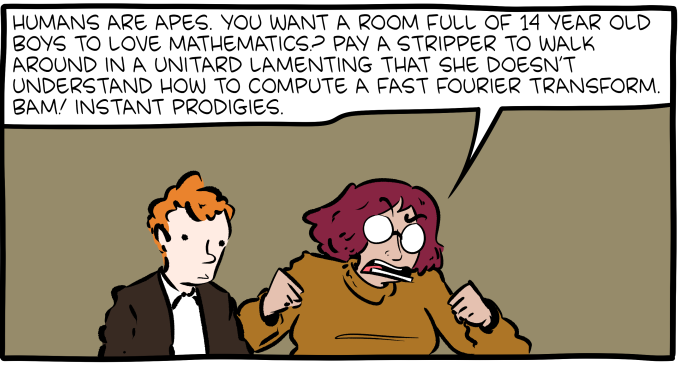
If this works, it’ll revolutionize my classes. Hire a stripper to walk around lamenting that she doesn’t understand Poisson distributions or how to get a p value from that set of data, and presto, we’re done!

Except for one catch. I just checked my class list, and 71% of my students are young women, maybe some are lesbians, but that isn’t recorded in the class data.

Would it work if I traipsed around the classroom in a unitard?

Effective shunning

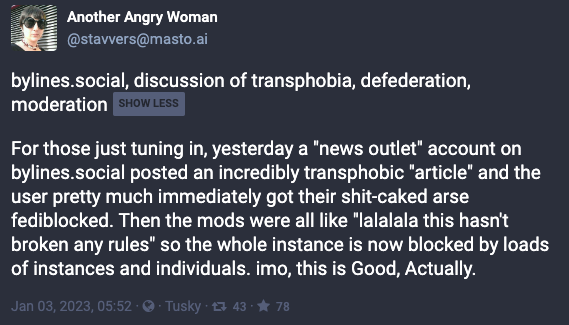
One of the bonuses of being on Mastodon is the fediverse is actually strong about crushing bad actors. A shiny new newspaper out of Yorkshire trying to make it in an online world published a lazy, stupid opinion piece about trans people — it’s England, you know, the place is infested with transphobes — and got slammed hard for it.

Yeah, they tried to play the game of saying it didn’t break any of their rules, just like Twitter was always doing — using vague rules to allow clear-cut hatred to get a pass.

That didn’t go over at all well. The Yorkshire lights went out all over Mastodon as instance after instance killed their feed. You want to see the horror settling into the admin of this for-profit newspaper as they realize they may have just destroyed their audience? Look here.

That’s usually a good sign that you done fucked up when Nazis start camping on your doorstep. I wish more media could grasp that simple, straightforward clue.

The House of Silence

The disease afflicting our house has now descended into the quiet hush phase. Our throats are sore, it hurts to talk; my wife waved good morning to me, we haven’t said a single word yet. It’s a bit eerie.

Don’t bother to visit, it’s like popping into a monastery where all the monks have taken vows of silence. You will get only gestures, and you will be turned away.

Grow a segmented spine!

You want to see something awesome? This is a video of human embryonic cells developing in a dish and activating the segmentation clock to build a series of somites.

That embryos do this is pretty neat but not surprising. It’s easy to see that process going on in zebrafish embryos, where a new segmental blob pinches off every 20 minutes. What’s cool is that they’ve pared down the system to just what looks like presomitic mesoderm — no gut endoderm, no nervous system or ectoderm, just those mesodermal cells grouping and organizing to make pre-muscle tissue. At first, I thought, no big deal. We’ve observed vertebrate segmentation in fish and frogs and chicks for many decades, why would we need to look at it in human embryos? They almost certainly use the same molecules and interactions as mice or any other vertebrate. It’s got to be using Notch signaling, after all.

What’s special here, though, is that they’ve reduced the complexity of the system to a remarkable degree. You don’t need a nervous system or a gut or even, it seems, a notochord to assemble segmental organization. They’re even getting colinear expression of HOX genes! That’s the surprise to me, that so little is required to trigger oscillatory expression and patterning. And that’s the point the authors emphasize.

Our bottom-up experimental approach demonstrates that complex developmental events such as somitogenesis, can be deconstructed and dissected into discrete “building blocks” of developmental principles which are usually intricately connected and cannot be easily uncoupled in vivo. Axioloids, a self-organizing in vitro model of human axial development allowed us to individually assess and manipulate such building blocks at the molecular, cellular and morphogenetic level. Axioloids -a surrogate model of the human embryonic tail and forming axis- are capable of recapitulating core features of human somitogenesis, and represent an exciting new platform to investigate axial development and disease in a human context.

Don’t read the YouTube comments. There are people complaining that it’s a human life with a unique genetic code (no, it’s not a person, and these embryonic cultures cannot develop into a person — while scraps of mesoderm might be enough to make somites, it’s not sufficient to build a whole human being) and Stop trying to PLAY GOD!!! (this isn’t god-like, it’s biology).

Funzies in the grandparent’s house

It’s a Masque of the Red Death scenario. I’ve been happily free of infectious disease for the last few years, thanks to social distancing/masking and excessive caution. No colds! No sniffles! No lying abed with the blinds closed all day! It’s been nice. All that has changed.

Earlier this week, my daughter and granddaughter came to visit and brought back memories of when our kids would bring home all kinds of crud from school every day. Mary has been hit hardest with snot and phlegm and goo and sore throat and muscle aches, and has been laid flat for a few days. I got a sniffle. This is an unusual situation — usually I’m the one lying in bed crying and weeping, and she has to take care of me.

She’s starting to feel better now, she says, and of course we’d be happy to have the cheerful little plague rat come back again. Even if she was beating me at checkers all the time. She didn’t even know how to play the game until I taught it to her!

She was probably oozing brain-eating viruses the whole visit, and that’s the only reason she could win.

You don’t have to bring back blogging

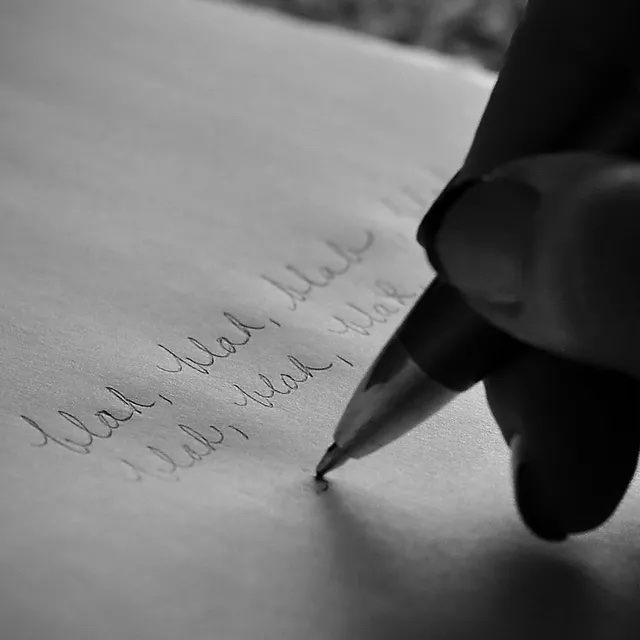
“blah blah blah”? I think I am offended.

Hey! What are you talking about, “Bring back personal blogging”? We never went away. But OK, I agree with the general sentiment.

In the beginning, there were blogs, and they were the original social web. We built community. We found our people. We wrote personally. We wrote frequently. We self-policed, and we linked to each other so that newbies could discover new and good blogs.

I want to go back there.

You’re all still here! You didn’t go away, neither did we.

People were way more connected to each other. There wasn’t a whole lot of anonymity because anyone could look up your WHOIS information and see who a blog actually belonged to. Trolls were simply banned from your comment section, never to be heard from again.

When Twitter came along, it started as a “microblogging” platform where people would go to put out short, frequent missives as opposed to the longer, personal pieces we put on our blogs. It, too, evolved, as these things do, and now it is the hellscape we at once loathe but can’t leave alone.

There’s some fancy rose-colored glasses there. People may have been way more connected, but there were far fewer people involved. Just the fact that the author is taking it for granted that users would know about WHOIS is revealing — there’s an assumption that everyone knew how to use a command-line tool.

Twitter was an improvement for the majority. You didn’t need to know anything, you were required to keep everything short and pithy, so you didn’t even need to really know how to write. You just had to blurt. Blogs require a bit more engagement and a longer attention span.

The best blogs gave us a glimpse into the life of someone we “knew” online. Good storytelling, coupled with a lively discussion afterward, kept us coming back for more day after day.

Twitter threads just don’t do the trick — and neither will Elon’s alleged plan for allowing 4,000-character tweets (I swear, if I see anyone tweeting out 4,000 characters, that is an immediate block).

Personal stories on personal blogs are historical documents when you think about it. They are primary sources in the annals of history, and when people look back to see what happened during this time in our lives, do you want The New York Times or Washington Post telling your story, or do you want the story told in your own words?

The optimistic perspective might be that as Twitter fades, all those people who had grown accustomed to communicating online will shift back, to some degree, to blogs. Which are still here and have been here all along.

It’s a brain! Don’t trust it

Well, ain’t this a kick in the pants. Here’s a compilation of failed concepts in psychology, for example, the oft-mentioned Stanford Prison Experiment is a badly done botch, the Pygmalion effect is small and inconsistent, the Milgram experiment is full of experimental errors, etc., etc., etc. It’s rather depressing.

As someone who spends a lot of time online, though, I was relieved to learn that’s not responsible for feeling low.

Lots of screen-time is not strongly associated with low wellbeing; it explains about as much of teen sadness as eating potatoes, 0.35%.

So you’re saying I should cut potatoes out of my diet, then?

The impression I get is that a lot of the popular ideas that have emerged out of psychology arise not because the experimenter is rigorous and cautious, but because they either conform to conventional wisdom or are surprisingly contrary. There’s also something analogous to the TED Talk effect, where people are convinced more by the certainty of the presentation of the story than by the data. I’m beginning to develop my own rubric for assessing psychological claims: if it’s so simple that it gets condensed down to just the investigator’s name, it’s probably shoddy work with questionable validity. I’m calling it the Myers Rule.

The author of the list says something I think is worth keeping in mind, though. They’re talking about the concept of Ego Depletion, which has a substantial wiki page.

It’s 3500 words, not including the Criticism section. It is rich with talk of moderators, physiological mechanisms, and practical upshots for the layman. And it is quite possible that the whole lot of it is a phantom, a giant mistake. For small effect sizes, we can’t tell the difference. Even people quite a bit smarter than us can’t.

If I wander around an old bookshop, I can run my fingers over sophisticated theories of ectoplasm, kundalini, past lives, numerology, clairvoyance, alchemy. Some were written by brilliant people who also discovered real things, whose minds worked, damnit.

We are so good at explaining that we can explain things which aren’t there. We have made many whole libraries and entire fields without the slightest correspondence to anything. Except our deadly ingenuity.

Human brains are so easily diddled by grand simplifications (religion, for instance) that they’ll then turn phantasms into sweeping, detailed rules for existence. It’s all superstitious behavior in the psychological sense — we’re all searching for patterns so obsessively that if they aren’t there, our minds start imposing them on the world.

I’m so glad I’m not working in psychology. Evolution and developmental biology would never cultivate popular errors. Wait — but those sciences are studied by human minds, which are clearly kind of squirrely.

Follow-up on ID at conferences

The other day, I posted about the Discovery Institute’s end of year wrap-up. One of the things that bugged me about it was that while Brian Miller said, In 2022, I participated in several conferences and private events in which I interacted with prominent scientists, he failed to mention any of these conferences or the names of these prominent scientists. That’s a striking omission! Waving vaguely in the direction of unspecified conferences and scientists is the opposite of persuasive. So I browsed through the archives of the Disco Institute to see if he mentioned any of them at the time they occurred.

This is not definitive at all — these are just the conferences he mentioned on Evolution News & Views. Maybe he was jet-setting around the world attending an international conference every week, but then it’s peculiar, given the braggadacio of his year end post, that he never brought them up before. Here is just the 2022 conferences he mentioned. There weren’t many of them.

  • In November, he attended a Catholic conference on creation.

    I’m back now from a conference this past week at Notre Dame, titled “‘And It Was Very Good’: On Creation,” hosted by the de Nicola Center for Ethics and Culture. The Center described the conference as follows:
    In the created world, Pope Francis writes, we are able to perceive “a grammar written by the hand of God” (Lumen Fidei). If creation is a language, what can we discern regarding the creator? The de Nicola Center’s 22nd annual Fall Conference will explore the many facets of the created world and the act of creation, including questions of cosmology, teleology, natural ends, natural law, the Imago Dei, creaturely status, ecology, stewardship, cocreation, recreation, redemption, and more.
    The organizers accepted my abstract for a talk titled “The Return of Teleology to the Natural Sciences.” I presented the talk as part of a panel with two other scholars, and it seemed well received.

  • In September, he mentioned a conference, but it’s not clear that he attended.

    As an engineering professor at Bristol University and Cambridge, Stuart Burgess has researched biomechanics for nearly thirty years. He is one of the leading engineers in the UK. Earlier this year, he presented a talk at the Westminster Conference on Science and Faith titled, “Why Human Skeletal Joints Are Masterpieces of Human Engineering: And a Rebuttal to the ‘Bad Design’ Arguments.”

  • In May, he was at a conference on science and faith.

    At the recent Dallas Conference on Science and Faith, Discovery Institute physicist Brian Miller gave a great talk on the convergence of biology and engineering. It’s up now on YouTube and eminently worthy of being shared. Miller’s theme is that “you see the same engineering principles in human engineering as you see in life.”

    (Yes, he wrote the article, and is referring to himself and the great talk in the third person. Weird.)

  • I don’t know that this one should count, but in March he was promoting a Disco Institute summer seminar. He doesn’t say, but I assume he participated in this yearly event in 2021? Maybe?

    In 2016, I attended the Center for Science & Culture’s annual Summer Seminars on Intelligent Design, and that fateful week pulled me into the epicenter of the design debate. For years, I had studied and lectured on the evidence for design in nature.

I’m being generous in noting the conferences he talked about, but note: none of these are professional conferences, and they all have a religious agenda. It’s not that religious people can’t be excellent scientists, but these are not events that would attract a diverse group of scientists — all the attendees would have had a certain bent towards favoring creationist explanations to varying degrees. It makes his implication that he was reasonably representing the views of many prominent people in the sciences a bit suspect. Talk to creationists, you tend to find they like creationism…news at 11.

He may have also attended real, secular, professional conferences as well that he didn’t tout, but I have reservations about that, too. He has a Ph.D. in physics. Not to demean physicists, but few of them have the kind of knowledge of biology to be able to appropriately assess the evidence for evolution, and I wouldn’t be surprised to learn that some brilliant minds in physics are part of the crackpot fringe in biology.

I suspect that a creationist who wanted to present his theorizing on gods and design at a physics conference would get the same response Paul Nelson got at a biology conference — uninterested neglect. Lonely indifference.He sure wouldn’t have cause to brag about his reception.