I’ve lived in Minnesota for 12 years now, and never been there. That will be rectified next month.

I’ll see you folks from the Northeast quadrant of the state there.

I’ve lived in Minnesota for 12 years now, and never been there. That will be rectified next month.
I’ll see you folks from the Northeast quadrant of the state there.

Chase Community Giving is handing out almost half a million dollars in a great big blatant popularity contest — it seems like a very poor way to distribute funds, and you know what I think of online polls. But hey, it’s their money, and they’ve come up with this scheme to distribute, so who are we but poor peons to play the game. Greta Christina has the details. The bottom line, though, is that you each have TWO votes through your Facebook account (if you don’t have a Facebook account, get one just so you can vote!). Pick two of the three secular organizations below and vote for ’em.
It’s a bit weird: when you vote, you get a link that you can share via email, facebook, google+, whatever, and if other people vote using it, you get credited for another vote. So spread the word and share the links.
There are various tiers of success, so we don’t have to get first place to get some money for our favorite groups — but we’re in competition with others, so we do have to push to get into the best tier we can.
Vote, vote, vote. I know these polls are usually utterly pointless, but at least this one has a chance of getting a good group a substantial reward.


Kitty! Jaguar Macho B in 2009.
I’m honestly not sure how I feel about this article: it’s either one of the silliest pieces of writing I’ve ever seen on endangered species issues, or a fiendishly clever way of roping ecologically apathetic adolescent d00dz into getting behind a conservation issue:
Usually, endangered species stories are lame. It’s some stupid owl or lizard or some other animal that nobody actually cares about.
Not this time. This time an animal actually worth caring about it [sic] getting some protected habitat. And if we’re really lucky it’s going to maul a few hikers.
The writer’s referring to a proposal last month by the US Fish and Wildlife Service that 838,000 acres of rough terrain on the US-Mexican border be designated Critical Habitat for the jaguar, the result of a lawsuit by the Center for Biological Diversity (CBD) in Tucson. The designation covers mountain ranges stretching from the Tohono O’odham Reservation eastward to the southwesternmost corner of New Mexico. Jaguars were pretty much extirpated from the US early in the 20th Century, but there have been sightings of male jaguars over the years in parts of the proposed critical habitat, including one sighting and capture in 2009 that ended sadly.
Not mentioned in the d00dz-targeted article linked above: the largest impact of the critical habitat designation, if it’s approved, will likely be to cause problems for the proposed Rosemont copper mine in the Santa Rita mountains. CBD says the mine is its main concern with regard to protecting Arizona jaguar habitat. In response, in a statement likely to provoke wry smiles around these parts, a Rosemont Vice President accused CBD of bullying.
In any event, despite the enthusiasm of the Uproxx writer linked up top, the designation doesn’t mean we’re getting more jaguars: it just makes it somewhat harder to damage jaguar habitat with the federal government’s help.
So: stupid or clever? Uproxx writer Dan Seitz at least makes an effort to drop a little science, and he doesn’t get it completely wrong:
One theory maintains that peripheral populations are key to maintaining a species’ biodiversity. Species that live on the very edge of the range tend to develop new traits and evolve in different ways, then interbreed with other populations and pass on those useful mutations.
“Key” is an overstatement: some people do in fact suggest that peripheral populations may well be important for maintaining diversity in some species, but that certainly isn’t the only factor involved. Still, I wonder if I shouldn’t credit Seitz for slipping a little bit of science into a publication that features stories like this one, which is probably not safe for work even though it doesn’t involve stupid owls or lizards or some other animal that nobody actually cares about.

Pat Robertson was asked that question. His answer was simple: you’ve got to stand up to her, and oh, how he wishes he could announce on television that you should beat her.
Well, you could become a Muslim and you could beat her. … This man’s got to stand up to her and he can’t let her get away with this stuff. I don’t think we condone wife-beating these days but something has got to be done.
How clever! To simultaneously advocate domestic violence while distancing oneself from it, and at the same time get in a little Muslim bashing! Who says Pat Robertson is senile? He’s not — he’s just evil.
But he’s wrong. You don’t need to be a Muslim to beat your spouse; we’ve got relatively few Muslims here in mostly lily-white Minnesota, and we’ve still got a tremendous number of domestic violence cases.
One in every four women will experience domestic violence in her lifetime. 1 One in 33 men have experienced an attempted or completed rape.
An estimated 1.3 million women are victims of physical assault by an intimate partner each year.
The majority (73%) of family violence victims are female. Females were 84% of spousal abuse victims and 86% of abuse victims at the hands of a boyfriend.
And then there’s this juicy statistic: in Minnesota alone in 2006,
5,295 battered women and 5,131 children used
Minnesota emergency shelter services.
Were they all Muslim? Hey, Pat, maybe you can crack a joke about how those 5,000 women and children have learned a little something about submission and respect.


So, where’s the Doctor’s cowboy hat? You have to wear the hat.

I scan the main page of Freethoughtblogs every day, and here are a few of the stories that caught my eye this time around.
Black Skeptics has posted a list of books by and about African American atheists. I’ve read one, Moral Combat
Jason Thibeault finds an excellent post on io9 about recent sexist dust-ups in geek communities. It compares ReaderCon (SF), DefCon (hacking), and TAM. It’s a good objective article on the topic, and I’m afraid TAM comes off the worse in the comparison, and DJ Grothe appears to be an evasive jerk who rejects the solutions found in every other organization.
Maryam Namazie has just discovered Atheism+. She likes it.
AronRa has also thought about Atheism+. He’s not jumping on the bandwagon, but he sees it as a “new civil rights movement, stripped of religion.”
An Arizona judge has declared that women ought to stay out of bars, unless they want to be blamed for sexual assault, says Zinnia Jones. Interesting. I wonder if owners of bars in Arizona are now freaking out at the tremendous loss of business that would entail, or if they’re all high-fiving each other and looking forward to evenings with drunken bros everywhere?
Dana Hunter is teasing us with promises of dragonfly porn. All right, already, deliver. I’m going to be teaching all morning, I can’t possibly hit reload on her blog every minute.
Did you know Brianne works as a clinic escort? You should read some of her stories: she deals with screamers and the biggest assholes in the universe.


This is the lounge. You can discuss anything you want, but you will do it kindly. Shhh—don’t wake the baby skunk.
Status: Heavily Moderated; Previous thread

When I was very young, my Dad combed my hair. I don’t know why; perhaps I was hilariously bad at it. But it meant that we had a few minutes one-on-one in the morning before he went to work and I went to daycare or the like. We would talk about whatever was on our minds. It was on one of these morning that we broached the subject of first cause, or, as a young child would put it, where everything comes from. He explained about the Big Bang and the Primordial Point. I don’t remember the words, but the image in my mind is vivid.


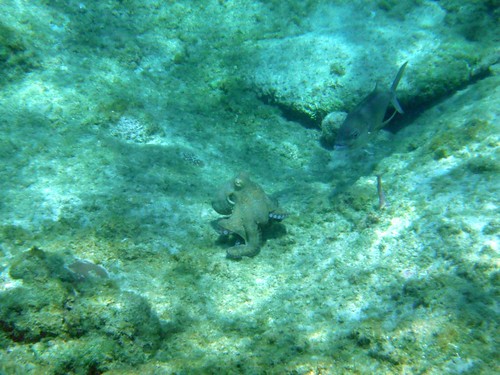
ObCephalopod: Cayman Islands reef octopus faces down boring vertebrate (Creative Commons photo by Pete)
The International Union for the Conservation of Nature’s World Conservation Congress is taking place right now in South Korea, and a report from Friday’s session is trickling through various social media, including The New York Times’ Green blog: Caribbean coral reefs are in trouble.
From the WCC’s coral reef workshop’s Executive Summary (PDF):
Some Caribbean reef ecosystems are relatively intact compared to average conditions in the region. For example, many reefs in the Netherlands Antilles and Cayman Islands have 30% or more live coral cover, little macroalgae, and a moderate (albeit strongly depleted) abundance of fish. In contrast, reefs in Jamaica and the US Virgin Islands have well below 10% live coral cover, abundant macroalgae, and virtually no fish larger than a few cm.
When local reefs that are 70% dead qualifies as “relatively intact compared to average conditions in the region,” headlines like NatGeo’s “Caribbean Coral Reefs Mostly Dead, IUCN Says” stop seeming quite so alarmist.
The issue with macroalgae is that they encroach on coral reefs and compete with the coral organisms. They’re often present in healthy reefs, kept in control by algae-eating animals. When those fish aren’t there for one reason or another, or when a reef gets a big shot of extra nutrients from on-shore fertilizers or eroded soil, the algae can get out of hand.
The Smithsonian Tropical Research Institute assembled 36 scientists in Panama to assess the region’s coral reefs, and the results of that work are what were presented at the WCC Friday. Researchers are pinning the damage on human interference. The precise mechanism by which we’re killing the reefs is open to question, but they have some prime suspects:
Caribbean reefs with the highest surviving coral cover and least macroalgae tend to be characterized by little land-based pollution, some degree of fisheries regulations and enforcement, moderate economic prosperity, and lower frequency of hurricanes, coral bleaching, and disease.
The team will have a more complete analysis of their data by mid-2013, and plan to expand their survey to other oceans’ reefs by 2016.
This isn’t a surprise: the degradation of Caribbean reefs has been talked for decades. Coral reefs serve as nurseries for commercially important fish species, they absorb wave energy and thus shelter coastlines from storm damage, and they’re just full of fascinating critters. Reefs can recover from our damage if we start to protect them: parts of Australia’s Great Barrier Reef recently recovered from bleaching events a lot more quickly than scientists had hoped.
But it’s still awful news.
