Richard Dawkins was explaining design, and then halfway through, something happened. Acid flashback, maybe. Or somebody slipped something in my tea. It was kinda ’60s, though.
If it’s just me, I may have to sign myself into rehab for a while.

Richard Dawkins was explaining design, and then halfway through, something happened. Acid flashback, maybe. Or somebody slipped something in my tea. It was kinda ’60s, though.
If it’s just me, I may have to sign myself into rehab for a while.

For convicting corrupt former prime minister Silvio Berlusconi of sex with an underage girl. I understand he’s been sentenced to seven years in jail, but will be free pending appeal…could you make sure not to elect him to any high office ever again?

You know, Ken Ham has this standing challenge to debate Aron Ra and me, and he seems to be in denial. But still, take a look at the new image he has on his facebook page:

I don’t think he’s capable of “defending it”.
I like the point made in the comments that his slogan is missing three “sh”s.

Watching the Sunday news shows, which have become all Perfidious Snowden all the time, David Sirota asks some most excellent questions. These two in particular struck me as important:
9. Snowden’s decision to flee the United States has often been depicted as an act of treason unto itself. The idea is that whereas Daniel Ellsberg was a hero for blowing the whistle and remaining in the United States, Snowden is a coward for blowing the whistle and fleeing. Left largely unmentioned is the big change between the time of Ellsberg’s disclosures and today: this White House is waging an unprecedented campaign to criminalize whistleblowing; it sometimes tortures whistleblowers; and it claims the right to extra-judicially assassinate American citizens who criticize the government but haven’t even been formally charged for a single crime. In light of this, why have most media outlets not bothered to even ask whether Snowden’s location outside the United States is, unto itself, a response to these troubling changes in U.S. government policy?
10. And finally, perhaps the most damning question of all: Why are so many media outlets far more interested in the minute details of Edward Snowden’s life and location than in the potential crimes against millions of Americans that he exposed?
Yeah, that last one. On CNN, I saw some jerk standing in front of a map of the world spending 10 minutes tracing the route of Snowden’s flight from Hong Kong to Moscow, then going through likely countries he might end up in, and talking about the state of their extradition treaties to the US. Why? Are we going to marshal the citizenry to strap on their handguns and fly off to Iceland to patrol the airport?
The US media have become criminal colluders in oppression, instead of the watchdogs for citizen rights that they ought to be.

Remember when I met Ray Comfort and he interviewed me? Here’s my summary.
He started by asking me for evidence of evolution. I tried to explain the evidence for speciation in sticklebacks, but he asked if they were still fish, and when I said they were, he said that didn’t count because they didn’t become a different “kind”, like a dog becoming a cat. So I told him that doesn’t happen in a single lifetime, and that carnivores diverged over 60 million years ago. I suggested he look at fossils, but he rejected that, because he wanted “observable” evidence, and anything that happened millions of years ago isn’t observable. So I said it was, too — fossils and molecular evidence are observable.
So the usual creationist run-around, where he defines what evidence he’d find acceptable by rejecting historical evidence as nonexistent, and contemporary evidence as too trivial.
Then he tried the usual stunt: “Are you a good person?” “Yes.” “Have you ever told a lie?” “Yes, but that a person has flaws doesn’t make them a bad person. The overall estimation of an individual’s character is not determined by one mistake.” And then he dropped the whole line of discussion.
Comfort is going to turn that into a movie!
Right. He held my feet to the fire until it was clear that there was no evidence for evolution. Riiiiight.
Someday maybe I’ll get to be in a movie in which I’m not selectively edited and misrepresented. It will not be this movie.

Every once in a while, someone chastises me for calling someone a liar. It’s rude, they say, and you don’t know if they’re intending to utter a mistruth, so you can’t really call them “liars”.
Oh, fuck that noise. When you get patent phonies like the Christians of Evansville, you have to call it as it is: they’re lying. Lying, lying, lying. The West Side Christian Church is putting up 30 crosses on the public streets along the riverfront, and they’re going to have them decorated by their vacation bible school. How can the city get away with permitting this blatant violation of the separation of church and state? By LYING.
The Board of Public Works has jurisdiction under city ordinance to approve or reject such requests, Ziemer said.
“We told (the church) they could not have any writing of any kind of them,” Ziemer said of the crosses. “So they are statues. They might be a religious symbol to someone or they might be attractive statues to someone else.”
Oh, yeah? Just an “attractive statue”? Does this look like an “attractive statue” to anyone with half a brain?

This is the same kind of stunt Christians tried to pull with the 9/11 “cross” they want to install as a memorial. The same thing they did with the Soledad cross. Somehow we’re all supposed to pretend that their obvious religious symbol, erected by a church, used as a prop for religious instruction, is supposed to be a merely secular symbol. Lies. And within the context of their own religion, worse — it’s a denial of a symbol of their faith. It’s total cowardice and dishonesty.
Of course there’s a poll. And of course the majority of godflogging pudtuggers in that town are for it.
Should West Side Christian Church be allowed to put crosses along the riverfront?
Yes 55%
No 44%
I have an idea. Let’s cast a decorative bronze statue of my ass, and erect multiple copies of it on Evansville’s streets. To some, they might be an obnoxious symbol of my contempt, but they might be attractive statues to someone else.

Stasia Bliss is the Senior Editor of Health and Science at The Guardian Express on-line Newspaper. Keep that in mind. Senior Editor of Health and Science.
We encountered Ms Bliss yesterday, when I was criticizing that ghastly Newagey article on cystic fibrosis that she authored, and which the Guardian Express later withdrew. She babbled some nonsense about genes from host tissue somehow migrating into lung transplants, and then went on about how cystic fibrosis, a genetic disease, is somehow caused by bad emotions. It was total garbage, through and through.
Remember, she is the Health editor for this online newspaper, and her head is full of pseudoscientific quackery.
She’s also supposedly the science editor. She’s full of shit there, too. You must read her piece on DNA and evolution. She knows nothing about biology — she’s reduced to spewing nonsensical crap right from the beginning.
Inside each and everyone of our cells is an amazing blueprint containing all of the information to create you again. Scientists have identified 2 strands of these amazing building block storage containers of life and call them DNA or Deoxyribonucleic acid, the molecules containing all the genetic information and instructions for your being. So, what about these other strands which scientists have not identified as useful…the one’s commonly called ‘junk’ DNA and now refer to softly as noncoding DNA? Did you know that somewhere around 98% of all human DNA fits into the category of noncoding DNA? Only 2% accounts for the genetic functions and life-building codes we are familiar with. We do know that some of that 98% has functions such as translation regulation of protein-coding sequences, but what is the rest for? Is it possible our DNA contains within it codes for our evolution as a species? Is it possible that by activating our noncoding DNA we would start to experience reality very differently?
Your first clue that she doesn’t have the slightest grasp on the concepts is when she tries to tell you that there are 2 strands called DNA that contain all the genetic information, and there’s…these…other strands? That are junk DNA? WTF?
I want to give her a test. A very simple test that I’m confident that she would fail miserably.
Draw the 2 strands of DNA. Just a rough sketch, no deep details needed, I’ll even grade generously. Show me that she knows what the hell she’s talking about when she says “strands”. And then I’ll ask her to point on the sketch to where the junk DNA lies.
This isn’t hard, and I’m not expecting a lot. For example, James Watson was asked to give a simple drawing of what he thought was an important formula or principle, and here’s what he came up with.
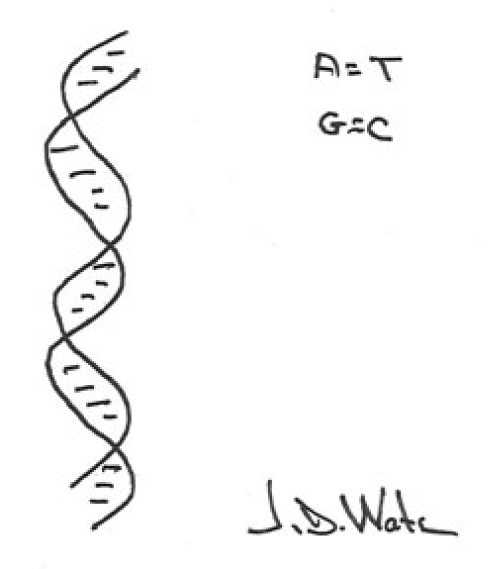
See? Easy! I don’t think Stasia Bliss could do it. Especially when you consider the next paragraph of her essay.
Many mystics, philosophers and spiritual teachers agree that the key to our evolution as a species lies within our DNA. If all strands of DNA were active, we would have 12 strands. According to some, each strand correlates with a different dimension of consciousness, or a different perspective by which we can experience this reality. Those who study and practice DNA activation techniques say the 2 basic DNA strands keep us at a very dense, physical structure and perspective of reality, but as we activate more DNA, our bodies change to become less dense and more ‘full of light.’ This state can be recognized in beings known in spiritual and religious traditions as ‘ascended masters’ with glowing halos and radiant skin. As evolution in consciousness occurs, and DNA ‘turns on’ it is speculated that this would mean a transformation from a carbon-based matter body, to a silica-based, and finally a crystalline liquid-light pre-matter state body, where the body would glow with light. According to sources, most of us have approximately 3-3.5 strands activated, allowing for the experience of only three dimensions of reality.
Hey, did you just feel something sticky and damp? Sorry. That was my brains, blood, bile, and colon contents exploding forcefully and spewing debris through my screen, up the ethernet line, out in a misty cloud of pulverized organic matter contaminating the interwebs, settling into your ports and dribbling out onto your keyboard. Sorry.
First order of business, Stasia: FUCK mystics, philosophers and spiritual teachers. You’re supposed to be a goddamn science editor, and these are your vaguely cited sources? Some mystic somewhere, who you can’t even name?
For that sin alone, Bliss ought to be fired. She is grossly unqualified for a position with that title.
At the end: “According to sources”. WTF again? According to who? She is unqualified to have a position in journalism, period. Fire her.
Next test: Draw a picture of 12 strand DNA. I double dog dare you. Be prepared: a squiggle like Watson’s above is only a preliminary answer, and if you manage to make up something coherent at that level, I will also drill down further and ask about the interactions of the nucleotides in your model.
I’ve encountered this “12 strand DNA” bullshit before: it’s a money-making scam from a quack who promises to show you how to activate your psychic powers if you buy his videos. It’s a fucking fraud. And here’s Stasia Bliss parroting it as if it’s reasonable science.
If this is symptomatic of the Guardian Express’s attitude towards science, that they’d hire this wretched incompetent buffoon to be their science editor, I hope their bankruptcy is imminent. It’s disgraceful.

Today I attended the Federated Church of Morris. I’ve actually been here many times before in a different capacity — it’s where my district goes to vote (but that’s a different bag of worms to complain about). It also has a reputation as the most liberal church in Morris, so this is where a lot of the believing faculty go, and I suspect most of the registered Democrats in town.
So I was not at all surprised at all of the effete decadence I saw going down in there.
First, the service starts at the odd hour of 9:30 — they just have to be out of phase with the rest of the town. One of the notable things I saw at the other churches was their remarkable punctiliousness, with every service starting precisely on the hour, and ending exactly one hour later. Not the Federated Church; they were a little more casual with their time, starting 5 minutes late, and the service went on for an hour and a quarter. I know, you’re already shocked, but the worst is yet to come.
Unlike the other churches, we were asked to stand once at the beginning (and then, only “if you are able”) and once at the end. I could spend the whole dang hour and a quarter with my butt firmly pressed against my seat (And, of course, the pews were padded, but then that seems to be par for the course here in degenerate Morris). My knees did not get a workout in this place at all.
The pastor is a woman, and the opening hymn even included a line about “Mother God”. The church isn’t even organized traditionally. There was a central altar, and the pews were arranged in the round around it. Or, should I say, since there were 5 banks of pews, they were arranged rather pentagonally…or perhaps [duh-duh-DUUUUHH!!] pentagrammatically.
So, anyway, so far it seems to be my kind of place. Thumbs up on ambience and clientele and hosts. What about the content?
And that, alas, was all too typical. Hymns, prayers, and invocations of some dude named Jesus all over the place; readings from some stodgy old book; a list of prayer recipients we were supposed to remember. Somebody has been giving the pastor lessons in good pedagogy, because rather than lecturing at us, she called for active participation from the audience. If only the interactions had been interesting! We had a blank page in the papers we were handed at the beginning, and she asked us to come up for names for their god — and so people were offering up happy pablum, like “love” and “service” and “parent” and so forth. I was coming up with names that I would not have wanted to utter in the respectful atmosphere of a church, so it’s a good thing she didn’t call on me. I think the nicest things floating around in my head were “nothing”, “ghost”, and “nonsense”, and even those would have been disruptive to use. So I kept silent.
Don’t ever say I don’t know how to be polite!
Unfortunately, despite the well-meaning attitudes of this congregation, all I heard was a lot of mumbo-jumbo. I’m afraid that even the mildest of Christian habits, praising a non-existent god, is as nonsensical to me as going to a charismatic church and seeing people twitching on the ground, chanting “FALAFA DOOBA SHADA BAKA LAKA ZALA FA NA”. It left me cold, bored, and wondering what the heck people got out of this repetitive fantasy. It’s sad. I think they were all good people, but they have this need to dress up humanitarian good-heartedness with goofy old legends, and for some, I’m sure, the goofiness is the point. But I can’t share that view.
So I’m hanging this project up. The Federated church would have been the high point of my experience, I’m sure — these are my kind of people, except for the religion thing — and it would all be downhill from here. There was still our local biblical literalists, the Apostolic Christian Church, and the Morris Assembly of God, and the Kingdom Hall, but those folks be batboinking nuts, and I think I could only get a worse opinion of religion by visiting those. So that’s enough. I’ve had a charitable sampling of local faith.
Also, I’ve got to tell you — church services are goddamned boring. I think that’s how the tediously dull game of football got to be such a big sport in this country — they only had to be less boring than church.

I saw with some trepidation an article by an atheist that rebukes the man: the title is “Christopher Hitchens’ lies do atheism no favors“. I felt that trepidation because there really are very good reasons to criticize Hitchens: his politics were vile, he was a cheerleader for war, his ‘solutions’ for problems in the Middle East were little more than excuses for genocide. He had the capacity to be thoughtful and interesting and deep, but when it came to world politics, he was a madman waving a gun. Someone could write a strong, well-researched criticism of Hitchens that would actually have a lot of weight, and it could overshadow the fellow’s virtues (and, by the way, I think we should recognize that he was not a saint, and that like every one of us, he had his flaws).
But I shouldn’t have worried. The author, Curtis White, basically writes an apologia for religion, and goes after Hitchens for…not respecting faith enough. Seriously? Yeah, seriously. This guy is an atheist who thinks the great theological circle-jerk is a beautiful ballet.
As critics have observed since its publication, one enormous problem with Hitchens’s book is that it reduces religion to a series of criminal anecdotes. In the process, however, virtually all of the real history of religious thought, as well as historical and textual scholarship, is simply ignored as if it never existed. Not for Hitchens the rich cross-cultural fertilization of the Levant by Helenistic, Jewish, and Manichaean thought. Not for Hitchens the transformation of a Jewish heretic into a religion that Nietzsche called “Platonism for the masses.” Not for Hitchens the fascinating theological fissures in the New Testament between Jewish, Gnostic, and Pauline doctrines. Not for Hitchens the remarkable journey of the first Christian heresy, Arianism, spiritual origin of our own thoroughly liberal Unitarianism. (Newton was an Arian and anti-Trinitarian, which made his presence at Trinity College permanently awkward.) Not for Hitchens the sublime transformation of Christian thought into the cathartic spirituality of German Idealism/ Romanticism and American Transcendentalism. And, strangely, not for Hitchens the existential Christianity of Kierkegaard, Dostoevsky, Karl Jaspers, Paul Tillich, Martin Buber, and, most recently, the religious turn of poststructural thought in Jacques Derrida and Slavoj Žižek. (All of these philosophers sought what Žižek calls Christianity’s “perverse core.”) And it’s certainly not that he didn’t have the opportunity to acknowledge these intellectual and spiritual traditions. At one point he calls the story of Abraham and Isaac “mad and gloomy,” a “frightful” and “vile” “delusion,” but sees no reason to mention Kierkegaard’s complex, poetic, and deeply felt philosophical retelling of the story in “Fear and Trembling”. In this way, Hitchens is often as much a textual literalist as the fundamentalists he criticizes.
I think I wrote about this before. It’s a red herring: when we ask for evidence of a god, the apologists point to a whole bunch of people wrangling at daunting length about the interpretation of holy writ and say, “See? There. They couldn’t possibly be arguing about nothing at all, now could they?” I wish this would sink in, that someone making an intricate paean to the ineffability of nothing is not evidence of anything other than the human brain’s immense capacity for masturbatory self-reference.
And then the screed continues this trend with the credulous claim that the Bible actually is a solid historical document, contra Hitchens.
This case has been well made by others, if mostly in places far more obscure than Hitchens’s privileged position on the New York Times best-seller list. For example, William J. Hamblin wrote a thorough and admirably restrained review (“The Most Misunderstood Book: Christopher Hitchens on the Bible”) in which he held Hitchens to account for historical howlers of this kind:
In discussing the exodus, Hitchens dogmatically asserts: “There was no flight from Egypt, no wandering in the desert . . . , and no dramatic conquest of the Promised Land. It was all, quite simply and very ineptly, made up at a much later date. No Egyptian chronicle mentions this episode either, even in passing. . . . All the Mosaic myths can be safely and easily discarded.” These narratives can be “easily discarded” by Hitchens only because he has failed to do even a superficial survey of the evidence in favor of the historicity of the biblical traditions. Might we suggest that Hitchens begin with Hoffmeier’s Israel in Egypt and Ancient Israel in Sinai? It should be noted that Hoffmeier’s books were not published by some small evangelical theological press but by Oxford University—hardly a bastion of regressive fundamentalist apologetics. Hitchens’s claim that “no Egyptian chronicle mentions this episode [of Moses and the Israelites] either, even in passing” is simply polemical balderdash.
Hamblin is thorough, patient, relentless, but also, it seems to me, a little perplexed and saddened by Hitchens’s naked dishonesty and, in all probability, by his own feeling of impotence. You can hardly blame him. Criticism of this character would have, and surely should have, revealed Hitchens’s book for what it is … if it hadn’t been published in The FARMS Review of the Neal A. Maxwell Institute for Religious Scholarship at Brigham Young University. Hitchens need never have feared the dulling of his reputation for intellectual dash and brio from that source.
No, Hitchens was quite right. There is no archaeological evidence for the dramatic events of the Exodus. The stories of a vast and powerful rising Hebrew kingdom are all mythologizing and self-aggrandizement. I’m sure Hamblin was quite saddened by the criticism of the self-serving Biblical archaeological community. He probably wept when he read Avalos’ The End of Biblical Studies
I see no “historical howler” in Hitchen’s comment. The people who argue for the historicity of the Bible are religious apologists who read their interpretation of the faith into the historical record, who ignore evidence of the minor significance of the Jewish tribes of that era, and who constantly inflate trivial anecdotes into evidence of empires. It’s a discipline tainted by people who go into it solely to make excuses for their faith.
This is not to say that the Jewish people didn’t exist, or that they were never enslaved in Egypt, or that they never invaded Palestine — merely that the stories in the Bible are grossly exaggerated and untrustworthy.
White does make one justifiable argument, that Hitchens tended to sweep all Eastern religions into the same rubbish bin, and was rather too casual in lumping them all together. I think it’s valid to say Hitchens was not an expert on Eastern philosophy…but then the responsibility falls on his critics to explain exactly why we should grant an Eastern religion greater credence than something a two-year old babbles? And why then, isn’t the atheist author of this piece now adopting the superior ethical philosophy of ancient Tibetans?
And finally, White goes galloping off to attack secular reasons for moral behavior.
Hitchens’s second metaphysical claim has to do with conscience. He counters the claim that without religion we would have no ethics by saying that conscience is innate. He writes, “Human decency is not derived from religion. It precedes it.”
Well, as Hitchens likes to say, this is “piffle.” After all, what is a conscience? Does it light up on a brain scan when we think virtuous thoughts? And if it is innate (and just what exactly does it mean to be innate?) why was Crassus’s crucifixion of six thousand Spartacans lined up along the Appian Way from Rome to Capua in 71 BCE thought by the people of Rome to be an expression of Roman vertù and a very good reason to honor Crassus with a full triumphal procession back into the city? Are we to imagine that the citizens of Rome threw garlands in the path of the conquering hero against their better judgment? Are we to imagine that after the celebration the citizens were stung by conscience and were unable to sleep at night? Or did Crassus merely confirm for Rome that it was what it thought it was, a race of masters?
White does not understand at all. Humans are plastic, with some innate biases. If you raise a child with love and encourage them to love others, they will (well, usually — we’re also too complex to be programmed simplistically). If you raise them with hate, they grow up hating. If you bring them up believing that slaves are a less worthy other, they will feel no guilt if you murder them en masse. Romans were recipients of life-long propaganda about the virtue of Rome…just as Americans now are raised with a lifelong faith in the superiority of their way of life. And there are all kinds of indoctrination systems out there.
Religion is one. It’s not the only one, obviously. Religion is just something that raises people to unquestioningly accept the superiority of a system of beliefs — not just about ethics, but about the nature of the universe. And it’s a system that is demonstrably false. It’s also a useful tool for obedience that is often coopted by other beliefs — American exceptionalism, for instance, is also all tangled up in Christianity.
I have no religion, and after meeting many people who were sincere in their beliefs, I realized that I never did — as a child, I was going through the motions, but never believed in any deity, nor even felt fear or concern or love for one. I acquired that basic human decency not from religion, but from family and friends, being brought up in an almost totally religion-free home that regarded fairness and justice towards others as an important value.
And that’s what Hitchens meant: ethical behavior is independent of religion, which merely claims against all evidence to be the wellspring of human decency. He does not imply in any way that freedom from religion automatically gives you good values, but that the causes of those values precede the nonsense your church layers upon you. And further, when you look at what religion effectively teaches — deference to authority, gullibility, guilt and fear — it’s true, religion really does poison everything.


